
Sports
Sadeesh’s century helps Joes force a draw

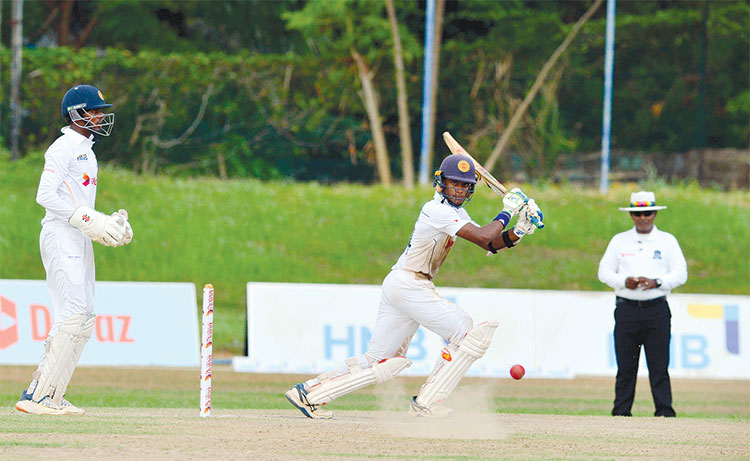
88th Battle of the Saints
A back to the wall century by Sri Lanka Under 19 player Sadeesh Jayawardena helped pre match favourites St. Joseph’s avert a possible defeat at the hands of St. Peter’s as the latter dominated the 88th Battle of the Saints which ended in a draw at the P. Sara Oval on Tuesday.
Given a target of 321 runs to chase, the Joes lost their fourth wickets for 91 runs when spinner Niman Umesh dismissed their key middle order batsman Dunith Wellalage for the second time in the Big Match. With the national player leaving early, St. Peter’s were starting to make further advances.
That was when the batting opener produced his best, playing the sheet anchor role. Jayawardena carried his bat through with an unbeaten 103 runs before bad light halted play around 5pm.
He faced 189 balls and hit 11 boundaries in his unbeaten knock. Hiran Jayasundara kept him company posting an unbroken 51 runs stand for the sixth wicket.
Jayasundara remained unbeaten on 19. Together they stayed in the wicket for 20 overs to disappoint Petes.
Earlier, commencing from 35 for two wickets, the Petes posted 232 for seven wickets declared as the night watchman Abilash Wellalage top scored with 61 runs.
He scored just two fours in his 134-ball knock. Lahiru Dawatage made 53 runs inclusive of six fours. While Wanuja Kumara chipped in with 28 runs, Danal Hemananda scored 21 runs not out.
Sadeesh Jayawardena was adjudged the Man of the Match for his match saving knock.
Shevon Daniel, who took five wickets for Joes and made a vital half century for them in the first innings received the award for the Best All-rounder.
For Petes, who dominated the match, Lahiru Dawatage, Wanuja Kumara and Shenal Botheju won the Best Fielder, Best Bowler and Best Batsman awards respectively.


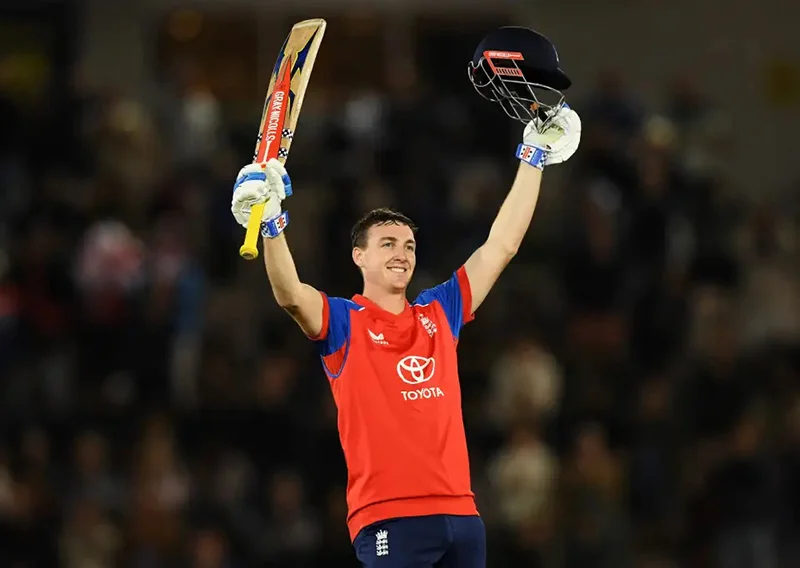
As he nears the end of a hectic summer, Harry Brook was offered the chance to rest rather than play this series and how Sri Lanka must wish Pakistan’s red ball side had extended him enough to force a layoff. As it turned out, the 27-year-old could hardly have looked fresher as he inspired his side to an overwhelming win over emphatically outclassed opponents, a brilliant century powering England to a 19th victory in 22 completed games since he took over the captaincy, secured by the margin of 119 runs.
Brook cavorted to triple figures off 42 balls, of which precisely a third were dispatched to the boundary, six of them beyond it, and ended unbeaten on 114 as England posted 254. But as much as his power his running impressed, using the size of the ground and manipulation of angles to maximum advantage, aided occasionally by the tourists’ imperfection in the field, as he scurried a succession of twos.
These teams have already met nine times this year, with potentially six more encounters to come between now and November. Having been left punch-drunk here, if Sri Lanka fail to recover their senses and create a plan to counter Brook in particular they are in for a miserable few weeks.
This was the 27-year-old’s second international T20 century, the other coming in Sri Lanka, against Pakistan during the World Cup earlier this year, the first time that he batted for his country at No 3. He has now done so eight times , scoring in addition to those two tons two unbeaten half-centuries and compiling an average of 95.2 at a ludicrous strike rate of 200.84.
Aneurin Donald, at 29 England’s oldest debutant since Dawid Malan in 2017, started strongly, hitting Maheesh Theekshana for a six and a four off the final two balls of the first over, but the next one he faced, the opening delivery of the third over and Dunith Wellalage’s first of the night, was skewed into the air, straight down the ground and easily caught.
Encouraged by an over that brought a wicket and just five runs, Wellalage – who would return to top score for Sri Lanka from No 8 – stayed on for a second, off which Brook flayed three sixes and as many fours, and from there England never let up.
England, put in to bat, had the best of the conditions but Sri Lanka’s innings featured nearly three times as many dot balls as theirs, and just over half as many boundaries. After six overs England had 90 for the loss of one wicket; the tourists at the same stage had 32 and had lost three, their task already far beyond forlorn.
It did not help that Sonny Baker, expensive against Ireland on T20 debut almost exactly a year ago, looked a player transformed on his second appearance, his four overs bringing three wickets and just 12 runs.
There were a few brief moments of fun as Dasun Shanaka hit Adil Rashid for successive sixes, struck with enormous power either side of long-off, but the next ball found his edge and Buttler’s gloves, and Wellalage’s cameo was the only succour for the tourists thereafter. They were eventually bowled out for 135, with an over unbowled.
England seem to have taken a liking to the Rose Bowl, and in their last three appearances here have thrashed South Africa by 342 runs in a record-breaking one-day international, comfortably beaten India in a T20, and now this.
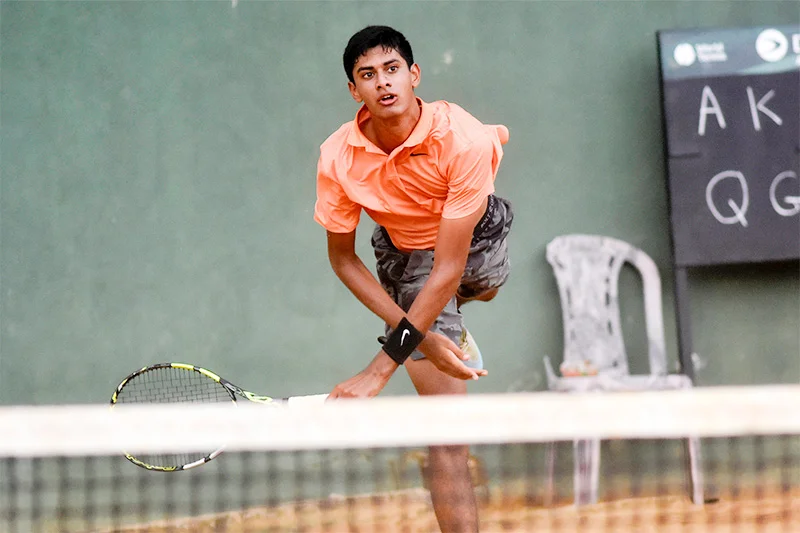
Aahil Kaleel and Rehan Gunawardhane advanced to the boys’ singles quarter-finals of the ITF J60 Week Two tennis tournament with convincing victories at the Sri Lanka Tennis Association courts.
Kaleel continued his impressive run with a commanding 6-1, 6-2 victory over China’s Qiaoshen Guo in the second round. The Sri Lankan controlled the match from the outset, giving Guo little opportunity to settle and securing his place among the last eight.
Gunawardhane also produced a strong performance to overcome Hong Kong’s Jason Fu 6-4, 6-2. After a competitive opening set, Gunawardhane stepped up his game in the second to seal a straight-set victory and join Kaleel in the quarter-final line-up for the hosts.
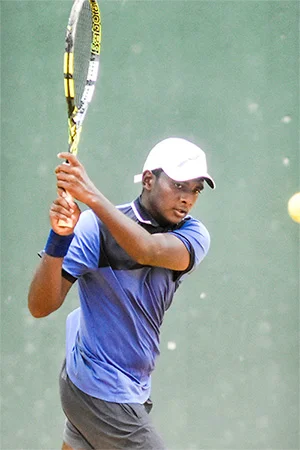
Rehan Gunawardhane
The two Sri Lankan youngsters will now face another challenge as they look to progress further in the tournament, which is being conducted at the SLTA courts from September 14 to 19.
In the other boys’ second-round matches, China’s Mingrui Shi beat Sri Lanka’s Nevan Kannangara 6-1, 5-7, 6-2, while Poland’s Jerzy Filip Urban defeated Damsath Peiris 6-1, 6-4. Singapore’s Luke Jie Xi Hd beat Revan Amarasingha 6-3, 6-2, and China’s Yidu Yang overcame Andrew Wijemanne 6-2, 6-4.
In the girls’ singles, India’s Aleena Farid defeated Australia’s Sara Patil 7-5, 6-2. China’s Tianyi Gong beat Japan’s Miku Matsuo 6-0, 6/-3, while China’s Runyang Ye defeated Singapore’s Saina Jayesh Vaidya 6-3, 7-5.

The Bahrain National Cricket Team after a dissapointing performance at the Asian Cricket Council Men’s Premier Cup group stage matches played in Malaysia a few days back arrived in Sri Lanka to prepare for the upcoming 2026 ICC Men’s T20 World Cup Asia Sub – regional qualifier A which is also scheduled to be hosted in Malaysia from 3 to15 October 2026.
The ‘2026 ICC Men’s T20 World Cup Asia Sub – regional qualifier A’ forms part of the qualification pathway for the 2028 T20 World Cup. Teams from Thailand, Kuwait, Bhutan, Qatar, Nyabnar, Mongolia and Bahrain scheduled to participate.
During their 20 day stay in the island, the Bahrain cricketers will avail the facilities including the coaching staff at Sri Lanka Cricket’ s High Performance Centre at Khettarama courtesy SLC and play four practice games at the Galle International Stadium .
The Bahrain National Team led by Asif Ali comprise Prashant Kurup [Vice captain and wk], Amish Rana, Junaid Niazi, Ali Dawood, Ahmer Bin Naser, Imran Javed, Monammed Waseem, Abdul Majid, Rizwan Butt, Yaseer Naser, Asif Shaikh, Sohail Ahmed and Shujath Rasool
The team is managed by Adil Ahmed and Nishantha Weerasinghe is the Head Coach while Isuru Weerasinghe is the Physio. The team’s inbound travel arrangements are being handled by Celebrate Lanka.

US embassy won’t comment on IGP’s probe into joint drug raid

Gnanasara Thera declares outside High Court that he wouldn’t flee

Namal further remanded

22A: LAWASIA questions compostion of five-judge bench

Sri Lanka’s lifestyle coffee culture boom and the two faces of its economy

England thrash Sri Lanka after Harry Brook blasts brilliant century

‘Dates have the highest sugar content to fight Coronavirus’

Sunday Island 27 December – Headlines

#SundayIsland 17th December – Headlines

Sunday Island – 28th March

Sunday Island Headlines – 21 March

Sunday Island – 21st February – Headlines
-

 Sports6 days ago
DDS set to lose Test captaincy
-

 News6 days ago
Sri Lanka faces new grid challenge as rooftop solar surges: former CEB GM
-

 Latest News6 days ago
Shafali, Deepti power India into sixth T20 Asia Cup final
-

 News4 days ago
Gnanasara Thero absconding after SC ruling
-

 Latest News5 days ago
Sri Lanka thwart Fatima Sana challenge to secure Asia Cup final spot
-

 News5 days ago
Ammunition cache found in old Kandy bungalow
-

 Editorial6 days ago
A flight of fancy
-

 News5 days ago
Green Climate Fund (GCF) Regional Dialogue for East and South Asia will be held from 14 to 17 September 2026 at Cinnamon Life at City of Dreams Hotel, Colombo