
News
RW says great power rivalries and geopolitics emerging threat to Third World


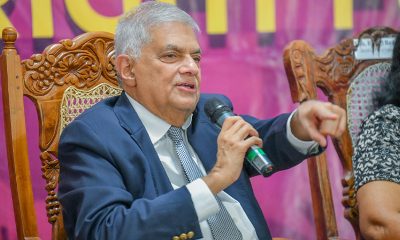
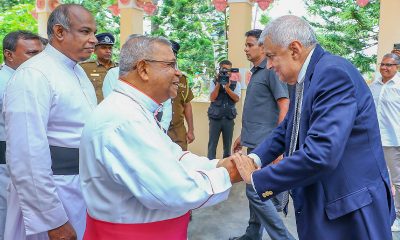
The West has labeled China’s Belt and Road Initiative as a cohesive program, and the participating countries like Sri Lanka are looked upon with suspicion, President Ranil Wickremesinghe said on Thursday (28) at the Berlin Global Conference.
“This will further hurt economic prospects in the global South, and the polarization will become more evident,” he said.
Great power rivalries and geopolitics have been an emerging threat for open access to trade, investment, capital, and technology that are vital for the economic recovery of the developing world, Wickremesinghe said.
He said that recently Jake Sullivan, United States national security advisor to President Joe Biden, rejected the Washington Consensus at an address at the Brookings Institute.
“With the new concept of de-risking and decoupling, the developing South, which was compelled to follow the Washington Consensus, is now asked to do a 180 degree turn even without consultation with us. With decoupling, whatever it is, we have been asked to change the system. We were compelled to get into it. Now we are told this is no longer relevant,” he said.
Wickremesinghe said the global south is now looking for alternative leadership, given the expansion of the BRICS and the downgrading of G20. In 2024, the US leadership might change and that people are wondering what policy changes would ensue.
“We know in 2024, the US leadership may not be there. Then who is going to act? So I think it’s a chance for the EU to come up and work with the other countries. There’s no one else. So I am suggesting that the EU, together with G20 BRICS, certainly USA, and some selected other Asian and African nations, the IMF and the NDBs, and you can bring in the big financial institutions, private ones, sit down and find urgent solutions,” he said.
The President said the world requires a constructive dialogue between the West and China.
“We need a constructive dialogue between the US and China. We need a constructive dialogue between the EU and China. Otherwise we will not move forward. So this is the stark reality. It’s a question of how we get together and how we work, and who’s going to take the lead in 2024,” he said.
Below are excerpts of the speech : “I don’t think in any other period of modern history have we gone through this type of a crisis. And in all these instances, it’s the developing economies and the global south that has suffered extremely. We are now faced with stubbornly high inflation in advanced economies, oil prices edging towards US $100 a barrel, and monetary tightening by the global central banks.
“One example is that Sri Lanka’s export to Europe has not increased at all this year, so far this year. That’s an indication of how we are being affected as we try to recover from the crisis we face. The confluences of factors face serious risk for many developing countries. In the global south, we are facing rising import costs, food, energy, insecurity, and the problems of our exports. The resulting balance of payment stress translates into a weaker economy for all of us. The difference between the advanced economies and the developing nations is that you all have all the buffers and reserves to deal with these shocks. We haven’t. And it’s from here that the sovereign debt crisis started.
“In this context, I think the world may be in another crisis if corrective measures are not taken immediately. Many developing countries find themselves with large debt burdens. For example, the IMF has no mechanism to face this new situation. When Sri Lanka declared bankruptcy, all foreign funding ceased and that started the political crisis. If not for the help given by the World Bank in re-graduating Sri Lanka, and the help given by my old friend Samantha Power in funding us with fertilizers, the chances are that I may not be, I would not be able to come here today.
“The funding on the table is woefully inadequate to address the vast challenges at hand. So we haven’t got any money. But we do have 100 billion with the IMF. Let’s start with that money. 100 billion is better than nothing. Then let’s see how we can raise the rest of it. Because though I talk of Sri Lanka, I must say Africa’s needs, especially of the low-income countries, are far greater than ours. The problems Africa faces need not be described by me because I think there are enough representatives here.
The developing countries require financing up to US 5.9 trillion to fulfil their nationally determined contributions. Then a further US 4 trillion, for clean energy technology to achieve net zero emissions, look at Sri Lanka’s financing needs for our climate prosperity plan to succeed. We need five billion US dollars by 2030.
“This is a country that’s bankrupt. And the IMF states, we’ll have for the next few years a growth rate of 3.5% if you are lucky. Here again, global coordination and leadership to resolve these challenges have simply not been sufficient to address the magnitude of the urgency of the problem. So what we need here is a new architecture.
Now we’ve been talking of the many crises and shocks we have discussed today. And we’ve been talking about what we have to do. First, we’ve all agreed that the core of the international financial architecture today was designed almost 80 years ago. The world has seen dramatic changes since then with many emerging economies in Asia, Middle East, South America, and Africa becoming global economic powerhouses.”








News
AgriConnect Sri Lanka’ to be launched on 30 October to Modernise the Agricultural Sector Through Digitalisation

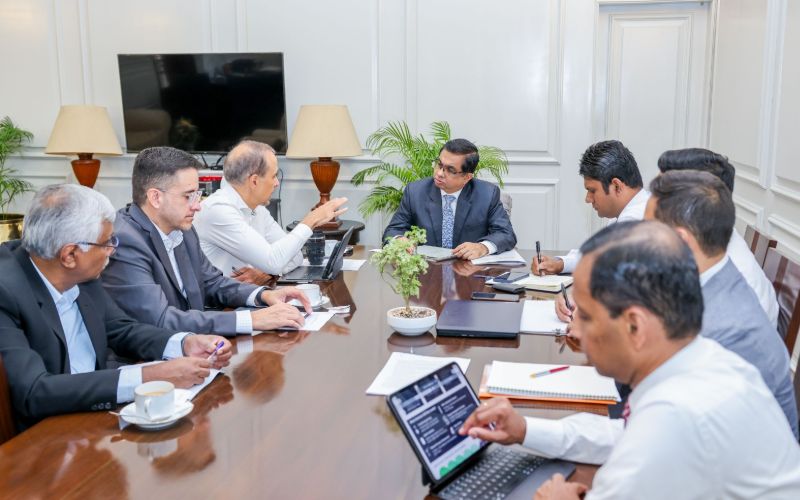
A discussion on the official launch of the ‘AgriConnect Sri Lanka’ programme was held at the Presidential Secretariat on Tuesday (13) morning between Secretary to the President Dr. Nandika Sanath Kumanayake and a delegation led by Gevorg Sargsyan, World Bank Group Manager for Sri Lanka and the Maldives.
The discussion focused on the official launch of the ‘AgriConnect Sri Lanka’ programme, scheduled to take place on 30 October at TRACE Expert City.
The World Bank delegation provided a comprehensive briefing on the programme and emphasised that Sri Lanka is set to become the first country in South Asia to join this global initiative of the World Bank Group, marking a significant milestone.
Victor Anthonypillai, Senior Country Officer of the International Finance Corporation (IFC), Tomas Ricardo Rosada Villamar Practice Manager at the World Bank, Felipe F. Dizon, Senior Economist and Athula Senaratne, Senior Agriculture Specialist, also attended the meeting. The Presidential Secretariat was represented by Senior Assistant Secretary to the President Dr Danushka Perera and Assistant Secretary to the President R. A. Ruwanpathirana.
President’s Media Division (PMD)
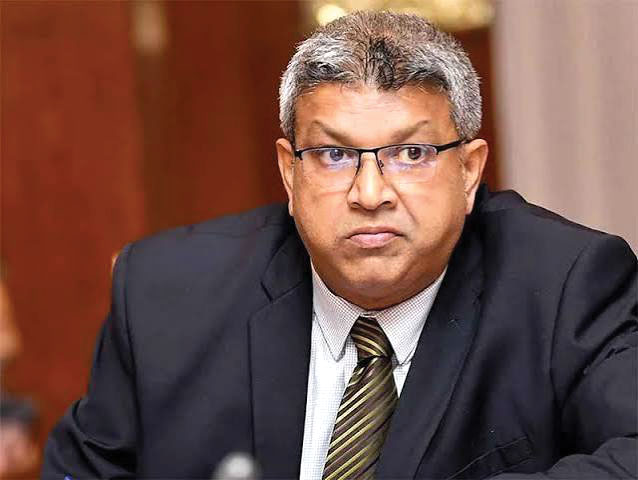
Appointment of committee eyewash, says UNP
The government is considering changes to prison regulations pertaining to the treatment of Buddhist monks serving jail terms, including their right to wear monastic robes when taken outside prison.
Justice and National Integration Minister Harshana Nanayakkara announced the proposed changes yesterday (14) following the submission of an interim report by a committee appointed to review the rules and procedures governing prisons.
The report was handed over to Secretary to the President Dr Nandika Sanath Kumanayake at the Presidential Secretariat.
One of the key recommendations is to amend Prison Standing Order 356 by introducing a new provision, 356(A). The proposed revision would require prison authorities to consult the Department of Buddhist Affairs on the removal of a monk’s robes upon admission to prison. The Commissioner of Prisons would be allowed 10 days to notify the department and take the necessary steps.
A separate amendment to Departmental Order 550 would allow Buddhist monks to wear their robes whenever they are taken outside prison, unless their respective Nikaya formally requests that the privilege be withdrawn.
The committee has also recommended extending similar arrangements, with suitable modifications, to members of other religious clergy who are imprisoned.
The proposals follow concerns raised over the treatment of Ven. Galagoda Aththe Gnanasara Thera after he was taken into custody. President Anura Kumara Dissanayake subsequently held discussions with representatives of the three main Buddhist Nikayas and appointed the committee to examine the existing legal framework.
Nanayakkara said the interim report had been forwarded to the Acting Commissioner General of Prisons, along with instructions to revise the relevant standing orders in accordance with its recommendations.
The proposed amendments have yet to be confirmed as formally implemented.
Meanwhile, the UNP yesterday criticised the government’s decision to appoint a committee to make recommendations on the attire to be worn by imprisoned Buddhist monks and other religious leaders when taken outside prison, describing the move as unnecessary.
In a statement issued yesterday (14), the UNP said the procedures governing the matter were already clearly set out in the Department of Prisons’ Standing Orders, making the appointment of a separate committee unwarranted.
The party cited remarks by Professor G.L. Peiris, Convenor of the Janathawadi Joint Opposition, who had described the committee’s appointment as a
“complete eyewash” and questioned the need for such a move.
Referring to Standing Order 550 of the Prisons Department, the UNP said convicted prisoners appearing before court for legal proceedings should not be required to wear prison uniforms.
It further stated that the regulations allowed prisoners to wear civilian clothing consistent with what they wore before imprisonment, including attire appropriate to their cultural and religious backgrounds.
The UNP accused the government of unnecessarily prolonging the issue by appointing a committee, despite the existence of regulations governing prisoners’ attire.
The party also called on the government to seek forgiveness from the Mahanayake Thera and the Sangha Council of the Kotte Sri Kalyani Samagri Dharma Maha Sangha Sabha of the Siyam Maha Nikaya over the decision concerning the religious attire of Ven. Galagoda Aththe Gnanasara Thera.
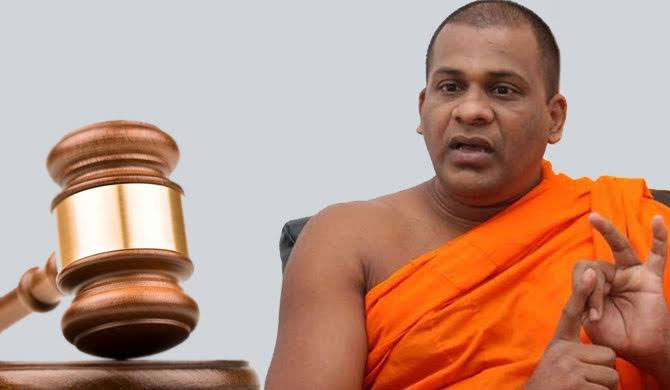
Court of Appeal President Justice Rohantha Abeysuriya yesterday withdrew from the bench hearing petitions challenging the decision by prison authorities to require Ven. Galagoda Aththe Gnanasara Thera to wear prison attire following his imprisonment.
The decision was announced when the petitions seeking to invalidate the prison authorities’ decision were taken up for consideration on October 14.
Following his withdrawal, a three-judge bench was appointed to hear the petitions.
The petitions relate to the prison authorities’ decision to require Gnanasara Thera to wear prison attire after he was taken into custody to serve the remainder of his sentence for contempt of court.
In September this year, the Supreme Court annulled the presidential pardon granted to Gnanasara Thera by former President Maithripala Sirisena in May 2019.
Following the ruling, the Court of Appeal directed the Commissioner General of Prisons to take the necessary steps to enforce the remainder of the monk’s prison sentence.
Gnanasara Thera had originally been sentenced to six years’ imprisonment for contempt of court but had served only around nine months before receiving the presidential pardon in 2019.

AgriConnect Sri Lanka’ to be launched on 30 October to Modernise the Agricultural Sector Through Digitalisation

57th Annual Saints’ Quadrangular Tournament on Saturday and Sunday

Showers or thundershowers will occur at most parts of the island

Prison rules to be revised over monks’ attire

AC President recuses himself from hearing prison attire case pertaining to Gnanasara Thera

Court orders steps to obtain INTERPOL Red Notice against Basil

‘Dates have the highest sugar content to fight Coronavirus’

Sunday Island 27 December – Headlines

#SundayIsland 17th December – Headlines

Sunday Island – 28th March

Sunday Island Headlines – 21 March

Sunday Island – 21st February – Headlines
-

 News7 days ago
NDB fraud Rs 60mn more than reported
-

 News7 days ago
Removing monk’s robes matter for Sangha to decide: Mahanayake Theras
-

 News5 days ago
Sri Lanka escalates anti-graft drive with Shiranthi’s jailing
-
 News6 days ago
NPP govt. reminded of its responsibilities as US warship leaves Colombo
-
 Latest News6 days ago
Farhan, Sadaqat help Pakistan ace 183 chase to go 1-0 up
-
 News7 days ago
BHC, Colombo: “LTTE remains a proscribed org. in the UK”
-

 Latest News4 days ago
Farhan and Sadaqat help Pakistan seal series in style
-
 News5 days ago
Iranian ships stranded, Lanka fears US sanctions