
Latest News
Russia complicating end to war, says Zelensky ahead of Trump meeting

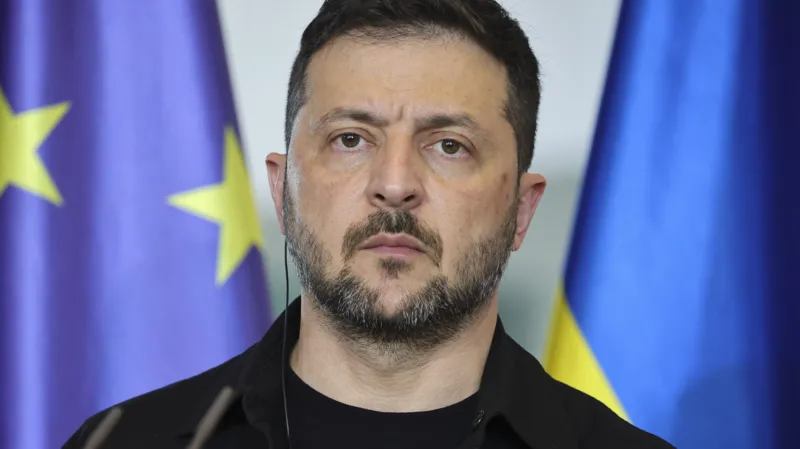
Volodymyr Zelensky has said that Russia’s refusal to agree to a ceasefire is complicating efforts to end the war.
“We see that Russia rebuffs numerous calls for a ceasefire and has not yet determined when it will stop the killing. This complicates the situation,” the Ukrainian president said in a statement on X.
On Monday, Zelensky will travel to Washington DC, where US President Donald Trump has said he will urge the Ukrainian leader to agree to a peace deal.
Trump said he wants to bypass a ceasefire in Ukraine and move directly to a permanent peace agreement after his meeting with Russian President Vladimir Putin.
In a major shift in position, the US president wrote on Truth Social following Friday’s summit that this would be “the best way to end the horrific war”, as ceasefires often “do not hold up”.
Following a phone call with Trump after the summit, Zelensky called for a real, lasting peace, while adding that “the fire must cease” and killings stop.
He later outlined Ukraine’s requirements for “a truly sustainable and reliable peace”, including a “credible security guarantee” and the return of children he says were “abducted from occupied territories” by Moscow.
Trump had said before the summit on Friday that he wanted a ceasefire “rapidly”, having threatened Russia with economic sanctions if one was not agreed.
Ukraine’s main demand has been a quick ceasefire before talks on a longer-term settlement, with Trump reportedly telling European leaders beforehand that his goal for the summit was to obtain a ceasefire deal.
Putin reportedly presented Trump with a peace offer that would require Ukraine withdrawing from the Donetsk region of the Donbas, in return for Russia freezing the front lines in Zaporizhzhia and Kherson.
Russia claims the Donbas as Russian territory, controlling most of Luhansk and about 70% of Donetsk. It also illegally annexed the Crimean peninsula in 2014, eight years before launching its full-scale invasion of Ukraine.
Trump, who has previously said any peace deal would involve “some swapping of territories”, is said to have relayed the offer to Zelensky in their call following the summit.
Just days ago, Ukraine’s president ruled out ceding control of the Donbas – composed of the Luhansk and Donetsk regions – saying it could be used as a springboard for future Russian attacks.
The BBC’s US partner CBS has reported, citing diplomatic sources, that European officials were concerned Trump may try to pressure Zelensky into agreeing to terms that may have been discussed at Friday’s summit when they meet on Monday.
CBS quotes sources as saying that Trump had told European leaders that Putin would make “some concessions”, but failed to specify what they were.
In an interview with Fox News following the US-Russia summit in Alaska, Trump was asked what advice he had for the Ukrainian leader, to which he replied: “Make a deal.”
He added: “Russia’s a very big power and they’re not.”
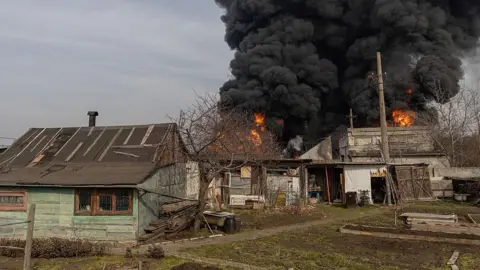
Trump had previously threatened “very severe consequences” if Putin did not agree to end the war, last month setting a deadline for Moscow to reach a ceasefire or face tough new sanctions, including secondary tariffs on its allies.
But the two left Friday’s talks with no agreement reach, despite both insisting progress had been made.
On Saturday, Putin described the summit as “very useful” and said he had been able “set out our position” to Trump.
“We had the opportunity, which we did, to talk about the genesis, about the causes of this crisis,” the Russian president said. “It is the elimination of these root causes that should be the basis for settlement.”
A senior Russian diplomat later told BBC Newshour that the summit had been “a very important building block for further efforts” to end the war.
Russia’s first deputy permanent representative to the UN, Dmitry Polyanskiy, said that everybody who wanted peace “should be satisfied by the outcome”. He wouldn’t say if Putin should now meet Zelensky.
European leaders have reacted with caution to the outcome of the Trump-Putin meeting, seeking not to criticise the change of direction despite their long-held support for a ceasefire.
However, Trump notably said the US was prepared to provide security guarantees for Ukraine – a key request of Zelensky’s and the “coalition of the willing”, a group of nations, including the UK, France and Germany, that have pledged to protect peace in Ukraine once it is achieved.
German Chancellor Friedrich Merz called this “significant progress”.
The group will hold a call on Sunday afternoon before Zelensky visits the White House on Monday.
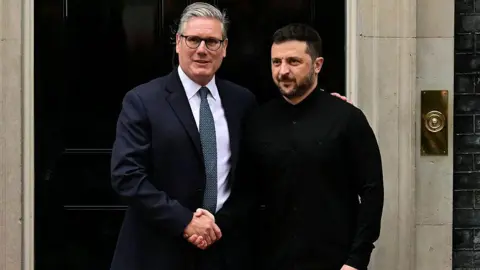
European leaders – including Merz, French President Emmanuel Macron and European Commission President Ursula von der Leyen – said “the next step must now be further talks including President Zelensky”.
“It will be up to Ukraine to make decisions on its territory,” they said, adding: “International borders must not be changed by force.”
UK Prime Minister Sir Keir Starmer praised Trump’s efforts to end the war, saying they had “brought us closer than ever before”, but said the “path to peace in Ukraine cannot be decided without” Zelensky.
In Kyiv, Ukrainians have described feeling “crushed” by the scenes from Alaska.
“I understand that for negotiations you shake hands, you can’t just slap Putin in the face when he arrives,” Serhii Orlyk, a 50-year-old veteran from Donetsk, said.
“But this spectacle with the red carpet and the kneeling soldiers – it’s terrible, it makes no sense.”
Monday’s White House meeting will be Zelensky’s first since he was hectored by Trump and his Vice President JD Vance in February.
They appeared to reconcile in April, in what the White House described as a ‘very productive’ 15-minute meeting on the sidelines of Pope Francis’s funeral.
[BBC]

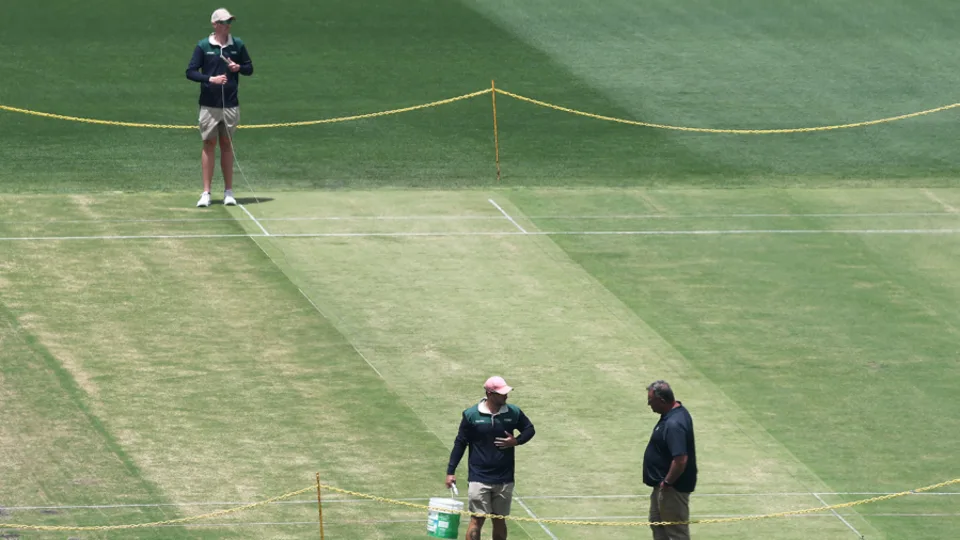
Todd Murphy is firming to play his first home Test, after the SCG’s head curator declared the pitch’s green covering would be near-irrelevant come day one.
With administrators still on edge after last week’s two day debacle in Melbourne, an extremely green SCG surface raised eyebrows in Sydney on Thursday.
But chief curator Adam Lewis insisted on Friday that should not be a concern, and he was hopeful Sydney would extend into a fifth day.
“You want to see green tinge three days out,” Lewis said. “If you’re not seeing any live grass three days out, then that’s when it’s a worry, … I’m really comfortable with where we’re sitting.
“We had a little bit of sun this morning. They’re saying a bit more sun tomorrow. That will take the greenness out of the pitch. We’re really happy with the pitches at the moment. We’re looking good.”
Lewis admitted he felt for MCG counterpart Matt Page last week, but said he felt no external pressure to ensure the fifth Test in Sydney went the distance.
It’s estimated that Cricket Australia (CA) has lost in the vicinity of AUD15 million in profits this summer, with the opening Test in Perth also finishing inside two days.
Even Prime Minister Anthony Albanese joked at a function with teams on Thursday night that they had to ensure the game went to day three, in order to support the McGrath Foundation fundraiser.
One of the hardest grounds in the world to bowl on between 2014 and 2023, last year’s SCG Test was over in just two-and-a-half days.
Lewis said that his ground staff would go with 6mm of grass this year compared to 7mm last season, while also reducing its density. That in itself generally acts to flatten out the wicket and produce less movement, while also inviting the chance of spin late in the match.
“We just thought … we could thin our density out a little bit,” Lewis said. “That’s what we’ve done this year. We’ve practised that in the Shield matches and we’ve received very good marks.”
CA CEO Todd Greenberg said he too was confident the SCG Test would last the distance.
“I’ve had more phone calls and conversations about wickets and millimetres of grass than I thought I’d ever have,” Greenberg said. “But I’m hopeful and confident we will have a long and productive Test match here.”
All of which should spell good news for Murphy. Australia’s coaching staff had a prolonged conversation around the pitch on Friday morning, after leaving Murphy out and going with four quicks at the MCG.
Murphy then spent most of Friday’s training session bowling to Australia’s top order, while Alex Carey also had an extended run keeping to him.
With seven Tests to his name overseas, Murphy would be expected to come in for Jhye Richardson if he does play in Sydney.
England have promised to take the attack to Murphy, who played two Tests during the 2023 Ashes were he conceded 4.72 an over.
“Whoever plays, I think that’s the mantra of our team, is to try and put pressure on people,” opener Zak Crawley, said. “Todd’s a very good bowler, but I can envisage us trying to put some pressure on him, like we would all their bowlers.
That’s going to come with some risks, and if it’s turning it’s definitely going to be a threat. But I think we’ll try and put pressure on all their bowlers.”
The other question for Australia will be whether Cameron Green remains in the side, after Beau Webster was spotted fielding in the gully during slips training on Friday. Green has averaged 18.66 with the bat in this series. The SCG was the scene of Webster’s debut a year ago against India.
[Cricinfo]

Palestine was the deadliest place to work as a journalist in 2025, with the Middle East as a whole the most dangerous region for media professionals, according to a global journalist union.
The International Federation of Journalists (IFJ) said the region accounted for 74 deaths last year – more than half of the 128 journalists and media workers killed – in a new report released on Wednesday.
The Middle East was followed by Africa with 18 deaths, Asia Pacific (15), the Americas (11) and Europe (10), according to the report. The vast majority of those killed were men, but the list included 10 women.
“128 journalists killed in a single year is not just a statistic; it is a global crisis. These deaths are a brutal reminder that journalists are being targeted with impunity, simply for doing their job,” IFJ General Secretary Anthony Bellanger said.
Palestinian journalists were the biggest cohort of victims: 56 Palestinian media professionals were killed in 2025. Yemen followed, with 13 deaths, Ukraine, with eight, and Sudan, with six, according to the IFJ.
The Paris-based media union cited Israel’s killing of Al Jazeera journalist Anas al-Sharif as the most “emblematic” of the 56 journalists murdered in Palestine last year covering Israel’s genocidal war on Gaza. Al-Sharif, 28, was killed on August 10 alongside several colleagues when Israeli forces struck a media tent outside Gaza City’s al-Shifa Hospital.
The attack also killed Al Jazeera correspondent Mohammed Qreiqeh, Al Jazeera camera operators Ibrahim Zaher and Mohammed Noufal, freelance camera operator Momen Aliwa and freelance journalist Mohammed al-Khalidi.
IFJ also cited an Israeli strike in early September on a Yemeni newspaper office as “one of the worst-ever attacks on a media office”. Thirteen journalists and media workers at the Houthi-affiliated “26 September” newspaper were killed, along with more than 20 other people.
Another nine deaths were ruled as accidents, while others – including two journalists in Syria and two in Iran – were “targeted and killed” because of their work, IFJ said.
While the Middle East was the deadliest region for the third year in a row in 2025, the Asia Pacific accounted for the largest number of journalists and media workers behind bars. Most cases in 2025 were in China and Hong Kong, which together accounted for 143 journalists, followed by 49 in Myanmar and 37 in Vietnam.
Europe was another detention hotspot last year, accounting for 149 imprisoned journalists. IFJ attributed the figure, up 40 percent from a year earlier, to “intensified repression in Azerbaijan and Russia”.
[Aljazeera]

United States President Donald Trump has said that he will delay the implementation of tariffs on upholstered furniture, kitchen cabinets and vanities for one year, amid growing concerns over cost-of-living issues.
Trump signed an order on Wednesday night, during the New Year’s Eve holiday, pausing a planned 50 percent tariff on cabinets and vanities and a 30 percent tariff on upholstered furniture.
But the order maintained the 25 percent tariff he put in place for those products in September.
The US president had previously described the furniture tariffs as a step to “bolster American industry and protect national security”.
Polls indicate that rising prices and the cost of living are major concerns for people in the US as the country approaches its 2026 midterm elections, scheduled for November.
Voters hold President Trump’s policies, and tariffs in particular, at least partly responsible for their economic woes. A Politico poll released in December found that 30 percent of respondents cited tariffs as the primary reason prices were high, and 32 percent said that Trump bears “full responsibility” for the state of the economy.
A majority of respondents cited the cost of living as a top issue facing the country, while 32 percent cited the state of the economy. Democratic politicians have sought to hammer Trump and his Republican Party on affordability concerns, which Trump has waved away as a “hoax” perpetuated by his political rivals.
The Italian foreign ministry said on Thursday that the US had also agreed to slash proposed import duties on pasta products from 13 companies.
Previously, the Trump administration had threatened the pasta companies with additional tariffs of 92 percent, in addition to import taxes on European Union products.
Italy’s foreign ministry said that the US Commerce Department had agreed to bring that rate down to 2.26 percent for La Molisana and 13.98 percent for Garofalo, two Italian food companies the administration had accused of undercutting other pasta producers through unfairly low prices.
The other companies will face a rate of 9.09 percent.
“The recalculation of the duties is a sign that US authorities recognise our companies’ constructive willingness to cooperate,” the foreign ministry said.
[Aljazeera]

Over 400,000 Russians killed, wounded for 0.8 percent of Ukraine in 2025

SCG curator ‘really happy’ with pitch for final Ashes Test

Showery condition is expected to enhance in the Eastern, Northern and Uva provinces during the coming days, due to the development of a low-level atmospheric disturbance to the East of Sri Lanka

GMOA warns of trade union action unless govt. urgently resolves critical issues in health sector

Elephant census urged as death toll nears 400

CTU raises questions about education reforms

‘Dates have the highest sugar content to fight Coronavirus’

Sunday Island 27 December – Headlines

#SundayIsland 17th December – Headlines

Sunday Island – 28th March

Sunday Island Headlines – 21 March

Sunday Island – 21st February – Headlines
-

 Sports5 days ago
Gurusinha’s Boxing Day hundred celebrated in Melbourne
-
 News3 days ago
Leading the Nation’s Connectivity Recovery Amid Unprecedented Challenges
-

 Sports6 days ago
Time to close the Dickwella chapter
-

 Features4 days ago
It’s all over for Maxi Rozairo
-

 News6 days ago
Environmentalists warn Sri Lanka’s ecological safeguards are failing
-
 News4 days ago
Dr. Bellana: “I was removed as NHSL Deputy Director for exposing Rs. 900 mn fraud”
-
 Features6 days ago
Digambaram draws a broad brush canvas of SL’s existing political situation
-

 News3 days ago
Dons on warpath over alleged undue interference in university governance