
News
Road to be widened at Kochchikade

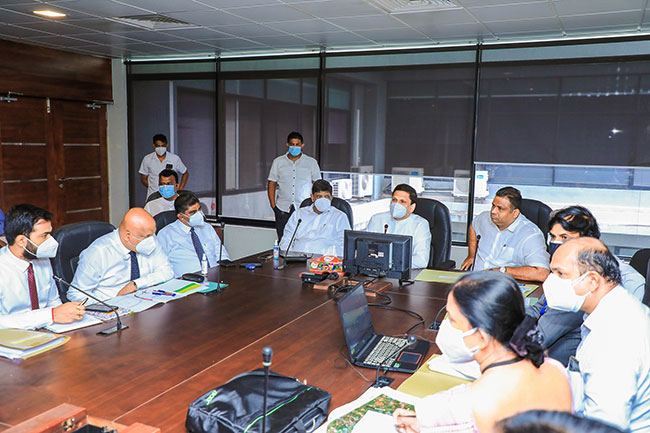
Rural Roads and Other Infrastructure State Minister Nimal Lanza chaired a meeting on Friday to find means to put an end to traffic congestion in and around Kochchikade on the Colombo-Puttalam main road. Officials were given instructions to widen a 5.6 km stretch between Dalupotha junction to Thoppuwa bridge to a four-lane road.
The Ministry said that as its first stage, the development of 820 meters of the road in the Kochchikade city limits with four lanes would be expedited.
After business community representatives pointed out that business activities in the Kochchikade town may decline as a result of vehicles traveling on the Peliyagoda-Puttalam (A003) road to Anuradhapura, Puttalam and Jaffna tend to use alternative routes to bypass the Kochchikade town due to the congestion, State Minister Lanza said that the project would be implemented to save people’s time, money and reduce pollution.
Minister Lanza instructed officials of the Road Development Authority to take steps to minimise the damage to the business community during the implementation of this project.
The business association also said they would provide maximum support for the road widening project.
State Minister Arundika Fernando, Secretary to the Ministry of Highways R.W.R. Pemasiri, Chaminda Athaluwage, Chairman, Road Development Authority, Sardha Weerakoon, Director General of RDA and local government officials were present at the discussion.

News
MullenLowe Sri Lanka integrates Synapse VII Advanced Analytics to elevate data-driven advertising


MullenLowe Sri Lanka, has announced the integration of Synapse VII’s advanced data analytics capabilities into its digital services ecosystem. The partnership signals an important shift in the local advertising landscape, bringing together high-impact creative storytelling with rigorous data diagnostics.
As Sri Lankan brands navigate an increasingly complex digital economy, the collaboration aims to address a growing challenge within the industry, which is the disconnect between daily digital content activity and long-term brand equity. Synapse VII focuses on the discipline of digital effectiveness, an approach that looks beyond short-term engagement metrics commonly associated with social media marketing to identify media patterns that genuinely influence business performance in both the short and long term.
“The industry has spent years chasing immediate engagement, often at the expense of sustainable growth,” said Thayalan Bartlett, Executive Chairman of MullenLowe Group Sri Lanka. “By integrating Synapse VII’s analytical engine, we move beyond traditional reporting and give our clients the ability to understand where their brand is heading, not simply where it has been.”
Kevin Kulatilake, Managing Director of Synapse VII, brings extensive international experience to the partnership. His career includes leading the digital division for Unilever at Mindshare, part of GroupM in Sri Lanka, and serving as the former Head of LoweDigital at MullenLowe Sri Lanka before relocating to the United Kingdom.
During his time in the UK he operated within a highly competitive marketing environment, holding senior performance leadership roles across global brands. As Performance Director for organisations such as Haleon at Publicis, Eurostar at Wavemaker, and the Volkswagen Group at Omnicom, he was responsible for managing multi-million-pound digital performance budgets. Within these environments, where data-driven accountability is a business necessity, advanced predictive analytics form the foundation of marketing decision-making.
“Synapse VII was built on the principle that data should steer the brand rather than simply describe it,” Kulatilake said. “Having implemented these frameworks in the UK, where the scale of data and the weight of media investment demand absolute precision, I am excited to bring that same level of analytical discipline back to Sri Lanka.”
News
‘Show us the science, not slogans’: Prof. Anura Wijepala challenges Sri Lanka’s renewable energy push

A former Chairman of the Ceylon Electricity Board, Prof. Eng. Anura Wijepala has called for urgent, evidence-based clarity on Sri Lanka’s renewable energy (RE) ambitions, warning that politically driven targets risk destabilising the country’s already fragile power sector.
Speaking on the ongoing debate over Sri Lanka’s transition to renewable energy, Wijepala said he has yet to receive satisfactory answers to critical technical and economic questions—despite these targets being widely promoted in policy circles and election platforms.
“I never got answers for these questions in that programme or up to this day,” he said, expressing concern that ambitious targets such as 70% or 80% renewable energy penetration have been adopted without rigorous, transparent studies.
Wijepala stressed that he is not opposed to renewable energy—in fact, he would support even a 100% transition—provided it is grounded in credible analysis led by key state institutions, including the Central Bank of Sri Lanka, the Finance Ministry, and the restructured power utility, now operating as Generation Lanka.
“I am for even 100% RE if the Central Bank, Finance Ministry and CEB—now Generation Lanka—can do a study and convince us on the best way forward,” he said.
However, Wijepala warned that in the absence of such due diligence, arbitrary targets risk doing more harm than good. He alleged that these figures may have been quietly inserted into election manifestos by individuals with vested interests, rather than emerging from a transparent, technocratic process.
“How I understand these 70% or 80% figures are numbers that crept into election manifestoes of unsuspecting presidential candidates by very crafty people who join such policy-making committees and work on their vested interests,” he charged.
The consequences, he cautioned, could be severe.
“The end result is the destruction of the electricity sector and hardship for the people of this country,” Wijepala said, urging policymakers to prioritise system stability, affordability, and long-term sustainability over headline-driven targets.
Sri Lanka’s energy sector has faced repeated crises in recent years, from fuel shortages to tariff hikes and generation shortfalls.
Analysts warn that while renewable energy offers a pathway to energy security and reduced import dependency, its integration must be carefully managed—particularly in a grid that still relies heavily on thermal and hydroelectric balancing.
Wijepala’s remarks add to growing calls within the engineering and energy community for a comprehensive national study on the feasibility, cost implications, grid stability, and storage requirements of high renewable penetration.
By Ifham Nizam
News
Pathfinder Foundation and JAIN University jointly organised the International Roundtable on Migration in Bangalore

A one-day international roundtable on “The Geopolitics of Climate Change and the Securitisation of Climate-Induced Migration” was held in Bangalore, an event jointly organised by Deemed-to-be University (JAIN) and the Pathfinder Foundation.
The discussion brought together experts from India and Sri Lanka to examine how climate change is increasingly shaping global geopolitics, security priorities, and economic vulnerabilities. In his opening statement, Dr Dayaratna Silva, Executive Director of Pathfinder Foundation, stated that countries in our region are highly vulnerable to extreme weather events, resource scarcity, ecosystem disruption, and intensifying geopolitical tensions, not only environmentally but also economically and socially. He cited Cyclone Ditwah in November 2025 as a stark example, which affected all 25 districts in Sri Lanka. Therefore, addressing these climate-related challenges requires stronger regional cooperation and institutional resilience.
Prof Sandeep Shastri, Vice President of Bangalore Campus, in his opening remarks emphasised that climate change and SDGs are closely interconnected; therefore, the progress made towards mitigating climate change impacts will significantly ease the path to achieving many SDGs.
Prof Ranjith Bandara, Chairman of Kirula Foundation, and Subhashini Abeysinghe, Research Director at Verité Research, contributed to the Climate Risks, Maritime Vulnerabilities, and Supply-Chain Disruptions session. Anuradhi Navaratnam, Attorney-at-Law and Migration Consultant, contributed to the session on Securitisation of Climate-Induced Migration and Displacement. The roundtable emphasised the importance of adopting climate justice-oriented approaches, strengthening supply chain resilience, and enhancing India–Sri Lanka collaboration, while also laying the groundwork for a future international conference and joint policy outputs.

MullenLowe Sri Lanka integrates Synapse VII Advanced Analytics to elevate data-driven advertising

‘Show us the science, not slogans’: Prof. Anura Wijepala challenges Sri Lanka’s renewable energy push

Ranjith Siyambalapitiya turns custodian of a rare living collection

Smoke Free Sweden calls out to WHO not to suggest nicotine alternatives

‘Style Surge’ blends glamour with a cause

Thoughts about “People and Events”

‘Dates have the highest sugar content to fight Coronavirus’

Sunday Island 27 December – Headlines

#SundayIsland 17th December – Headlines

Sunday Island – 28th March

Sunday Island Headlines – 21 March

Sunday Island – 21st February – Headlines
-

 News3 days ago
2025 GCE AL: 62% qualify for Uni entrance; results of 111 suspended
-

 News5 days ago
Tariff shock from 01 April as power costs climb across the board
-
 News6 days ago
Inquiry into female employee’s complaint: Retired HC Judge’s recommendations ignored
-

 Features6 days ago
New arithmetic of conflict: How the drone revolution is inverting economics of war
-

 Editorial3 days ago
Search for Easter Sunday terror mastermind
-

 Business4 days ago
Hour of reckoning comes for SL’s power sector
-

 Sports6 days ago
Sri Lanka’s 1996 World Cup heroes to play exhibition match in Kuala Lumpur
-

 Features5 days ago
Seychelles … here we come