
Business
Rising price of rice in Sri Lanka: The roots and remedies


By Manoj Thibbotuwawa
Rice is the dietary staple and the major domestic crop cultivated in Sri Lanka since ancient times. Therefore, the production and availability of rice are closely tied to food security as well as political stability in the country. Every government since independence has given prominence to the goal of achieving self-sufficiency in rice. Accordingly, a significant amount of resources are allocated for the supply of irrigation water, land development, research on technological improvements, farm mechanisation, and support facilities such as credit, subsidised inputs, and farmer welfare measures.
As a result, the cultivation of paddy and production of rice increased steadily with Sri Lanka reaching near self-sufficiency in rice and rice imports dropping to an insignificant amount. Despite these achievements, problems relating to the paddy and rice sector continue to occupy a foremost place among the country’s socio-economic issues. At present, supply shortages and rising retail prices have caused severe social unrest. In this background, this blog identifies the current problems in the rice sector and suggests some policy recommendations.
Demand and Supply Dynamics of Rice
Rice is an essential consumer good with inelastic demand in the local market and the consumption of rice is important not only to the economy but to Sri Lankan culture as well. Based on 2016 per capita consumption of 104.5 kg per annum, the annual national rice demand was 2.1 million MT which is equivalent to 3.2 million MT of paddy. After adjusting for seed paddy, processing, waste and other requirements, Sri Lanka needs to produce 4 million MT of paddy to fulfil the above national demand. No significant change in national requirement is expected in the near future due to the balance between gradual reduction in per capita consumption and population growth.
Sri Lanka managed to achieve this target over the last two years and is on course to achieve the same this year as well. The 2020 Yala output of 1.9 million MT paddy (equivalent to 1.3 million MT rice) produced around September 2020 was sufficient to feed the country for about six months. The 2020 Maha output of 3.1 million MT paddy (equivalent to 2 million MT rice) produced around March 2021 is sufficient to feed the population for about nine months. The Department of Agriculture estimated a harvest of 1.5 million
MT for the 2021 Yala. Therefore, any current or speculatory rice shortage is not expected.
The Problem: Pricing Dilemma
The rice market has a delicate system of price determination that is associated with availability in the market. It is connected to seasonal harvests of Maha and Yala leading to high fluctuation of prices over certain months of the year. From January, the prices of paddy and rice decline gradually and reach their lowest in March with the major Maha harvest. It increases slightly from April and undergoes a minor slump during July-August when the minor Yala harvest reaches the market. The rise of the prices of all types of rice is quite sharp from September onwards reaching the peak in December and begin to decline again in January continuing the cycle. The difficulties faced by consumers due to a sharp rise in rice price during September-January is one of the most politically sensitive issues in the country.
Severe disruptions happened to this usual pricing mechanism in recent times by the cooperative decision making and anti-competitive practices of large and leading millers who have large storage facilities, purchasing power and economic stability. Farmers are inherently disadvantaged in the market because a large number of farmers sell their harvest at the same time due to lack of capacity to store paddy and credit bound relationships due to up-front capital requirement for uncertain several months.
Cooperative decision-making by large millers who handle a sufficiently large (about 33.8%) share of purchase in the paddy market gain an oligopolistic advantage by releasing large stocks of rice to the market during the harvesting period to create a glut so that they can purchase paddy at minimum prices. Also, their anti-competitive practices such as exclusive supply agreements, horizontal cartel practices and compelling farmers to sell paddy only to them prevent small scale millers from purchasing paddy. Curtailing stocks thereafter create a scarcity of rice to maintain a high price till the next harvest period.
The Remedies
Different command-and-control methods such as adhoc price controls and emergency regulations were used by successive governments to control the market. These were easy to enact, yet have proven ineffective. Therefore, measures that provide facilitation, monitoring, and regulation should be the key strategies of the government in both the rice and paddy markets while allowing market forces of supply and demand to determine prices.
Promoting competition is the key to constrain the oligopolistic market power enjoyed by the large millers. However, small and medium millers will find it difficult to survive in the market due to strong competition from the successful, large ones that dominate the space with wide-ranging products including premium and mass markets. Thus, small and medium millers should be empowered through credit facilities to buy paddy and to upgrade their mills to achieve economies of scale and production cost advantage.
Further, organising them under a suitable collective business model such as cooperatives will facilitate competition while providing a sustainable solution. In the meantime, as a short-term measure, the Paddy Marketing Board (PMB) can increase its purchases so that these can be milled by small and medium millers on a quota basis and distributed through Sathosa.
While the Consumer Affairs Authority Act, No. 09 of 2003 was designed to control anti-competitive practices that harm consumers, this is constrained by resource limitations and information asymmetry. This can be minimised by establishing a market information system with mandatory reporting under Section 12 of the Paddy Marketing Board Act No. 14 of 1971 which provides for recording data on production, sale, supply, storage, purchase, distribution and milling of paddy and rice.
Other than the anti-competitive practices, the cost of production of paddy and bargaining power are also factors that determine the price received by farmers. Modern technologies should be promoted to optimise the input use so that the cost of production could be minimised. The current policy drive on organic farming could be rationalised to reduce the dependency on costly imported inputs such as chemical fertiliser and agrochemicals gradually.
Small-scale farmers should be organised under suitable operational units such as The Japan Agricultural Cooperatives (JA) so that their farming efforts are coordinated and consolidated to increase their collective bargaining power. Decisions on rice importation should be based purely on market conditions given by the proposed market information system. These strategies can stabilise the prices of paddy and rice without severe fluctuations and make paddy farming a viable livelihood with a sustained income for small-scale farmers.
Link to blog: https://www.ips.lk/talkingeconomics/2021/10/07/rising-price-of-rice-in-sri-lanka-the-roots-and-remedies/
Manoj Thibbotuwawa is a Research Fellow at IPS with research interests in agriculture, agribusiness value chains, food security, and environmental and natural resource economics. He holds a BSc (Agriculture) with Honours from the University of Peradeniya, an MSc (Agricultural Economics) from the Post-Graduate Institute of Agriculture at the University of Peradeniya, and a PhD from the University of Western Australia. (Talk with Manoj – manoj@ips.lk).

Business
Sri Lanka’s apparel sector records 5.42% growth for January-November 2025: November slight dip


Sri Lanka’s apparel industry delivered a robust performance during the first eleven months of 2025, with cumulative exports reaching US$4,571.99 million marking a 5.42% increase over the same period last year, according to data released today by the Joint Apparel Association Forum (JAAF).
Sri Lanka’s total apparel exports for November 2025 reached US$367.60 million, representing a slight decrease of 1.96% compared to US$374.94 million in November 2024.
The monthly performance showed mixed results across key markets: United States: US$152.32 million (up 5.79% from US$143.98 million), European Union (excluding UK): US$119.61 million (up 3.35% from US$115.73 million), United Kingdom: US$43.63 million (down 13.83% from US$50.63 million), Other Markets: US$52.04 million (down 19.44% from US$64.60 million)
Strong cumulative performance: January-November 2025
Despite the November softness, cumulative apparel exports for the eleven-month period from January to November 2025 demonstrate solid growth, reaching US$4,571.99 million—a 5.42% increase over the corresponding period in 2024 (US$4,336.84 million).
Year-to-Date Performance by Market:
European Union (excluding UK): US$1,435.39 million (up 13.07%)
Other Markets: US$742.98 million (up 5.75%)
United States: US$1,769.08 million (up 1.73%)
United Kingdom: US$624.54 million (down 0.22%)
Commenting on the export data, JAAF stated “The 5.42% growth in our cumulative exports for the first eleven months of 2025 reflects the resilience and adaptability of Sri Lanka’s apparel sector in navigating a challenging global environment. While we experienced a modest 1.96% decline in November, this should be viewed within the broader context of our strong year-to-date performance.
“Particularly encouraging is our 13.07% growth in the European Union market, which demonstrates the success of our strategic focus on strengthening relationships with EU buyers and meeting their increasingly stringent sustainability and compliance requirements. Similarly, our continued growth in the US market, despite tighter margins, shows that Sri Lankan manufacturers remain competitive on quality, delivery, and ethical manufacturing standards”.
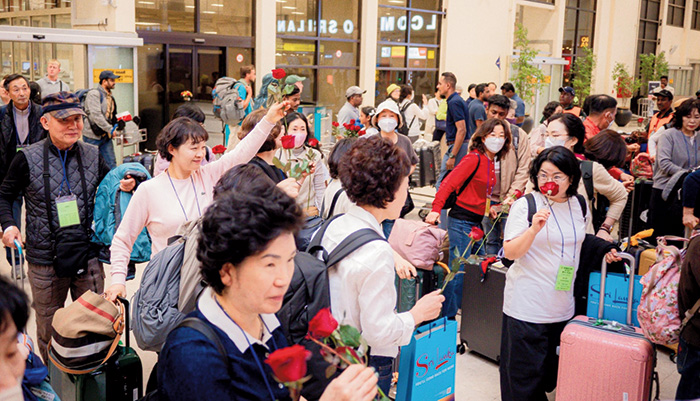
Sri Lanka Tourism, in collaboration with the Embassy of Sri Lanka to the Republic of Korea, is providing support for the two VVIP South Korean Buddhist delegations visiting the country, demonstrating solidarity and strengthening cultural and religious ties with Sri Lanka.
The first delegation included Anunayake thero of Jogye order , South Korean chief Buddhist monks and devotees arrived in Sri Lanka consisting of 120 , on 01st December 2025, with the intention of undertaking a pilgrimage tour and highlighting Sri Lanka’s importance as a major Buddhist attraction for Buddhists around the world.
As same as the first delegation, the second VVIP Buddhist delegation which arrived on the 10th of December, 2025, was also given warm and a colorful welcome at the Bandaranaike International Airport, complete with a Cultural Dance troupe and a group of Sri Lankan children to greet them upon their arrival, making them feel at home and happy to see such a sensational sight. Ms . Thanuja Muniweera , Deputy Director and also the officer in charge of the Korean Market , was there to welcome the much revered guests . The delegation consisted of 150 visitors including both priests and devotees.
Led by Ven . Hyeil, , Chief priest of Haeinsa Temple , the main purpose of this visit is to show Sri Lanka as a welcoming and culturally vibrant destination. This will be a great opportunity to show the importance of the Korean Market as an emerging market and also promote Buddhist and Pilgrimage Tourism. South Koreans are known to be travelling in large numbers, including December 2025. The South Korean Buddhist delegation is one such example.

Diversified conglomerate Sunshine Holdings PLC (CSE: SUN) has been included in the S&P Sri Lanka 20 Index, following the 2025 year-end index rebalance announced by the Colombo Stock Exchange (CSE) and S&P Dow Jones Indices. The inclusion takes effect from 22 December 2025, after market closing on 19 December 2025.
The S&P Sri Lanka 20 Index represents the 20 largest and most liquid companies listed on the CSE, selected based on stringent criteria including market capitalisation, liquidity, financial viability and sustained profitability. Constituents are weighted by float-adjusted market capitalisation, with a single-stock caps to ensure balanced representation.
Commenting on the milestone, Sunshine Holdings Group Chief Executive Officer, Shyam Sathasivam, said, “Our inclusion in the S&P Sri Lanka 20 is the result of more than five decades of collective effort and perseverance by our people, past and present, who have built Sunshine Holdings into the institution it is today. This recognition reflects the strength of our foundations, the discipline with which we have grown, and the consistency of our performance across business cycles. As we move forward, we remain focused on building resilient businesses, upholding strong governance standards and delivering sustainable long-term value to all stakeholders.”
The S&P Sri Lanka 20 Index is constructed in line with global index methodologies and international best practices, with all constituents classified under the Global Industry Classification Standard (GICS®). Eligibility requires a minimum float-adjusted market capitalisation of Rs. 500 million, a six-month median daily value traded of Rs. 250,000, and positive net income over the twelve months preceding the rebalancing reference date.
Sunshine Holdings’ inclusion in the S&P Sri Lanka 20 reflects the Group’s long-term capital markets journey, evolving from a closely held family enterprise into a widely held blue-chip listed company. Over the years, the Group has focused on building institutional credibility, strengthening governance standards and expanding its shareholder base, resulting in a current market capitalisation of approximately LKR 70 billion, underscoring its scale and relevance within the Colombo Stock Exchange.

A question of power

Land dispute brings death to three in a knife attack that also left a fourth in hospital

Sri Lanka’s apparel sector records 5.42% growth for January-November 2025: November slight dip

Sri Lanka highlighted as a popular tourism hotspot among South Korean travelers

Sunshine Holdings joins S&P Sri Lanka 20 Index

Public – private partnerships strengthen rebuilding efforts post Cyclone ‘Ditwah’

‘Dates have the highest sugar content to fight Coronavirus’

Sunday Island 27 December – Headlines

#SundayIsland 17th December – Headlines

Sunday Island – 28th March

Sunday Island Headlines – 21 March

Sunday Island – 21st February – Headlines
-

 Sports5 days ago
Gurusinha’s Boxing Day hundred celebrated in Melbourne
-
 News3 days ago
Leading the Nation’s Connectivity Recovery Amid Unprecedented Challenges
-

 Sports6 days ago
Time to close the Dickwella chapter
-

 Features4 days ago
It’s all over for Maxi Rozairo
-

 News6 days ago
Environmentalists warn Sri Lanka’s ecological safeguards are failing
-

 News4 days ago
Dr. Bellana: “I was removed as NHSL Deputy Director for exposing Rs. 900 mn fraud”
-

 News3 days ago
Dons on warpath over alleged undue interference in university governance
-

 Features6 days ago
Digambaram draws a broad brush canvas of SL’s existing political situation