
Foreign News
RFK Jr sacks entire US vaccine committee

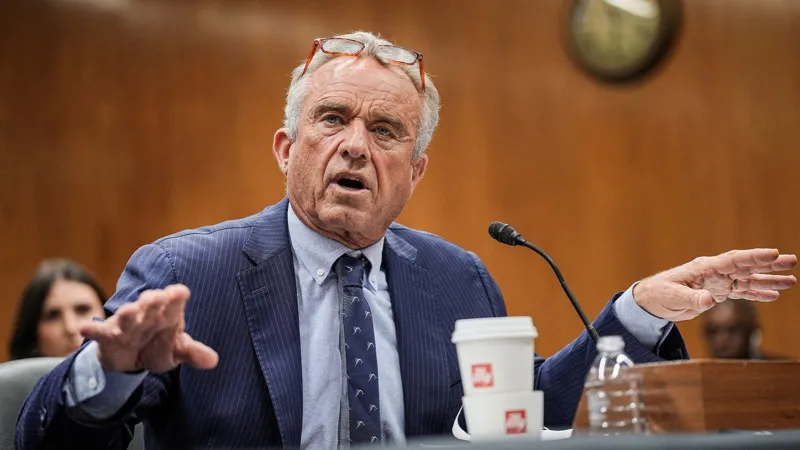
US Health Secretary Robert F Kennedy Jr, a vaccine sceptic, has removed all 17 members of a committee that issues official government recommendations on immunisations.
Announcing the move in an editorial in the Wall Street Journal, Kennedy said that conflicts of interest on the Advisory Committee on Immunization Practices (Acip) were responsible for undermining trust in vaccinations.
Kennedy said he wanted to “ensure the American people receive the safest vaccines possible.”
Doctors and health experts have criticised Kennedy’s longstanding questioning of the safety and efficacy of a number of vaccines, although in his Senate confirmation hearing he said he is “not going to take them away.”
On Monday he said he was “retiring” all of the Acip panel members. Eight of the 17 panellists were appointed in January 2025, in the last days of President Biden’s term.
Most of the members are practising doctors and experts attached to major university medical centres.
After the US Food and Drug Administration (FDA) approves vaccines based on whether the benefits of the shot outweigh the risks, Acip recommends which groups should be given the shots and when, which also determines insurance coverage of the shots.
Noel Brewer, a professor at the University of North Carolina Gillings School of Global Public Health who served on Acip for a year, called Kennedy’s decision “norm-breaking”.
“I was stunned, but not surprised,” he told the BBC. “It was deeply disappointing and more than a bit upsetting.”
Kennedy noted that if he did not remove the committee members, President Trump would not have been able to appoint a majority on the panel until 2028.
“The committee has been plagued with persistent conflicts of interest and has become little more than a rubber stamp for any vaccine,” Kennedy wrote.
He claimed that health authorities and drug companies were responsible for a “crisis of public trust” that some try to explain “by blaming misinformation or antiscience attitudes.”
In the editorial, Kennedy cited examples from the 1990s and 2000s and alleged that conflicts of interest persist.
“Most of ACIP’s members have received substantial funding from pharmaceutical companies, including those marketing vaccines,” he wrote in the Wall Street Journal.
Acip members are required to disclose conflicts of interest, which are posted online, and to recuse themselves from voting on decisions where they may have a conflict.
Dr Brewer said the panel had “one of the most rigorous conflict of interest procedures of any federal committee”.
The members had a wide range of vaccine expertise, and thoroughly reviewed and debated vaccine data to make the best decisions for the public, said Paul Offit, a former Acip member and director of the Vaccine Education Center at Children’s Hospital of Philadelphia.
In his editorial, Kennedy said that the “problem isn’t necessarily that ACIP members are corrupt”.
“The problem is their immersion in a system of industry-aligned incentives and paradigms that enforce a narrow pro-industry orthodoxy,” he claimed.
Dr Bruce Scott, president of the American Medical Association, a professional organisation for American doctors, said mass sacking “upends a transparent process that has saved countless lives.”
“With an ongoing measles outbreak and routine child vaccination rates declining, this move will further fuel the spread of vaccine-preventable illnesses,” Dr Scott said in a statement.
Kennedy’s move appears contrary to assurances he gave during his confirmation hearings. Bill Cassidy, a Republican senator from Louisiana who is also a doctor, reported that he received commitments from the health secretary that Acip would be maintained “without changes.”
On Monday, Cassidy wrote on X: “Of course, now the fear is that the Acip will be filled up with people who know nothing about vaccines except suspicion.
“I’ve just spoken with Secretary Kennedy, and I’ll continue to talk with him to ensure this is not the case.”
Public health experts share Cassidy’s concerns that Kennedy may appoint vaccine-sceptics to the board.
Such replacements would mean some vaccines “won’t be recommended at all” and other effective shots could “no longer be reimbursable by insurance companies”, said Peter Lurie, a former FDA official.
“As a consequence, we will see still further declines in vaccination rates, and then a resurgence of the diseases that they could have prevented,” he said.
Kennedy did not say who he would appoint to replace the board members. The health secretary appears to be calling people himself and asking them to serve on the panel, said Dr Offit, who said he has heard from at least two people Kennedy called.
“His whole notion of radical transparency – this is the opposite of that,” Dr Offit said. “This is one man making a decision behind closed doors.”
Acip has a meeting scheduled starting 25 June, at which members are scheduled to vote on recommendations for vaccines for Covid, flu, meningococcal disease, RSV and other illnesses.
Dr Brewer said Acip had some of the “best scientists in the world”, adding that the secretary would have a hard time finding that calibre of experts again on short-term notice.
The BBC contacted the US Department of Health and Human Services and the Acip chair, Dr Helen Keipp Talbot, for comment.
[BBC]

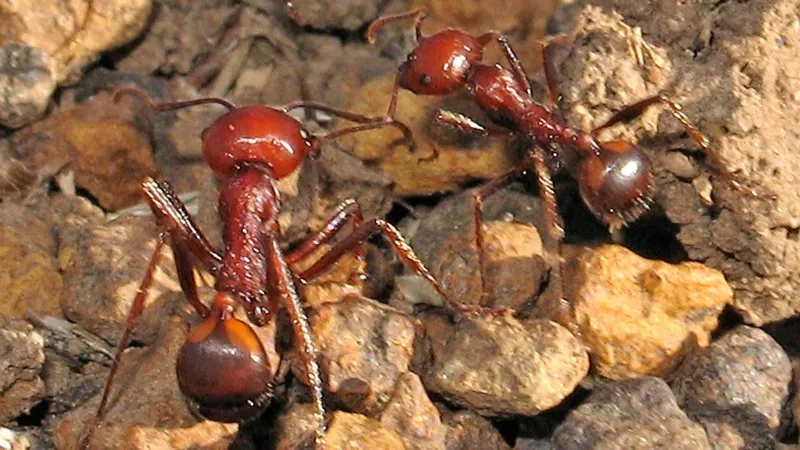
The ants are flying in Kenya at the moment
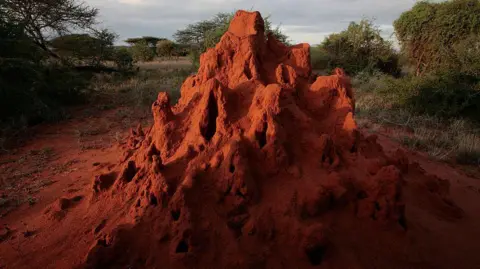
During this rainy season, swarms can be seen leaving the thousands of anthills in and around Gilgil, a quiet agricultural town in Kenya’s Rift Valley that has emerged as the centre of a booming illegal trade.
The mating ritual sees winged males leave the nest to impregnate queens, who also take flight at this time. This makes it the perfect time to chase down queen ants to sell on to smugglers who are at the heart of a growing global black market, that taps into the pet craze for keeping ants in transparent enclosures designed to observe the insects as they busily build a colony.
It is the giant African harvester ant queens, which are large and coloured red, that are most prized by international ant collectors – one can fetch up to £170 ($220) on the black market, which tends to operate online.
A single fertilised queen is able to create a whole colony and can live for decades – and can be easily posted as scanners do not tend to detect organic material.
“At first, I did not even know it was illegal,” a man, who asked not to be named, told the BBC about how he had once acted as a broker, linking foreign buyers with local collection networks.
Also known as Messor cephalotes, these ants are native to East Africa and known for their distinctive seed-gathering behaviour making them popular with ant collectors.
“A friend told me a foreigner was paying good money for queen ants – the big red ones which are easily seen around here,” the former broker said.
“You look for the mounds near open fields, usually early morning before the heat. The foreigners never came to the fields themselves – they would wait in town, in a guest house or a car, and we would bring the ants to them packed in small tubes or syringes they supplied us with.”
The scale of the illicit trade in Kenya became apparent last year when 5,000 giant harvester ant queens – mainly collected around Gilgil – were found alive at a guest house in Naivasha, a nearby lakeside town popular with tourists.
The suspects – from Belgium, Vietnam and Kenya – had packed the test tubes and syringes with moist cotton wool, which would enable each ant to survive for two months, according to the Kenya Wildlife Service (KWS).
The plan was to take them to Europe and Asia and put them up for sale.
This trade in ants has caught scientists and the authorities by surprise.
The East African nation is more accustomed to high-profile wildlife crimes involving elephant tusks and rhino horns.
UK based retailer Ants RbUs described the giant African harvester ant as “many peoples dream species” – though the queens are currently out of stock, with the site explaining that it is very hard for retailers to source them.
“Even I, as an entomologist, have been surprised at the extent of the apparent trade,” Dino Martins, a biologist based in Kenya, where there are around 600 kinds of ants, told the BBC.
However, he can understand the fascination with East Africa’s harvester, with colonies created by a “foundress queen”, who can grow up to 25mm (0.98 inches) and who produces eggs throughout her life.
“They are one of the most enigmatic species of ants – they form large colonies, engage in interesting behaviours and are easy to keep. They are not aggressive.”
During the swarming he says the queens mate with several males.
“Then that is it for the males – their job is done… most are eaten by predators or die,” the entomologist says, going on to explain how the queen then scurries away to dig a small burrow and begin laying eggs to start her empire.
Her workers and soldier ants, those that protect the nest, are all female and will eventually number in the hundreds of thousands.
“Nests can live for over 50 years, perhaps even up to 70 years. I personally know of nests near Nairobi that are at least 40 years old as I’ve been visiting them for that long,” said Martins.
This means the queens live that long too – because as soon as she dies, the colony collapses and any surviving workers will look for another nest.
Kenyans who have had to deal with ants raiding their crops or invading their houses know this well – and to get rid of a colony someone is sent in to locate the queen, often hidden deep in one of the tunnels or chambers of an ant mound.
The former broker said ants could also be harvested by gently disturbing the mound and collecting them as they tried to escape.
“It was only when I saw the arrests on the news that I realised what I had been part of – and I immediately quit,” he said.
Those arrested were convicted on charges of biopiracy and ordered to pay fines or serve 12 months in jail – they opted to pay the $7,700 fee and the foreign nationals left the country.
Two weeks ago, a Chinese national – the alleged mastermind behind last year’s ring and who is said to have escaped using a different passport, was arrested at Nairobi’s Jomo Kenyata International Airport with another 2,000 queen ants packed in test tubes and tissue rolls.
For Zhengyang Wang, who was part of a team of researchers who published a report on the ant trade in 2023 focusing on China, this is a worry and could “wreak havoc” with local ecosystems.
“Initially, we were very excited when we learnt that many people have taken up keeping ants,” Wang, assistant professor at Sichuan University, told the BBC.
“A colony of pet ants are often kept in a formicarium, which is basically a transparent plastic box so that keepers can observe colonies at work, digging tunnels, collecting food, and guarding their queen. I’d say it’s quite charming and… can be a good way of educating people about insects and their behaviour.
“But then we realised, wait, isn’t keeping invasive species incredibly dangerous?”
Monitoring online sales – of more than 58,000 colonies – in China over six months, the researchers found that more than a quarter of the traded species were not native to China – despite it being illegal to import them.
“If the trade volume of invasive ants continues to grow, it’s only a matter of time before a few escape from their formicaria and become established in the wild,” said Wang.
The study he worked on, published in the journal Biological Conservation, explained what could happen in the case of giant African harvester, one of the most traded species in China: “For example, Messor cephalotes, an East African native, is among the largest seed harvesters in the world and could potentially disrupt predominantly grain-based agriculture in south-eastern China.”
The environmental consequences are also a concern in Kenya.
“Harvester ants are both keystone species and ecosystem engineers. They harvest seeds of grasses, and other plants and in so doing also help to disperse the seeds,” said Martins, adding that the insects “create a more healthy and dynamic grassland”.
Mukonyi Watai, a senior scientist at Kenya’s Wildlife Research and Training Institute, shares these fears.
“Unsustainable harvesting – particularly the removal of queen ants – can lead to colony collapse, disrupting ecosystems and threatening biodiversity,” he told the BBC.
It is possible to collect ants legally in Kenya – in line with various international treaties – with a special permit, which would require the buyer to sign a benefit-sharing agreement with the local community involved to split any profits.
But, according to the KWS, so far none have been applied for – with the paperwork also requiring details of how many ants are being collected and their destination.
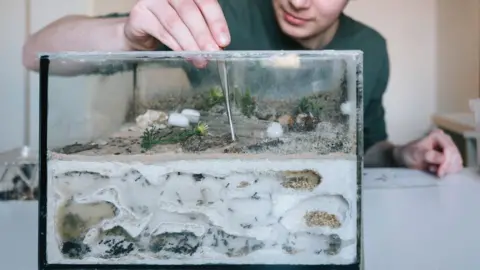 formicarium allows collectors to see the workings of an ant colony (BBC)
Some conservationists are now calling for greater trade protections for all ant species under the Convention on International Trade in Endangered Species (Cites), the global wildlife trade treaty.
“The reality is that no ant species is currently listed under Cites,” Sérgio Henriques, a researcher into the global ant trade, told the BBC.
“Without international treaties monitoring these movements, the scale of the trade remains largely invisible to policy makers and the global community,” he said.
But for the KWS the real problem is more immediate – how to monitor and clamp down on “under-reported” insect trafficking, with the agency suggesting better surveillance equipment at airports and others border points would be a good start.
Martins agrees: “It is likely only a fraction of the actual ants being traded that are being detected, so one can only guess at the scale for now.”
Journalist Charles Onyango-Obbo argues that Kenya is overlooking a significant global revenue opportunity.
“The ants are not finite items like gold or diamonds. They are biological assets that can be bred and farmed, and their production can be scaled up to thousand a day. Yet we treat them like stolen artefacts,” he recently wrote in Kenya’s Daily Nation newspaper.
In fact, Kenya’s cabinet did approve policy guidelines last year aimed at commercialising the wildlife economy, including the ant trade.
“The guidelines seek to promote sustainable use trade of wild species such as ants to generate jobs, wealth and community livelihoods across all the counties,” said Watai.
With careful monitoring in place, it could be that future farmers around Gilgil will have special formicaria on their land expanding the yields from their fields and orchards – full of vegetables and fruits – to include lucrative queen ants.
But the debate over the dangers of exporting ants to hobby collectors in different parts of the world is yet to be settled.
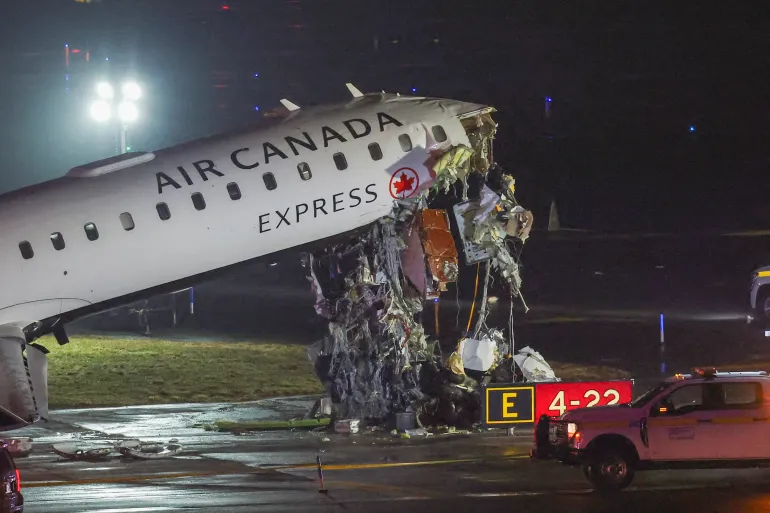
At least two people have been killed when an Air Canada Express flight from Montreal struck a ground vehicle while landing at New York’s LaGuardia Airport, according to several United States media outlets. The airport has been closed and flights diverted.
Kathryn Garcia, the executive director of the Port Authority of New York and New Jersey, said 32 of the 41 people who were injured had been released on Monday while nine remained in hospital with “serious injuries”. Those injured included passengers, crew members and the two officers on the fire truck. Both officers remained hospitalised with non-life-threatening injuries.
The aircraft, operated by Jazz Aviation, a regional partner of Air Canada, struck a firefighting truck on Runway 4 about 11:40pm on Sunday (03:40 GMT on Monday) as the vehicle drove to a separate incident, the Port Authority said.
A preliminary passenger list showed 76 people on board Flight AC8646, including four crew members, Jazz Aviation said in a statement.
The CRJ-900 aircraft struck the vehicle at a speed of 39 kilometres per hour (24 miles per hour), the flight tracking website Flightradar24 said.
“The airport is currently closed to facilitate the response and allow for a thorough investigation,” the Port Authority said in a statement to the AFP news agency.
Emergency response protocols were “immediately activated”, it said.

The US Federal Aviation Administration (FAA) issued a ground stop for all departures to LaGuardia due to the aircraft emergency with the airport closure in effect until 05:30 GMT. The probability of an extension was listed as high.
[Aljazeera]

Along Beirut’s downtown waterfront, Alaa is looking for somewhere to rest his head.
The Syrian refugee, originally from the occupied Golan Heights, is now homeless. He explained that he had already spent the day wandering around the Lebanese capital trying to find shelter.
He used to live in Dahiyeh – the southern suburbs of Beirut that have been pummelled by Israeli attacks, which have now killed MORE THAN 1,000 across Lebanon.
Now, he’s just looking for somewhere he can be safe. And in that context, Eid al-Fitr, the Muslim festival that began on Friday, is far from his mind.
When asked if he had any plans for Eid, he replied in the negative. Instead, his focus was on getting a tent.
“I got rejected from staying in a school, then I went to sleep on the corniche,” Alaa said. “Then people from the municipality told me to come here to downtown Beirut’s waterfront.”
Alaa wasn’t able to find a tent and is sleeping in the open air for now. But others in the area have, transforming a downtown more famous for its expensive restaurants and bars into a tent city for those displaced by the fighting. Across Lebanon, more than a million people have been displaced.
Lebanese are uncertain when this war will end, particularly as they have barely recovered from the conflict with Israel that ran between October 2023 and November 2024.
It makes celebrations difficult – a common theme across the countries affected by the current conflict.
In Iran, now in its third week of US-Israeli attacks – with no sign of an immediate end and an economic crisis that preceded the conflict, people are struggling to afford any of the items typically bought during the holiday season.
And it is potentially dangerous for people to shop at places like Tehran’s grand bazaar, which has been damaged by the bombing.
The religious element of Eid adds an extra sensitivity for antigovernment Iranians, some of whom now see any sign of religiosity as support for the Islamic Republic. The fact that Nowruz – the Persian New Year – falls on Friday this year means that some in the antigovernment camp will be focused on that celebration instead, and eschewing any events to mark Eid.
[Aljazeera]

Electricity tariffs to be increased from 1st April

A QR code system to be introduced for agricultural lands and other sectors requiring fuel

Rickelton, Rohit, Shardul break Mumbai’s first-game jinx

Oil tops $116 a barrel as Iran accuses US of preparing invasion

Iranian attack damages Kuwait power and desalination plant, kills worker

Warm weather conditions prevailing over the island are expected to continue

‘Dates have the highest sugar content to fight Coronavirus’

Sunday Island 27 December – Headlines

#SundayIsland 17th December – Headlines

Sunday Island – 28th March

Sunday Island Headlines – 21 March

Sunday Island – 21st February – Headlines
-

 News6 days ago
Senior citizens above 70 years to receive March allowances on Thursday (26)
-

 Features3 days ago
A World Order in Crisis: War, Power, and Resistance
-

 News4 days ago
Energy Minister indicted on corruption charges ahead of no-faith motion against him
-

 News5 days ago
US dodges question on AKD’s claim SL denied permission for military aircraft to land
-

 Business5 days ago
Dialog Unveils Dialog Play Mini with Netflix and Apple TV
-

 Business7 days ago
Postponement of Sri Lanka Investment Forum 2026
-

 News6 days ago
CEB Engineers warn public to be prepared for power cuts after New Year
-

 Sports4 days ago
SLC to hold EGM in April