
Business
Restructured SOEs to be converted into limited liability companies – Suresh Shah

By Hiran H.Senewiratne
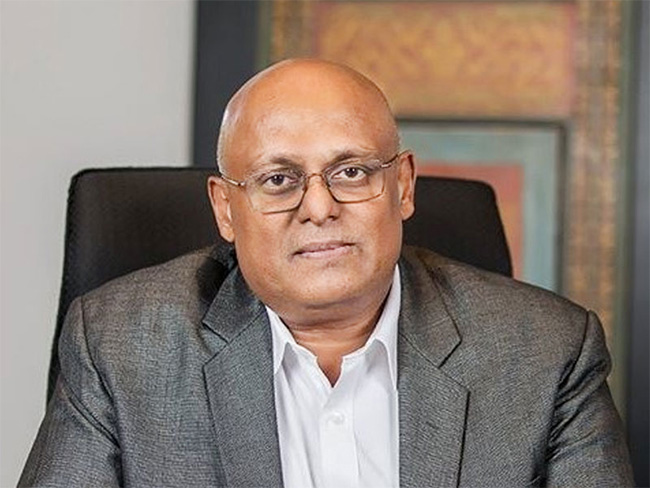
A new legislature would be in place by the middle of this year to restructure 130 State Owned Enterprises (SOE), which would not accommodate any political appointments to their Boards because they will be converted into limited liability companies, Head, State-Owned Enterprises Restructuring Unit (SOERU), Suresh Shah said.
‘At present, out of 130 SOEs in the country, 17 are non- operational but the Boards of directors are still functioning in them. In respect of 85 entities, state intervention is not necessary. These would need to be sold but with regard to the balance; government intervention is needed, Shah said.
Shah made these observations at a recent seminar titled, “Enhancing Efficiency of State Owned Enterprises”, organized by the Organization of Professional Associations of Sri Lanka (OPA). It was attended by a large number of professionals.
Shah said that enhancing efficiency of state owned enterprises is immensely important considering the country’s current economic situation and added that Sri Lanka Telecom, CPC and CEB should be definitely privatized for the betterment of the people of the country.
Shah added: ‘CPC, Sri Lanka Telecom and CEB get guarantees from the Treasury and raise loans from state banks. When those loans cannot be settled, the state banks’ balance sheets are at stake.
‘Therefore, Sri Lanka Telecom and some major parts of the CEB should be privatized to enhance the services being provided to the people of the country. Even CPC should be privatized for the sake of the people who need a better service.
‘SOE entities will be restructured based on nine principles. All appointments to Boards must be done through the Constitutional Council. Politicians should not get involved in appointments.
‘Approximately 85 institutions were identified as being suitable for divestment. Among the challenges that had been identified by the SOE Restructuring Unit were; subsidies, the appointment of unsuitable directors, overstaffing, and circular debt.
‘Consequently, the Unit had come up with a number of recommendations that included, divestment of loss-making or non-strategic SOEs, bringing all such enterprises under the Finance Ministry, while making them limited liability companies.
‘The importance of not “parking” subsidies with state banks should be emphasized. The government should create a better environment to attract investors to the country. Singapore is a fine example of this.
‘Divestiture guidelines would be crafted by the Unit with experts’ ideas and once divested, these entities would be holding companies and profits would be divided as dividends among the owners of the entity, as in listed companies.’
Secretary to the Treasury and the Ministry of Finance Mahinda Siriwardena highlighted that state owned enterprises have both positive and negative impacts on the economy. ‘The government was also implementing institutional reforms to improve the balance sheets of these enterprises. Another key reform was bringing all SOEs under the control of a holding company, he said.
Siriwardana also noted that strict regulations would be brought regarding the appointment of directors. He said reducing the losses in some SOEs is the priority of the government and strict regulations will be brought in future when appointing directors, chairmen etc.




Business
Lanka’s largest solar park set to transform energy landscape and local economy in Hambantota

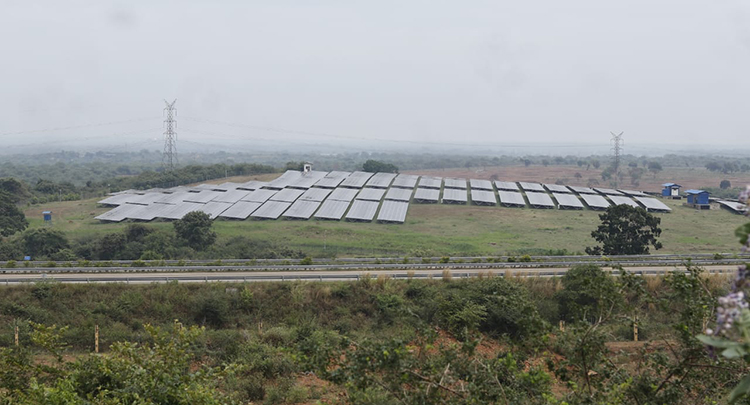
A new era in Sri Lanka’s renewable energy is unfolding in the Gonnoruwa Division of Hambantota District, where construction has begun on the country’s largest solar power park. Spanning 450 acres and designed to generate 150 megawatts (MW) of electricity, the US$150 million private-sector-led project is poised to become a cornerstone of the nation’s sustainable energy ambitions.
Officials say the solar park, guided by the Sustainable Energy Authority and the Mahaweli Authority, will make its first contribution to the national grid by the end of this year, with full capacity expected by 2026. Once completed, the facility will rank among Sri Lanka’s largest renewable energy installations, second only to the 210 MW Victoria Dam and the 150 MW Upper Kotmale hydropower project.
The initiative is being framed as a strategic response to recurring power cuts in the Southern Province during annual drought periods. With a projected 20% contribution to the country’s daytime electricity demand, the solar park is expected to significantly stabilize the grid, reduce reliance on fossil fuels, and contribute to the country’s renewable energy targets.
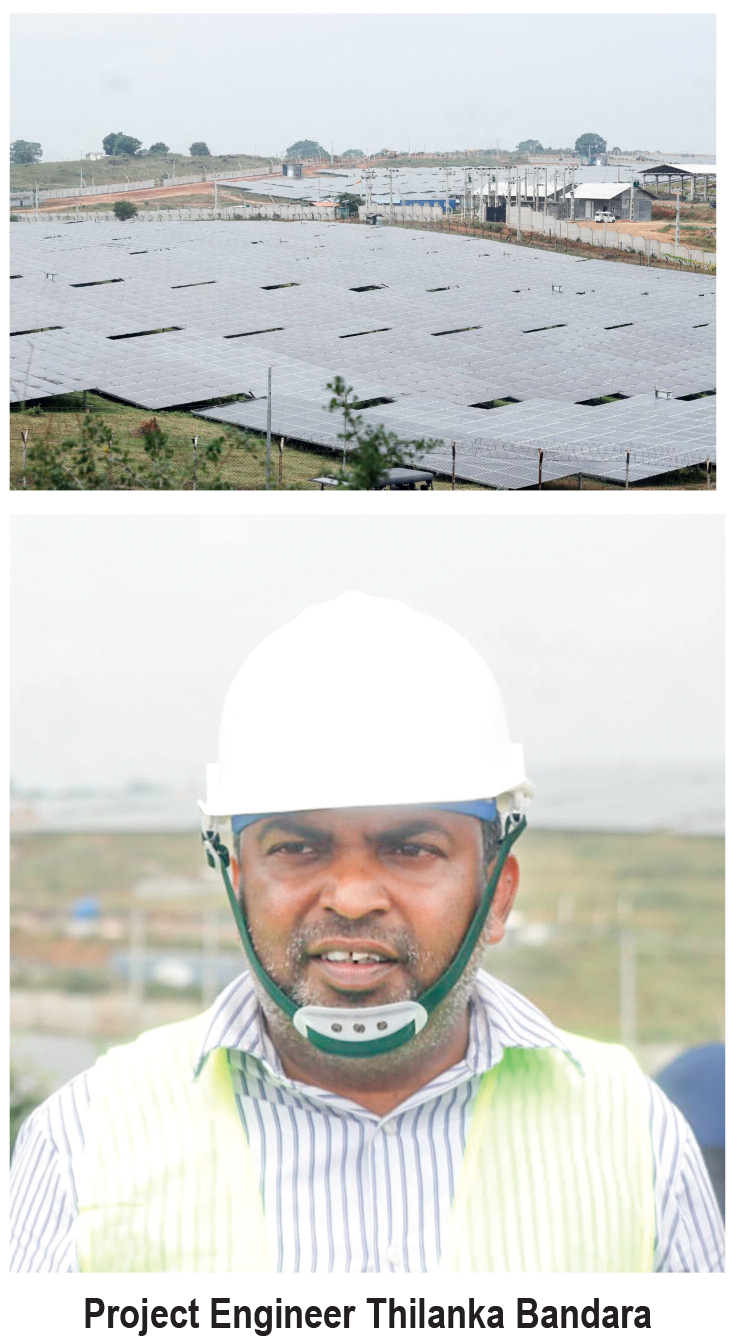
Project Engineer Thilanka Bandara confirmed that preliminary land preparation and boundary works have been completed, with 50 MW already feeding into the national grid. The investment, fully funded through foreign direct investment, local bank loans, and equity capital, requires no government funding. Two private firms are sharing the development, contributing 70 MW and 80 MW respectively.
Bandara highlighted a unique feature of the project: the transmission infrastructure, estimated at US$16 million, is entirely financed by the investors, marking a departure from conventional grid-connected projects. The park will also employ state-of-the-art ground-mounted solar technology, considered the most advanced currently deployed in Sri Lanka.
In a first for Sri Lanka, the solar panels will be installed five feet above the ground, allowing partial-shade crops to be cultivated underneath. Technical Officer Sithmina Bandara explained that this setup will enable the cultivation of food plants such as mushrooms, which thrive in shaded conditions, creating a model for integrated solar-agriculture systems. Agricultural experts have already provided guidance on implementing this initiative, which combines energy production with local food security.
The project is expected to generate 750 to 1,000 direct and indirect jobs, with 400–500 already employed in the initial phase. Long-term maintenance work will provide further employment opportunities, offering a substantial economic boost to the Hambantota region. Environmental management measures are also in place to prevent elephants from entering nearby villages, ensuring harmony between development and wildlife.
All necessary approvals and permits were obtained by February 2025, aligning the project with the Ceylon Electricity Board’s national generation plan. Officials confirmed that upon completion, the total output of the Solar Energy Park will rise to 200 MW, combining existing installations with the new 150 MW facility.
Experts say the Hambantota solar park represents more than just a power generation project. Its innovative design, private-sector financing, and integrated agricultural approach position it as a template for future renewable energy projects in Sri Lanka, reflecting a new model of sustainable development that balances energy, economy, and environment.
By Sirimanta Ratnasekera
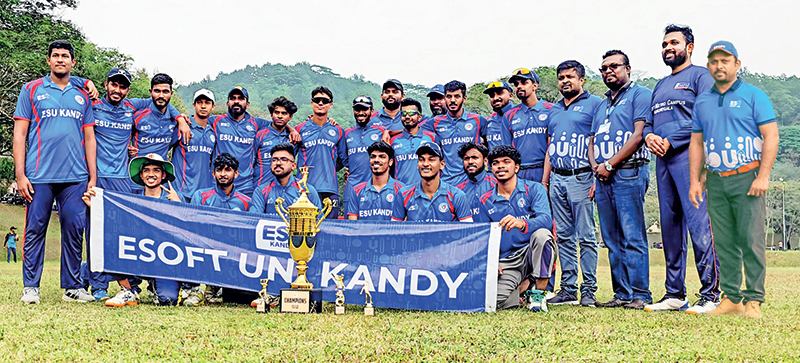
The Battle of Esoftians, an annual cricket encounter organized by ESOFT Uni Kandy, concluded with a spectacular display of cricketing prowess as the Kandy team secured a massive 245-run victory over ESOFT Metro Campus, Kurunegala. The match was held on the 15th at the University of Peradeniya Grounds.
Winning the toss and electing to bat first, the ESOFT Uni Kandy batsmen dominated the field from the outset. They showcased an explosive batting performance, posting a formidable total of 280 runs for the loss of 5 wickets in their allotted 20 overs.
In response, the Kurunegala ESOFT Metro team struggled against a disciplined bowling attack. The Kandy bowlers dismantled the opposition’s batting lineup, bowling them all out for a mere 35 runs, sealing a historic win for the Kandy campus.
The event was graced by the presence of key officials from the ESOFT management: Amila Bandara – Chief Operating Officer (ESOFT Uni), Dimuthu Thammitage – General Manager (Central Region), Lakpriya Weerasinghe – Deputy General Manager, ?Lahiru Diyalagoda
Centre Manager-Degree Division, ESOFT Metro Campus Kurunegala and Dushantha Sandaruwan – Master in Charge (ESU Kandy Cricket Club)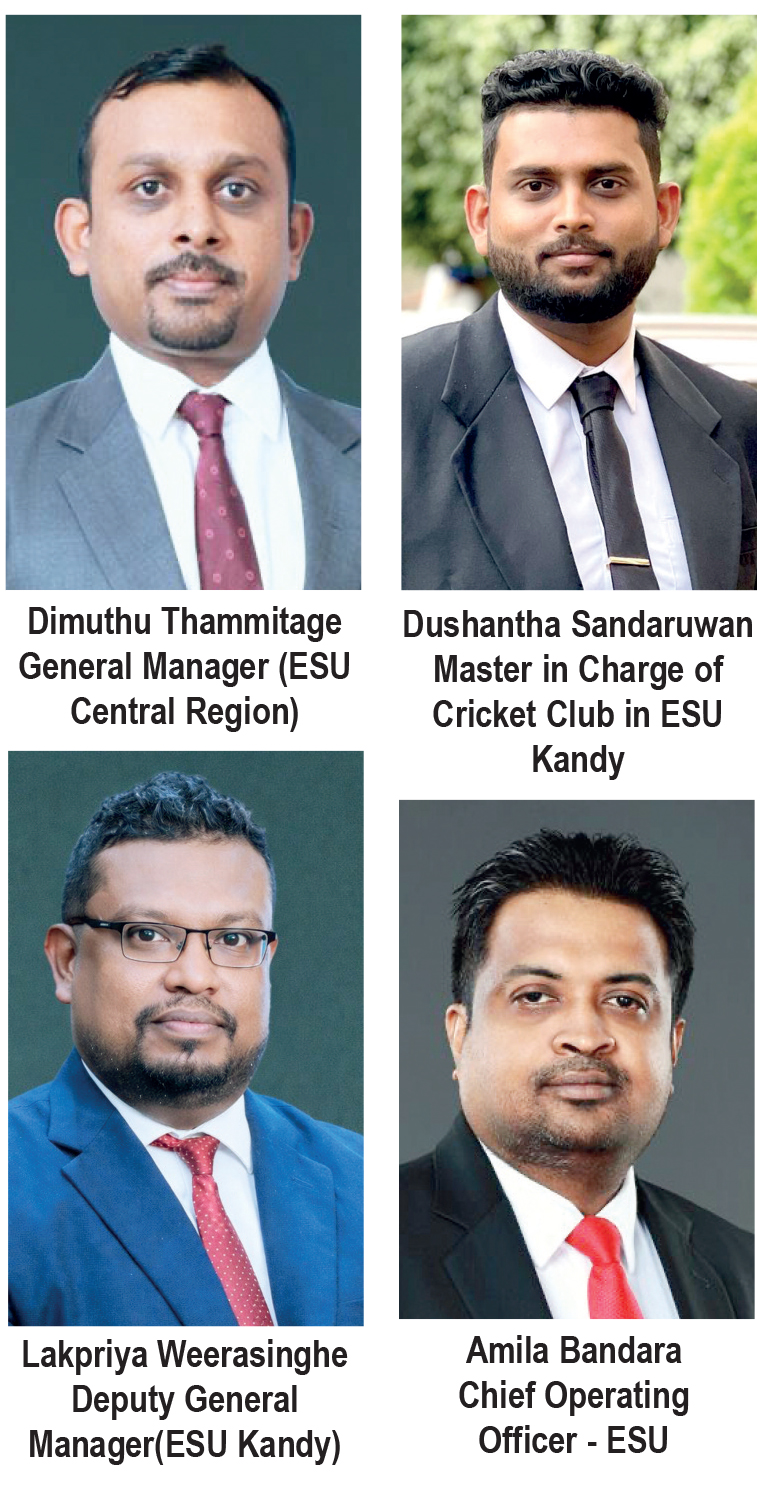
Team Lineups
ESOFT Uni Kandy (Winners)
Chamath Ekanayake (Captain), Dinuka Tennakoon (Vice Captain), Dushantha Sandaruwan (MIC), Chalitha Rathnayake, Pulasthi Bandara, Isuru Dehigama, Kesara Nuragoda, Aadhil Sherif, Isuru Pannala, Achintha Medawatta, Ahamed Shukri, Gowtham Hari Dharshan, Danushka Sahan, Eranda Bandara, and Damith Dissanayake.
ESOFT Metro Campus Kurunegala (Runners-up)
Adeesha Samarasekara, Savishan Madusha, Lahiru Diyalagoda, Hirun Damayantha, Naveen Madushanka, Daham Pothuwewa, Senuda Thewnaka, M.R. Abdulla, Arunodya Dasun, Mohamad Afri, Desith Perera, Lasitha Ranawaka, Anton Dilon, Shenuka Thirantha, and Kavindu Bandara.
Text and Pix By S.K. Samaranayake
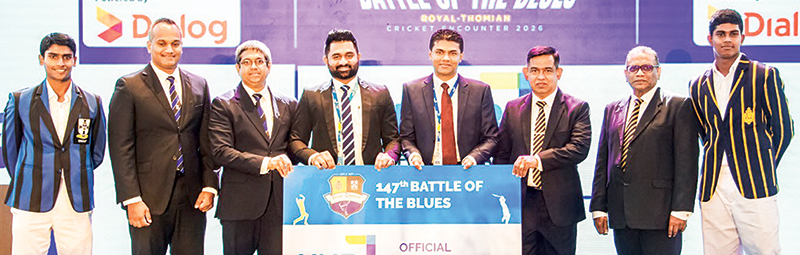
HNB PLC, Sri Lanka’s leading private sector bank, has joined as the Official Banking Partner for the 147th edition of the historic “Battle of the Blues,” the Royal–Thomian cricket encounter between Royal College, Colombo, and S. Thomas’ College, Mt. Lavinia. Commenting on the partnership, HNB’s Managing Director/CEO Damith Pallewatte highlighted the bank’s long-standing connection with cricket, including sponsorship of Sri Lanka’s first Test match against England in 1982, and emphasized HNB’s commitment to nurturing young talent and promoting school cricket. The three-day clash for the Rt. Hon. D. S. Senanayake Memorial Shield will take place from March 12–14 at the SSC Grounds, with the Mustangs Trophy one-day match following on March 28 under lights. HNB’s inaugural involvement marks a milestone in the bank’s sports marketing journey, strengthening its role in the school cricket ecosystem. The bank will enhance the spectator experience by introducing digital and cashless banking solutions, modernizing the event while preserving its rich heritage and sporting tradition.

Advisory for Heavy Rain issued for the Central, Uva, Sabaragamuwa, Eastern and North-central provinces and in Galle and Matara districts

Sri Lanka opt to chase against England in Pallekele

More than 1,500 Venezuelan political prisoners apply for amnesty

Six races, six golds – Klaebo’s historic Olympics

India, South Africa meet in the final before the final

Matara Festival for the Arts’ inaugurated by the Prime Minister

‘Dates have the highest sugar content to fight Coronavirus’

Sunday Island 27 December – Headlines

#SundayIsland 17th December – Headlines

Sunday Island – 28th March

Sunday Island Headlines – 21 March

Sunday Island – 21st February – Headlines
-

 Business6 days ago
Ministry of Brands to launch Sri Lanka’s first off-price retail destination
-
 Features10 hours ago
Why does the state threaten Its people with yet another anti-terror law?
-
 Latest News2 days ago
New Zealand meet familiar opponents Pakistan at spin-friendly Premadasa
-

 Latest News2 days ago
Tariffs ruling is major blow to Trump’s second-term agenda
-

 Latest News2 days ago
ECB push back at Pakistan ‘shadow-ban’ reports ahead of Hundred auction
-
 Features6 days ago
Giants in our backyard: Why Sri Lanka’s Blue Whales matter to the world
-
 Sports3 days ago
Old and new at the SSC, just like Pakistan
-

 News2 days ago
Construction begins on country’s largest solar power project in Hambantota