
Sports
Remembering the country’s first Olympic medallist Duncan White


Duncan White preparing the starting blocks.
BARRIER BREAKERS
During this Olympic year it is pertinent to remember one of country’s greatest athletes Major Duncan White on his 23rd death anniversary (July 3). On his way to success, he had to glide over 10 barriers and not break them!
Duncan White was born on the 1st of March 1918 at Lathpandura a rural village 2km from Baduraliya in the Kalutara District
His early education was at Trinity College Kandy. He was the captain of athletics in 1936 when Trinity College won the John Tarbat Challenge cup and the Jefferson cup for the Relays. White won the 220yds establishing a new record, 120yds Hurdles and the Long Jump. He was a member of the Trinity Rugger team which won the Bradby trophy. He was awarded the Trinity Lion for Athletics
On leaving Trinity College, he joined the Medical Department as a Physical Training Instructor and represented the Department at the Government Services Meet. In 1937 he participated in the National Championships representing Ace Athletic Club he returned a time of 52.0 secs in September and further improved it to 50.4secs the same year. Running in the 440 yds Hurdles event he clocked 56.4 secs. In 1940 he returned a time of 56.0 secs in the 440yds Hurdle event at the National Championships. It took 20 long years to improve the record till Nimal Fernando of the CT & FC returned a time of 55.7 secs. In 1944 running for the Ceylon Army Duncan clocked 22.2 secs for the 200m, which was equalled by W. Wimaladasa of the Army in 1964. D.K Podimahathmaya had the privilege of erasing Duncan’s record of 22.2 by .1 of a second after 24 years.
In 1938 he represented Ceylon at the British Empire Games held in Sydney in 1938. He was the only schoolboy in the team. He represented Ceylon at the first Indo-Ceylon dual meet held in Colombo in 1940 and at the second Indo-Ceylon Meet held in Bangalore. At the first Indo-Ceylon Meet he won gold medals in the 400m and 400m Hurdles events and helped win the two relays. In Bangalore he won a gold medal in the 400m hurdles and won a silver in the 110m hurdles.
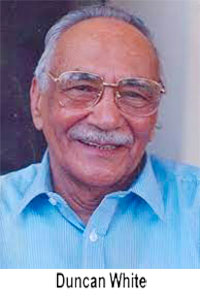 After breaking records in the National arena he turned to the wider International arena. He was a member of the first Ceylon team to an Olympic Games. That was the 1948 London Olympic Games. There was a special significance for Ceylon as it was in the year 1948 that we gained Independence from the British Empire. Duncan White won the silver medal beaten by Roy Cochran of USA by only 7/10th of a second. While Cochran established an Olympic Games Record, Duncan White too bettered the previous record.
On the strength of his performance at the Olympic Games he was awarded a Government Scholarship to follow a course in Physical Education at the prestigious Loughborough College of Physical Education. At Loughborough, he Captained the College for three consecutive years. During his period the College won the British University Athletics Championships.
At the 1950 British Empire Games held in Auckland, New Zealand Duncan White won the gold medal in the 440yds hurdles event with a new British Empire Games Record which was only 3/5th of a second outside the World record.
On completing his studies at Loughborough College he returned to Ceylon in 1951, took up the post of a lecturer at the Training College Maharagama. In 1960 he took up the post of Athletic coach for the schools of the Department of Education with the approval of the then Minister of Education E.A. Nugawela.
He did yeoman’s service to the young athletes of the schools, especially the Central Schools. R.A.C. Hubert of Piliyandala Madya Maha Vidyalaya was one such athlete who did well in the 400m. I am personally aware that he had gone to Gamini Vidyalaya Benthota on three occasions. He also had helped Harris Manikkam at the Christian College Kotte athletic camps. There he had screened his final run in the 400m Hurdles at the 1948 London Olympics. C.W. Pitigala as a sharp student at that time had asked Duncan why he had looked back while fixing the blocks. He had commented on his observant nature and answered. “when I was nailing my starting blocks someone had shouted “Hey Ceylon you are late” So he had turn back and said “shut up” and nailed his blocks. While nailing the blocks he injured his finger. He ignored the injury and concentrated on the event. And the rest was history. It is a good lesson for our young athletes not to get ruffled for the slightest thing at the start of an event.
In 1964, he left for Nigeria to take up the post of Senior Lecturer in Athletics at the University of Ibadu. Later he settled down in Nuneaton, Warwickshire.
Duncan White was awarded the Member of the British Empire (MBE) in 1949 and the Helms World Trophy as the Most Outstanding Athlete in Asia.
Duncan White married Angela Siebel and they had six children Nita, Marilene, Fiona, Daniel, Maxine and Christopher.
His teammates to the British Empire Games held in Auckland New Zealand said that when Duncan White ran the last lap for Sri Lanka in the 4x400m Relay the whole stadium stood up and cheered him because it was a fantastic run. He had overtaken several runners and came fourth. Several officials had asked him why he had not entered for the 400m event.
Late Cyril Gardiner, the then chairman of the prestigious Galle Face Hotel, as a mark of respect to Duncan White adorned his name on a plaque at the entrance to the Galle Face Hotel as a distinguished guest of the Hotel. It was at this Hotel that I had the privilege of meeting the great man on his last visit to Sri Lanka.
In 1991 Major-General Denzil Kobbekaduwa had organized a Peace Relay Run from Vavuniya to Colombo to celebrate the founding of the Duncan White Foundation. When the runners who came to Kurunegala were given T shirts with the Duncan White Logo embossed. One runner while putting on the T shirt had asked another “kawdayako Duncan kiyanne.”
In 1996 the late Luxman Kadirigamar initiated and obtained dual citizenship for Duncan White.
Duncan White was conferred the honour of ‘Deshamanya’ by President Chandrika Bandaranayake Kumaratunga, celebrating the 50th Anniversary of the Silver Medal feat at the London Olympic Games.
K.L.F. Wijedasa
(The writer is a former national record holder of the men’s 100 metres)



After three one-sided, low-scoring encounters, the fourth T20I between India and Sri Lanka exploded into a run-fest in Thiruvananthapuram, with both sides posting their highest totals in women’s T20Is. India’s big score of 221 for 2 proved too much for Sri Lanka, who fell short by 30 runs, handing the hosts a 4-0 series lead with one match remaining. India missed two catching opportunities and a stumping chance, while Sri Lanka gave away three, but the batting dominance was decisive.
Smriti Mandhana and Shafali Verma set the tone with blistering half-centuries to power India’s innings, while Chamari Athapaththu kept Sri Lanka in the chase with a fighting 52. Despite a few late cameo efforts, the visitors couldn’t overcome India’s dominant batting display.
Shafali and Mandhana delivered a masterclass in aggressive opening batting, putting together 162 runs off just 92 balls – the highest opening partnership for India in women’s T20Is. Shafali continued her purple patch with a third successive T20I half-century, while Mandhana, who had managed only 40 runs in the first three matches, roared back to form. The innings also saw Mandhana climb to the top of the charts for most runs (1,703) in women’s internationals in a calendar year, underlining her dominance.
India’s openers were relentless from the outset, racing to 61 without loss in the powerplay with 12 boundaries. Shafali’s innings was built on control and placement – her first six came only after her fifty, a loft over long-off in the 11th over – and she finished with 12 fours and a six.
Mandhana, meanwhile, struck 11 fours and three sixes, though her innings briefly dipped in tempo. After racing to 24 off 14 balls, she moved to 28 off 24 during a short lull before accelerating sharply to reach her half-century off 35 deliveries. From there, she cut loose, using the feet to loft the spinners and driving straight with authority.
The contest decisively tilted in overs 11 to 13, when India tore into the attack. The 11th over went for 15 runs, followed by a 20-run 12th and an 18-run 13th, each featuring two fours and a six. Any hopes Sri Lanka had of restricting the damage vanished as India surged from 85 for no loss to 120 in just two overs.
India brought up 150 in only 14.2 overs, making light of the Sri Lanka captain’s assessment at the toss that 140 would be a competitive total.
Sri Lanka had to wait 92 balls for their first breakthrough and struck again in the following over, the 17th, but any momentum was swiftly snuffed out by Richa Ghosh. With Harleen Deol replacing Jemimah Rodrigues, who was recovering from a mild fever, India promoted Ghosh to No. 3 for the death overs – a move that paid rich dividends. Having faced just one delivery in the series before this match, Ghosh made an impact, blasting 40 off 16 balls and adding an unbroken 53-run stand with Harmanpreet Kaur.
Ghosh announced herself by heaving her second ball over Nimasha Meepage’s head for four. After a relatively quiet 17th over, she found her range against the same bowler, striking two more boundaries. The onslaught peaked against Kavisha Dilhari, one of Sri Lanka’s more experienced bowlers, as Ghosh went into overdrive. She smoked three sixes and a four to plunder 23 runs from the 19th over, punishing anything in her hitting arc and underlining India’s ruthless finish.
Sri Lanka began their chase aggressively, with Hasini Perera taking charge. She tore into Renuka Singh’s first over, hitting three boundaries, while Arundhati Reddy, making a comeback in place of the rested Kranti Gaud, conceded 17 off the second over. By the end of four, Sri Lanka had raced to 52 for 0, with the opening stand between Perera and Athapaththu putting on 59 runs off 34 balls.
Athapaththu struck the chase’s first six, charging down the track and clearing long-off off Deepti Sharma in the third over. Both left-handers punished anything too full or short, though Perera fell in the sixth over, holing out to Harmanpreet at mid-off off Reddy’s offcutter.
Athapaththu kept the momentum going, adding 57 runs off 46 balls with Imesha Dulani for the second wicket. Athapaththu moved from 20 off 15 balls to fifty in the next 19 deliveries, hitting three sixes and as many fours. However, her innings ended when she mistimed a charge over the off side, gifting a catch to Mandhana at long-off off Vaishnavi Sharma. At that stage, Sri Lanka needed 106 runs from 42 balls. Despite a few late cameos, the chase fell short.
On a night dominated by big scores, Vaishnavi emerged as the standout bowler, picking up two crucial wickets for just 24 runs. Introduced into the attack after the powerplay, she began by floating the ball outside off stump to entice the batters before gradually attacking the stumps and testing the left-handers with clever variations.
After dismissing Athapaththu in the 13th over, she also removed Harshitha Samarawickrama for a 13-ball 20 in the 17th, when the batter looked threatening. Her disciplined lines and sharp changes of pace helped India keep Sri Lanka’s scoring in check.
Brief scores:
India Women 221 for 2 in 20 overs (Smriti Mandhana 80, Shafali Verma 79, Richa Ghosh 40*, Harmanpreet Kaur16*; Malsha Shehani 1-32, Nimasha Meepage 1-40) beat Sri Lanka Women 191 for 6 in 20 overs (Chamari Athapaththu 52, Hasini Perera 33, Imesha Dulani 29, Harshitha Samarawickrama 20, Kavisha Dilhari 13, Nilakshika de Silva 23*; Arundhati Reddy 2-42, Vaishnavi Sharma 2-24, Shree Charani 1-46) by 30 runs
(Cricinfo)
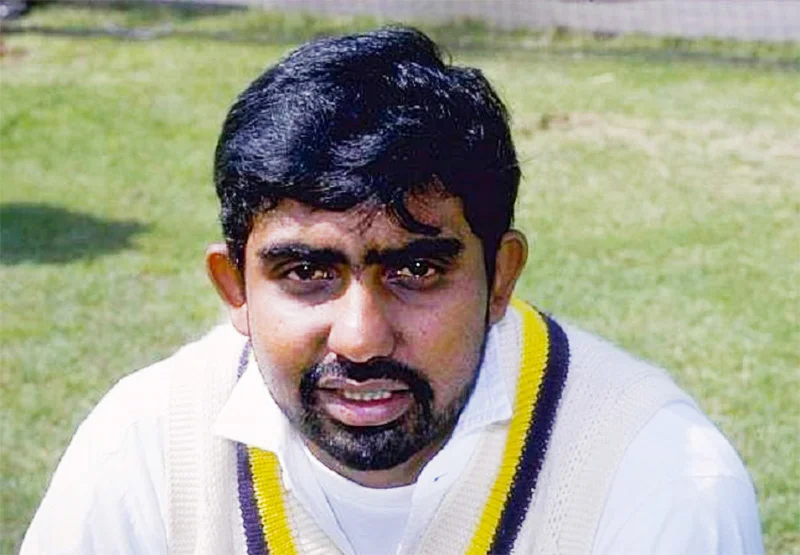
A private function will be held on Monday, December 29 at Melbourne’s Spicy Wicket Restaurant to celebrate Asanka Gurusinha’s iconic Boxing Day century at the MCG, the first and still the only hundred by a Sri Lankan at the grand old ground that staged the game’s inaugural Test and has long been cricket’s festive showpiece in Australia.
Sri Lanka featured in the 1995 Boxing Day Test against Australia at the Melbourne Cricket Ground, a match remembered as much for controversy as for courage. Umpire Darrel Hair repeatedly no-balled Muttiah Muralitharan for throwing in front of a stunned crowd of 55,000, turning the contest into a cauldron.
It was a one-sided affair dominated by Mark Taylor’s Australians. Forced to follow on, Sri Lanka were staring down the barrel before Gurusinha dug in to produce a back-to-the-wall 143. It was the left-hander’s career-best Test score and more importantly helped Sri Lanka avoid the ignominy of an innings defeat.
“Any Test hundred is a moment to remember, but to do it against Australia, facing McDermott, McGrath, Warne and Reifel at the MCG is very special,” Gurusinha told Telecom Asia Sport. “It didn’t sink in 30 years ago, but I know now why it’s special. I always enjoyed batting on pitches with bounce and seam and Australia was a place I loved playing.”
“Coming up against the best team in the world at the time and that formidable bowling attack is something that will stay with me forever,” he added.
Gurusinha also paid tribute to those behind the celebration. “I want to thank my good friends David and Cathy Cruse for organising this event. All my family will be there and it’s great to have Aravinda de Silva as chief guest. I played against him at school level for eight years and then alongside him for 12 years for Sri Lanka. He’s a dear friend.”
Gurusinha made his Test debut in 1985, straight out of school as a 19-year-old wicketkeeper-batter. His sound technique soon demanded promotion and he settled into the No. 3 slot, becoming the side’s human sandbag, valuing his wicket, batting time and wearing down attacks during marathon vigils that tested bowlers’ patience as much as their stamina.
A key member of Sri Lanka’s World Cup-winning squad in 1996, Gurusinha willingly shelved his natural strokeplay to play the anchor’s role, allowing the likes of Sanath Jayasuriya and Aravinda de Silva to cut loose. He struck a vital half-century in the final against Australia, earning praise from captain Arjuna Ranatunga, who famously labelled him the unsung hero of Sri Lanka’s World Cup triumph.
Gurusinha retired prematurely at the age of 30 soon after that World Cup success, migrated to Australia and has since made Melbourne his adopted home, fitting, perhaps, that the city where he played his finest innings will now raise a glass to a knock that has aged like fine wine.
Royal scored a first innings win over Gurukula after they restricted the team from Kelniya to 215 runs in reply to their 302 in the Under 19 Division I Tier ‘A’ match at Reid Avenue on Sunday.
For the home team open bat Hirun Liyanarachchi scored back to back half centuries. He remained unbeaten on 56 in the second innings.
For the visitors Ohas Sadew picked up six wickets.
Scores
Royal 302 for 9 decl. in 80 overs (Hirun Liyanarachchi 50, Dushen Udawela 25, Ramiru Perera 60, Yasindu Dissanayake 41, Thevindu Wewalwala 36, Manuth Disanayake 42, Udantha Gangewatta
22n.o.; Ohas Sadew 6/101) and 130 for 2 in 39 overs (Hirun Liyanarachchi 56n.o., Rehan Peiris 59)
Gurukula
215 all out in 75.2 overs (Sahas Induwara 35, Denura Dimansith 79, Janith Mihiranga 44; Himaru Deshan 2/65, Ramiru Perera 2/58) (RF)

Mandhana, Shafali and Ghosh help India edge run-fest to go 4-0 up

Showers predicted in several provinces today (29th December)

Delay in govt. response to UK sanctions on ex-military chiefs, and others causes concern

Sri Lanka outlines seven key vectors of international cooperation at Moscow forum

Sri Lanka third most preferred destination for Indians

Ondansetron controversy: Health Minister explores interim measures to address growing concerns

‘Dates have the highest sugar content to fight Coronavirus’

Sunday Island 27 December – Headlines

#SundayIsland 17th December – Headlines

Sunday Island – 28th March

Sunday Island Headlines – 21 March

Sunday Island – 21st February – Headlines
-

 News6 days ago
Members of Lankan Community in Washington D.C. donates to ‘Rebuilding Sri Lanka’ Flood Relief Fund
-

 News4 days ago
British MP calls on Foreign Secretary to expand sanction package against ‘Sri Lankan war criminals’
-

 Features6 days ago
General education reforms: What about language and ethnicity?
-
 News6 days ago
Suspension of Indian drug part of cover-up by NMRA: Academy of Health Professionals
-
 Sports4 days ago
Chief selector’s remarks disappointing says Mickey Arthur
-
 News3 days ago
Street vendors banned from Kandy City
-

 Editorial6 days ago
A very sad day for the rule of law
-

 News6 days ago
US Ambassador to Sri Lanka among 29 career diplomats recalled