
Sports
Remembering the country’s first Olympic medallist Duncan White


Duncan White preparing the starting blocks.
BARRIER BREAKERS
During this Olympic year it is pertinent to remember one of country’s greatest athletes Major Duncan White on his 23rd death anniversary (July 3). On his way to success, he had to glide over 10 barriers and not break them!
Duncan White was born on the 1st of March 1918 at Lathpandura a rural village 2km from Baduraliya in the Kalutara District
His early education was at Trinity College Kandy. He was the captain of athletics in 1936 when Trinity College won the John Tarbat Challenge cup and the Jefferson cup for the Relays. White won the 220yds establishing a new record, 120yds Hurdles and the Long Jump. He was a member of the Trinity Rugger team which won the Bradby trophy. He was awarded the Trinity Lion for Athletics
On leaving Trinity College, he joined the Medical Department as a Physical Training Instructor and represented the Department at the Government Services Meet. In 1937 he participated in the National Championships representing Ace Athletic Club he returned a time of 52.0 secs in September and further improved it to 50.4secs the same year. Running in the 440 yds Hurdles event he clocked 56.4 secs. In 1940 he returned a time of 56.0 secs in the 440yds Hurdle event at the National Championships. It took 20 long years to improve the record till Nimal Fernando of the CT & FC returned a time of 55.7 secs. In 1944 running for the Ceylon Army Duncan clocked 22.2 secs for the 200m, which was equalled by W. Wimaladasa of the Army in 1964. D.K Podimahathmaya had the privilege of erasing Duncan’s record of 22.2 by .1 of a second after 24 years.
In 1938 he represented Ceylon at the British Empire Games held in Sydney in 1938. He was the only schoolboy in the team. He represented Ceylon at the first Indo-Ceylon dual meet held in Colombo in 1940 and at the second Indo-Ceylon Meet held in Bangalore. At the first Indo-Ceylon Meet he won gold medals in the 400m and 400m Hurdles events and helped win the two relays. In Bangalore he won a gold medal in the 400m hurdles and won a silver in the 110m hurdles.
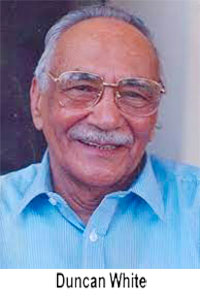 After breaking records in the National arena he turned to the wider International arena. He was a member of the first Ceylon team to an Olympic Games. That was the 1948 London Olympic Games. There was a special significance for Ceylon as it was in the year 1948 that we gained Independence from the British Empire. Duncan White won the silver medal beaten by Roy Cochran of USA by only 7/10th of a second. While Cochran established an Olympic Games Record, Duncan White too bettered the previous record.
On the strength of his performance at the Olympic Games he was awarded a Government Scholarship to follow a course in Physical Education at the prestigious Loughborough College of Physical Education. At Loughborough, he Captained the College for three consecutive years. During his period the College won the British University Athletics Championships.
At the 1950 British Empire Games held in Auckland, New Zealand Duncan White won the gold medal in the 440yds hurdles event with a new British Empire Games Record which was only 3/5th of a second outside the World record.
On completing his studies at Loughborough College he returned to Ceylon in 1951, took up the post of a lecturer at the Training College Maharagama. In 1960 he took up the post of Athletic coach for the schools of the Department of Education with the approval of the then Minister of Education E.A. Nugawela.
He did yeoman’s service to the young athletes of the schools, especially the Central Schools. R.A.C. Hubert of Piliyandala Madya Maha Vidyalaya was one such athlete who did well in the 400m. I am personally aware that he had gone to Gamini Vidyalaya Benthota on three occasions. He also had helped Harris Manikkam at the Christian College Kotte athletic camps. There he had screened his final run in the 400m Hurdles at the 1948 London Olympics. C.W. Pitigala as a sharp student at that time had asked Duncan why he had looked back while fixing the blocks. He had commented on his observant nature and answered. “when I was nailing my starting blocks someone had shouted “Hey Ceylon you are late” So he had turn back and said “shut up” and nailed his blocks. While nailing the blocks he injured his finger. He ignored the injury and concentrated on the event. And the rest was history. It is a good lesson for our young athletes not to get ruffled for the slightest thing at the start of an event.
In 1964, he left for Nigeria to take up the post of Senior Lecturer in Athletics at the University of Ibadu. Later he settled down in Nuneaton, Warwickshire.
Duncan White was awarded the Member of the British Empire (MBE) in 1949 and the Helms World Trophy as the Most Outstanding Athlete in Asia.
Duncan White married Angela Siebel and they had six children Nita, Marilene, Fiona, Daniel, Maxine and Christopher.
His teammates to the British Empire Games held in Auckland New Zealand said that when Duncan White ran the last lap for Sri Lanka in the 4x400m Relay the whole stadium stood up and cheered him because it was a fantastic run. He had overtaken several runners and came fourth. Several officials had asked him why he had not entered for the 400m event.
Late Cyril Gardiner, the then chairman of the prestigious Galle Face Hotel, as a mark of respect to Duncan White adorned his name on a plaque at the entrance to the Galle Face Hotel as a distinguished guest of the Hotel. It was at this Hotel that I had the privilege of meeting the great man on his last visit to Sri Lanka.
In 1991 Major-General Denzil Kobbekaduwa had organized a Peace Relay Run from Vavuniya to Colombo to celebrate the founding of the Duncan White Foundation. When the runners who came to Kurunegala were given T shirts with the Duncan White Logo embossed. One runner while putting on the T shirt had asked another “kawdayako Duncan kiyanne.”
In 1996 the late Luxman Kadirigamar initiated and obtained dual citizenship for Duncan White.
Duncan White was conferred the honour of ‘Deshamanya’ by President Chandrika Bandaranayake Kumaratunga, celebrating the 50th Anniversary of the Silver Medal feat at the London Olympic Games.
K.L.F. Wijedasa
(The writer is a former national record holder of the men’s 100 metres)



by Reemus Fernando
Vetum Chandul de Zoysa of Galewela Central hogged the limelight on the opening day of the All Island School Games Athletics Championship as he shattered one of Rumesh Tharanga’s longstanding meet records on Friday.
Chandul, who is trained by his parents, both physical education instructors, improved Rumesh Tharanga’s 2017 record twice during the event.
He first shattered the record when he cleared 55.67 metres in his third attempt to enter the best eight as the leader.
Then he further improved the record with a performance of 55.83 metres.
Tharanga’s record of 55.58 metres stood unshaken since 2017.
Current world leader in the javelin throw, Rumesh Tharanga took part in both the javelin and discus throw when he was attending St. Peter’s College.
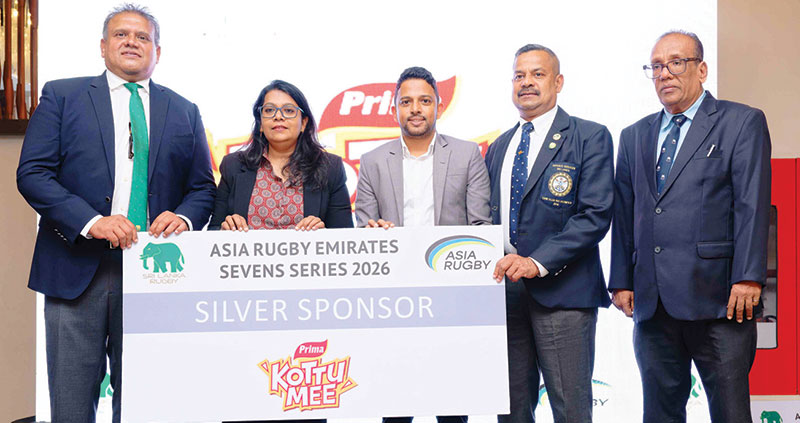
Prima KottuMee has come on board as the Silver Sponsor of the Asia Rugby Emirates Sevens Series 2026, throwing its weight behind Sri Lankan rugby as the national team prepares to take on the region’s best.
The prestigious tournament will reach its climax in Colombo on 17 and 18 October, giving local rugby enthusiasts an opportunity to witness some of Asia’s finest talent in action on home soil.
The 2026 edition features 24 national teams, with 12 sides each competing in the men’s and women’s categories, promising two days of fiercely contested rugby.
Prima KottuMee has been a longstanding supporter of Sri Lankan rugby, extending its backing to the sport at school, club and national levels.
Over the years, the brand has played an active role in supporting players, teams and tournaments, contributing to the development and promotion of rugby across the country.
With Colombo set to host the final leg of the series, Prima KottuMee hopes to add further momentum to the occasion while reaffirming its commitment to nurturing local sporting talent.

by Rex Clementine
The long awaited overhaul of Sri Lanka Cricket has reached a decisive stage, with the Supreme Court set to play a pivotal role next week in determining the fate of the proposed new constitution.
For months, legal experts have been burning the midnight oil, working on sweeping reforms aimed at dragging cricket administration into the modern era and bringing its governance structure into line with international standards. The draft constitution was presented to Parliament and following days of debate, received the legislature’s initial nod. The matter is now before the Supreme Court, where interested parties have been given an opportunity to raise objections.
A lawyer and former cricket board chief Thilanga Sumathipala have so far filed objections. The judges will examine whether these challenges have merit and more importantly, whether the proposed constitution is compatible with the law of the land.
One contentious provision that has raised eyebrows among key stakeholders is the proposal to strip District Cricket Associations of their voting rights.
October 20 is the deadline for submitting objections. The court will then fix dates for arguments, following which the judges are expected to communicate their determination to the Speaker of Parliament within 48 to 72 hours.
Parliament will subsequently have to complete the remaining legislative formalities before the new constitution can become law, potentially drawing the curtain on decades of mediocrity, mismanagement and administrative wrangling in cricket administration.
More objections had been anticipated from those who have called the shots at Maitland Place in recent years. Although several expressed reservations behind closed doors, few have shown any appetite for a courtroom battle.
There is a delicious irony here. When these gentlemen were running Sri Lanka Cricket, they would dash to Hulftsdorp at the drop of a hat, seeking judicial intervention even if a reporter called them ‘misfits’. Now, with the very structure that sustained them facing the axe, they appear to have developed a sudden case of cold feet.
The proposed constitution promises greater transparency in the running of the cash rich cricket board. Equally important is the emphasis on efficiency and professionalism, with suitably qualified individuals expected to occupy key administrative positions rather than appointments being dictated by friendships, club loyalties or reputations earned on the cricket field.
The Sunday Island learns that the Attorney General’s Department has been providing legal advice and expertise to the Cricket Transformation Committee from the outset.
Former ICC legal officer David Becker was also brought on board to lend his expertise to the drafting of the new constitution.
For years, successive governments have been reluctant to confront the cricket establishment, despite mounting public pressure for meaningful reform. Administrators survived one controversy after another, even weathering a unanimous parliamentary resolution calling for their removal following the national team’s disastrous performances.
Their survival owed much to their connections in the corridors of power. Whenever their positions came under serious threat, the spectre of Sri Lanka losing its ICC membership was raised, effectively holding the country’s cricketing future to ransom.
This time, however, the familiar manoeuvres have been conspicuous by their absence.
President Anura Kumara Dissanayake recognised the depth of public dissatisfaction with cricket administration and opted for a different approach. Rather than installing a political loyalist, as has so often been the practice when filling influential positions, he entrusted the responsibility to Eran Wickramaratne, a figure from the opposition political camp.
A former first-class cricketer and banker, Wickramaratne brought financial expertise to an institution where fiscal discipline had long been a subject of concern.
AKD also enlisted the services of three respected former cricketers; Kumar Sangakkara, Roshan Mahanama and Sidath Wettimuny, to help steer Sri Lankan cricket through a difficult period.
It is said that members of the Cricket Transformation Committee, despite hailing largely from the Colombo and Kandy elite, have been so impressed by President AKD’s vision and his hands off approach to cricket administration that they are now inclined to cast their votes for the NPP at the next election. That, if true, would be quite a political transformation in its own right.
The results on the field have not arrived as quickly as supporters would have wished. Sri Lanka’s performances remain a source of frustration and there is still a mountain to climb before the national team can regain its standing among the game’s elite.
But one significant change is already evident. Those entrusted with the responsibility of putting cricket back on its feet have sent an unmistakable message: no individual, however celebrated or influential, is bigger than the game.
Even the superstars are beginning to fall in line.
That, in itself, is no small achievement in a cricketing culture where reputations have too often carried more weight than results.
The real test, of course, lies ahead. A new constitution alone will not produce world class cricketers or restore Sri Lanka to its former glory. But sound administration is the foundation on which lasting success must be built.
After years of false starts, broken promises and endless power struggles, Sri Lankan cricket finally has an opportunity to turn the page.

Record 1,600 students take Russian Classical Ballet examination in Sri Lanka

Half a million people join protests in France, but some turn violent

Deadly fire breaks out at Canada military base

Showers or thundershowers will occur in most parts of the island after 1.00 p.m.

Buddhist hierarchy demands prison perks for monk convicts

Debate on NCM against Speaker postponed indefinitely

‘Dates have the highest sugar content to fight Coronavirus’

Sunday Island 27 December – Headlines

#SundayIsland 17th December – Headlines

Sunday Island – 28th March

Sunday Island Headlines – 21 March

Sunday Island – 21st February – Headlines
-

 Latest News5 days ago
Nissanka’s return headlines Sri Lanka’s Test squad against Pakistan
-

 Latest News6 days ago
Farhan and Sadaqat help Pakistan seal series in style
-

 Features6 days ago
Intake 16: 45 years of duty and honour
-
 News6 days ago
Malwathu Chapter issues statement on talks with President over Gnanasara Thera’s robes
-
 News6 days ago
CP alleges NPP has taken the blame for illegal US sanctions on Iranian vessels
-

 Opinion6 days ago
How long can Sri Lanka remain silent on its demographic crisis?
-

 News4 days ago
Sri Lanka, India caught in US-Iran ship crisis
-
 Latest News4 days ago
Kusal Mendis’ unbeaten 87 hands Sri Lanka consolation win