UN Security Council support cannot be mustered for anti-SL move
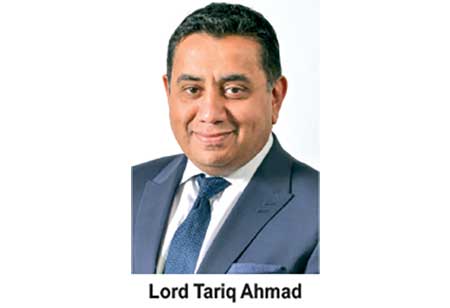
Minister of State for South Asia and the Commonwealth Lord Tariq Ahmad of Wimbeldon has told the UK-based pro-LTTE groups that the International Criminal Court (ICC) has no jurisdiction to investigate Sri Lanka. The ICC could only do so if Sri Lanka accepted its jurisidiction, or if the UN Security Council adopts a resolution to refer Sri Lanka to the ICC.
The UK didn not think such a step would have sufficient support among Security Council members and it would not help accountability in Sri Lanka for an ICC referral to fail to win Security Council support or be vetoed, Lord Ahmad said.
Ahmad is also the Prime Minister’s Special Representative on Preventing Sexual Violence in Conflict.
The following is the full text of Lord Ahmad’s letter to the pro-LTTE groups:
“Thank you for your correspondence of 1 March and petition regarding the UK’s approach to Sri Lanka at the 46th UN Human Rights Council (UNHRC), and for recommending amendments to the draft resolution.
“I recognise the points you have raised, and understand that achieving justice, peace and accountability is a priority for all Sri Lankans affected by the conflict. Please be assured that this is a long standing priority for the UK, and that we regularly raise the importance of justice and accountability with the government of Sri Lanka, both privately and publicly.
“We have highlighted our concerns about the lack of progress towards accountability and the wider human rights situation, including in our statements to the UNHRC in February, June and September 2020. As Minister of State for South Asia and Minister responsible for Human Rights, I set out our serious concerns about human rights in Sri Lanka in a statement at the UN Human Rights Council on 25 February.
“I have also raised the importance of accountability, justice and reconciliation on several occasions with the Sri Lankan High Commissioner and Sri Lankan Foreign Minister Dinesh Gunawardena, most recently during calls on 12 February and 22 January respectively.
“We will continue to press for a strong role for the UNHRC to help deliver accountability and reconciliation and ensure the protection of human rights in Sri Lanka. The UK is working hard to build support for the new resolution on Sri Lanka. The resolution will provide a continued framework for international engagement on human rights in Sri Lanka, and will highlight our serious concerns about the situation, including those detailed in the recent report of the Office of the High Commissioner for Human Rights (OHCHR).
“It will call on the government of Sri Lanka to make progress on accountability and human rights, and will stress the importance of a comprehensive accountability process for all violations and abuses committed in Sri Lanka. It will keep Sri Lanka firmly on the UNHRC agenda and will request continued and enhanced OHCHR reporting on the human rights situation and on accountability. Importantly, it will also strengthen the capacity of OHCHR to consolidate, preserve and analyse information and evidence to support future accountability processes.
“I take note of your request to make amendments to the draft resolution. We believe the resolution the UK has presented to the UNHRC is an ambitious one that can pass in the face of challenging UNHRC dynamics. Voting members of the Council change every year, and current voting members are not the same as those who voted on previous resolutions.
“The 2021 composition is particularly challenging for consideration of country resolutions. The risk of losing a vote is very serious, and tabling an unwinnable resolution would likely result in the end of any accountability process and would be a crushing blow to the victims and all those who have fought for justice and accountability. A failed resolution would also see Sri Lanka removed from the agenda of the UNHRC, making it more difficult to draw international attention to the human rights concerns identified in the recent report by OHCHR. While we will continue to consider amendments to our resolution during the course of negotiations, we strongly believe that it is the best way of achieving accountability and justice for all those affected by the conflict.
“In your email, you ask that Sri Lanka is referred to the International Criminal Court (ICC). Sri Lanka is not a party to the Rome Statute which established the ICC. As a result, the ICC has no jurisdiction to investigate Sri Lanka. It could only do so if Sri Lanka accepts the jurisdiction of the ICC, or if the UN Security Council refers Sri Lanka to the ICC through a resolution. We do not judge that this step would have sufficient support among Security Council members. Moreover, it would not help accountability in Sri Lanka for an ICC referral to fail to win Security Council support or be vetoed.
“In regards to establishing an International Independent Investigative Mechanism, we agree on the importance of preserving information and evidence gathered so far. Our draft resolution therefore requests OHCHR to consolidate, analyse and preserve this information so it can be used in future accountability processes. This will build on the work of previous resolutions, including the 2014 resolution which mandated a comprehensive OHCHR Investigation on Sri Lanka (OISL).
“On the question of appointing a Special Rapporteur, we do not believe this would prove beneficial in the current circumstances since, at present, the High Commissioner for Human Rights is herself at the forefront of the UN’s efforts. Our draft resolution will request enhanced reporting by OHCHR to ensure that both the UN and the Human Rights Council remain focused on the situation in Sri Lanka.
“On the question of a referendum to determine the aspirations of the Tamil people, we recognise your strength of feeling on this matter. The UK Government has long supported peace building and reconciliation in Sri Lanka, and called for the rights of all Sri Lankans to be respected. Through UK-funded programmes, we have supported a number of activities to benefit those in the north and east of the country, including demining, resettlement of internally displaced persons and interfaith dialogue. We continue to urge the Government of Sri Lanka to deliver on reconciliation and political inclusion for all Sri Lankans. However, we do not think it is realistic to include a reference to a referendum on Tamil self-determination in the draft UNHRC resolution. Please be assured that justice, accountability and human rights in Sri Lanka will remain a priority for the UK government.”