
Life style
Rasai ! Top Sri Lanka Food and Drink Experiences


by Tim Russell
“Rasai” is Sinhalese for “delicious”, and if you’ve spent any time in Sri Lanka it’s no doubt a word you’ve heard a lot, for Sri Lankan cuisine is one of Asia’s most underrated.
Sri Lankan food is spicy, robust, filling and very, very tasty, whether you’re eating at an upscale restaurant like Colombo’s famous Curry Club, or stopping at one of the countless street stalls for a snack.
And Sri Lankans love a drink too! The country’s tea is world-famous, and you’ll also find fresh juice bars on practically every street. In the evening, bottles of the country’s famous liquor – arrack – are cracked open, and consumed neat, with soda or in cocktails, along with the local Lion Beer.
At Khiri we’ve scoured the country to find the best ways to introduce your clients to the best food and drink Sri Lanka has to offer, so here are our favourite Sri Lanka food & drink experiences…
Colombo Food and Drink Tours
Colombo, Sri Lanka’s capital, is an increasingly modern city but one that is still very much in touch with its heritage, with new skyscrapers towering over tastefully refurbished colonial buildings, and a street food culture that remains vibrant and traditional.
Khiri offers several food/drink-related tours including the Foodie Tour (an evening street food tour), Colombo Behind the Scenes, and the Arrack Adventure, where you can discover – and taste – the country’s local liquor.

My time in Colombo was limited so I did a combination of all three. My tour started at a Tamil restaurant where I tasted various Tamil delicacies including ghee roti accompanied by a fiery seeni sambal (onions, sugar and chilli), followed by snacks at a Muslim street food joint, before we moved onto classier surroundings with arrack cocktails at the stunning Galle Face Hotel.
We then had some street snacks down by the beach including isso vade (small shrimp cakes) and the ubiquitous kottu roti (a mix of chopped roti bread, chicken, vegetables and curry sauce). We then tried the egg hoppers (and more arrack) at the Curry Club, before rounding off the evening at a traditional Sri Lankan dive bar, for more arrack!
This is an excellent experience that really gives travelers a quick primer into the kind of dishes that they’ll encounter during their trip, and also a really fun way to learn more about the culture and history of Sri Lanka’s capital.
Markets of Sri Lanka
Like most Asians, Sri Lankans still do most of their shopping at fresh markets and every town has at least one bustling marketplace selling all manner of weird and wonderful fruit, veg, seafood and meat. They’re a great place to learn about local ingredients, chat to the friendly locals, and stop for a snack and a cup of Ceylon tea.
My personal favourite was Pettah Market in Colombo – less a market and more a maze of streets selling pretty much everything including food, electronics, clothing, shoes and much more besides. I could easily have spent hours trawling these streets and watching the apparent chaos unfold, especially in the wholesale fruit and veg district, a riot of trucks, porters and flying watermelons!
Kandy’s central market is also well worth a visit, especially the chaotic, yellow-walled vegetable hall which is a photographer’s dream, and the spice stalls selling dozens of different spices packed into plastic tubes.
And finally there’s Dambulla vegetable market, a huge wholesale market where growers from all over Sri Lanka come to sell their wares to the resident traders – expect lots of haggling, shouting and friendly smiles, and don’t miss the tea and spicy samosas at the workers’ cafe.

Old woman picking tea on a traditional plantation
A Sustainable Tea Plantation
Sri Lanka’s tea is world famous. Ever since the British introduced tea plantations in the 19th century, Ceylon tea has been a byword for quality. These days however, the industry is struggling. Outflanked by high-tech tea plantations in Japan and lower labour costs in Kenya and China, Sri Lankan tea is no longer as competitive as it was on the global market and the country has slipped to third place in the list of world tea exporters.
Add the fact that tea picking is a hard, unglamorous and poorly-paid job (on most traditional plantations pickers earn around $3 per day for picking 22kg of leaves), which makes it less appealing to younger Sri Lankans, and you have an industry that is in trouble.
So increasingly, growers are starting to realize that quality, rather than quantity is the way forward, and one such company is Amba, situated in the hills near the town of Ella. Amba specialises in high quality craft teas, hand-picked by tea ‘artisans’, who are responsible for their leaves from picking to drying. They are paid well, don’t have daily quotas to meet, are given protective clothing from the sun and rain, and are the way forward for the industry.
Watching them work there’s a clear difference from the traditional workers I encountered by the roadside – whereas the old model is to pick as many leaves as you can, Amba’s pickers take their time, sometimes going maybe half a minute without picking a single leaf – unthinkable on one of the old plantations.
The company exports its tea to high-end sellers worldwide (including London’s famous Fortnum & Mason), and offers tours of its facilities to visitors, finishing with a tasting of their different brews. A great way to learn about the history – and more importantly the future – of what is still Sri Lanka’s biggest export.
Discovering Buffalo Curd
The name ‘buffalo curd’ may not sound particularly appealing, but it is by far Sri Lanka’s most popular dessert and you will see covered clay pots of the stuff for sale along the roadside all over the country. It tastes just like natural yogurt, and is traditionally served with coconut syrup to sweeten it. Spend any time in Sri Lanka and you’ll quickly get a taste for it, whether at breakfast or as a dessert – and it’s fascinating to see how it’s made.
One of our newest experiences takes place in the village of Tissa near Yala. My day began with the sunrise as we arrived at a small buffalo farm near the lake to watch the whole process from start to finish. Mr Jinadasa, the grandfather of the family, is up early to milk the buffalo – he was particularly busy on the day I visited as there were several younger buffalo there which meant the mothers were producing more milk than usual, and the family were thus able to make a dozen pots of curd instead of the usual five or six.
Jinadasa’s wife and daughter then take turns to heat the milk to separate the curd. This is the hardest job of the lot as the milk is boiled over a wood fire in a poorly ventilated room – I could only stand the smoke for a couple of minutes! The curd is then poured into clay pots to set before being taken to sell by the roadside, earning the family a few dollars per day. Your clients’ visit helps support them in an economic climate where costs are rising dramatically but their income isn’t keeping pace.
The clay pots in which the curd is sold are unglazed so can only be used for food storage once – Sri Lankans then use them as flowerpots, building material or simply as ornaments and they can be seen in nearly every garden!
The tour continues with a simple breakfast – including some curd of course – before a visit to a local pottery to watch the pots being made and dried before being sold to the area’s buffalo farms.
Sri Lankan Family Dinner in Galle
Eating in restaurants or at street food stalls is great, but to find out how local people really live you can’t beat visiting a local family home and eating at their table, and that’s exactly what I did during my stay in Galle.
Our hostess Natasha and her husband Navi – a respected local hotel chef – welcomed us to their home in Galle where we began with arrack and passion fruit Mojitos and a game of carrom (one of Sri Lanka’s national sports – they were 2018 world cup winners!), before being presented with a table groaning with shrimp curry, grilled fish, salads, vegetable curries, and of course the ever-present dhal curry and rice.
In traditional Sri Lankan fashion the family didn’t actually eat with us – they sat and nervously watched us eat to make extra sure we were happy with the food, which of course we were as it was absolutely delicious. We finished with fresh fruit and some watalappan (a kind of custard made from coconut and cardamom) before heading home very full and very happy. It was a great way to spend my last full night in Sri Lanka and a fascinating insight into local home life.
Tim Russell joined the Khiri Core team in 2022, bringing decades of experience in the tourism industry into his role as Group Marketing Manager. Before moving to Bangkok in 2012 – where he now lives with his wife and their three rescue dogs – Tim spent almost ten years in Vietnam. When he is not overseeing Khiri’s marketing efforts, Tim can be found indulging in his passions for photography, live music, and street food. – Khiri Travel


Anita Sharma is a psychologist, who approaches the human mind with equal measures of empathy and insight. Known for her calm presence and thoughtful perspectives, she works closely with individuals navigating anxiety, relationship, trauma and the quiet emotional struggles that often go unseen. With experience working with individuals, couples and families, she has built a reputation for helping people navigate emotional challenges with clarity. Compassion and confidence. Anita Sharma stands as a reassuring voice bridging science, sensitivity and cultural understanding.
What inspired you to pursue a career in psychology?
I was inspired to pursue a career in psychology because I have always been curious about how people think and behave, especially when observing the world around us today. With so much happening in society, I often found myself wondering why people responded differently to similar situations and what influenced their choices, emotions, and behaviours. Psychology allows me to explore these questions on a deeper level and understand how factors like the environment, experiences, and social pressures shape a person’s behaviour. This interest motivated me to want to better understand others and eventually use that knowledge to make a positive impact.
How has your journey been as a psychologist? Have you faced unique challenges?
My journey as a woman in this field has required a lot of resilience and self-belief. In a world that is not always kind, there have been moments where certain spaces felt intimidating, but I chose to turn those experiences into strength rather than allow it to limit me. Instead of shrinking myself, I learned to speak up and trust my inner voice. These challenges have shaped my confidence, sharpened my perspective, and reinforced my commitment to the field.
What areas of psychology Do you specialise in and why did you choose them?
I specialize in counselling, focusing on people experiencing depression and anxiety, as well as adolescents, couples, and individuals recovering from surgery. I chose this area because I’m passionate about helping people go through life’s challenges. Supporting adolescents allows me to guide young people through critical stages of growth, counselling couples strengthens relationships, and working with individual’s post-surgery helps them cope emotionally and adjust to major life changes. Overall, this field lets me make a meaningful impact on people’s mental and emotional well-being.
How Do you approach therapy or counselling with clients facing anxiety or depression or trauma?
When working with clients facing anxiety, depression, or trauma, I approach therapy with empathy and patience. I start by creating a safe, non-judgmental space where clients feel heard and understood. I focus on understanding their experiences, thoughts, and feelings, and together we identify coping strategies and goals that are realistic and meaningful for them.
In your opinion, what are the most promising mental health challenges facing women and men?
In my opinion, some of the most pressing mental health challenges today revolve around stress, anxiety, depression, and the pressures of balancing personal and professional life. For women in particular, societal expectations, gender bias, and body image pressures can take a significant toll. Women are often expected to excel at work, manage family responsibilities, maintain social roles, and meet certain standards of weight and beauty appearances. Society frequently makes remarks or judgments about women’s bodies and looks, which lowers their self-esteem. Men also face challenges, like societal pressure to suppress emotions, which can lead to untreated stress or depression. Addressing these challenges requires awareness, supportive environments, and access to mental health resources
What role do you think society can play in reducing stigma around therapy and counselling?
Society plays a crucial role in reducing the stigma around therapy and counselling. By openly talking about mental health, sharing personal experiences, and normalizing seeking support, we can challenge the idea that needing help is a sign of weakness. Media, workplaces, schools, and communities all have a part to play in creating safe, supportive environments where people feel comfortable accessing mental health care. Education and awareness campaigns can also help people understand that therapy isn’t just for crises
Psychology can be emotionally demanding. How do you maintain your own mental health and balance work like pressures?
Psychology can definitely be emotionally demanding and it’s not a field that is suited for everyone. Maintaining my own mental health is a priority. I make a deliberate effort to detach from work at the end of the day, which allows me to process my own emotions and recharge. I also practice regular self-care, such as meditation, listening to music, and spending time with my family. Seeking supervision and peer support helps me gain perspective on challenging cases, ensuring I don’t carry that emotional weight alone
Would you say has been your most rewarding experience as a Psychologist?
Looking back, the most rewarding part of my work in psychology is hearing a client say, ‘I feel so much better after speaking to you.’ In those moments, I’m reminded that simply being present, listening without judgment, and offering support can truly make a difference in someone’s life. Knowing that I’ve helped someone feel lighter, more understood, or more hopeful is incredibly fulfilling and just reinforces why I chose this profession.
Where privacy and social perceptions matter greatly. How do you help individuals feel safe and comfortable seeking psychological support?
In a close-knit society where privacy and social perceptions are deeply valued, some women face pressures from traditional family expectations, including arranged marriages and strict cultural norms. To help them feel safe seeking psychological support, I focus on creating a space built on trust and understanding. For many, it’s the first time they can truly voice their thoughts and emotions, and helping them express themselves is incredibly empowering. By being sensitive to their cultural and societal context, I guide them towards confidence, emotional relief, and the belief that their feelings matter.
Ultimately, I hope this helps people understand the importance of mental wellbeing and seeking support when needed. I believe that at some stage, everyone can benefit from counselling. It’s not just for when you face a problem, seeking support can help you understand yourself better, manage challenges, and grow stronger. Life is always changing and nothing stays the same forever. By taking steps to care for our minds, we can move forward with clarity, courage, and a sense of inner balance, trusting that even difficult moments will pass.
By Zanita Careem ✍️

Tranquil and tropical with a rugged beauty and temperate climate, Sri Lanka’s south coast is blessed with a naturally restorative environment. On a rocky outcrop overlooking a secluded cove of golden sand, Anantara Peace Haven Tangalle Resort harnesses the nurturing qualities of its shoreline home to create a sophisticated oasis of soothing and renewal.
Entering its second decade, the resort has announced a fresh expansion of its Anantara Spa menu, enriching an already extensive range of traditional and modern therapies. Anantara Peace Haven Tangalle Resort now hosts the region’s only spa overseen by three resident Ayurveda doctors. Led by Head Ayurvedic DoctorBhagya Wellapilli, these qualified medical officers work alongside accomplished practitioners in immaculate facilities, ensuring authentic and effective experiences, delivered by the safest hands.
In addition to enhancing its wellness team, the resort has also launched the pioneering Ayurvedic beauty sanctuary, Ayu Lavanaya. Named from the Sanskrit words Ayu (life) and Lavanaya (grace), the sanctuary is a modern reimagination of a quintessential Ayurvedic parlour. It aligns physical care with deeper wellbeing through timeless rituals and ancient wisdom. Offered in a new space within the lush, floral environs of Anantara Spa, each meditative treatment at Ayu Lavanaya is formulated for immediate results and long-lasting benefits.
Signature therapies complement a full menu of Ayurvedic manicures, pedicures and eye rituals. The brightening and firming Kumkumadi Royal Facial uses the esteemed Kumkumadi oil to leave skin supple and luminous. The Kesha Revive Hair Ritual pairs a lime and onion extract head massage with warm triphala therapy to relieve tension, fortify roots and boost scalp health. The 120-minute Prana Radiance Ritual detoxifies the senses and rejuvenates vital energies through carefully crafted steps that promote release, balance and renewal. Also available are Abhyanga massages, Pizhichil Kerala-style oil baths, Sweda thermal infusions and more.
Beyond Ayurveda, the award-winning Anantara Spa has also introduced four specially curated aromatic massages, showcasing the sensory potency of the island’s indigenous ingredients. Melt away stress and tension with a Four Hand Massage in which two skilled therapists work in perfect synchronicity to induce profound relaxation. Invoking the natural healing of the ocean, a unique Seashell Massage releases muscles and improves circulation by moving polished shells in graceful, flowing strokes across the body.
Age is no barrier to bliss at Anantara Spa with tailored 30-minute Kids’ Massages for ages four to 12. Using light pressure and natural coconut oils, these gentle treatments support healthy care for growing bodies. For mums-to-be, a 60-minute Pregnancy Massage eases the back, neck, and shoulders, reducing swelling and assisting sleep to boost comfort for mother and baby throughout their shared journey.
Yoga sessions by the sea, a state-of-the-art fitness centre, and nutrient-rich menus augment all therapies and treatments, maximising every benefit and laying the foundation for long-term vitality. For more intensive healing, five-day programmes focus on inner harmony, deep sleep, natural weight management, or holistic detox and rebuilding.
“Since our doors opened, we have been honoured to continue and grow Sri Lanka’s long-lasting tradition of Ayurvedic practices and natural wellness,” said Erik Billgren, General Manager at Anantara Peace Haven Tangalle Resort. “By expanding our spa menu and opening the exciting Ayu Lavanaya sanctuary, we are proud to set a new benchmark in holistic healing for every treasured guest.”
“As a fully-trained Ayurvedic Doctor, I understand the importance of fostering a calm and welcoming environment in which guests can feel completely comfortable,” added Ms Wellapilli, Head Doctor at Anantara Peace Haven Tangalle Resort. “By offering this alongside an extensive menu of expertly delivered rituals, we are excited to redefine the possibilities for soothing stays on Sri Lanka’s beautiful south coast – now, and for many years to come.”
Life style
ITC Ratnadipa awarded prestigious 5-Star classification by Sri Lanka Tourism Development Authority

ITC Ratnadipa has been awarded the coveted 5-Star Classification Certificate by the Sri Lanka Tourism Development Authority (SLTDA), reaffirming its commitment to delivering world-class hospitality and sustainable luxury.
The certificate was formally presented by Mr. Buddhika Hewawasam, Chairman of SLTDA & SLTPB, and accepted by Mr. Keenan McKenzie, Area Manager – Sri Lanka and General Manager of ITC Ratnadipa.
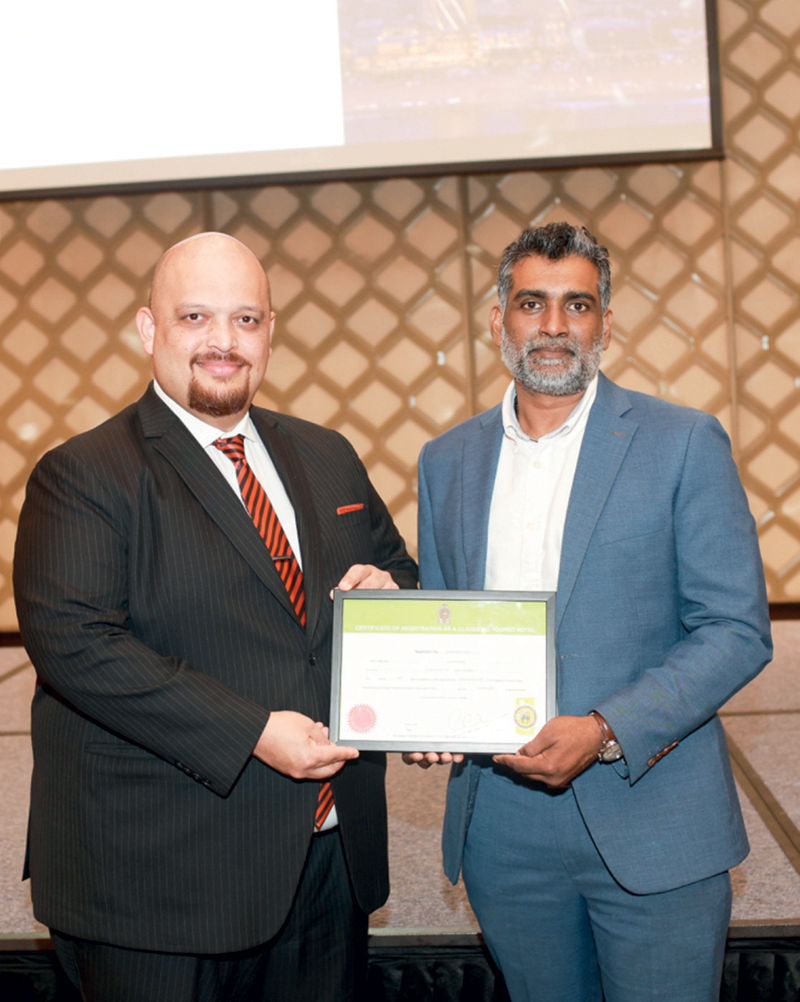
General Manager, Keenan McKenzie accepting the Certificate from Buddhika Hewawasam from SLTPB
The ceremony was attended by several distinguished officials and industry leaders, including, Board Member, SLTDA; Mrs. Malkanthi Rajapaksha, Director – Standards & Quality Assurance, SLTDA; and Mr. Trevine Gomas, Chairman, Hotels’ Classification Committee. Their presence underscored the significance of this milestone for Sri Lanka’s hospitality sector.
ITC Ratnadipa, a Luxury Collection Hotel, opened its doors in Colombo, Sri Lanka, on April 25, 2024, introducing a new benchmark in responsible luxury and sustainability-driven hospitality. Since its inception, the hotel has been committed to offering exceptional experiences that blend opulence with environmental stewardship.
Addressing the gathering, Mr. Keenan McKenzie stated:
“We are grateful to the Sri Lanka Tourism Development Authority and the Hotels’ Classification Committee for their guidance and trust, and to our partners and stakeholders for their continued support. This milestone strengthens our resolve to elevate Sri Lanka’s hospitality landscape while delivering responsible luxury rooted in sustainability.”
This recognition underscores ITC Ratnadipa’s dedication to excellence, sustainability, and its vision to redefine luxury hospitality in Sri Lanka.

Showers about 100 mm are likely at some places in Uva province and in Nuwara-Eliya, Matale, Polonnaruwa, Batticaloa and Ampara districts

Advisory for low pressure area over South-east Bay of Bengal Sea area

US raid on Venezuela violation of UN Charter and intl. law: Govt.

Ban on foreign research vessels: FM promises decision within two months

Broad support emerges for Faiszer’s sweeping proposals on long- delayed divorce and personal law reforms

US seeking to rob Venezuela resources: SLPSC

‘Dates have the highest sugar content to fight Coronavirus’

Sunday Island 27 December – Headlines

#SundayIsland 17th December – Headlines

Sunday Island – 28th March

Sunday Island Headlines – 21 March

Sunday Island – 21st February – Headlines
-

 News1 day ago
Private airline crew member nabbed with contraband gold
-

 News3 days ago
Health Minister sends letter of demand for one billion rupees in damages
-
 News6 days ago
Leading the Nation’s Connectivity Recovery Amid Unprecedented Challenges
-

 Opinion5 days ago
Remembering Douglas Devananda on New Year’s Day 2026
-

 Latest News1 day ago
Curran, bowlers lead Desert Vipers to maiden ILT20 title
-
 News6 days ago
Dons on warpath over alleged undue interference in university governance
-

 Features1 day ago
Pharmaceuticals, deaths, and work ethics
-

 News1 day ago
Bellana says Rs 900 mn fraud at NHSL cannot be suppressed by moving CID against him