
News
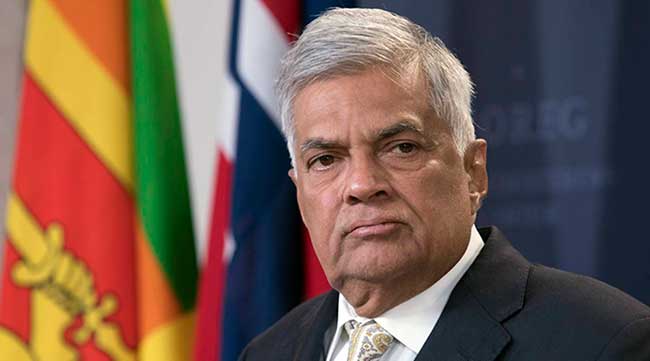
Ranil named first respondent in FR case filed against ex-Cabinet, Monetary Board

Revelations by Sabry, Nandalal cited; CIABOC asked to investigate
Prime Minister Ranil Wickremesinghe has been named the first responded in a fundamental rights case filed by Dr. Athula Kumara Samarakoon of the Open University, Sri Lanka, Soosaiappu Neavis Morais and Dr. Mahim Mendis, in connection with the wrong policies which led to the current economic meltdown.The application filed in terms of the Articles 17 and 126 of the Constitution named the entire Cabinet of Ministers, including former PM Mahinda Rajapaksa and Basil Rajapaksa and Ali Sabry, PC. Among others named are former presidential secretary Dr. P.B. Jayasundera, ex-CBSL Governors, Prof. W.D. Lakshman and Ajith Nivard Cabraal and ex-Treasury Secretary S.R. Attygalle.
Members of the CIABOC (Commission to Investigate Allegations of Bribery or Corruption), too, have been made respondents; the petitioners have in a letter, asked the CIABOC members to investigate the mismanagement of the economy by former members of the Monetary in violation of Section 70 of the Bribery Act as well as lawmakers Mahinda Rajapaksa and Basil Rajapaksa.The petition cited the controversial decision taken to reduce a range of taxes in terms of SLPP presidential election candidate Gotabaya Rajapaksa’s manifesto titled, ‘Vistas of Prosperity’ as one of the major causes of the current crisis.
The petitioners have stated that as at April 2022, the price of essential goods had increased from the previous year as follows: (a) The price of Petrol increased by 85%;, (b) The price of Diesel increased by 69%;, (c) The price of a cylinder of Liquid Petroleum Gas increased by 84%;, (d) The price of turmeric increased by 443%;, (e) The price of bread increased by 433%;, (f) The price of rice increased by 93%; and (g) The price of dhal had increased by 171%
The petitioners have adduced incumbent CBSL Governor Dr. Nandalal Weerasinghe’s statement before the Committee on Public Enterprises (COPE) on 25 May in support of their argument. Dr. Weerasinghe was quoted as having told COPE that the government lacked foreign currency reserves to pay its foreign debt or buy essential imports, and the assistance of the International Monetary Fund and foreign nations was required.
Petitioners have also quoted statements made by ex-Finance Minister Sabry to underscore the crisis created by what they call the wrong policies of the then government. They cited President Rajapaksa’s unilateral decision to prohibit the use of chemical fertilizer and agrochemicals as another reason for the crisis.Issues such as the government using foreign reserves to prevent the depreciation of the rupee have also been raised by the petitioners. Statements made by Dr. Ranee Jayamaha and Sanjeeva Jayawardena PC, two appointed members of the Monetary Board, before the COPE were also cited in support of the petition. They were quoted as having said that they received instructions to use dollar reserves to hold the rupee as Rs. 203 in spite of their strong objections (SF)




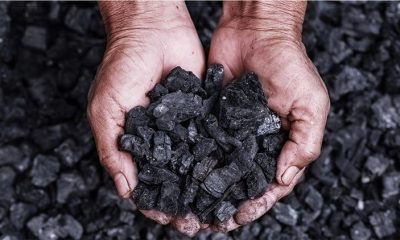

Environmentalists have raised fresh concerns over possible mercury contamination linked to coal used at the Norochcholai coal power plant, warning that Sri Lanka still lacks binding standards on mercury content in imported coal despite mounting health risks in nearby communities.
Chairperson of the Centre for Environmental Justice (CEJ), Environmental Scientist Hemantha Withanage, said recent coal consignments suspected to be of inferior quality could contain elevated mercury levels, posing a threat to both ecosystems and human health.
“International studies show that mercury content in coal can vary significantly. For example, research on South African coal indicates a range between 0.01 and 0.49 ppm. However, Sri Lanka has still not established a maximum permissible mercury level for imported coal,” Withanage told The Island.
He pointed out that the environmental protection licence issued for the Norochcholai Coal Power Plant allows mercury emissions of up to 0.01 mg/Nm³, but stressed that regulating emissions alone is insufficient without controlling mercury content at the source.
“With no standard for mercury in imported coal, there is a serious regulatory gap. This raises legitimate concerns that recent shipments may contain higher mercury concentrations,” he said.
Withanage cited a 2018 CEJ study conducted in the Kalpitiya peninsula, near Puttalam, which found alarming levels of mercury exposure among women of childbearing age. According to the study, 28 out of 36 women—approximately 77%—had mercury levels in hair samples exceeding the internationally accepted safety threshold of 1 ppm.
“The most disturbing finding was a recorded level of 15.584 ppm in one individual. These women were regular consumers of fish from the Puttalam lagoon, suggesting a bioaccumulation pathway,” he explained.
The CEJ believes that mercury released during coal combustion at Norochcholai may enter the marine environment, eventually accumulating in fish consumed by local communities.
“Mercury is a potent neurotoxin. When released into the environment, it can transform into methylmercury and enter the food chain, particularly affecting coastal and fishing communities,” Withanage warned.
He further alleged that despite formally notifying the Central Environmental Authority and the North Western Provincial Environmental Authority at the time, there had been insufficient follow-up action.
He added:”We raised these findings years ago with the relevant authorities, but there has been little to no meaningful response. This is unacceptable given the potential public health implications.”
Environmentalists are now calling for immediate steps, including the establishment of national standards for mercury content in imported coal, independent testing of all coal consignments, and a comprehensive health assessment of communities living in proximity to the power plant.
They also stress the need for continuous monitoring of mercury levels in air emissions, marine ecosystems, and food sources such as fish.
“With growing evidence of contamination, authorities must act decisively. Public health cannot be compromised,” Withanage added.
By Ifham Nizam
Latest News
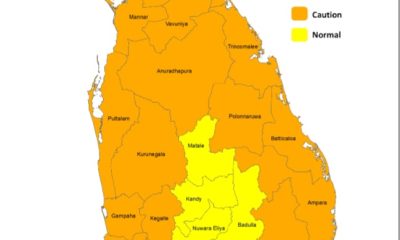
Heat Index at Caution Level in the Western, Sabaragamuwa, Southern, Eastern, North-western, Northern and North-central provinces and in Monaragala district.

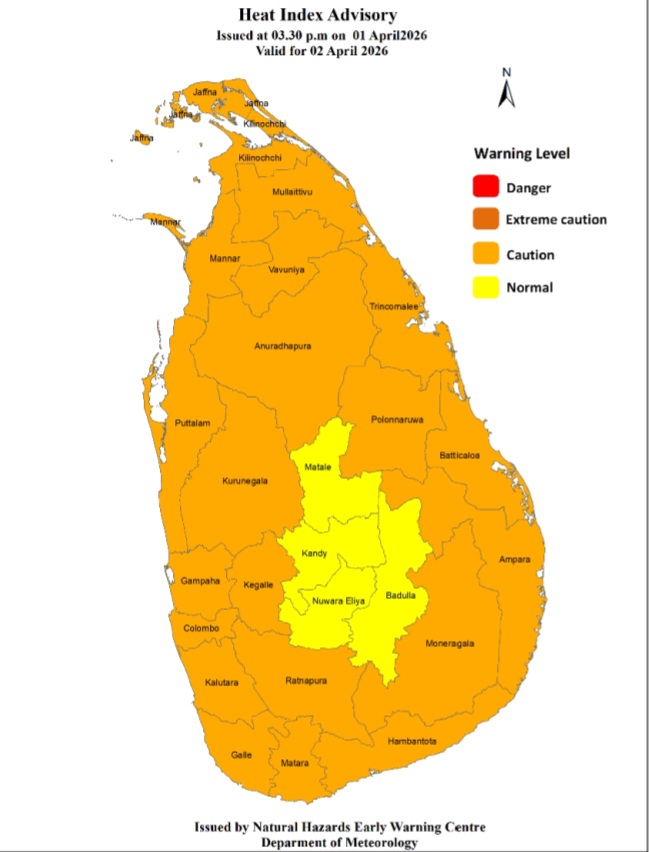
Warm Weather Advisory
Issued by the Natural Hazards Early Warning Centre
Issued at 3.30 p.m. on 02 April 2026, valid for 03 April 2026.
The Heat index, the temperature felt on human body is likely to increase up to ‘Caution level’ at some places in the Western, Sabaragamuwa, Southern, Eastern, North-western, Northern and North-central provinces and in Monaragala district.
The Heat Index Forecast is calculated by using relative humidity and maximum temperature and this is the condition that is felt on your body. This is not the forecast of maximum temperature. It is generated by the Department of Meteorology for the next day period and prepared by using global numerical weather prediction model data.

Effect of the heat index on the human body is mentioned in the above table and it is prepared on the advice of the Ministry of Health and Indigenous Medical Services.
ACTION REQUIRED
Job sites: Stay hydrated and takes breaks in the shade as often as possible.
Indoors: Check up on the elderly and the sick.
Vehicles: Never leave children unattended.
Outdoors: Limit strenuous outdoor activities, find shade and stay hydrated.
Dress: Wear lightweight and white or light-colored clothing.
Note:
In addition, please refer to advisories issued by the Disaster Preparedness & Response Division, Ministry of Health in this regard as well. For further clarifications please contact 011-7446491.
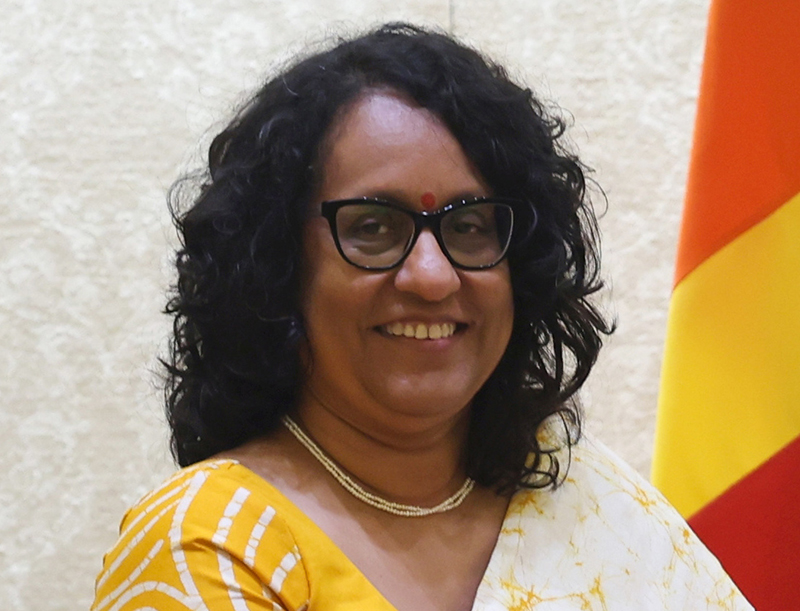
Government authorities are exploring the possibility of shifting public sector work online on April 16 and 17, to maintain essential services while managing available fuel and energy amid disruptions linked to West Asia conflagration.
The proposal was discussed at the third meeting of the Cabinet-appointed committee on ensuring continuity of public services, chaired by Prime Minister Dr Harini Amarasuriya via a virtual platform, according to the President’s Media Division.
Officials highlighted that the Ministry of Health and Mass Media had reduced diesel consumption by 42% by March 31, reflecting wider government efforts to reduce fuel use across institutions. Awareness programmes on energy management at schools are scheduled for April 7 and 9, while universities are already operating online where feasible.
The Ministry of Public Administration confirmed that examinations, including the Grama Niladhari entrance test, have continued as planned. Key ministries, including Transport, Digital Economy and Justice, are maintaining operations by deploying essential staff and utilising online systems.
The committee also discussed launching a public awareness campaign to curb water wastage and promote alternative water sources, to be jointly conducted by the National Water Supply
and Drainage Board and the ‘Clean Sri Lanka’ initiative.
Guidelines for conducting official duties online have been prepared by the Ministry of Digital Economy, with a circular expected by April 20 following consultations with the Ministry of Public Administration. Plans were also reviewed to monitor daily energy consumption, fuel reserves, and public service attendance through a digital dashboard.The committee is scheduled to reconvene on April 8.

Trump fires Pam Bondi as US attorney general, elevates Todd Blanche

Klaasen fifty, Travishek onslaught hand Sunrisers Hyderabad first points of the season

Atmospheric conditions will be favorable for afternoon thundershowers in most parts of the island.

Nuwan Thushara files lawsuit against SLC for IPL NOC

Mercury fears over coal imports: CEJ urges urgent standards, health probe

Heat Index at Caution Level in the Western, Sabaragamuwa, Southern, Eastern, North-western, Northern and North-central provinces and in Monaragala district.

‘Dates have the highest sugar content to fight Coronavirus’

Sunday Island 27 December – Headlines

#SundayIsland 17th December – Headlines

Sunday Island – 28th March

Sunday Island Headlines – 21 March

Sunday Island – 21st February – Headlines
-

 Features6 days ago
A World Order in Crisis: War, Power, and Resistance
-
 News3 days ago
Tariff shock from 01 April as power costs climb across the board
-
 News6 days ago
Minister Jayakody indicted in Colombo High Court over alleged corruption
-
 News4 days ago
Inquiry into female employee’s complaint: Retired HC Judge’s recommendations ignored
-

 News6 days ago
Police look for male partner of Chinese woman found stabbed to death at an apartment in Kohuwala
-

 Features4 days ago
New arithmetic of conflict: How the drone revolution is inverting economics of war
-
 Business2 days ago
Hour of reckoning comes for SL’s power sector
-
 Features5 days ago
When seabed goes dark: The Persian Gulf, cable sabotage, and race for space-based monopoly