
News
Ranasinghe Premadasa – the People’s President


97th birth anniversary on June 23, 2021
The 97th birth anniversary of former President Ranasinghe Premadasa, which falls on June 23, 2021, evoke fond memories of a great leader who stood steadfastly by his party and the common masses through thick and thin.
My father, the late E. P. De Silva (EP), former Editor of the then Daily Mirror and Times, was a longstanding friend of Premadasa. In fact, he was a close family friend like Dr. N. M. Perera, Peter Keuneman and others who were engaged in trade unions and political activities at the time.
My father, a well-informed political reporter before he became the Editor, also had a close rapport with leftist leaders and trade unionists such as Alavi Moulana and Bala Thampo. As a result of these societal connections, President Premadasa consulted my father frequently as he knew the power of journalists and made good use of them to the advantage of the country.
In the good old days, the phone in our home at Rawathawatte, Moratuwa, started ringing from 5.00 am. The first regular caller was always President Premadasa. This was the pattern since he served as an opposition MP, deputy minister, minister and later Prime Minister.
My father kept an ear to the ground and was well tuned to the political affairs. He had a network of “contacts”, which kept him well briefed of the ‘behind the scene’ developments in the political firmament.
Ranasinghe Premadasa ventured into politics in 1950. He was first elected a Labor Party member of the Colombo Municipal Council and later ascended to the position of Deputy Mayor. In 1956, he joined the United National Party (UNP) under the leadership of the late Prime Minister Dudley Senanayake. Four years on, he was elected a Member of Parliament from Colombo Central.
In the late 1960, he was appointed Minister of Local Government, Housing and Construction. Thereafter, in 1977 when J. R. Jayewardene became the first President of Sri Lanka, Premadasa was appointed the Prime Minister.
Premadasa worked tirelessly to eradicate poverty in Sri Lanka. Among his major endeavors were the Janasaviya poverty alleviation program and the 200 Garment Factories initiative in addition to building model villages with infrastructure facilities and amenities. His mission in life was to give a better tomorrow to the common man.
When my eldest sister passed away on January 2, 1973, we informed our father, who was on a call with Premadasa. Though he was not told anything about the death by my father, he called over to console us. Later in the evening also, he visited again with Mrs. Premadasa, a simple and gracious lady.
In the same way, the both of them also paid their last respects to my father. Premadasa was such a grateful person that he never forgot us. Whenever he visited Badulla district, he made it a point to visit me. He came over when I was the Assistant Superintendent at Downside Estate, Welimada and when I served as the Superintendent at Shawlands Estate, Lunugala.
With Premadasa’s untimely death, the country lost a dynamic leader who had the vision to spearhead the development of the economy by taking small-scale industries to the villages and providing employment to rustic youth. This resulted in alleviating poverty in the rural sector to some extent.
President Premadasa made it a point to monitor and evaluate by sending his staff to visit sites and submit a report to him. When the inspection reports were received, he proceeded with comparing the statistics maintained by the Ministries. This enabled him to track officials who worked hard to achieve results and those who tried to bluff him.
If we could have continued with the era of President Premadasa, we would have been a nation like Singapore today.
– Lalin I. De Silva,
Senior Planter/Agricultural Advisor & Consultant/Freelance Writer

Latest News
Heat Index at Caution level’ in the Northern, North-central, North-western, Western and Southern provinces and in Trincomalee district.


Warm Weather Advisory
Issued by the Natural Hazards Early Warning Centre
Issued at 3.30 p.m. on 12 April 2026, valid for 13 April 2026.
Heat index, the temperature felt on human body is likely to increase up to ‘Caution level’ at some places in the Northern, North-central, North-western, Western and Southern provinces and in Trincomalee district.
The Heat Index Forecast is calculated by using relative humidity and maximum temperature and this is the condition that is felt on your body. This is not the forecast of maximum temperature. It is generated by the Department of Meteorology for the next day period and prepared by using global numerical weather prediction model data.

Effect of the heat index on human body is mentioned in the above table and it is prepared on the advice of the Ministry of Health and Indigenous Medical Services.
ACTION REQUIRED
Job sites: Stay hydrated and takes breaks in the shade as often as possible.
Indoors: Check up on the elderly and the sick.
Vehicles: Never leave children unattended.
Outdoors: Limit strenuous outdoor activities, find shade and stay hydrated.
Dress: Wear lightweight and white or light-colored clothing.
Note:
In addition, please refer to advisories issued by the Disaster Preparedness & Response Division, Ministry of Health in this regard as well. For further clarifications please contact 011-7446491.

On the apparent northward relative motion of the sun, it is going to be directly over the latitudes of Sri Lanka from 05th to 15th of April in this year.
The nearest areas of Sri Lanka over which the sun is overhead today (13th) are Pesalai, Mankulam and Nedunkerny about 12:11 noon.
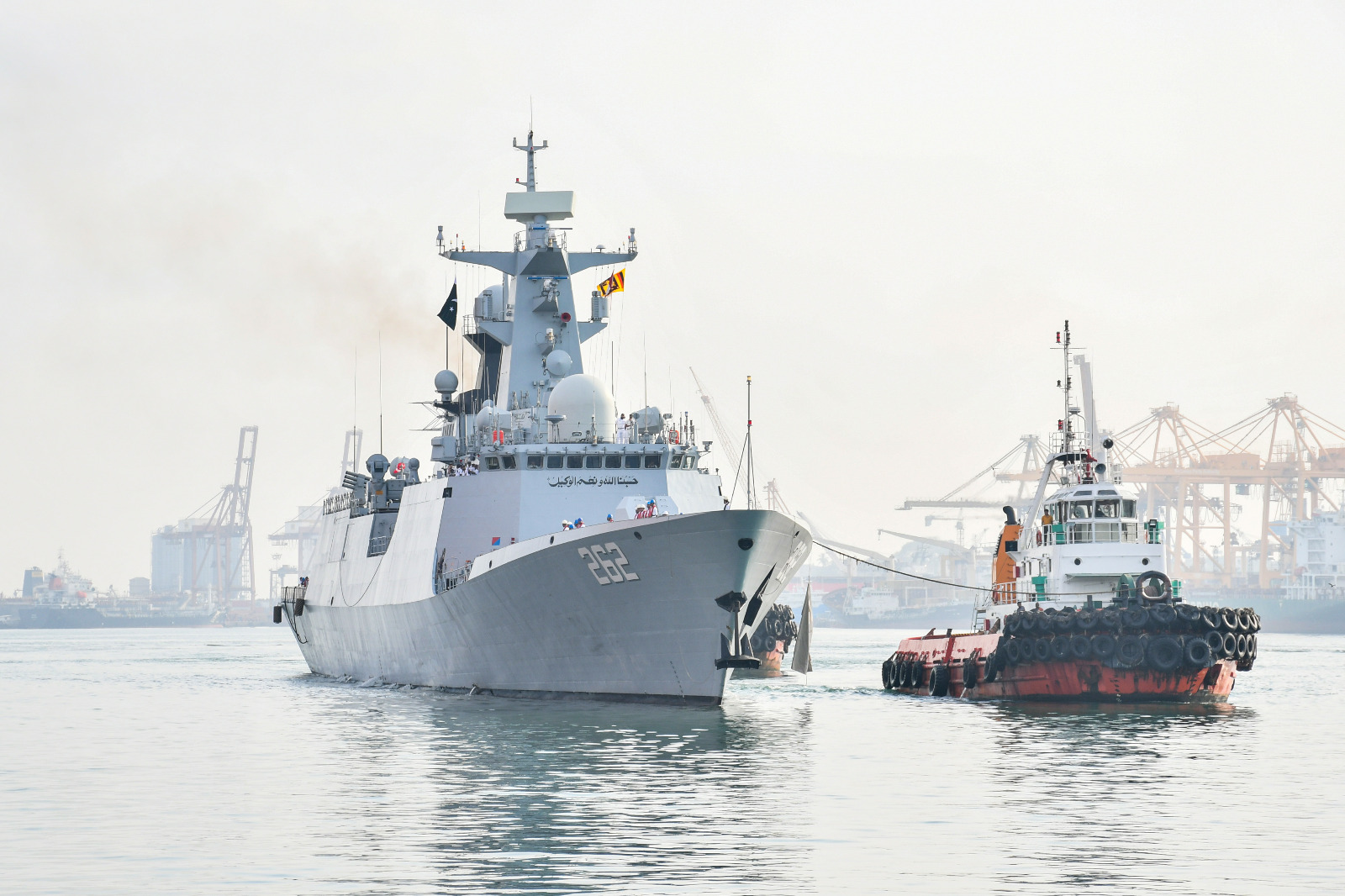
The Pakistan Navy Ship (PNS) TAIMUR and ASLAT arrived at the Port of Colombo on a goodwill visit on 12 Apr 26.
The visiting ships were welcomed by the Sri Lanka Navy in
compliance with naval traditions.
The duo of ships is commanded by Captain NIAMAT SAEED KHAN (PNS TAIMUR) and Captain NADIR MATEEN AFRIDI (PNS ASLAT).
Meanwhile, the ships are expected to conduct a Bilateral Naval Exercise LION STAR V with the Sri Lanka Navy in Colombo seas.

Salt and Patidar power RCB past Mumbai Indians

Prasidh, Buttler set up comfortable win for Gujarat Titans

Heat Index at Caution level’ in the Northern, North-central, North-western, Western and Southern provinces and in Trincomalee district.

Showers above 75 mm are likely at some places in the Western, Sabaragamuwa, Central, Southern and North-western provinces.

Sun directly overhead Pesalai, Mankulam and Nedunkerny about 12:11 noon

PNS TAIMUR & ASLAT arrive in Colombo

‘Dates have the highest sugar content to fight Coronavirus’

Sunday Island 27 December – Headlines

#SundayIsland 17th December – Headlines

Sunday Island – 28th March

Sunday Island Headlines – 21 March

Sunday Island – 21st February – Headlines
-

 News2 days ago
CEB orders temporary shutdown of large rooftop solar systems
-

 News7 days ago
Lankan-origin actress Subashini found dead in India
-

 News5 days ago
AG: Coal procurement full of irregularities
-

 Business4 days ago
Israeli attack on Lebanon triggers local stock market volatility
-

 Business5 days ago
Hayleys Mobility introduces Premium OMODA C9 PHEV
-

 News7 days ago
UN Regional Director launches SL’s first Country Gender Equality Profile during official visit
-

 News7 days ago
Dialog Launches ‘GanuDenu QR’, Making Cashless Transfers Free for All with eZ Cash and Dialog Finance
-

 Business4 days ago
HNB Assurance marks 25 years with strategic transformation to ‘HNB Life’