
Editorial
Quorum quandary


Monday 11th December, 2023
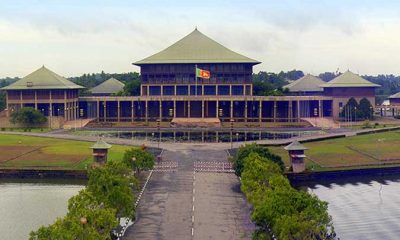
Yesterday’s parliamentary session had to be adjourned until today for want of a quorum. While the VAT (Amendment) Bill was being debated, an SJB MP brought it to the notice of the Chair that the session was inquorate. The SLPP has about 124 MPs on its side, but most of them were absent yesterday. The SJB MPs walked out in protest against what they called serious flaws in the list of commodities to be subjected to VAT.
Inquorate parliamentary sessions are not uncommon in this country. What’s the world coming to when at least 20 out of 225 MPs, whom the public is paying through the nose to maintain, are not present in Parliament when a crucial tax bill is taken up for debate?
The MPs often take the moral high ground and wax eloquent on the virtues of diligence and punctuality. They berate public officials for dereliction of duty. But they are not present in Parliament even during debates on crucial bills. What is the use of maintaining 225 MPs when Parliament can do without many of them?
However, there was something unusual about yesterday’s inquorate parliamentary session. The Opposition is known to stage walkouts and plunge Parliament into chaos when it seeks to delay the passage of bills, etc. But the government MPs make it a point to be present in the House when an important bill is presented, and it is puzzling why so many SLPP MPs were absent yesterday.
Speculation is rife in political circles that most of the government MPs kept away yesterday due to an internal dispute in the ruling coalition. It may be recalled that SLPP MP Namal Rajapaksa was absent when a vote was taken on the second reading of Budget 2024 recently. Later, he said he had absented himself because the budget had not offered any relief to the public. Interestingly, his father, Mahinda, voted for the budget, making one wonder if Namal and his father did not see eye to eye on the budget. The SLPP is also resentful that some of its district leaders have been denied ministerial posts.
The proposed VAT increase from 15% to 18% with its application being expanded to cover almost all goods and services is bound to cause a surge in the general price level, aggravating the economic woes of the public. Increases in indirect taxes adversely impact the entire population. The public will have to pay more for public transport, essential commodities and services including medical care. The VAT (Amendment) Bill has been presented to Parliament almost on the eve of an election year. It is therefore natural that the SLPP MPs are wary of openly supporting the hugely unpopular bill and incurring public opprobrium in the process.
They stand accused of having inflicted untold suffering on the public by supporting the policies and actions of the Gotabaya Rajapaksa government, which precipitated the country’s bankruptcy. If they vote for the VAT bill, they will make the people’s lot even more unbearable, and there’ll be hell to pay in such an eventuality. This is something the government MPs need like a hole in the head with only a couple of weeks to go before the dawn of an election year. They, however, will have to decide whether to support them or oppose them, soon. They cannot dilly-dally indefinitely. The passage of the VAT bill is a prerequisite for the release of the next tranche of the IMF loan.
In the run-up to the debate on the VAT bill a story began to do the rounds that Parliament was likely to be dissolved early next year. This rumour can be considered part of a campaign to tame the SLPP MPs by instilling fear of elections in them. President Ranil Wickremesinghe can now dissolve Parliament at a time of his choosing.
All eyes are on today’s parliamentary session. Chief Government Whip and Minister Prasanna Ranatunga told the House yesterday that the VAT bill would be debated and passed on Monday (11). Whether the SLPP MPs will attend Parliament today and help the government secure the passage of the bill remains to be seen.








Thursday 16th July, 2026
Occasions are not rare when absurd twists and turns in Sri Lanka’s legal system remind us of Mr. Bumble, the famous Dickensian character, who declared, “The law is an ass”. The police arrest criminals, after months of meticulous planning, risking their life and limb, but the latter obtain bail, go into hiding, either here or overseas, and continue to run their illegal operations. The police have to launch fresh operations to arrest the criminals on the run.
The police have sought information about Mohommad Najim Mohommad Imran alias Kanjipani Imran, who is wanted under an INTERPOL Red Notice. He is running his criminal operations from overseas, according to a report published in this newspaper yesterday. It defies comprehension why he was released on bail in 2021 though it was patently clear that he would flee the country.
Quoting the police, our news item has said intelligence reports point to links between Imran and international terrorist organisations as well as major mafia syndicates, which enable him to use transnational networks and technology to manage drug trafficking and other criminal operations.
Much is being spoken these days about the need to strengthen public confidence in the judiciary. There is no gainsaying that everything possible must be done to preserve the integrity and dignity of the judiciary. Worryingly, some issues crop up, making one wonder whether a section of the law enforcement authorities and some members of the legal fraternity bend the law to safeguard the interests of wealthy underworld figures at the expense of the judicial process and public security.
The police and the state prosecutor take great pains to prevent some suspects, especially the political opponents of governments in power, from obtaining bail. They invoke all laws and come out with various arguments to have such suspects held on remand for extended periods. Instances abound where their investigations get underway in earnest only after suspects are arrested and remanded for weeks, if not months, while ruling party politicians conduct social media trials, as it were, and declare the suspects guilty, with no heed for the presumption of innocence or the fact that public speculation is prohibited when cases are sub judice.
When Imran was arrested in Dubai and extradited in 2019, it was widely thought that he would have his work cut out to secure bail because Sri Lanka police and their UAE counterparts had worked tirelessly for months to arrest him and Makandure Madush, known as Sri Lanka’s Napoleon of Crime, and bring them here. Madush was shot dead while in custody, and the then government claimed that he had been caught in the crossfire between police and an underworld gang while being taken to a place where a haul of narcotics was believed to have been buried. It is doubtful whether the discerning public bought into that claim.
The news of Imran being released on bail raised many an eyebrow. We said in an editorial comment dated 02 January 2023 that having secured bail he would flee the country and carry out his illegal operation from overseas as other criminals did.
However, Imran is not the only criminal to have jumped bail and fled the country. Janith Madushanka de Silva alias Podi Lasi, a dangerous underworld character, fled to India after being released on bail in 2024. He even claimed that his life was in danger and asked for police protection. It was obvious that he would flee the country, and he did so soon afterwards. One may recall that in 2020, while being detained at the Boossa high-security prison, he and two other criminals, known as Kosgoda Tharaka and Pitigala Keuma, threatened to kill the then President Gotabaya Rajapaksa, Defence Secretary General Kamal Gunaratne and several senior prison officers. Podi Lasi bragged that their private armies were capable of striking anywhere at will. He was arrested in India and brought back in 2026. Thus, criminals are caught, released and caught again. Now, the police are trying to arrest Imran.
Only a thorough probe into the circumstances that led to the release of Imran on bail will reveal how he managed to manipulate the legal process and flee the country.
Wednesday 15th July, 2026
The JVP-NPP government’s efforts to increase the retirement ages of the judges of the Supreme Court (SC) and the Court of Appeal (CA) has triggered an avalanche of criticism. The Judicial Service Association of Sri Lanka (JSASL), which represents all District Court judges and Magistrates in the country, has also opposed the government move. It has written to President Anura Kumara Dissanayake, informing him of its decision. However, the government remains unresponsive.
Ironically, the JVP affronted elderly politicians and officials in previous administrations, claiming that they were past their productive years and therefore had to be put out to pasture. But no sooner had it formed a government in 2024 than it brought two former police officers, Ravi Seneviratne and Shani Abeysekera, out of retirement and elevated them as the Secretary to the Ministry of Public Security and the Director of the CID, respectively, because they were members of the NPP’s Retired Police Collective. Its action compromised the integrity of the CID and the Ministry of Public Security. Now, it is trying to extend the retirement ages of some members of the judiciary selectively.
Several leading lawyers’ associations, both local and foreign, prominent political leaders and legal luminaries have unequivocally taken exception to the government’s proposed plan to amend the Constitution to extend the tenure of the SC and CA judges. The Bar Association of Sri Lanka (BASL) is leading the campaign against the government plan at issue. Its arguments are cogent. The Colombo Law Society has also asked President Dissanayake not to proceed with the proposed constitutional amendment and warned that such a move could undermine public confidence in the judiciary. The Colombo High Court Lawyers’ Association has also called upon the government to abandon its controversial plan which, if implemented, will undermine judicial independence, disrupt career progression within the judicial service, and erode public confidence in the judiciary. The opponents of the government’s questionable move also include LAWASIA (the Law Association for Asia and the Pacific), which consists of regional association of lawyers, judges, jurists, legal academics and legal organisations in the Asia-Pacific region, and the Commonwealth Lawyers’ Association, which promotes the rule of law, an independent legal profession, access to justice, human rights and high standards of legal ethics.
All arguments put forth by the aforesaid legal associations are compelling. They have pointed out that a change benefiting sitting judges could create a perception of favouritism; judicial tenure is closely linked to the separation of powers and constitutional safeguards; any reform should follow broad consultation rather than a rushed constitutional amendment, and existing vacancies numbering four each in the SC and the CA, should be filled immediately through proper appointments rather than extending the tenure of current judges.
One may recall that in 2024, the then Speaker Mahinda Yapa Abeywardena told Parliament that following the resignation of President Gotabaya Rajapaksa at the height of Aragalaya, in July 2022, a foreign envoy and a group of Sri Lankans had striven to pressure him into appointing himself Acting President in violation of the Constitution, and their intention had been to plunge Sri Lanka into anarchy, like Libya. Tens of thousands of protesters were trying to march on Parliament at that time. The JVP has admitted that it sought to lead those protesters to Parliament. Luckily, Sri Lanka did not become Asia’s Libya in 2022, but four years on, under a JVP-led government, it runs the risk of facing the same fate as Zimbabwe!
Addressing a recent BASL public forum, CLA President Steven Thiru warned that Sri Lanka would risk repeating Zimbabwe’s judicial crisis if it went ahead with its controversial plan to extend the retirement ages of sitting judges arbitrarily. If Sri Lanka proceeded with an ad hoc, non-transparent extension of Superior Court judges’ tenure without a broad consultative process, it risked plunging its legal system into a crisis of legitimacy similar to that in Zimbabwe, he warned.
The government must abandon its ill-conceived plan to amend the Constitution to extend the tenure of the superior court judges. Instead, it must take steps to fill the vacancies in the SC and the CA. Let it be warned that missteps can lead to pratfalls.
Tuesday 14th July, 2026
Paddy farmers have refused to sell their produce to the Paddy Marketing Board (PMD) at the prices offered by the government. They are demanding better prices in view of increasing production costs, and their protests are gathering momentum. Their consternation is understandable. They backed the JVP-led NPP to the hilt, enabling it to win elections, expecting it to liberate them from the clutches of unscrupulous millers. Today, big-time rice millers are buying Rolls-Royces and helicopters while farmers are mortgaging their houses and tractors, unable to recover production costs.
Protesting farmers have claimed that although the government has offered to buy paddy, most of its warehouses still have stocks of paddy purchased during the Maha season. Even if storage facilities are available, the government can buy only 2% of the national paddy production, according to the PMD officials. So, how can the government make an effective market intervention to safeguard the interests of paddy farmers and consumers? It apparently does not explore other ways and means of preventing wealthy millers from exploiting paddy farmers and consumers.
Powerful rice millers, who bankroll election campaigns of main political parties, leverage their political connections to protect their interests. Reams have been written about how they manipulate governments to facilitate exploitation. They create rice shortages a few weeks before the commencement of every paddy harvesting period, prompting governments to import rice. Thereafter, they release some of their stocks into the market, bringing the prices of rice down so that they can buy paddy from farmers at very low prices. When their rice enters the market, imported rice in government warehouses rot and end up in breweries or animal feed factories. Governments, capitalist or socialist, are wary of antagonising the powerful millers for obvious reasons.
Curiously, President Anura Kumara Dissanayake has recently argued that Sri Lanka should diversify the uses of locally produced rice by manufacturing more value-added products. He has said rice can be used for producing beer and animal feed among other things. The government has cancelled a gazette notification that prohibited the use of rice as a raw material for beer and animal feed. Rice-based food products are common in this country, and the use of rice for manufacturing them does not adversely affect the public. However, the lifting of the aforesaid ban could lead to unforeseen problems.
The question is whether it is advisable to allow a water-intensive crop, raised with subsidised fertiliser, etc., to be used for manufacturing beer or animal feed when alternative raw materials are available. Is the government capable of regulating the paddy and rice markets to prevent a situation where the manufacturers of beer and animal feed will act in a way that may lead to a shortage of rice?
It is hoped that the government will be able to build sufficient buffer stocks of paddy, particularly in view of the current El Niño phenomenon, which is expected to adversely impact rainfall here. El Niño drastically changes predictable weather patterns and poses challenges for agriculture and water resources, experts have warned.
If the government is planning to divert a part of the local rice production to breweries and animal feed factories due to storage issues, as claimed in some quarters, it should seriously consider abandoning its plan and expanding its warehouse network by rebuilding the PMD storehouses, most of which went to wrack and ruin under UNP governments, following the 1977 regime change or were destroyed by the JVP during its second uprising in the late 1980s.
Minister Bimal Rathnayake has gone on record as saying that unlike in the past, today there are ‘tons and tons of money’ in the state coffers. If so, there is no reason why the government should not utilise a fraction of those funds to help the hapless farmers struggling to keep their heads above water and develop the PMD so that it will be able to regulate the paddy and rice markets and safeguard the interests of rice growers and consumers.

Current El Niño Status in Sri Lanka

A few showers may occur in the Western, Sabaragamuwa and North-western provinces and in Kandy, Nuwara-Eliya, Galle and Matara districts.

Argentina face fine for Falklands banner in semi-final win

US launches fresh strikes on Iran as Trump warns Tehran it ‘better behave’

Govt. move to extend retirement ages of top judges: Opp. complains to UN

Dengue surge pushes hospitals to the brink as cases near 70,000

‘Dates have the highest sugar content to fight Coronavirus’

Sunday Island 27 December – Headlines

#SundayIsland 17th December – Headlines

Sunday Island – 28th March

Sunday Island Headlines – 21 March

Sunday Island – 21st February – Headlines
-
 News6 days ago
Herath warns prospective migrant workers not to get fleeced by racketeers
-
 Features4 days ago
Prison riots and politics: NPP’s biggest challenge and Sri Lanka’s biggest opportunity
-

 Editorial5 days ago
What’s the world coming to?
-
 Foreign News6 days ago
Tensions erupt in Indian state after 11-year-old raped and murdered
-

 Features6 days ago
Devanesan Annan – in Memoriam
-
Editorial6 days ago
Punishment in hellholes
-

 News7 days ago
Representatives of the Organization of Professional Associations (OPA) of Sri Lanka meet the Prime Minister
-
 Features1 day ago
Dirty Money