
Editorial
Proposed ban on cattle slaughter


Thursday 10th September, 2020
Prime Minister Mahinda Rajapaksa has decided to bring in new laws to ban cattle slaughter, according to media reports. He has earned praise from animal lovers, but meat eaters are not likely to take kindly to the proposed ban. The PM may have anticipated protests from beef lovers and the food industry; that may be the reason why he has said beef imports will be permitted. If the ban happens to be imposed, the cattle will be saved from the butcher’s knife in this country, but an equal number of bovines will get killed overseas to be dispatched here to meet the demand for beef!
Why Prime Minister Rajapaksa has suddenly decided to save cattle, of all sentient beings, is not known. He may have done so for religious or moral reasons, but it is sure to go down well with all those who are compassionate towards cattle. It, however, should be added that cattle are not the only animals that should be saved; there are many other dumb creatures slaughtered in their thousands daily for food. Who will save them?
We hope that Prime Minister Rajapaksa has not announced the proposed ban, at this particular juncture, to distract media attention from the controversy over the 20th Amendment and the swearing in of Premalal Jayasekera, who has been sentenced to death, as an SLPP MP. The government is drawing widespread criticism for 20A, which contains some draconian features. The SJB grabbed the headlines, on Tuesday, by protesting in Parliament against Jayasekera’s swearing in and 20A, which, it said, would pave the way for a dictatorship. The government has provided the Opposition with a rallying point.
PM Rajapaksa is quite adept at handling, if not manipulating, the media. (President Chandrika Kumaratunga used to call him the ‘reporter’ in her Cabinet because of his links to the media.) His proposal to ban cattle slaughter has led to a social media feeding frenzy. Web-based publications have got something to busy themselves with for days to come. They might forget 20A and MP Jayasekera for a while.
The Constitution makes specific mention of the fundamental rights of people and requires governments to safeguard them. The incumbent administration has drawn a lot of flak for 20A, which, among other things, seeks to prevent citizens from exercising their fundamental rights in case of wrongful presidential actions affecting them.
Animals, too, have rights, which need protection. After all, this country constitutionally gives the foremost place to Buddhism and is considered a Buddhist state. One may recall that the first thing Arahant Mahinda, who introduced Buddhism here, did after his arrival in this country was to stop the then King (Devanmpiya Tissa) from killing a deer before going on to conduct what may be considered the first ever IQ test in the world to see if the king was capable of understanding Dhamma. The great Thera may have wondered whether a king giving chase to a poor animal to kill it by way of entertainment had any intelligence, at all. The king’s answers, however, cleared his doubts.
Animals are deprived of their habitats and destroyed or reared and slaughtered in their thousands daily for food, in this country. Not even wildlife is spared. Elephants die painful deaths owing to hakkapatas (improvised explosive devices concealed in fruits, etc., and primed to go off when bitten). Leopards are killed in traps. Bush meat trade is thriving. Untold suffering is inflicted on domestic animals.
The government is under pressure to pass the Animal Welfare Bill, and animal rights activists who are pushing for it deserves praise, but what is needed more than anything else is to protect animals’ right to life. The rights of animals, too, must be constitutionally guaranteed like the fundamental rights of humans.



Saturday 4th April, 2026
Pivithuru Hela Urumaya leader and former minister Udaya Gammanpila is complaining that a fake copy of his book on the Easter Sunday terror attacks, Pasku praharaye mahamolakaru soya yema (“Searching for the mastermind behind the Easter Sunday attacks”), has been released on social media. He says the spurious book in Portable Document Format is based on an incomplete manuscript of his work, sent to former top military intelligence officer Maj. Gen. (Retd.) Suresh Sallay for fact-checking on a specific section. The Criminal Investigation Department (CID) took the incomplete manuscript into custody after Sallay’s arrest, Gammanpila has said, alleging that the fake book is based on that document. He has threatened legal action against the CID for misusing intellectual property and forgery.
The fake book under discussion will perhaps be the least of Gammanpila’s problems. The self-styled Hercule Poirots in the CID and their political masters must be drawing up plans for a witch-hunt against him, for he has ruffled the feathers of the powers that be by challenging the government’s narrative about the Easter Sunday carnage, and taking up the cudgels on behalf of those arrested by the CID, which is headed by a member of the JVP/NPP—retired SSP Shani Abeysekera, who is a member of the NPP’s Retired Police Collective.
The CID has been an appendage of the political party or coalition in power all these years. The JVP/NPP came to power promising a radical departure from the rotten political culture and swift action to depoliticise vital institutions, such as the police, but it is stuck in the same old rut as its predecessors; it keeps all state outfits under its thumb to advance its political agenda. The CID has been doing more political work than criminal investigations, under successive governments; no wonder unsolved crimes abound and the conviction rate remains extremely low (4% to 6%).
The release of the fake book at issue can be considered a propaganda misadventure. The controversy created by that ill-conceived move will help Gammanpila sell more copies of his book and bolster his claim that unable to counter his arguments, the government is trying to create confusion in the public mind about his narrative. Gammanpila’s real book offers fresh insights into the crucial issues surrounding the Easter Sunday carnage and related matters.
Meanwhile, Opposition Leader Sajith Premadasa has drawn criticism for attending Gammanpila’s book launch on 31 March. It is being claimed in some quarters that he should not have been there as the SJB does not subscribe to the contention that Zahran Hashim was the mastermind behind the Easter Sunday terror attacks. This argument is not tenable. One’s presence at a book launch is not tantamount to one’s endorsement of the views of the author concerned.
Interestingly, the JVP leaders, including Anura Kumara Dissanayake and Vijitha Herath, vigorously promoted Mahinda Rajapaksa’s presidential election manifesto, Mahinda Chinthanaya, in 2005, as a silver bullet capable of solving all the problems Sri Lanka was facing at that time. Videos of their fiery speeches promoting Mahinda Chinthanaya are available in the digital realm. A few years later, they turned against President Rajapaksa and even tried to topple his government. Today, they are vilifying Mahinda, who would not have been able to secure the executive presidency in 2005, much less become a prominent national leader, without their help. Sajith has not promoted Gammanpila’s book, has he?

Friday 3rd April, 2026
Sri Lankan governments are said to be like cattle-rustling trucks displaying various religious blessings above their windshields. A government once came to power promising to create a righteous society but did the very antithesis of its pledge. Its rule paved the way for a culture of political violence, election malpractices and corruption. One of the promises made by the JVP-NPP government during its election campaigns was to restore the rule of law. Those who voted for it may have expected it to ensure that everyone would be equal before the law. But it is doing the diametrical opposite of its promise. Ruling party politicians and backers violate the law with impunity.
The Gampaha Magistrate’s Court has recently ordered that an office forcibly taken over by a gang of JVP goons at Yakkala last year be handed back to the Frontline Socialist Party (FSP), which occupied it previously. In September 2025, a group of JVP cadres, led by a deputy minister, descended on the place, assaulted the FSP members staying there and seized the property, with the police siding with the ruling party mob. The JVPers produced what they described as a court order, claiming that the place rightfully belonged to them. The FSP protested, but in vain. The JVP asked the police to act according to the “court order”. The police put up a barricade near the disputed office for the safety of the JVP members. It is now clear that the JVP members not only misled the police but also caused an affront to the dignity of the judiciary by making a false claim. But no action has been taken against them.
Energy Minister Kumara Jayakody, facing a serious charge of corruption, was not arrested, unlike other suspects. He was indicted and bailed out on the same day. The Commission to Investigate Allegations of Bribery or Corruption arrests and hauls up before court Opposition politicians and state officials, whose offences pale into insignificance in comparison to the aforementioned corruption charge against Jayakody and the multi-billion-rupee coal procurement racket he has allegedly committed.
It has been reported that the Hambantota police recently warned and released a person taken into custody for clearing a section of a forest reserve under the Mahaweli Authority (MA) in Hambantota. A group of environmentalists and some concerned farmers protested when the suspect started clearing the protected area by using a backhoe, claiming that he was acting with the blessings of two JVP politicians in the area. The MA security personnel rushed to the scene and took the suspect and the backhoe into custody.
Ordinary people taken into custody for destroying forests are handed over to the police immediately afterwards and charges are pressed against them within 24 hours. But the MA took two days to make a complaint to the police against the above-mentioned suspect. In response to an RTI request, the police have said they released the suspect after warning him as the MA withdrew its complaint. Obviously, the MA and the police have succumbed to government pressure. There is sufficient ground for legal action against the MA officials and the police for releasing a suspect involved in illegal forest clearance.
If the JVP leaders and rank and file have any sense of gratitude, they ought to protect and conserve forests, which sheltered them during their first and second uprisings and helped save their lives. They should learn from the Buddha, who paid his gratitude to the Bo tree that had given him shade when he attained Enlightenment; he spent the second week after attaining Buddhahood, gazing steadily at that Bo tree without blinking. Sadly, two years into office, the JVP-led government has allowed its politicians and supporters to destroy forests with impunity. It looks as if the JVP politicians had waited for decades, looking at forests without blinking, until an opportunity presented itself for them to cut down trees and grab land.
Two policemen who went above and beyond the call of duty to arrest a drug dealer in another police area have been taken off their regular duties as a disciplinary measure because some government politicians have taken exception to their action, which, in our view, should be commended. This was revealed at a recent meeting, where Deputy Minister of Public Security Sunil Watagala ordered the police to ensure that their personnel confined their drug busting ops to their bailiwicks. Curiously, no action has been taken against the police officers who released an offender responsible for grabbing a section of a forest reserve and clearing it.

Thursday 2nd April, 2026
The truth about the 2019 Easter Sunday terror attacks remains buried under a mountain of conspiracy theories. The way most stakeholders have sought to get at the truth reminds us of the ancient folk tale, The Blind Men and the Elephant. They have grasped only fragments of what they believe to be the truth, each assuming that his or her limited perspective represents the entire reality. There are still others who have let their political prejudices and self-interest colour their vision of the issue, making it even more difficult to uncover the truth. However, all these viewpoints need to be examined carefully if investigators are to avoid the confirmation bias that could make them selective in gathering and examining evidence. It is against this backdrop that a host of arguments and counterarguments in Udaya Gammanpila’s book (in Sinhala), Pasku praharaye mahamolakaru soya yema (“Searching for the mastermind behind the Easter Sunday attacks”), launched on 31 March, should be viewed.
Udaya’s book is an attempt to demolish some dominant conspiracy theories about the mastermind behind the Easter Sunday carnage, challenge the credibility of the investigators who have launched a fresh probe into the terror attacks and assail the integrity of the ongoing investigation.
Former Attorney General (AG) Dappula de Livera caused quite a stir by claiming that there had been a ‘grand conspiracy’ behind the Easter Sunday attacks because he failed to secure a service extension from the then President Gotabaya Rajapaksa, Udaya has alleged, claiming that the former AG has refused to cooperate with investigators and support his claim with evidence.
The book says President Anura Kumara Dissanayake shelved the report of the Alwis Committee appointed by President Ranil Wickremesinghe. The committee held former Senior DIG Ravi Seneviratne, who was in charge of the CID at the time of the Easter Sunday attacks, accountable for the CID’s lapses that led to the carnage. President Dissanayake brought Seneviratne out of retirement and appointed him Secretary to the Ministry of Public Security. Udaya claims that former SSP Shani Abeysekera, who was reappointed CID Director in retirement, in an affidavit in a Fundamental Rights case, concealed the fact that on 12 April 2019, nine days before the Easter Sunday attacks, the military intelligence had sent a detailed report to the CID about the involvement of Zahran Hashim’s terror group, National Thowheed Jamaath (NTJ), in the killing of two policemen at Vavunathivu in November 2018, pointing out that the CID would be able to ascertain more information by interrogating Zahran’s brother Rilwan and another person called Army Mohamed. Udaya is of the view that Abeysekera concealed this fact to cover up his failure to prevent the carnage despite having received credible information about Zahran’s terrorist activities. The intelligence agencies provided 337 reports on Islamic extremist groups and Zahran’s terrorist activities to the police, Udaya has said, quoting from a probe commission report and arguing that if they had been behind the Easter Sunday attacks, they would never have furnished such information to the police.
The alleged disappearance of Sara Jasmine, widow of the Katuwapitiya bomber, Muhammadu Hastun, is used as a peg to hang the conspiracy theory that she fled to India as she had links to India’s RAW. Minister Nalinda Jayatissa himself propagated this claim while in the Opposition. Some politicians have alleged that Gotabaya Rajapaksa had a fresh DNA test conducted, at the behest of the then top intelligence officer Maj. General Suresh Sallay, to mislead the world into believing that Sara was among the NTJ activists killed in suicide blasts at Sainamaradu a few days after the Easter Sunday attacks. In the first two tests, DNA samples obtained from Sara’s mother did not match the DNA profiles of the victims. Udaya says that as the forensic reconstruction of the remains of the Sainamaradu bomb victims was extremely difficult, many body parts collected from the blast site had been buried in a bag; the third DNA test was conducted on the remains in the bag, and that was the reason for the different test results.
Udaya has said Azad Moulana, whose claims form the basis for a Channel 4 programme that holds Sri Lankan military intelligence responsible for the Easter Sunday carnage, is a lawbreaker, seeking political asylum in a developed country. Claiming that Moulana had links with the NTJ and helped Zahran’s brother, Rilwan, receive treatment for injuries sustained in a test blast in the East, Udaya has pointed out that the house where Moulana says Sallay met Zahran in February 2018 had been built only in August/September 2018. Most of all, Sallay was abroad from December 2016 to December 2019. The NTJ bomber who failed to explode himself at the Taj Hotel went to Dehiwala on his own, according to instructions given by Zahran before the attacks, and therefore Moulana’s claim that the military intelligence sought his help to give someone at the Taj Hotel transport does not bear scrutiny, Udaya says.
As for the unexploded bomb at the Taj Hotel, a list of hotel guests’ names was sent to intelligence agencies only a few moments before the blasts on 21 April, and the bomber, Jameel Mohamed, had used his father’s name for registration, and therefore even if the list had been sent earlier, nobody would have been able to trace him, Udaya argues in his book, pointing out that military intelligence officers tried to contact Jameel only after being alerted by a retired SSP, who had served as an intelligence officer. Jameel’s wife, who panicked, unable to contact her husband after receiving a voice message from him, kept on calling his number while he was still at the Taj Hotel. All calls that went unanswered, as seen in hotel CCTV footage, were from Jameel’s wife and not from the military intelligence, Udaya says. Jameel’s wife then contacted Jameel’s brother, who sought the help of the aforementioned former SPP. Bombs had gone off by that time, and the former SSP, realising the gravity of the situation, informed the intelligence agencies. Jameel contacted his wife, using a security guard’s telephone from a mosque in Dehiwala, where he went from the Taj Hotel. In the meantime, the intelligence officers rushed to his house, used his wife’s phone to call the unknown number, spoke to the security guard and asked him not to allow Jameel to leave. Jameel, who had left by that time, blew himself up in a guesthouse in the area.
Udaya argues that an efficient intelligence operative, using the nom de guerre, Sonic Sonic, who has been described in some quarters as the Easter Sunday terror mastermind, won the confidence of Podi Zahran (Rahuman Mohamed Zahran) working for the NTJ and obtained information about the terror group. According to Udaya’s book, after the Easter Sunday blasts, Sonic Sonic did not ask Podi Zahran to have IS take responsibility for the attacks, contrary to conspiracy theorists’ claims; instead, he only asked Podi Zahran why IS had not taken responsibility if it was behind the carnage, and this query has been misinterpreted as an attempt to pressure Podi Zahran to have IS say it was behind the attacks, as part of a cover-up.
What one gathers from Udaya’s book is that Zahran was the IS leader in Sri Lanka, and he organised and executed the Easter Sunday attacks. Drawing inspiration from the Bangladesh IS leader who carried out a suicide attack, Zahran blew himself up as he did not want to be caught alive. Following the raid on the Wanathawilluwa camp, where a huge stock of explosives belonging to the NTJ was taken into custody, and the breakaway of a group of NTJ members, including the ‘Deputy IS leader in Sri Lanka’, Mohamed Naufer, Zahran feared that someone would betray him and there would be a crackdown on his terror network.
Udaya’s book provides fresh insights into some crucial issues that have been used to concoct conspiracy theories and level unsubstantiated allegations against the intelligence agencies. It is bound to provoke debate. One can only hope that there will not be a witch-hunt against the author.

Iran executes two convicted members of banned opposition group

Afghanistan earthquake kills eight members of same family

Breakdown of the teams and groups of the FIFA World Cup in Canada, Mexico and the US after the final playoffs

365 US service members injured since start of Iran war – Pentagon

World Cup 2026: Italy’s football chief resigns after qualifying failure

Iran says it downed two US jets as search for one pilot continues

‘Dates have the highest sugar content to fight Coronavirus’

Sunday Island 27 December – Headlines

#SundayIsland 17th December – Headlines

Sunday Island – 28th March

Sunday Island Headlines – 21 March

Sunday Island – 21st February – Headlines
-

 News3 days ago
2025 GCE AL: 62% qualify for Uni entrance; results of 111 suspended
-

 News5 days ago
Tariff shock from 01 April as power costs climb across the board
-
 News6 days ago
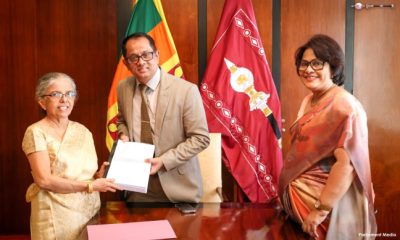
Inquiry into female employee’s complaint: Retired HC Judge’s recommendations ignored
-

 Features7 days ago
When seabed goes dark: The Persian Gulf, cable sabotage, and race for space-based monopoly
-

 Features6 days ago
New arithmetic of conflict: How the drone revolution is inverting economics of war
-
 Business4 days ago
Hour of reckoning comes for SL’s power sector
-

 Editorial3 days ago
Search for Easter Sunday terror mastermind
-

 Sports6 days ago
Sri Lanka’s 1996 World Cup heroes to play exhibition match in Kuala Lumpur