
Business
Policy certainty: The real investment test for Sri Lanka in 2026


When Arjuna Herath assumed duties as Chairman of the Board of Investment of Sri Lanka, he quite correctly sent a clear message: Sri Lanka intends to position itself as an investor-friendly destination. The message was reinforced during a visit by a high-level delegation from the USSri Lanka Business Council, where officials spoke of renewed confidence in the country’s economic trajectory.
The optimism is not without foundation. After years of crisis, Sri Lanka has begun to stabilize. Foreign direct investment crossed the psychological threshold of about US$1 billion in 2025, exports climbed to more than US$17 billion, and tourist arrivals reached record levels. These numbers suggest that international capital is once again willing to take a second look at the island. Yet statistics alone do not tell the whole story.
The deeper question facing policymakers in 2026 is whether that early interest can be sustained. For investors, confidence is rarely built on incentives alone; it rests on the expectation that rules will remain consistent once a project begins. In other words, predictability matters more than promises.
That tension between optimism and uncertainty is now emerging as the central theme in Sri Lanka’s investment narrative.
On the one hand, authorities are signaling reform and openness. On the other, several recent developments have reminded investors that implementation can still be uneven. One widely discussed case involved the proposed Ambuluwawa cable-car project in the hill country, where a cross-border investor withdrew after reportedly spending about US$3.5 million. The developer, Amber Adventures (Pvt) Ltd, had planned a US$12.75 million tourism venture but later said the project was halted despite earlier technical clearances from multiple agencies.
Regardless of where the merits of the dispute lie, the episode left a familiar impression in investment circles: timelines and approvals can appear uncertain once projects move from paper to construction.
A separate case in the renewable-energy sector has generated similar concerns. Policy resets and prolonged negotiations reportedly discouraged a major regional developer. Governments everywhere reserve the right to renegotiate contracts, but when processes appear open-ended, investors begin to factor in higher risk.
This is why policy certainty may be the most powerful – and least expensive – stimulus available to Sri Lanka in 2026.
The macroeconomic outlook already underscores this point. Analysts expect moderate growth in the range of about 3 – 4 percent this year, while the International Monetary Fund has projected roughly 3.1 percent, linking stronger expansion to steady reform implementation rather than new borrowing. In other words, execution matters more than announcements.
Institutional efficiency also plays a role. With more than a million cases pending in Sri Lanka’s courts, businesses often see legal delays as an additional cost of operating in the country. Reducing that backlog – particularly in commercial disputes – would signal that contracts and administrative decisions can be resolved within predictable timeframes.
Tourism offers another illustration. Visitor arrivals have surged, yet revenue growth has lagged because spending per traveller remains modest. Improving digital payments, mobility and dispute resolution may prove just as important as marketing campaigns if Sri Lanka hopes to extract greater value from the sector.
All in all, these signals reveal a simple truth. Sri Lanka does not necessarily lack investor interest; it risks losing momentum if processes remain uncertain.
For policymakers, the challenge therefore lies in bridging perception and practice. Codifying approval timelines, digitizing government services, and completing a handful of transparent public-private partnerships could quickly demonstrate that decisions in Sri Lanka are not only possible but reliable.
If that credibility gap is closed, the message delivered by the BOI chairman that Sri Lanka is open for business – will resonate far more strongly in global boardrooms. Because in frontier markets, the most valuable incentive is not a tax break or subsidy. It is certainty.
By Sanath Nanayakkare

by SK Samaranayake
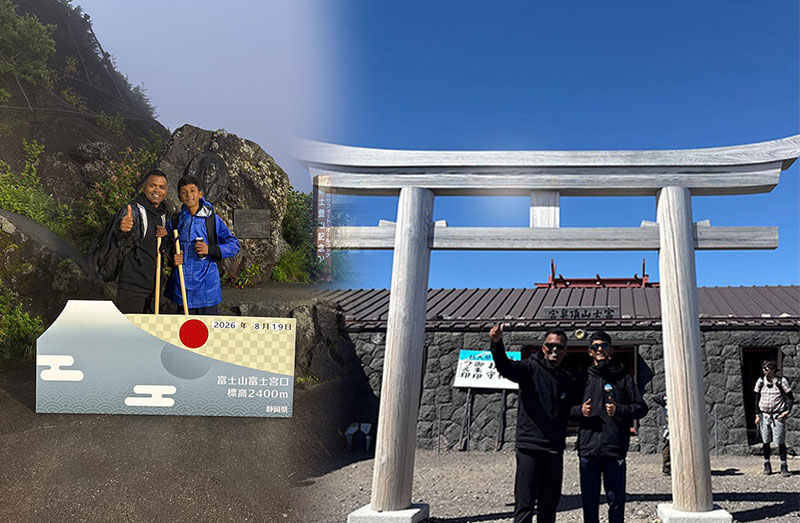
For Daham Gunasena, reaching the summit of Mt. Fuji with his 12-year-old son was not the end of the journey but the beginning of a different kind of lesson.
Gunasena, Director – Commercial at SPAR Sri Lanka and a senior business leader, academic and Chartered Accountant, spent nearly 12 hours on August 19 climbing Japan’s highest mountain with his son, Methum. After eight hours of climbing, the pair reached the 3,776-metre summit before beginning a demanding four-hour descent to Fujinomiya 5th Station.
“The summit was only halfway,” Gunasena reflected, describing the experience as a lesson in preparation, perseverance and responsibility.
Their journey began two days earlier with a trial excursion to the 6th Station and the volcanic landscape around Mt. Hoei. The experience allowed Gunasena to assess the altitude, terrain, weather and equipment before deciding whether his son was ready for the summit attempt.
The climb itself reinforced the value of taking one step at a time. Rather than focusing on the distant summit, father and son concentrated on the next marker, the next few steps and short periods of rest.
Reaching the summit brought another lesson. After taking photographs and celebrating, they still had four hours of descent ahead of them over loose volcanic terrain.
“Reaching the top was an achievement. Returning safely was success,” Gunasena said.
The experience also prompted him to reflect on how Japan manages Mt. Fuji, including visitor education, digital information, sanitation, transport, safety and environmental protection.
Having climbed Sri Pada 12 times last year and five times so far this year, Gunasena sees opportunities to apply some of these principles in Sri Lanka without compromising the mountain’s unique pilgrimage traditions.
He suggested a comprehensive digital platform for Sri Pada providing information on weather, congestion, transport, sanitation, first aid and emergencies, while educating foreign visitors about its religious significance.
For Gunasena, however, the most enduring lesson was personal: a mountain can teach what lectures cannot—through preparation, perseverance, respect for nature and the shared experience of taking each step together.

Sri Lankan industries are being encouraged to adopt advanced condition monitoring technologies to detect equipment problems before they develop into costly failures, as global technology company FLIR and its local partner Marlbo Trading Company strengthen their collaboration.
The companies brought together industry professionals at a technical seminar held on August 20 at Taj Samudra, Colombo, focusing on the use of thermography and acoustic imaging to reduce unplanned downtime, improve energy efficiency and lower maintenance costs.
Organised by Marlbo under the theme “Condition Monitoring Using Thermography and Acoustic Imaging for Measurable ROI,” the seminar highlighted the growing importance of proactive and predictive maintenance in improving equipment reliability and operational efficiency.
FLIR Sales Director – Instrumentation, India, Bhaskar Lala, and APAC Condition Monitoring Specialist David Gambarte shared their expertise on the latest diagnostic technologies and their practical industrial applications.
Thermal imaging can identify abnormal heat patterns linked to electrical and mechanical faults, while acoustic imaging can detect problems that may go unnoticed during routine inspections.
The technology is particularly useful in identifying compressed-air leaks, which can cause significant energy losses and increase operating costs.
Shevon Liyanage, Engineer – Measuring Instruments at Marlbo, also shared insights into applying condition monitoring technologies in the Sri Lankan industrial environment.
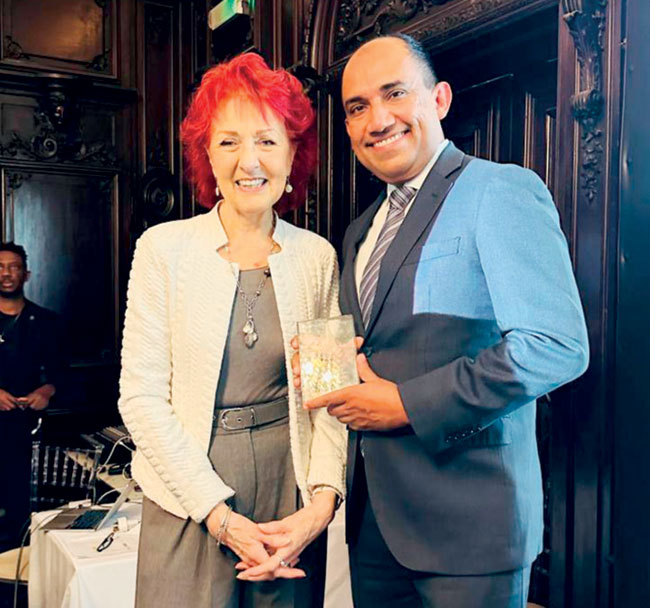
Lumbini Tea Valley Ceylon won an award for its Singharaja Wirytips at The Leafies: International Tea Awards held in London in 2024, marking another international recognition for the Sri Lankan tea producer.
The award comes as the company marks two decades of direct exports, with its premium and organic Ceylon teas now reaching 35 countries across six continents.
Established in 1984, Lumbini Tea Valley began its direct export drive after Chaminda Jayawardana joined the family business in 2000 alongside his father, Dayapala Jayawardana. The initiative materialised in 2006 with the company’s first direct shipment—a 15-kilogram consignment of Flowery Broken Orange Pekoe (FBOP) tea to the United States.
Since then, the company has expanded its direct-export operations, which now account for around 20% of its total manufacturing output. Following its transition to organic production, approximately half of its organic tea output is exported directly by the company.
Its key export markets include Japan, the United States, France, the Netherlands, Switzerland and Australia, with direct shipments now reaching 35 countries.
The company said its direct-export model would continue to expand amid growing international demand for traceable, single-origin Ceylon tea, with premium and organic grades at the centre of its export strategy.

Petrol to cost less from midnight today (30)

Head teacher evacuated 900 children minutes before school washed away by Nepal floods

UPDATE: Seven killed and 23 missing after boat capsizes off northern Cyprus, says Turkish Cypriot PM

Iceland votes against restarting talks on joining EU

“Rathuwewi Mihimadala” Book Launched with the Participation of the Prime Minister

Turkiye, Somalia forces free cargo vessel hijacked by pirates

‘Dates have the highest sugar content to fight Coronavirus’

Sunday Island 27 December – Headlines

#SundayIsland 17th December – Headlines

Sunday Island – 28th March

Sunday Island Headlines – 21 March

Sunday Island – 21st February – Headlines
-

 News6 days ago
Missing doctor’s body found in Mahiyanganaya
-
 News6 days ago
Australia declines to release Finance Secy Suriyapperuma’s citizenship details
-
 News6 days ago
22A: BASL suggests CJ recuse himself from hearing petitions
-

 News3 days ago
Eight politicians in drug kingpin probe
-

 Editorial7 days ago
Govts. drag feet as undergrads age
-

 Business3 days ago
Sri Lanka opens up: A new season of direct connectivity
-
 Features5 days ago
Insights from Chieftains of Uva: Genealogy of two Kandyan Families – Part II
-

 Features23 hours ago
“Wrap Me Up in My Blazer”— A Gentlemanly Bradby Reminiscence