
Sports
Player unity stands tall despite rugby’s divisions

By A Special Sports Correspondent
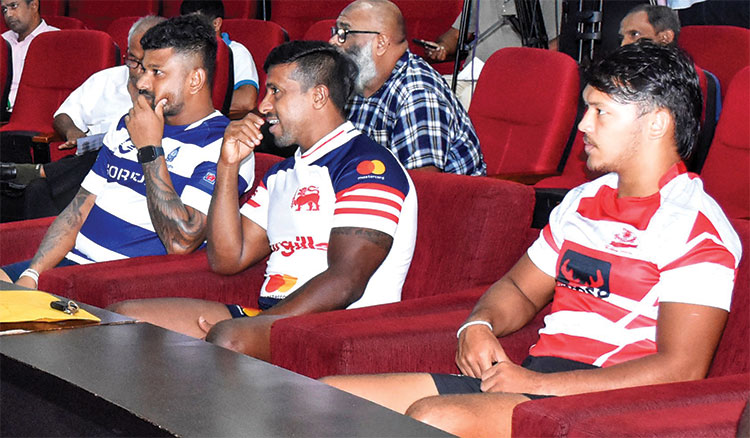
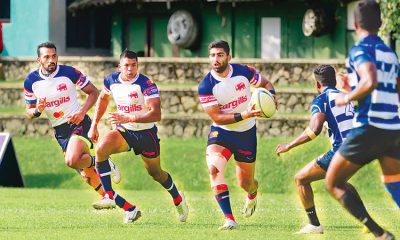
The Inter-club Nippon Paint sponsored league rugby tournament is set to make an ambitious start on December 1 (Friday) for the 2023/24 season with Havelocks Sports Club hosting Air Force Sports Club at the Park Club under lights. The kick-off is scheduled for 6.30 pm.
Rugby is a game of nerves and knowledge more than a contest between muscled men as of now. Today one needs the knowledge to take the ball forward and enough of information about where the opposition is weak. We have to see what the coaches have to offer this season; especially young coaches like Dushanth Lewke (CR&FC), Saliya Kumara (Havelocks SC), Shamly Nawaz (Army SC) and Fazil Marija (Kandy SC). From the three mentioned above Lewke reads the game the best and has produced results. Under the latter’s guidance CR&FC won the knockouts and performed exceptionally well during the league tournament.
Kandy Sports Club has maintained its stature as a rugby ‘institute’ ever since a revolt by members in a leading Colombo club back in the 1990s; which sparked an exodus of players to Nittawela. Since winning the league for the first time in 1994 Kandy SC has won this piece of silver wear for a record 23 times; the last being during the 2022/34 season under the leadership of Damith Dissanayake. The strength of Kandy SC is that the club can make its match-winner sit on the bench and still win a crunch game. Does that leave the players in a position where they cannot bargain unnecessarily when the time comes to renew playing contracts? We hear of just one casualty at the club and that is Suhiru Anthony who has crossed over to CR&FC and leads them this season. The Nittawela club is led this season by the fast running Lavanga Perera, who has shone for the side in both the ‘sevens’ and 15-a-side versions of the game.
As much as the country is divided in politics, so are the rugby clubs, but not necessarily the players. That’s why players are able to freely cross over to other clubs. In this rugby set-up it’s the clubs that own the players and look after their interests. If there is any little grey area associated with the cream of players there among them a few who don’t give their heart and soul when representing the nation at overseas tournament. This was once confirmed to this writer last season by the chief rugby selector at that time Asoka Jayasena. For the record the divisions among the clubs and the animosity against the rugby administration was shown in no uncertain terms when some clubs followed the sports minister’s orders and ganged up against SLR; showing their will to serve a stabilizing committee which was put in place to see to a constitution change at the SLR. Another sour point last season was Kandy SC protesting against playing at a neutral venue for the Clifford Cup and eventually pulling out of the tournament.
But coming back to the inter-club season it’s a different ball game. This writer believes in the saying ‘there is no game without players’. This was the catch-phrase for an advertisement regarding a leading brand of cigarettes which once sponsored the domestic league rugby tournament in this country. Rugby in Sri Lanka is about player management and clubs must take a bow for doing that since the game in the island went semi-professional some years ago.
One of the clubs which couldn’t retain some of its best products was Havelocks Sports Club. The best examples for such loses are Sanjeewa Jayasinghe and Dhanushka Ranjan. Both players ended up in Kandy. But still, despite these episodes, the Park Club has been a force to be reckoned with and has given the best teams in the league a run for their money. The only real loss this season would be last season’s coach Sanath Martis who has taken up the reins at CH&FC. The Park Club this season is led by Azmir Fajudeen.
Another team to watch this season is Navy Sports Club; a team which in the past was an institute that served as ‘the rugby home’ for at least two out of the three boys of the Rajapaksa family. Navy started becoming a force when Namal and Yoshitha played for the ‘sea going force’, but then the Sailors lost their sting in rugby after one brother crossed over to another club and the other hung up his boots to take up serious politics. Still Navy SC produces good rugby and had with them players in the likes of Samuel Maduwantha, Dinesh de Silva, Radeesha Senewiratne, Gihan Madusanka and Thilina Weerasinghe last season. The latter leads them this season. The only notable casualty this season for them is Adeesha Weerathunga who has joined the ‘Red Shirts’ this season.
Some of the other teams that could be in contention of high finishes this season are Police SC (Led by Mohan Wimalaratne), Army SC (led by Ashan Bandara) and Air Force SC (led by Parkrama Ratnayake).
There is a solid team build up at the Gymkhana Club (CH&FC) with the side being led this season by Avantha Lee and coached by rugby veteran Martis. The side finished at the bottom of the points table in the league tournament last season, but surprisingly produced some exciting rugby and was featured in some closely contested games as well. A question that rugby critics pose is how Sri Lanka Rugby SLR) can motivate a team like CH&FC- which had a low finish last season- when there is no relegation system in club rugby when compared to the schools tournament? In the schools’ rugby tournament the last placed team in the points table is demoted to playing in a lower division the next season.
Matches of the Nippon Paint Inter-club league rugby tournament will be officiated by an elite panel of referees assigned by the Sri Lanka Society of Rugby Football Referees.








The ICC Board and committee meetings scheduled for later this month in Doha have been called off due to the ongoing military conflict in West Asia. ESPNcricinfo understands that specific meetings, particularly those pertaining to the finance committee will take place virtually over the next few weeks. The possibility of in-person meetings in April remains open but much will depend on whether airspace has sufficiently re-opened for the board and committee members to fly safely.
The meetings were originally scheduled for March 25 to 27 and were due to include ICC Board Directors, Chief Executives, Committee members and ICC senior leadership. Three of the key issues up for discussion were global broadcasting rights ,with the deal between the ICC and *JioStar set to end in 2027, initial discussions over the next FTP and Olympic qualification for LA 2028. The second of those have already begun informally with several members approaching others as they make plans for cricket’s next four-year calendar.
This was the first time the ICC was due to meet in Qatar, which reports a cricketing participation growth rate of 447%. With limited flights to and from the country, hosting the meetings was deemed impossible at this time.
The crisis in West Asia has had an impact on scheduling too. The white-ball series between Afghanistan and Sri Lanka, scheduled to be held in the UAE from March 13 to 25, is likely to be postponed indefinitely.
[Cricinfo]

India produced a ruthless, near-flawless performance to retain the T20 World Cup title they won in the Caribbean two years ago, steamrolling New Zealand by 96 runs in Sunday’s final in Ahmedabad.
The Kiwis, who had marched into the final after ending South Africa’s unbeaten run in the Calcutta semi-final, ran into a blue wall. India piled up a daunting 255 for five after being asked to bat and then bundled New Zealand out for 159 with an over to spare, sealing one of the most emphatic wins in a World Cup final.
India had been given a wake-up call earlier in the tournament when South Africa handed them a heavy defeat in the Super Eight stage, leaving them needing four straight wins to lift the trophy. From that point on, Surya Kumar Yadav’s men put their foot on the accelerator and never looked back, playing like a side on a mission and delivering the knockout punch when it mattered most.
It was a triumph built not just on star power but on depth and system. India’s conveyor belt of talent keeps churning out match-winners, and their bench strength is the envy of the cricketing world. You may grumble about their strong-arm tactics in the corridors of power, but there is no denying the machine they have built. The result is domination across formats – men’s, women’s and Under-19 – echoing the era of Australian supremacy. At the moment, India are the team everyone else is chasing.
The victory was India’s biggest in T20 World Cup history and made them the first team to win the title three times. Former captains Rohit Sharma, who led the side to the 2024 crown and M.S. Dhoni, the architect of the inaugural triumph in 2007, were present at the venue to witness another chapter of Indian cricketing glory.
New Zealand, however, got their sums wrong. Their seamers stuck to predictable pace and failed to mix things up, allowing India’s openers to cash in during the powerplay.
Abhishek Sharma and Sanju Samson came out all guns blazing, racing to 98 for the first wicket in just 7.1 overs and putting the Kiwis immediately on the back foot. Abhishek set the tone with a blistering 52 off 22 balls, while Samson anchored the charge with a sparkling 89 off 46 deliveries, peppered with five fours and eight towering sixes.
Samson had been India’s banker throughout the tournament, striking three consecutive half-centuries during the campaign and walking away with the Player of the Series award.
The fireworks did not stop there. Ishan Kishan chipped in with a breezy 54 off 25 balls at number three as India threatened to push past the 270 mark. New Zealand managed to drag things back slightly at the death, but chasing 256 in a World Cup final was always going to be a bridge too far.
India’s bowlers then applied the squeeze. Jasprit Bumrah led the charge with a masterclass in fast bowling, finishing with figures of four for 15 and walking away with the Man of the Match award as New Zealand’s chase fizzled out quickly.
Rex Clementine in Ahmedabad
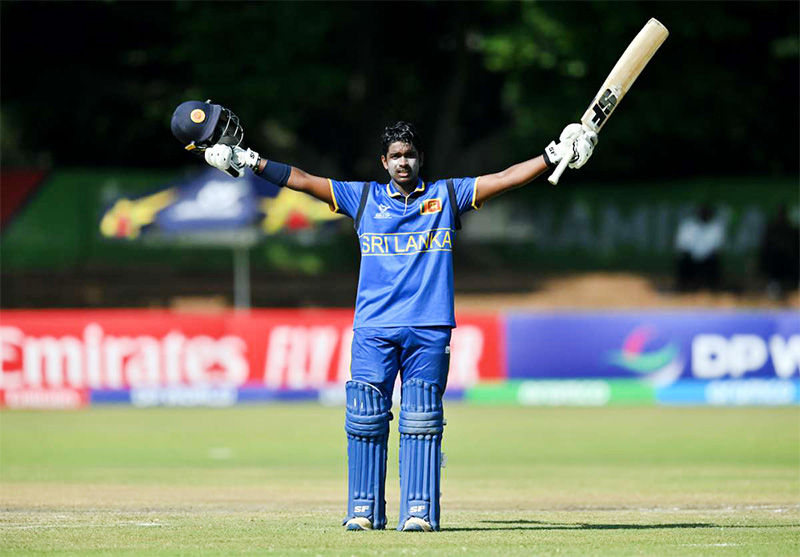
Sri Lanka Under-19 player Viran Chamuditha produced a superb all-round performance to power St. Servatius’ College Matara to a convincing innings and 55-run victory over Lumbini College in their Under-19 Division I Tier ‘A’ cricket tournament match played at the BRC Ground on Monday.
Chamuditha, who had earlier dazzled with the bat, went on to claim a match haul of ten wickets to seal an emphatic win for the Matara school.
After being forced to follow on when they were dismissed for 112 runs in their first innings, Lumbini showed some resistance in the second innings. Pasindu Maheesha, Linoth Methmal and Jayanitha Mendis offered brief fightbacks as they batted for nearly 50 overs, but the side was eventually bowled out for 183 runs.
Chamuditha led the bowling attack with a fine five wicket hal for 48 runs, sharing eight wickets in the innings with Lasindu Ramanayake. The pair had also been the main wicket takers in the first innings as St. Servatius’ dominated with the ball.
The foundation for the comprehensive victory had earlier been laid by the Servatius’ top order who piled up an imposing 350 for six wickets in 50 overs.
Heshan Madushanka top-scored with a fluent 128 runs off 147 deliveries, an innings studded with 16 boundaries and a six. Opener Risinu Kithmuka provided early impetus with a brisk 64 off 47 balls.
Chamuditha then capped the innings with a blistering knock of 83 runs off just 31 balls, smashing eight fours and six sixes. The explosive innings came after the young all-rounder had broken batting records at the ICC Youth World Cup, further underlining his immense potential.
With both bat and ball, Chamuditha’s outstanding display ensured St. Servatius’ completed a dominant victory.

Cabinet approves 14 day Visa extension
Sunil Galagama appointed as District Secretary Badulla

Anupama Mangala Wickramaarachchi appointed District Secretary Ampara
Committee on Economic Surveillance to be established
Cabinet nod to include the National Savings Bank for the Interest-Free Loan Scheme for Students

Nepal election 2026: Counting continues with rapper Balendra Shah’s party close to super-majority

‘Dates have the highest sugar content to fight Coronavirus’

Sunday Island 27 December – Headlines

#SundayIsland 17th December – Headlines

Sunday Island – 28th March

Sunday Island Headlines – 21 March

Sunday Island – 21st February – Headlines
-

 News5 days ago
University of Wolverhampton confirms Ranil was officially invited
-

 News6 days ago
Legal experts decry move to demolish STC dining hall
-

 News5 days ago
Female lawyer given 12 years RI for preparing forged deeds for Borella land
-

 News4 days ago
Peradeniya Uni issues alert over leopards in its premises
-

 News2 days ago
Repatriation of Iranian naval personnel Sri Lanka’s call: Washington
-

 Business6 days ago
Cabinet nod for the removal of Cess tax imposed on imported good
-
 News5 days ago
Library crisis hits Pera university
-
 Business7 days ago
Dialog partners with Ratmalana Audiology Centre for World Hearing Day 2026