
News
‘Perpetrators of violence should be dealt with under criminal and civil laws’


By Shamindra Ferdinando
Senior Attorney-at-Law Manoli Jinadasa Monday (24) said that illegal acts, such as arson and trespass, couldn’t be vindicated on the basis of ‘trade union’ action, under any circumstances. Thus, the normal law should operate against the perpetrators of such violations, Jinadasa said, adding that they could be dealt with under the criminal law, as well as the civil law, for damages caused.
The lawyer said so in response to The Island query where deliberate ‘actions,’ perpetrated during the protest campaign, that also involved trade unions affiliated to political parties, as well as other groups, such as Government Medical Officers’ Association (GMOA) and Federation of University Teachers Association (FUTA), be dealt with under current laws?
President Gotabaya Rajapaksa was forced out of office, in the second week of July last year. Subsequent violence destroyed the then Premier Ranil Wickremesinghe’s private residence at Kollupitiya. Altogether over 70 houses, belonging to incumbent members of Parliament, were set ablaze.
Asked to explain, the Attorney-at-Law said that FUTA, GMOA and other groups would say that they were involved in ‘Aragalaya’ to protect the rights of their members to safe and secure employment which was under threat due to the breakdown of industry and governance. They would justify their participation in the change of government on the basis of their right to protect the interests of the members.
Jinadasa, with over 28 years of experience specialises in Industrial Law, Constitutional Law, Administrative Law, Contract Law and Commercial Law.
“However, it would be pertinent to ask that though FUTA and GMOA participated in the protest campaign, is there any evidence directly implicating them in illegal activity at the point of the overthrow. It is only illegal activity that will attract punishment,” the outspoken lawyer said.
The Island
raised the issue with Manoli Jinadasa in the wake of her recent interview with Derana 24 in which the top lawyer dealt with ongoing trade union actions, primarily directed at the government and rights of both the employees and employers.
Responding to Derana interviewer Anuradhie Wickramasinghe, she stressed that strike is a legitimate weapon but should be the last option after all attempts to resolve a particular matter failed. Appearing on ‘Law, Land and Liberty,’ Jinadasa explained the nexus between trade unions and political parties represented in Parliament. Likewise, employers could resort to lockouts, Jinadasa said, underscoring the fact that the Supreme Court has upheld the right to strike.
“Strike is a legitimate weapon a trade union has. There is no doubt about it as much as a lockout for an employer. So, you have strike action for the employees and lockouts for the employer. That is how it goes, Jinadasa said.
Referring to ILO Conventions and comparing them with the relevant domestic laws and regulations, Jinadasa discussed the denial of trade union rights to judicial officers, armed forces, police and prison officers here. In terms of the ILO Conventions, Sri Lanka has ratified over the years, no one could be deprived of trade union rights though the situation on the ground is different, she said.
Having dealt with the origins of trade union activity, both here and abroad, Jinadasa asserted that the nature of trade union strategies had changed. She dealt with several specific issues, including the widely practiced ‘sick note campaign’
“Now the morality of that kind of strike is a subject matter for discussion because especially for professionals such as medical, legal or teaching professions. What we are doing is presenting a note which is false because you are not sick,” Jinadasa said. “It is the view even of the Supreme Court. There were judgments to the effect that submitting false medical certificates is not an acceptable form of a strike.”
Jinadasa recalled a judgment delivered by the late Justice Mark Fernando in respect of termination of employment over submitting of false medical certificates and going on ‘sick note campaigns’. The case referred to was Bandara vs Ministry of Lands. Fernando was quoted as having declared…”the President’s Counsel for petitioners contended with little enthusiasm that submitting false sick notes and medical certificates was a legitimate trade union action as part of the work to rule campaign. I have equally little hesitation in rejecting that contention. The court will not condone the conduct of an employee who lies or otherwise deceives his employer as to the reason for his failure to work whether individually or collectively.”
Jinadasa strongly questioned the despicable practice of teachers submitting false medical certificates against the backdrop of students having to prove valid reason in case they didn’t attend classes conducted by those who falsely fell sick. Such actions couldn’t be acceptable under any circumstances, she said, explaining the stand taken by courts as regards the deliberate reduction of output. Courts have held such actions illegal, she said. To highlight the illegality of such trade union strategies, Jinadasa recalled the fundamental rights action filed by the Joint Apparel Manufacturers Association against relevant trade union for bringing down the output by 60 percent. The court held in their favour, she said.
However, work to rule campaign is a legitimate form of trade union action, she declared.
Responding to another query, Jinadasa said that collective agreements facilitate better relations between employees and employers. Commenting on a person’s right to strike, Jinadasa, while referring to the late justice Sharvananda, said that he held that one couldn’t invoke fundamental rights for strikes. “One can invoke fundamental rights if he/she is prevented from joining a trade union, but not for strikes.” She gave several instances where courts have rejected such applications.



A group of Tamil Progressive Alliance (TPA) members, including its Leader Mano Ganesan, met President Anura Kumara Dissanayake on Thursday (02) morning at the Presidential Secretariat.
Extensive discussions were held on the issues faced by the Malayagam communities, particularly in relation to education, housing and land, as well as on the urgent measures required to address these concerns. The President paid special attention to all these matters.
Attention was also drawn to the recruitment of qualified Tamil-medium teachers to address the teacher shortage in estate sector schools and this too was discussed at length.
Members of Parliament P. Digambaram and V. Radhakrishnan, along with several other party members, were present at the meeting.

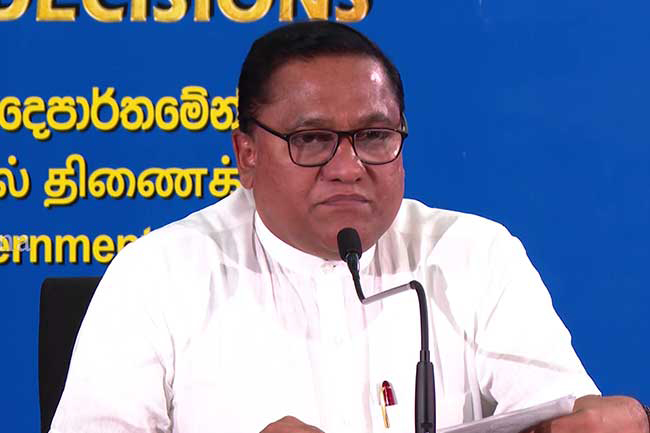
Minister of Foreign Affairs, Vijitha Herath, held talks with Deputy Foreign Minister of Russia Andrey Rudenko at the Foreign Ministry, in Colombo, on Thursday (02), with both sides reaffirming their commitment to strengthening bilateral relations.
The Sri Lanka Ministry of Foreign Affairs said the visiting Russian Deputy Minister noted that Russia regarded Sri Lanka as a long-standing friend.
Rudenko assured that Russia stood ready to support Sri Lanka when required, including in the swift supply of Russian oil to help address the current energy challenges, encouraging Russian investors to explore new opportunities in the country and promoting increased tourist arrivals.
He also expressed Russia’s readiness to provide compensation for Sri Lankan war veterans who had lost their lives in the ongoing conflict between Russia and Ukraine.
Minister Herath welcomed Russia’s willingness to assist, emphasising that Sri Lanka valued the support extended by its “old friend”, particularly at a time when the country was facing pressing energy needs.
He noted that the two countries shared nearly seven decades of diplomatic relations and said the present moment provided an opportunity to further strengthen ties, including through long-term trade agreements.
The discussions focused on enhancing cooperation in the fields of energy, investment, tourism and diplomacy, with both sides reiterating their commitment to further deepen the longstanding friendship between Sri Lanka and Russia.

Police yesterday arrested 157 foreign nationals in connection with an alleged organised online financial scam, conducted from a hotel in the Iranawila area in Chilaw.
The suspects were taken into custody during a raid carried out by the Police while they were staying at the hotel in Iranawila.
Police said the arrested group included 143 nationals from China, 13 from Bangladesh and one from Vietnam.
Investigators suspect the group had been involved in a coordinated online financial scam, targeting victims through digital platforms.
The suspects are being detained for further questioning while investigations are continuing to determine the full extent of the operation and whether additional individuals were involved.Police said further inquiries are underway.
By Norman Palihawadane

Iran executes two convicted members of banned opposition group

Afghanistan earthquake kills eight members of same family

Breakdown of the teams and groups of the FIFA World Cup in Canada, Mexico and the US after the final playoffs

365 US service members injured since start of Iran war – Pentagon

World Cup 2026: Italy’s football chief resigns after qualifying failure

Iran says it downed two US jets as search for one pilot continues

‘Dates have the highest sugar content to fight Coronavirus’

Sunday Island 27 December – Headlines

#SundayIsland 17th December – Headlines

Sunday Island – 28th March

Sunday Island Headlines – 21 March

Sunday Island – 21st February – Headlines
-

 News3 days ago
2025 GCE AL: 62% qualify for Uni entrance; results of 111 suspended
-

 News5 days ago
Tariff shock from 01 April as power costs climb across the board
-
 News6 days ago
Inquiry into female employee’s complaint: Retired HC Judge’s recommendations ignored
-
 Features7 days ago
When seabed goes dark: The Persian Gulf, cable sabotage, and race for space-based monopoly
-
 Features6 days ago
New arithmetic of conflict: How the drone revolution is inverting economics of war
-

 Editorial3 days ago
Search for Easter Sunday terror mastermind
-

 Business4 days ago
Hour of reckoning comes for SL’s power sector
-

 Sports6 days ago
Sri Lanka’s 1996 World Cup heroes to play exhibition match in Kuala Lumpur