
News
Pathfinder Foundation to develop a blueprint to double Sri Lanka’s growth rate


The Pathfinder Foundation has formed a Study Group of Experts to develop a blueprint and framework aimed at doubling Sri Lanka’s economic growth rate through accelerated economic integration and infrastructural connectivity with India. The framework document is expected to be formally launched in March 2024. Most economic forecasts place Sri Lanka on an average growth trajectory of 3% per annum for the next decade.
Such an anaemic growth rate will not help resolve Sri Lanka’s daunting social and economic challenges by any stretch of the imagination. Sri Lanka needs to think big and shift paradigms if the country is to find a way out of a seemingly hopeless predicament. As growth in the rest of the world including China continues to slowdown, India is expected to grow at above 6% per annum and will remain one of the best-performing economies in the world for the foreseeable future.While foreign investment into many regions is falling, investors are flocking to India due to its large market and emerging middle class.
Through an accelerated economic integration and physical connectivity strategy with India, Sri Lanka could take advantage of this momentum and easily double its economic growth to 6% per annum. India is already the largest source market for Sri Lankan tourism.
For example, at the end of the Second World War, the Netherlands seized the opportunity to develop its air, sea, rail, road, and energy sectors to become Europe’s distribution centre. Today, Rotterdam is the largest port in Europe, and Amsterdam is a principal global aviation hub. In fact, Singapore, too, used the Netherlands as a model for its own planning during its early stages of development. As windows of opportunity open and close quickly, it is essential for Sri Lanka to rapidly move towards becoming the principal gateway to South Asia, the Middle East, the Far East, and beyond before circumstances evolve and Sri Lanka is left behind.
Sri Lanka’s modern historical landscape has been littered with many missed opportunities. During the 1970s, in the heyday of US and European global expansion, Sri Lanka chose to nationalise Western multinationals operating in the country and as a result lost out on potential foreign investment opportunities to East Asia. Subsequently, President J.R. Jayewardene opened the economy and worked with the West and Japan to attract funding and investment for large-scale projects such as the Accelerated Mahaweli programme, port development, export-processing zones, and other infrastructure projects.
Unfortunately, Sri Lanka’s inability to grasp and manage the realpolitik of the Cold War period especially in terms of the Indian relationship, ultimately contributed to an intractable war that lasted nearly thirty years. In the 1980s when Japanese investors started to look abroad to relocate their industries for competitiveness, Sri Lanka was very high on the shortlist.
However, despite the excellent bilateral relationship between the two countries, due to persistent civil unrest during that period, in Sri Lanka, Japanese industries chose to relocate to Malaysia, Thailand, and other East Asian countries instead. In many ways, Sri Lanka also missed the opportunities presented during the early stages of China’s economic rise. Today, China is an important investment partner for Sri Lanka, although geopolitical realities will frame how this relationship can be managed.
India’s dramatic transformation into a fast-growing global economic powerhouse presents Sri Lanka with yet another chance to get the country onto a fast-economic growth trajectory that will integrate it with the global economy on a competitive footing. The Pathfinder Foundation Study Group blueprint and framework will conceptually present the key requirements for infrastructure connectivity between Sri Lanka and India including land, rail, ports/shipping, airports/airlines, electricity, energy/oil, telecommunications, and digital infrastructure. It will also identify other requirements that would facilitate speedy economic integration.
The Study Group will delineate an accelerated programme to achieve physical connectivity between India and Sri Lanka, while ensuring that Sri Lanka’s national security, territorial integrity, sovereignty, and unique cultural identity are safeguarded. It will also advocate an ambitious programme like the Accelerated Mahaweli programme that will seek to mobilise funding on a global level from bilateral, multilateral and international private-sector sources.
There is no doubt that this is a very auspicious time for such an initiative and international support and resources will be available, Sri Lanka must have the political will to seize this rare advantage that would put Sri Lanka on track. Besides the obvious medium and long-term advantages this program will have, there will also be many short-term spin-off benefits to the local economy as well. These will help create employment and opportunities in sectors such as construction.
Once this blueprint is complete, Pathfinder will present it for discussion in Sri Lanka and internationally. Earlier this year, the Pathfinder Foundation launched a report entitled ‘Medium and Long-term Strategy for Indo-Japanese Collaboration to Support the Economic Transformation of Sri Lanka’, which was launched in both Colombo and New Delhi.







During an operation conducted in the dark hours of 27 Dec 25, the Sri Lanka Navy seized an Indian fishing boat and apprehended 03 Indian fishermen while they were poaching in Sri Lankan waters, south of the Delft Island in Jaffna.
The seized boat and Indian fishermen (03) were brought to the Kreinagar Jetty and were handed over to the Fisheries Inspector of Jaffna for onward legal proceedings.


Admiral of the Fleet Wasantha Karannagoda said that he is still waiting for the government’s response to the UK sanctions imposed on three ex-military officers, including him, and a former member of the LTTE.
The former Navy Chief said so in response to The Island query whether he was aware of the position taken by a three-member ministerial committee, consisting of Foreign Minister Vijitha Herath, Justice and National Integration Minister Harshana Nanayakkara and Deputy Defence Minister Maj. Gen (retd) Aruna Jayasekera.
The government named the committee in the wake of the UK declaration of travel bans and asset freezes in respect of Karannagoda, General Shavendra Silva, General Jagath Jayasuriya and Vinayagamoorthy Muralitharan, also known as Karuna. Maj. Gen. Jayasekera said that they inquired into the issue at hand.
Karannnagoda said that he would like to know the government’s recommendations if the ministerial committee briefed the Cabinet as per a decision taken by the Cabinet of Ministers. Karannagoda said that the issue should have been taken at the highest level as various interested parties continue to humiliate the war-winning military by targeting selected individuals.
Other sources, familiar with the issues at hand, told The Island that the government was yet to announce its stand.
Sources pointed out that the Opposition has been silent on what they called a matter of utmost national importance.
Cabinet spokesman Dr. Nalinda Jayathissa is on record as having described the UK move as a unilateral move and that committee was formed to examine the developments and recommend appropriate measures to the Cabinet.
Foreign Minister Herath told The Island the government was not successful in getting the British to withdraw sanctions. Describing the UK decision as unilateral, the Miniser said that the government conveyed its concerns but the UK didn’t change its stand.
The Island raised the issue with Minister Herath and Admiral Karannagoda in the wake of British MP of Sri Lankan origin, Uma Kumaran requesting the UK Foreign Secretary Yvette Cooper to expand on the government’s sanctions imposed on the four above-mentioned persons.
During a Foreign Affairs Committee meeting on 16 December, the MP for Stratford and Bow highlighted the lack of accountability and political will from the current Sri Lankan government to address war crimes and mass atrocities committed in Sri Lanka.
Sources said that David Lammy, who served as Secretary of State for Foreign, Commonwealth and Development Affairs at the time of the declaration of sanctions, had no qualms in declaring that the action taken against four Sri Lankans was in line with a commitment he made during the election campaign to ensure those responsible wouldn’t be allowed impunity. The UK government statement quoted Lammy as having said that this decision ensured that those responsible for past human rights violations and abuses were held accountable.
By Shamindra Ferdinando
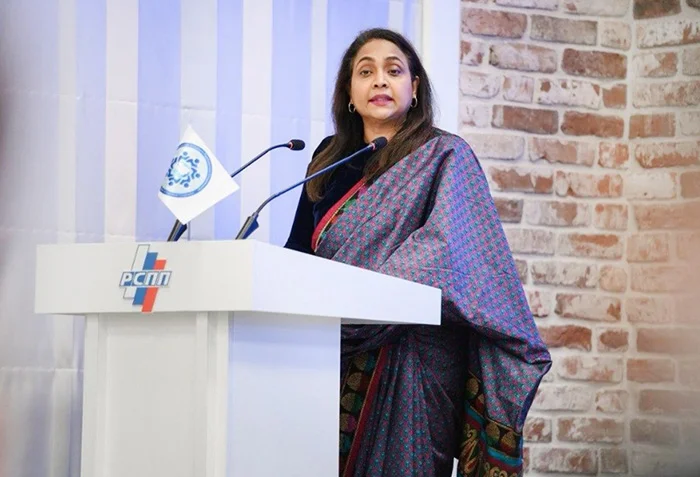
Sri Lankan Ambassador to the Russian Federation, Shobini Gunasekera recently presented a conceptual framework of seven key vectors that defined contemporary international relations and facilitated dialogue among States. She made the presentation at XI Moscow International Financial and Economic Forum held under the theme “Building Bridges: Partnership without Borders”.
In her address, the Ambassador emphasised that these vectors represent the channels through which ideas circulate, trade expands, and peace is strengthened, serving as guiding principles for cooperation amid global uncertainties. The seven key vectors highlighted were economic ties as a foundation for long-term stability; political choice and diplomacy through dialogue and multilateral engagement; security cooperation to address cross-border threats; cultural linkages through education, tourism, and professional exchanges; technological advancement, particularly in digital systems and artificial intelligence; environmental stewardship through collective action on renewable energy and climate change; and humanitarian obligations, including disaster relief and development cooperation.
Drawing on Sri Lanka’s experience, the Ambassador illustrated the practical application of these principles by highlighting the country’s strategic location in the Indian Ocean, its role as a trade and logistics hub, and its active engagement in regional groupings such as BIMSTEC and the Indian Ocean Rim Association, where the Russian Federation serves as a Dialogue Partner.
The potential for enhanced Sri Lanka–Russia bilateral cooperation was underscored, particularly through complementarities between Russia’s technological and energy expertise and Sri Lanka’s logistical capabilities and maritime infrastructure. She noted that such synergies could support joint initiatives in trade, innovation, tourism, and logistics, while cultural and scientific exchanges would further strengthen mutual understanding between the two countries.
Concluding her remarks, the Ambassador stated that sustained progress requires dialogue, mutual respect, and forward-looking partnerships capable of shaping a shared and stable future.

Navy seizes an Indian fishing boat poaching in northern waters

Mandhana, Shafali and Ghosh help India edge run-fest to go 4-0 up

Showers predicted in several provinces today (29th December)

Delay in govt. response to UK sanctions on ex-military chiefs, and others causes concern

Sri Lanka outlines seven key vectors of international cooperation at Moscow forum

Sri Lanka third most preferred destination for Indians

‘Dates have the highest sugar content to fight Coronavirus’

Sunday Island 27 December – Headlines

#SundayIsland 17th December – Headlines

Sunday Island – 28th March

Sunday Island Headlines – 21 March

Sunday Island – 21st February – Headlines
-

 News7 days ago
Members of Lankan Community in Washington D.C. donates to ‘Rebuilding Sri Lanka’ Flood Relief Fund
-

 News5 days ago
British MP calls on Foreign Secretary to expand sanction package against ‘Sri Lankan war criminals’
-

 Features7 days ago
General education reforms: What about language and ethnicity?
-
 News7 days ago
Suspension of Indian drug part of cover-up by NMRA: Academy of Health Professionals
-
 Sports5 days ago
Chief selector’s remarks disappointing says Mickey Arthur
-
 News4 days ago
Street vendors banned from Kandy City
-

 Editorial7 days ago
A very sad day for the rule of law
-

 News7 days ago
US Ambassador to Sri Lanka among 29 career diplomats recalled