
Sports
Pace dominates spin in Sri Lankan attack

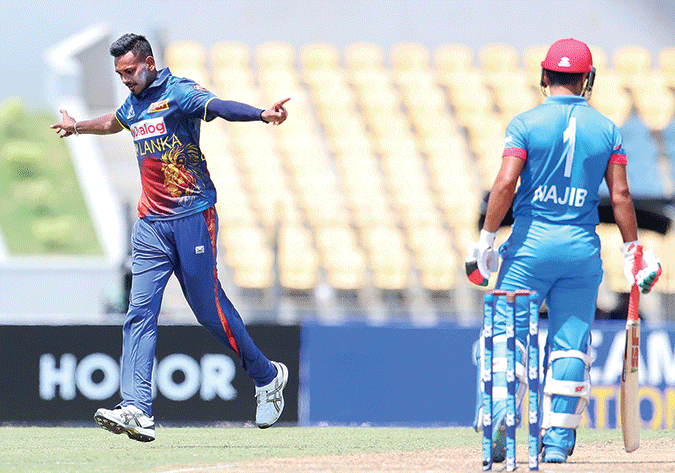
by Rex Clementine
When Singer boss Hemaka Amarasuriya headed the cricket board some 20 years ago, one of his keen interests was to build up a cricket academy at RPS like the one in Brisbane, Australia. The Queensland Academy was producing top notch cricketers at a rate and Amarasuriya had ambitious plans.
A keen sports enthusiast who loved both rugby and cricket, Amarasuriya wasn’t just interested in producing fine cricketers, but giving a professional outlook on them as well. The academy that he introduced taught players essentials of life such as managing finances, cricket history, etiquette and English among many other things.
Sadly, once Amarasuriya left office, the academy stationed at RPS ceased to exist. His visionary thinking should have been carried forward.
Along with the academy came the program called Pace Ace, a unit headed by Rumesh Ratnayake and supported by Champaka Ramanayake. Those days Sri Lanka were solely depending on Chaminda Vaas and the need to have more fast-bowling resources was felt.
Not only did the two coaches work with the next crop of quicks, but they also went headhunting for promising talents and were able to spot the likes of Lasith Malinga and Nuwan Kulasekara, just to name a few.
Similarly, you see several young fast bowlers coming up in recent years and it seems that Sri Lanka’s fast bowling strengths are better than spin options. Usually, it is the other way around. You have got to give credit to SLC’s District and Provincial coaches who have done an excellent job over the years in grooming rare talents.
Hambantota district where just a handful of schools play the game of cricket has produced the cream of the nation’s fast bowlers in recent years. There is Kasun Rajitha, Dilshan Madushanka and Pramod Madushan. Of course, there is also workhorse Suranga Lakmal, whose journey from Debarawewa to Derbyshire has been quite sensational.
The only captain to have won a Test match in Barbados, the fortress of West Indies cricket, is not Imran Khan, not Kapil Dev, not Arjuna Ranatunga but Lakmal.
It is the return of Dushmantha Chameera lead up to the World Cup Qualifiers that has enabled Sri Lanka to breathe easy. The quickest man in Sri Lankan colours is going to knock over the associate nations. He returned to international cricket this month after a seven-month layoff due to surgery and was quite a handful troubling the Afghans with his pace and not too often a Sri Lankan quick ends up as Player of the Series at home.
There maybe not much cricket left in Chameera as he has been constantly injured and rarely fulfilled his promise. The team management has carefully looked after his workload but even then he struggled with fitness and Sri Lanka will be hoping that he won’t break down this year which is very crucial with the Asia Cup and World Cup coming up.
Lahiru Kumara is capable of challenging Chameera when it comes to pace. Kumara at times struggles with his control whereas Chameera is on the money and tempts batters to take risks with his tight bowling.
The most improved bowler of them all is Kasun Rajitha, who has taken over Lakmal’s role since the tall quick retired last year. It is Rajitha’s discipline and his ability to move the ball that has proved to be handy and often he provides a breakthrough earlier on.
All the talk is about left-arm quick Dilshan Madushanka, who became the highest paid player in LPL with teams bidding for his services fiercely. He will take home a cool US$ 92,000 for just two week’s work. But the left-arm seamer who doesn’t get much attention is Binura Fernando. Standing at six feet and six inches, the former D.S. Senanayake College cricketer generates a steep bounce thanks to his height.
Matheesha Pathirana provides raw pace and his slingy action has not only earned him the nickname ‘podi Malinga’ but also has given Chennai Super Kings a quality death bowling option as they went onto win the IPL this season. The former Trinity player is yet to convert his success in franchise cricket into international cricket and questions remain whether he will be effective in the 50 over format.
The fact is Pathirana is just 20 and he will learn as he goes along and will win Sri Lanka lots of games in years to come.
Gradually, Sri Lanka’s attack has become pace oriented than spin. Wonder whether the curators should prepare pitches accordingly for home games. Not many pacemen barring Vaas and Malinga have had a major impact for Sri Lanka for a long period of time. You just get the feeling that all that is set to change.






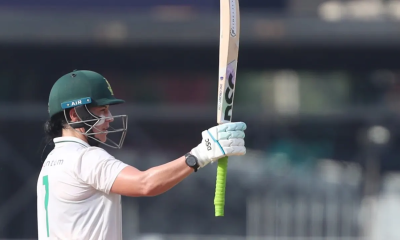

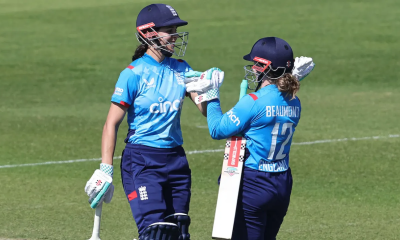


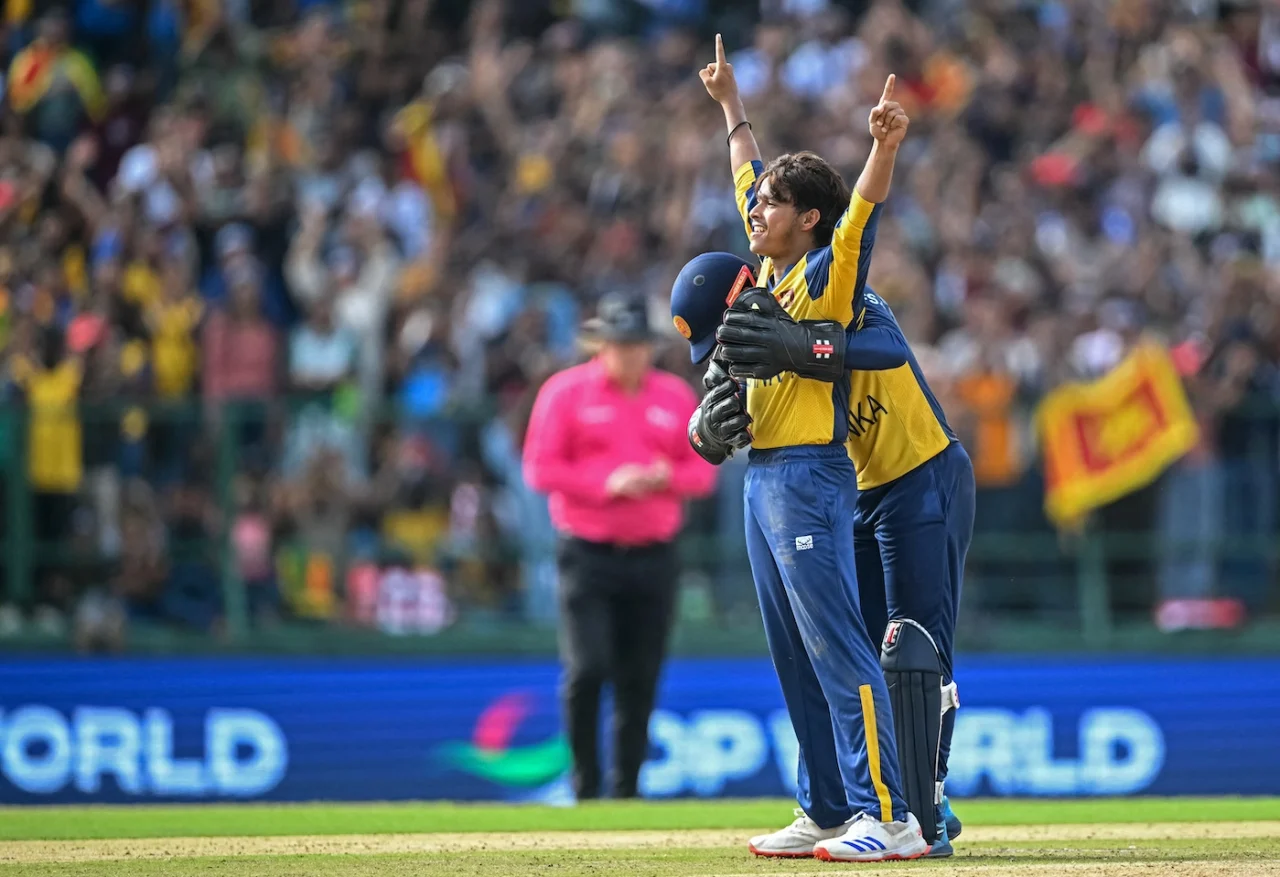
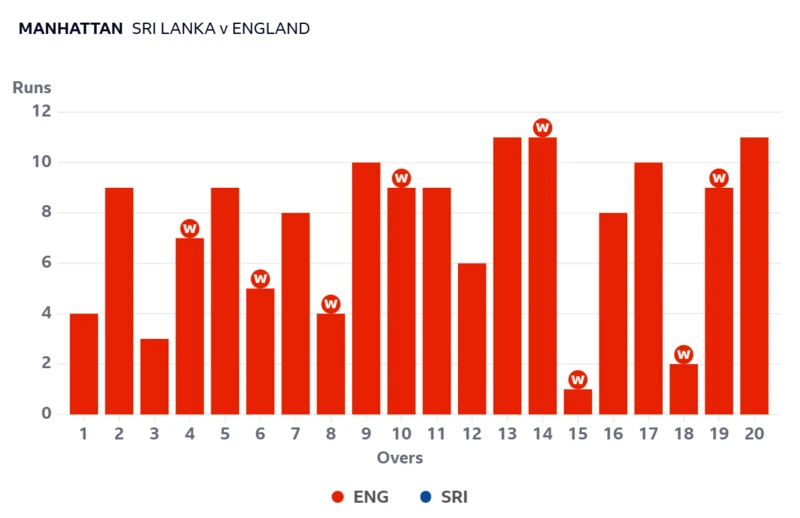
England stagger to 146‑9 at the end of their 20 overs as they failed to build any sustained partnerships.
This might just be well short of a truly competitive total but they will hope the pitch does them some favours when they come out to bowl.
Brief score:
England 146/9 in 2o overs [Phil Salt 62, Harry Brook 14, Sam Curran 11,Will Jacks 21, Jamie Overton 10*; Dilshan Madushanka 2-25, Dunith Wellalage 3-26, Maheesh Theekshana 2-21, Dushmantha Chameera 1-34] vs England
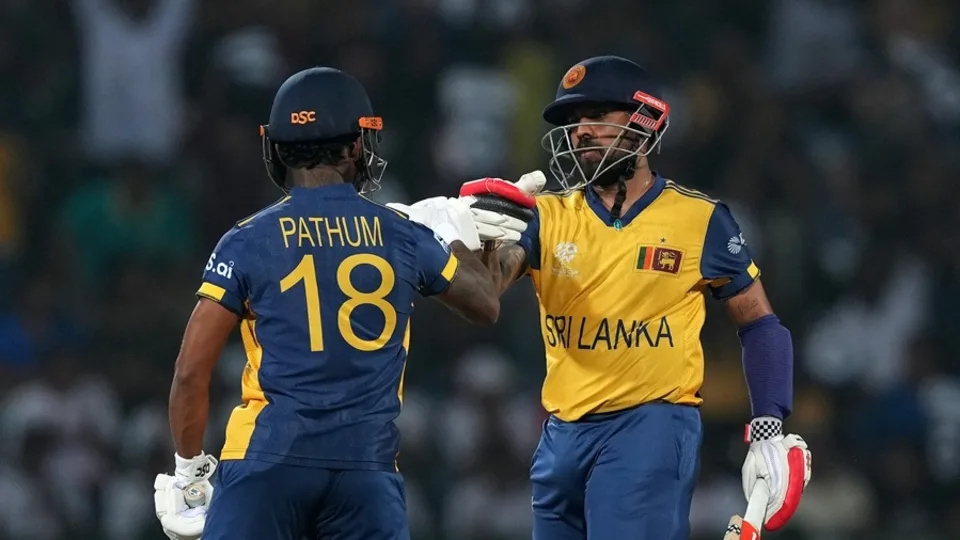
Sri Lanka have opted to chase against England at Pallekele, hoping to replicate their dominance victory over Australia here to kickstart their Super Eight campaign.
It was six days ago that Pathum Nissanka’s unbeaten 100 saw the hosts chase down Australia’s total of 181 with eight wickets and two overs to spare. And with home skipper Dasun Shanaka is looking to utilise that confidence in this Group 2 encounter.
“We’ve been chasing well in the past few occasions and happy to chase again,” said Shanaka at the toss. “The boys are very confident playing here.”
England skipper Harry Brook – on his 27th birthday – again called for bravery after his side stumbled into the second stage of this tournament. The two-time champions have gone in with an unchanged team for the fourth match in a row, with Jamie Overton retaining his place as the allrounder. Brook’s only slight worry is a cut to Jacob Bethell’s bowling hand (sustained during the match against West Indies), which is likely to prevent him from bowling due to the strapping on his finger.
Sri Lanka meanwhile make two changes to their XI, with Dushmantha Chameera returning in place of Pramod Madushan, having been rested for the defeat to Zimbabwe. Kamil Mishra comes back in for the man who replaced him, Kusal Perrera, as the hosts shuffle once more in an attempt to find a functional opening partnership.
These two squads know each other very well, having only concluded a three-match T20I series against one another at the start of the month, which took place entirely in Pallekele. England secured a 3-0 scoreline, capping things off with a professional 12run win in a low scoring encounter.
As for the outfield, both sides are primed for a different evening of ground-fielding on patchy grass. Heavy rains have punctuated the five das leading into this clash. Overnight precipitation has sodden the edges of the field, though the middle parts of the ground had been well-covered.
Sri Lanka: Pathum Nissanka, Kamil Mishara, Kusal Mendis (wk), Pavan Rathnayake, Kamindu Mendis, Dasun Shanaka (capt), Dunith Wellelage, Dushan Hemantha, Maheesh Theekshana, Dilshan Madushanka, Dushmantha Chameera
England: Phil Salt, Jos Buttler (wk), Jacob Bethell, Tom Banton, Harry Brook (capt), Sam Curran, Will Jacks, Liam Dawson, Jamie Overton, Jofra Archer, Adil Rashid
[Cricinfo]

Johannes Hoesflot Klaebo, Norway’s king of cross-country skiing, broke the record for the most gold medals won at a single Winter Olympics with his sixth of the Games.
Klaebo led a Norwegian sweep of the podium in the 50km mass start classic, with team-mates Martin Loewstroem Nyenget and Emil Iversen taking silver and bronze respectively.
The 29-year-old finished the brutal distance in two hours six minutes 44.8 seconds, 8.9secs ahead of Nyenget who takes his third medal of the Games.
“It’s been crazy, it’s a dream come true,” Klaebo told BBC Sport.
“I really think this Olympics has been perfect. Being able to crown the Olympics with the 50km was unbelievable.”
Klaebo breaks the previous record of five golds from a single Games, held by American speed skater Eric Heiden since the Lake Placid Olympics of 1980.
It also extends his own record for most Winter Olympic golds to 11, while he becomes the first athlete to win all six cross-country events at one Games.
Only US swimming great Michael Phelps, who won 23 gold medals, has more Olympic titles to his name.
Born in Oslo, Klaebo moved to Trondheim – a haven of cross-country skiing trails – as a young child, a move that has seen him become the greatest to ever do the sport.
No other man, active or retired, comes close to his record of 116 World Cup wins, while he is also a 15-time world champion, winning all six titles at last year’s edition on home snow in Trondheim.
“After the world championships last year, we knew that it was possible, but to be able to do it, it’s hard to find the right words,” he told reporters.
“[There were] so many emotions when I’m crossing the finish line.”
His sixth Olympic gold at Milan-Cortina adds to the titles he had won earlier in the Games in the skiathlon, sprint classic, 10km interval start free, 4×7.5km relay and the team sprint.
[BBC]

England limp to 146-9 against Sri Lanka

Advisory for Heavy Rain issued for the Central, Uva, Sabaragamuwa, Eastern and North-central provinces and in Galle and Matara districts

Sri Lanka opt to chase against England in Pallekele

More than 1,500 Venezuelan political prisoners apply for amnesty

Six races, six golds – Klaebo’s historic Olympics

India, South Africa meet in the final before the final

‘Dates have the highest sugar content to fight Coronavirus’

Sunday Island 27 December – Headlines

#SundayIsland 17th December – Headlines

Sunday Island – 28th March

Sunday Island Headlines – 21 March

Sunday Island – 21st February – Headlines
-

 Business7 days ago
Ministry of Brands to launch Sri Lanka’s first off-price retail destination
-

 Features15 hours ago
Why does the state threaten Its people with yet another anti-terror law?
-

 Features15 hours ago
Victor Melder turns 90: Railwayman and bibliophile extraordinary
-
 Features15 hours ago
Reconciliation, Mood of the Nation and the NPP Government
-
 Latest News2 days ago
New Zealand meet familiar opponents Pakistan at spin-friendly Premadasa
-

 Latest News2 days ago
Tariffs ruling is major blow to Trump’s second-term agenda
-

 Latest News2 days ago
ECB push back at Pakistan ‘shadow-ban’ reports ahead of Hundred auction
-
 Features7 days ago
Giants in our backyard: Why Sri Lanka’s Blue Whales matter to the world