
Latest News
Our responsibility is to restore the ecosystem for the benefit of future generations – President


The President emphasised that environmental restoration must begin with the removal of the damaging political culture that enabled destruction in the first place. “The political authority behind environmental degradation has been dismantled,” he said, issuing a stern message to public officials: “The time for change has come.”
The national campaign for World Environment Day this year, aligned with the global theme Beat Plastic Pollution, is operating under the sub-theme Let It Sprout. The President explained that this is not a mere symbolic observance, but a call to action, with programmes designed to create room for the environment to recover and regenerate.
Among key decisions announced at the event were: the declaration of Bandula Pethiya’s (Bandula Barb) habitat as a protected sanctuary; the gazetting of four new nature reserves along with the Nilgala Conservation Area; the designation of three schools as Eco-Friendly Model Institutions; and the launch of an evaluation system for Green Railway Stations. The event was jointly organised by the Ministry of Environment, its affiliated bodies, all state institutions, the Clean Sri Lanka Secretariat and environmental organisations.
President Disanayake further stated;
“Today is a momentous day. I have addressed many gatherings before and spoken on numerous occasions and voiced many opinions. But what I have to say today is not just another speech. It is a deep expression of commitment and responsibility towards our motherland and our natural ecosystem. I don’t see this as merely a ceremonial event, but as a declaration of our collective feelings and obligations towards environmental protection.
Foreign visitors often tell us how beautiful our country is. And it’s true, we are fortunate to possess an ecological legacy that has shaped our landscape and heritage. That same environment continues to enhance the beauty of our nation even today.
However, beneath this apparent beauty lies a tragic reality. We must ask ourselves: is the beauty we see truly reflective of a healthy ecosystem? Or is it a deceptive surface covering deep-seated environmental destruction? I believe we are facing a profound ecological tragedy.
In our youth, we knew a country free of landslides. But in our lifetime, we have witnessed the devastation of landslide disasters. We knew a Sri Lanka that was not plagued by severe floods or extreme droughts. Yet, we now experience these calamities all too frequently. The human-elephant conflict has reached crisis levels. A nation once known for its vibrant biodiversity now suffers from growing discord between nature and its inhabitants.
We who live in the present have a duty that we simply cannot ignore. We must restore our ecosystems. If this degradation continues unchecked, we will leave future generations with an irreversible catastrophe. Therefore, it is our moral responsibility to safeguard and rehabilitate the environment for our subsequent generations.
Sri Lanka already possesses some of the strongest environmental laws. We have a robust state apparatus capable of enforcing them. Yet, political patronage has been a significant barrier. Many of the coastal sand mining operations are owned by politicians or their close associates; you know this as well as I do. Even forest destruction has taken place under political protection.
Let me say this clearly: do not be agents of ecological destruction. Be agents of life. We will provide the political support needed for you to do so. The political authority has undergone reform, but elements of the bureaucracy remain trapped in outdated practices.
We have discovered officials in the Department of Immigration forging passports. We have found customs officers smuggling goods. There are even mining officials involved in enabling illegal exploitation. These are not isolated cases. That is why I say, let go of the old ways. Embrace change. The time has come. And I will repeat this again and again, either you change, or we will change you.
When I was living in Anuradhapura, water could be found just six feet below the ground. But today, even after digging sixty feet, water is nowhere to be found. We never imagined that, within our lifetime, shops would open in Anuradhapura to sell water. In the past, when we climbed Kadugannawa, all we could hear were the sounds of cicadas or crickets and flowing water and our ears get blocked. But now, that sound is gone. The environment has dried up. We have become a generation that is witnessing this environmental tragedies unfold within our own lifetime.
Many of the reservoirs in the central highlands are now filled with sediment. This raises an important question: did we truly consider the environmental impact when implementing these development projects? Historically, our ancestors never constructed reservoirs within the central highlands. Instead, they protected the highlands and diverted the water that flowed from them to build reservoirs at lower elevations. The Minipe canal system is one such example. In those days, the central highlands were also home to dense elephant populations.
Today, we no longer see flocks of storks or swarms of butterflies in our ecosystem. These are visible consequences of the destruction caused by human activity. Children are now growing up in a world where butterflies are no longer part of their natural surroundings. Therefore, it is our responsibility to restore an ecosystem where butterflies and other wildlife can return. In every field be it economics or education different perspectives may exist. But when it comes to the environment, there can be only one shared understanding the need to protect it. Safeguarding the environment and handing it over to the next generation is a duty that falls upon us as adults. Fortunately, citizens are standing with us in this effort and that gives us the opportunity to restore our natural ecosystems.
When it comes to environmental issues, Sinhala, Tamil and Muslim communities can all come together. Regardless of the nature of our national challenges, the environment is an area where unity is possible. The environmental sector has the potential to foster national cohesion. We now have an opportunity to rebuild our national environment through a shared national consciousness. That is why we are calling on everyone to “Let it Sprout”.
We have a responsibility to revive this land. A land that has dried up, where water systems have sunk deep underground, and where rapid destruction fuelled by concrete and plastic has taken its toll. I firmly believe it is our collective duty to restore and rebuild such a nation.
In doing so, this is the message we convey to the world: though we may be a small island in size, today we can rise as a giant in conscience. United, we can transform our country into a state that proudly owns a healthy and sustainable environment. When that day arrives, the world will look to Sri Lanka and say:
This is a nation that has reconnected with the land not in conflict with nature, but in harmony with it. Today, we find ourselves in confrontation with the natural world. Let us make it our collective aspiration to build a country that lives in peace with the earth. To achieve this, we must come together as one.
The event was attended by several distinguished guests, including Minister of Environment Dr. Dammika Patabendi, Governor of the Sabaragamuwa Province Champa Janaki Rajaratne, and the leader of the Indigenous Community,d Uruwarige Vannila Aththo.
[PMD]






US President Donald Trump has filed a $5bn (£3.7bn) lawsuit against the BBC over an edit of his 6 January 2021 speech in a Panorama documentary.
Trump accused the broadcaster of defamation and of violating a trade practices law, according to court documents filed in Florida.
The BBC apologised to Trump last month, but rejected his demands for compensation and disagreed there was any “basis for a defamation claim”.
Trump’s legal team accused the BBC of defaming him by “intentionally, maliciously, and deceptively doctoring his speech”. The BBC has not yet responded to the lawsuit.
Trump said last month that he planned to sue the BBC for the documentary, which aired in the UK ahead of the 2024 US election.
“I think I have to do it,” Trump told reporters of his plans. “They cheated. They changed the words coming out of my mouth.”
In his speech on 6 January 2021, before a riot at the US Capitol, Trump told a crowd: “We’re going to walk down to the Capitol, and we’re going to cheer on our brave senators and congressmen and women.”
More than 50 minutes later in the speech, he said: “And we fight. We fight like hell.”
In the Panorama programme, a clip showed him as saying: “We’re going to walk down to the Capitol… and I’ll be there with you. And we fight. We fight like hell.”
The BBC acknowledged that the edit had given “the mistaken impression” he had “made a direct call for violent action”, but disagreed that there was basis for a defamation claim.
In November, a leaked internal BBC memo criticised how the speech was edited, and led to the resignations of the BBC’s director general, Tim Davie, and its head of news, Deborah Turness.
Before Trump filed the lawsuit, lawyers for the BBC had given a lengthy response to the president’s claims.
They said there was no malice in the edit and that Trump was not harmed by the programme, as he was re-elected shortly after it aired.
They also said the BBC did not have the rights to, and did not, distribute the Panorama programme on its US channels. While the documentary was available on BBC iPlayer, it was restricted to viewers in the UK.
In his lawsuit, Trump cites agreements the BBC had with other distributors to show content, specifically one with a third-party media corporation that allegedly had licensing rights to the documentary outside the UK. The BBC has not responded to these claims, nor has the corporation with the alleged distribution agreement.
The suit also claims that people in Florida may have accessed the programme using a VPN or by using streaming service BritBox.
“The Panorama Documentary’s publicity, coupled with significant increases in VPN usage in Florida since its debut, establishes the immense likelihood that citizens of Florida accessed the Documentary before the BBC had it removed,” the lawsuit said
(BBC)

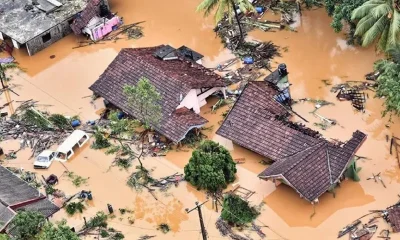
The Situation Report issued by the Disaster Management Center at 06:00AM on 16th December 2025 shows that 70,297 persons belonging to 22,338 house holds are still being housed at 731 safety centers established by the government.
The number of deaths due to the recent disastrous weather stands at 643 while 183 persons are missing.

Latest News
Bondi Beach gunmen who killed 15 after targeting Jewish celebration were father and son, police say

New South Wales Police say 15 people, including a 10 year old girl were killed in a shooting at Bondi Beach on Sunday – their ages range from 10 to 87
The attack happened while an event was being held to mark the start of Hanukkah – police say they’re treating it as a terror incident
The two gunmen were father and son, police say. The 50-year-old man also died at the scene while the 24-year-old remains in hospital in critical condition
Prime Minister Anthony Albanese calls the attack “an act of pure evil” that “deliberately targeted” the Jewish community
(BBC)

Trump files $5bn defamation lawsuit against BBC over Panorama speech edit

UK and South Korea strike trade deal

Rob Reiner’s son Nick arrested for murder after director and wife found dead

70,297 persons still in safety centers

Showers will occur at times in the Northern, North-Central, Eastern, Uva and Central provinces

MEPA to crack down on marine polluters

‘Dates have the highest sugar content to fight Coronavirus’

Sunday Island 27 December – Headlines

#SundayIsland 17th December – Headlines

Sunday Island – 28th March

Sunday Island Headlines – 21 March

Sunday Island – 21st February – Headlines
-

 Features7 days ago
Finally, Mahinda Yapa sets the record straight
-
 Features7 days ago
Handunnetti and Colonial Shackles of English in Sri Lanka
-
 Business5 days ago
Cabinet approves establishment of two 50 MW wind power stations in Mullikulum, Mannar region
-
 News6 days ago
Gota ordered to give court evidence of life threats
-

 Features6 days ago
Cliff and Hank recreate golden era of ‘The Young Ones’
-
 Opinion7 days ago
A national post-cyclone reflection period?
-
 Features6 days ago
Sri Lanka and Global Climate Emergency: Lessons of Cyclone Ditwah
-

 Latest News6 days ago
Sri Lanka squad named for ACC Men’s U19 Asia Cup