
Opinion
Orani Jansz – live wire of university English teaching programme


APPRECIATION
I am saddened to hear of the passing away of Orani Jansz, who became one of the dynamic coordinators of the English teaching programme in the universities. This is an opportunity to review the lessons we can learn from that era, as the same problems still exist today. I knew of Orani as a first year chemistry student in 1962 at the Colombo campus, when she was also a batch mate of Raddy Jansz and others in the General Science Qualifying programme. I was responsible for some of their chemistry lectures as well as chemistry practicals.
Orani Jansz was among those who were recruited to the ” English for all undergraduates” programme, launched in 1974, when I became the President of the Vidyodaya campus. I remember very clearly seeing the name of Orani Jansz in the list of applicants, and being agreeably surprised by it. We had diverse people, e.g., science graduates like Orani, and law students like Basil Fernando (now in Hong Kong) applying for teaching positions in the English project. Surprisingly, there were no “English Honours” applicants. Professor Gunawardena, the Head of the English Department was the enthusiastic live wire of the programme.
The “English for all undergraduates” was part of a curriculum overhaul (together with the introduction of course units etc.) that I began as soon as I became campus president. The moment the programme was launched, the “progressive”, “Marxist”, as well as “Nationalist” student leaders, rose against it. At the time S. B. Dissanayake was the leader of the campus Communist party and was the dominant student leader. Dissanayake and Mahinda Wijesekera (student leader of the Science Faculty with JVP links) declared their complete opposition to it. This was said to be “an attack on students using the “Kaduwa”. The “Kaduwa” or “sword” was the nickname for English used by the student leaders who regarded it as a weapon used by the “Kultoor set”. They threatened to reply in kind to the “Kadu Haramba” unless we stopped the programme immediately.
There were also threats to physically attack the English Instructors if they came to the campus to teach English. I rejected their threats and we proceeded to hire instructors, etc., when the student leaders launched a one-day strike as a test of strength. I had also asked Mr. Munasinghe, the Head of the Management Department, to ensure that no instructors were threatened. Mr. Munasinghe was well entrenched in the Gangodawila-Raththanapitya area and he informed the student leaders that any attacks on the instructors will be met by attacks on the student leaders by the village folk at the “Wijayaraama Junction”.
Some of the “moderate” student leaders, e.g., the World University Services (WUS) representative Gajaba, as well as the main student union, presented a “compromise” proposal, namely, that we should teach Russian instead of a “colonial language” like English. Instead of rejecting that as being absurd and inappropriate, I agreed that I can make immediate arrangements for holding Russian classes for those who wished to attend, while English will also continue. This was accepted by the student union. The Russian embassy was willing to provide a teacher, but not immediately.
However, I knew a Russian lady living in Colombo, and she agreed to give a few lessons in the interim. The first lesson attracted a large number of students, no doubt corralled in by the student leaders. So we had to hold the Russian class in the “arts hall” (called the “Lenin Hall” by the student leaders). After the first Russian lesson, there was a faster-than exponential decrease in numbers attending the subsequent classes. After about four classes there was no one turning up, and we terminated the teaching of Russian. Meanwhile the English department did a great job of developing a programme for teaching English to undergraduates who knew only their mother tongue.
It was the dedication of individuals, like Orani Jansz, that made the English Language programme a success. However, my attempts to modify the curriculum was viewed with great suspicion and antipathy by the student leaders, as well as some of the older members of the teaching staff. Their struggle continued for over an year. The option to have a degree named “B. Dev.” to cover what I called “Development Studies”, that looked at curricula in terms of their potential for national development, was treated with great suspicion by the faculties, as many of the staff felt that they may have to “re-learn” new stuff. However, the student leaders were supportive of getting a B. Dev. Instead of a “BA” that was felt to have no “Thathvaya” (Prestige). The Daily News columnist “Viranga” wrote a piece on the obsession of the students on “Thathvaya”, quoting me, and we had to face a day of strikes!
At the time, the students were given a degree on the basis of one giant “final exam”, with no credit for, or taking account of course work. Continuous assessment of the pedagogic process required holding and grading exams periodically, and evaluation of course work All this was considered by the older staff as “extra work” for them. Many lecturers, especially in the Arts faculty, normally tuned up just in time for their lecture and promptly went home, and considered their job to be over. Student leaders who rarely attended lectures feared course evaluation and the possible expelling of students who do not attend lectures or practicals. Their opposition, channelled through the Head of one of the science departments, and using strikes and threats, was supported by Mr. Sumanadasa, the then Vice Chancellor who trembled with fear whenever the student leaders came to his office and dictated terms.
The vacillations and actions of the Vice Chancellor were detrimental to the line of authority in the campus that was needed to carry out necessary reforms. He ignored the transgressions of students at every level, including unacceptable levels of ragging. Staff members who had been assaulted by student leaders lacked backbone and withdrew their complaints under further threats from students. The campus president was to handle all threats without any recourse to the police! The growth of naked violence in the campuses, as well as the waste of public money, seemed to be of no interest to authorities even after the failed 1971 JVP uprising. While the Central Bank refused foreign exchange to buy vital spare parts for lab equipment, “cyclostyle” wax sheets, or books needed for the new programme, it readily approved plastic wrap for cigarette companies. Ananda Meegama, then at the Central Bank approved some money on a personal basis when I saw him about all this. I felt that to be an unacceptable way of getting things done.
Political leaders were cheap enough to even undermine the university. For example, I managed to secure a much needed vehicle from a returning British diplomat; she was willing to just give it to the campus as a gift. Having got wind of it through a student leader, an influential MP claimed the vehicle for himself, because vehicle imports were banned in those days of “foreign exchange control”.
One has to look back to those times and say that individuals like Orani Jansz had to do their bit in an environment where campuses were in the grip of false ideologies. Unfortunately, things seem to have hardly changed today, given the horror stories of current campus raggings.
CHANDRE
DHARMAWARDANA

Confronting Sri Lanka’s Expanding Drug Threat
Senior security and intelligence professional with extensive experience in counter-terrorism, strategic risk assessment and law enforcement.
A Rising Tide Beneath the Surface
Sri Lanka’s recent success in intercepting large consignments of narcotics at sea is both reassuring and alarming. Reassuring, because it reflects the growing operational capability of the Sri Lanka Navy and the Police Narcotics Bureau. Alarming, because such volumes do not move without a market.
Are we merely intercepting supply, or are we ignoring a rapidly expanding demand within our own society?
· “If seizures are rising, it is not only a sign of enforcement success, it is also a signal of expanding demand.
“Boots on the Ground”: A New Meaning
In today’s Sri Lankan context, “boots on the ground” must be redefined. It is no longer limited to patrols at sea or coastal surveillance. It is about real presence intelligence-led, community-connected, and action-oriented.
Recent interdictions demonstrate a mature intelligence-to-action cycle. For this, the Sri Lanka Navy and Police deserve commendation.
Yet, behind every success lies a silent force
The Silent Shield: Intelligence Networks
Informants, analysts, and field operatives form the backbone of every successful operation.
* They operate under risk
* Their exposure can collapse entire networks
* Their contribution must be recognised discreetly, not publicly
“An exposed informant today is a lost network tomorrow.”
A Market-Driven Menace
Drug trafficking is not accidental, it is profit-driven.
The scale of maritime smuggling suggests that Sri Lanka is no longer just a transit hub. It is increasingly becoming a destination market.
This transforms narcotics from a policing issue into a national social crisis.
Inside the Network: A Structured Ecosystem
The drug trade operates through layered chains:
* International syndicates
* Maritime couriers
* Local facilitators
* Urban distributors
* Street-level peddlers
Each layer is insulated. Each link is replaceable.
“Break one link, and the chain adapts. Break the system, and the threat collapses.”
Demand Is Engineered
A critical reality:
Drug networks do not wait for demand; they create it.
* Free or low-cost initial access
* Targeting youth and vulnerable groups
* Expansion through peer networks
* Stealth distribution networks
Addiction is often designed, not accidental.
Awareness: Prevention or Promotion?
Sri Lanka’s awareness programmes show mixed results.
While well-intentioned:
* Overexposure can trigger curiosity
* Fear-based messaging is ineffective
* Generic campaigns lack relevance
“Poorly designed awareness can introduce what it seeks to prevent.”
The Missing Link: Awareness + Recovery
Awareness alone is insufficient.
A modern approach must include:
* Simple, relatable communication
* Focus on life consequences
* Clear access to rehabilitation
Shift the message:
From: “Say no to drugs”
To: “If trapped, there is a way out”
When Success Creates Strain: The Justice System Under Pressure
An often-overlooked consequence of increased drug detections is the pressure it places on the justice and prison systems.
A large number of drug-related offences are non-bailable, leading to a steady rise in remand populations. This has resulted in:
* Severe prison overcrowding
* Heightened tension among inmates
* Increased confrontation between prisoners and prison authorities
Overcrowded prisons are not only a humanitarian concern they are an escalating security risk.
The Forensic Bottleneck: Delays in Government Analyst Reports
At the centre of this strain lies a critical dependency the Government Analyst Department.
Every detection requires scientific confirmation. However, the system is under significant pressure:
* High volume of samples
* Shortage of trained personnel
* Limited availability of chemicals and laboratory materials
·
* Multiple deadlines imposed by courts
These constraints have led to delays in submitting reports, which in turn:
* Extend remand periods
* Increase court backlogs
* Fuel frustration among inmates
“Justice delayed in narcotics cases becomes both a legal failure and a security threat.”
A Sensitive Concern: Accuracy of Detections
Another emerging concern is that a number of samples sent for analysis reportedly do not contain narcotics.
If substantiated, this raises serious issues:
* Are arrests being made on insufficient preliminary evidence?
* Are field testing methods reliable?
* Is there undue pressure to increase detection statistics?
The implications are profound:
* Wrongful detention
* Loss of public trust
* Weakening of legitimate enforcement efforts
Each inaccurate detection undermines the credibility of the entire system.
A Dangerous Imbalance
Sri Lanka now faces a structural imbalance:
* Strong enforcement
* Increasing arrests·
* Limited forensic capacity·
* Overburdened courts·
* Overcrowded prisons
This imbalance creates a chain reaction of institutional stress.
The Strategic Gap: Where Is the Research?
Despite strong enforcement, Sri Lanka lacks a research-driven response.
The Police Narcotics Bureau and National Dangerous Drugs Control Board must be strengthened with:
* Dedicated research units
* Data on usage trends·
* Behavioural analysis·
* Evaluation of awareness programmes
Supported by international collaboration.
“Without research, strategy becomes a reaction.”
From Sea to Society
“Boots on the ground” must extend beyond enforcement:
* Religious leaders·
* Teachers and schools·
* Parents·
* Community networks·
The real battle is not only at sea but within society.
A National Priority
The consequences are severe:
* Loss of youth potential·
* Rising crime·
* Family breakdown·
* Long-term public health burden
This is a national security issue with generational consequences.
STRATEGIC CONCLUSION
OFFENSIVE FRAMEWORK (SUPPLY DISRUPTION)
INTERNATIONAL PARTNERS
NATIONAL INTELLIGENCE
SRI LANKA NAVY / COAST GUARD
POLICE NARCOTICS BUREAU
STF / POLICE OPERATIONS
ARRESTS & SEIZURES
JUDICIAL SYSTEM
Focus: Intelligence-led interdiction, maritime dominance, legal enforcement
PREVENTIVE FRAMEWORK (DEMAND REDUCTION)
GOVERNMENT POLICY & RESEARCH
NDDCB / PNB COORDINATION
EDUCATIONAL INSTITUTIONS
TEACHERS / COUNSELLORS
RELIGIOUS & COMMUNITY LEADERS
PARENTS
YOUTH
Focus: Awareness, early detection, social resilience, rehabilitation
INTEGRATED NATIONAL STRATEGY
(OFFENSIVE) (PREVENTIVE)
Sri Lanka has proven its ability to intercept drugs.
But interception alone is not victory.
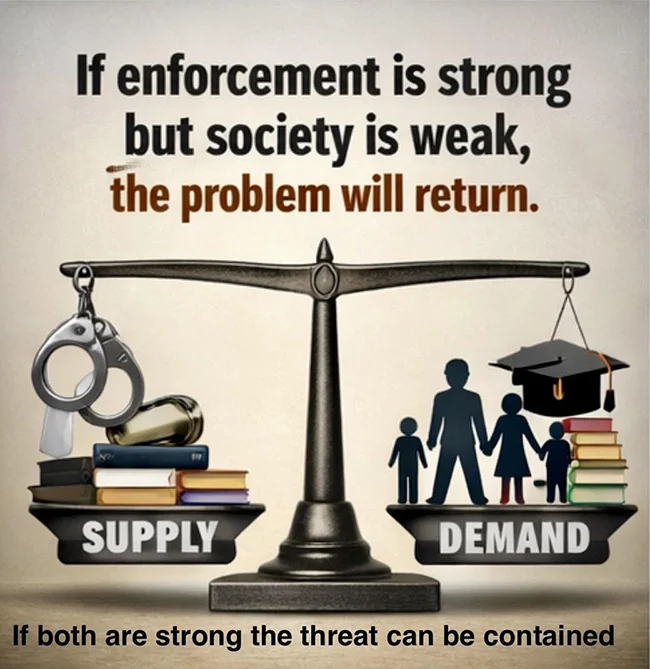
“If enforcement is strong but society is weak, the problem will return.
If both are strong, the threat can be contained.”
Conclusion
Sri Lanka is no longer confronting a distant or isolated narcotics threat it is facing a deeply embedded, evolving ecosystem that stretches from international waters to the minds of its youth.
The recent surge in maritime interceptions is not merely a success story. It is also a warning.
Every shipment seized at sea is a reflection of a demand that exists on land.
We must therefore move beyond the comfort of operational victories and confront the harder truth: this battle cannot be won by enforcement alone.
“Boots on the ground” must now mean more than patrol vessels and tactical units. It must represent a nationwide presence of awareness, vigilance, intelligence, and responsibility from coastal radar stations to classrooms, from intelligence cells to family homes.
At the same time, we must protect what protects us from the intelligence networks that operate in silence. Their strength lies in their invisibility. Their recognition must remain measured, discreet, and strategic.
The drug economy is adaptive. It creates demand where none exists, exploits vulnerability where it finds it, and thrives where systems are disconnected. If left unchecked, it will not only fuel crime it will reshape society, erode institutions, and compromise future generations.
What Sri Lanka needs now is not a fragmented response, but a coordinated national doctrine:
* Strong at sea
* Smart in policy
* Deep in research
* Present in societyBecause the real battleground is no longer just geography it is generational.
What is required now is not just stronger enforcement but smarter systems, balanced capacity, and a unified national response. Because this is no longer just about drugs. It is about the future of the nation.
Mahil Dole is a retired senior police officer and former Head of the Counter-Terrorism Division of Sri Lanka’s State Intelligence Service. With over four decades in policing and intelligence, he has interviewed more than 100 suicide cadres linked to extremist movements. He is a graduate of the Asia-Pacific Center for Security Studies in Hawaii and has received specialist training on terrorist financing in Australia and India.
By Mahil Dole

In recent months, President Anura Kumara Dissanayake has repeatedly expressed a concern that the government does not have the accurate data it needs to make good decisions.
At meetings with senior officials from ministries ranging from health and agriculture to education and infrastructure, the President has reportedly lamented that the government often lacks reliable information on what its projects are achieving, how funds are being spent, and whether public investments are producing results. The meeting on December 6th at the Matale District Secretariat was a case in point. The President emphasised the need for most accurate data to award compensation for damaged agricultural lands before the month’s end. He recalled that the Department of Agriculture’s data showed an excess of rice in the country, but the nation has faced a rice shortage.
For a country attempting economic recovery after the most severe crisis in its post-independence history, absence of accurate data is a dangerous position to be in.
Without data, decisions become guesswork. Without evidence, policy becomes speculation.
Ironically, Sri Lanka already possesses the policy architecture required to solve this problem. The National Evaluation Policy (2018) and the National Evaluation Policy Implementation Framework (2023) were created precisely to ensure that public spending is guided by evidence, results, and accountability. Yet today, despite these policies and the presence of a dedicated government agency tasked with monitoring development projects, the country still lacks the integrated digital monitoring and evaluation system needed to turn policy into practice. Until that gap is closed, Sri Lanka will continue to struggle with inefficient public investment, delayed projects, and policy decisions made without reliable evidence.
The scale of the problem
The Department of Project Management and Monitoring (DPMM), operating under the Ministry of Finance, is the central institution responsible for overseeing development projects implemented by government ministries. According to its 2024 Annual Performance Report, the department monitored 226 large-scale development projects across various ministries during the year. These projects collectively had an allocated budget of LKR 705 billion, but the actual expenditure amounted to only LKR 401.96 billion, representing about 56.9% utilization of the allocated funds.
In other words, nearly half of the planned development spending did not materialize.
While fiscal constraints and external factors contributed to this outcome, the data nevertheless highlights a deeper systemic issue: weak monitoring and decision-making structures that fail to identify and resolve implementation problems early.
The report also indicates that many projects face delays due to procurement issues, coordination failures, cost escalations, and operational bottlenecks. What makes the situation more troubling is that information about these problems is often fragmented and slow to reach decision-makers.
The government does monitor projects through reports and field visits, but the information flow remains largely manual and scattered across ministries. In the digital age, such a system is simply inadequate.
A policy that already foresaw the solution
Sri Lanka’s National Evaluation Policy (NEP), approved by the Cabinet in 2018, recognised this problem years ago. The policy aims to ensure that public investment decisions are guided by reliable evidence, efficiency, and measurable development results.
The NEP outlines several key goals:
· strengthening evidence-based decision making,
· improving efficiency in resource utilisation,
· ensuring transparency and accountability in public expenditure,
· promoting learning from successes and failures of past projects, and
· creating a national culture of evaluation.
To operationalise the policy, the government introduced the National Evaluation Policy Implementation Framework (NEPIF) in 2023. This framework explicitly calls for the creation of integrated information systems capable of gathering and analyzing data across the project cycle—from planning and budgeting to implementation and evaluation. In fact, NEPIF specifically proposes the establishment of a web-based integrated public investment management and evaluation information system to store project data and evaluation reports.
Such a system would allow decision-makers to access reliable information quickly, improving accountability and policy planning. Unfortunately, despite the clarity of this vision, the digital infrastructure necessary to implement it at a national scale is still largely absent.
A revealing moment at a Colombo seminar
The urgency of this gap became strikingly clear at a recent seminar in Colombo organized by a national NGO. The organization demonstrated its cloud-based monitoring and evaluation system which was comprehensive and updated by multiple layers of personnel, to a group of university students. On a large screen, a dashboard displayed real-time information on the organization’s twenty development projects across the country. Each project appeared as a branch of a digital tree, connected to activities, budgets, locations, and beneficiaries. With a few clicks, staff could generate reports showing the status of any project at national, district, or local levels, both of data and graphics. Updated data was available up to the previous day.
What would normally take weeks of manual compilation could be done in less than a minute.
Among the audience was a university academic who observed something obvious but powerful. ‘If a small NGO can run a system like this,’ he asked, ‘why can’t the Government?’ Another participant responded and told that the non-introduction of a digitalized Monitoring and Evaluation mechanism was due to some bureaucrats’ resistance. ‘I heard the Evaluation Reports of several projects of the government was not published because the respective Project Managers had opposed, fearing their failure would be exposed’, another academic commented. Those comments deserve serious reflection on the situation, I believe.
The digital revolution in monitoring and evaluation
Around the world, governments are increasingly adopting digital monitoring and evaluation platforms to track public investments in real time. These systems combine several elements:
· project databases
· geospatial mapping
· financial monitoring tools
· citizen feedback mechanisms
· performance dashboards for decision-makers.
Countries such as Estonia, South Korea, Rwanda, and Chile have integrated such systems into national governance structures. In these systems, ministers and senior officials can see instantly:
· which projects are progressing
· which projects are delayed
· how funds are being spent
· whether outputs and outcomes are being achieved.
More importantly, such platforms enable early intervention. Problems can be identified before they become crises. For Sri Lanka, which must now manage scarce fiscal resources with extreme care, such tools are no longer optional luxuries.
They are necessities.
The cost of not knowing
The absence of integrated data systems carries real economic consequences. Public investment decisions affect everything from roads and irrigation schemes to hospitals and schools. When these investments fail or underperform, the cost is not merely financial. It affects the daily lives of citizens.
A hospital without doctors. An irrigation scheme without water. A school building without teachers.
These are not simply implementation failures; they are information failures.
Without reliable monitoring systems, governments often learn about problems too late. By the time corrective action is taken, budgets have been spent and opportunities lost.
The NEPIF recognises precisely this challenge. It emphasises that evaluation should be an integral part of the entire development cycle—from project design to implementation and feedback for future planning.
But such evaluation cannot occur without reliable data systems.
Building an evaluation culture
Another important goal of the National Evaluation Policy is to create a culture of evaluation within the public sector. This requires a shift in mindset. Evaluation should not be seen as a fault-finding exercise. Instead, it should function as a learning mechanism that helps improve policy design and implementation.
The NEPIF stresses that evaluation findings should inform planning, budgeting, and future project selection. However, without systematic information systems, evaluation results often remain scattered across reports that few decision-makers read. Digital platforms can transform this situation by making information visible, accessible, and actionable. They turn data into knowledge. And knowledge into better decisions.
What a national digital system could look like
Sri Lanka does not need to start from scratch. The institutional building blocks already exist:
· the Department of Project Management and Monitoring (DPPM)
· the National Evaluation Policy
· the National Evaluation Policy Implementation Framework
· various sector-specific monitoring systems across ministries.
What is missing is integration.
A national digital monitoring and evaluation platform could include:
1. A centralised project database:
All government development projects recorded with budgets, timelines, outputs, and implementing agencies.
2. Real-time progress dashboards:
Accessible to the President, Cabinet, ministry secretaries, and provincial administrators.
3. Geographic mapping:
Showing where projects are located and how they benefit communities.
4. Automated reporting:
Reducing paperwork and enabling faster decision-making.
5. Citizen transparency portals:
Allowing the public to see how public funds are used.
Such a system would dramatically strengthen transparency, accountability, and efficiency.
The opportunity before Sri Lanka
Sri Lanka today has a rare opportunity. Economic crises often force governments to rethink outdated systems. The country cannot afford inefficient public investments any longer. Every rupee spent must produce measurable results. The National Evaluation Policy and its implementation framework already provide the intellectual foundation for this transformation. What remains is political commitment. A bold decision to build the digital infrastructure of evidence-based governance.
A call to action
The President’s concern about the lack of reliable data in government is both accurate and urgent. But the solution does not require new policies. The policies already exist. What Sri Lanka needs now is implementation. A national digital monitoring and evaluation system would give policymakers something they currently lack: a clear, real-time picture of the country’s development efforts. Such a system would empower leaders to identify problems early, allocate resources wisely, save billions of rupees from wasting and ensure that development projects truly benefit citizens.
In short, it would give Sri Lanka what every modern state needs: a digital nervous system connecting policy, data, and decision-making. The question is no longer whether the country needs such a system.
The question is simply this: how soon Sri Lanka is willing to build it.
by Tilak W. Karunaratne

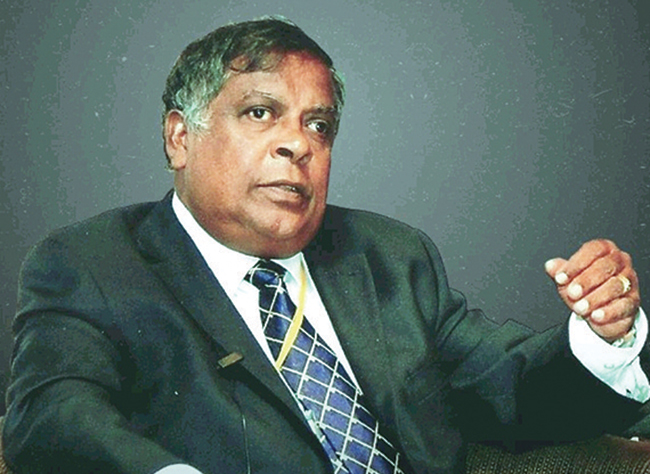
Mr. Tuli Cooray, former Deputy Director General of the Board of Investment of Sri Lanka (BOI) and former Secretary General of the Joint Apparel Association Forum (JAAF), passed away three months ago, leaving a distinguished legacy of public service and dedication to national economic development.
An alumnus of the University of Colombo, Mr. Cooray graduated with a Special Degree in Economics. He began his career as a Planning Officer at the Ministry of Plan Implementation and later served as an Assistant Director in the Ministry of Finance (Planning Division).
He subsequently joined the Greater Colombo Economic Commission (GCEC), where he rose from Manager to Senior Manager and later Director. During this period, he also served at the Treasury as an Assistant Director. With the transformation of the GCEC into the BOI, he was appointed Executive Director of the Investment Department and later elevated to the position of Deputy Director General.
In recognition of his vast experience and expertise, he was appointed Director General of the Budget Implementation and Policy Coordination Division at the Ministry of Finance and Planning. Following his retirement from government service, he continued to contribute to the national economy through his work with JAAF.
Mr. Cooray was widely respected as a seasoned professional with exceptional expertise in attracting foreign direct investment (FDI) and facilitating investor relations. His commitment, leadership, and humane qualities earned him the admiration and affection of colleagues across institutions.
He was also one of the pioneers of the BOI Past Officers’ Association, and his passing is deeply felt by its members. His demise has created a void that is difficult to fill, particularly within the BOI, where his contributions remain invaluable.
Mr. Cooray will be remembered not only for his professional excellence but also for his integrity, humility, and the lasting impact he made on those who had the privilege of working with him.
The BOI Past Officers’ Association
jagathcds@gmail.com

Punjab Kings fined for slow over-rate

Ice-cool Connolly leads nervy Punjab Kings home on IPL debut

Showers expected in the Western, Sabaragamuwa and Southern provinces in the evening or night

Heat Index at Caution Level in the Western, Sabaragamuwa, Southern, Eastern, North-western, Northern and North-central provinces and in Monaragala district

Urea shortage threatens Yala harvest: Experts

2025 property grab: Court orders JVP to hand back Yakkala office to FSP

‘Dates have the highest sugar content to fight Coronavirus’

Sunday Island 27 December – Headlines

#SundayIsland 17th December – Headlines

Sunday Island – 28th March

Sunday Island Headlines – 21 March

Sunday Island – 21st February – Headlines
-

 Features4 days ago
A World Order in Crisis: War, Power, and Resistance
-

 News5 days ago
Energy Minister indicted on corruption charges ahead of no-faith motion against him
-

 News6 days ago
US dodges question on AKD’s claim SL denied permission for military aircraft to land
-

 Business6 days ago
Dialog Unveils Dialog Play Mini with Netflix and Apple TV
-

 Sports5 days ago
SLC to hold EGM in April
-

 Latest News6 days ago
A strong Technical and Vocational Education and Training (TVET) system equips individuals with practical, relevant, and future-oriented skills helping to innovate responsibly towards a greener and sustainable future – PM
-

 Opinion5 days ago
When elephants fight, it is the grass that suffers
-

 Features5 days ago
Lest we forget