
Business
Only 0. 04% of SL’s land parcel allocated for Industrial Zones: Minister

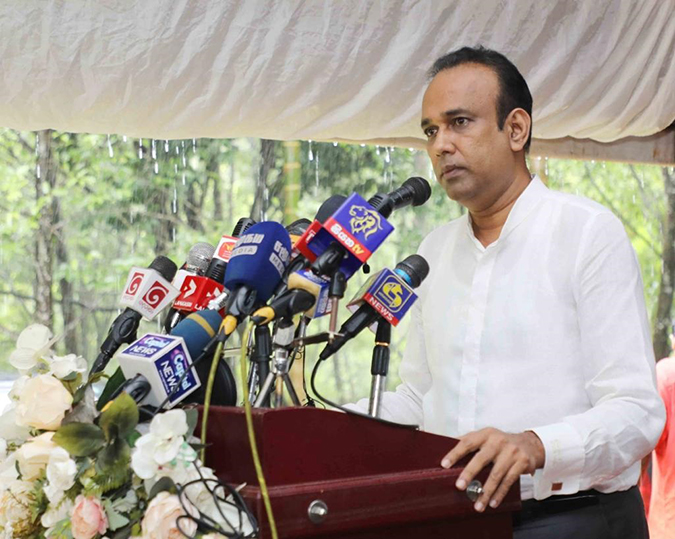
‘Productivity of land utilized for agriculture and plantations very low’
by Sanath Nanayakkare
Industrial Zones that account for 30% of local GDP have received only 0.04 % of the country’s land parcel, while millions of hectares of land utilized by the traditional agriculture and plantation sectors account for only 8% of the GDP because the two industries are lagging behind in their value- addition processes, Minister of Plantation Industries and Minister of Industries Dr. Ramesh Pathirana said on Monday.
Pathirana made these remarks while presenting the keynote speech at Nebada Sadaharitha Estate in the Kalutara district, where the Sadaharitha Group, a leader in the Sri Lankan green commercial forestry sector, marked its 21st anniversary.
Speaking further the Minister said:
“Our plantations industry dates back to more than a century and our agriculture industry is even more ancient. Approximately 4 million of our people directly depend on agriculture. In the past 75 years, we have benefited from these two sectors. A good example for this is in 1952, Sri Lanka and China entered into a rubber-rice pact when the country had to face a shortage of rice and China wanted rubber from Sri Lanka. In 1952, Sri Lanka’s population was 6.3 million. Today the population has increased to about 22 million and enough rice is produced for the nation without an issue.
This is because of the substantial investments we have made in water reservoirs, irrigation systems, seeds distribution and fertilizer subsidies. Tea and rubber also get re-planting subsidies. Cinnamon growers get plants for free. However, the country’s agriculture sector accounts for only 8% of the GDP. So, although millions of hectares of the nation’s land are utilized by the agricultural and plantations industries, there is a clear lack of productivity generated by the nation’s land resource by the traditional agriculture sector. This difference becomes clear to us when we work with the agricultural sector and the industrial sector. There is as little as 0.04% of land allocated for industrial zones of the country and they account for 30% of the GDP.”
“During the recent economic crisis, we realized that although the agriculture industry is good and the plantations industry is also good, they are more prone to dependency and their export-oriented value addition processes are on a back-foot relative to other countries in the world.”
“Our commercial tea industry is as old as 150 years since James Taylor, the Scottish planter, who discovered Sri Lanka had great potential for tea. Ceylon tea brand still fetches the best price in the world vis a vis Kenya and India. But our value addition and brand building fronts are in a very backward position. Our value addition is 40% including the production of 5-kilo bags which is also considered as a value addition.
Traditional tea exporters are not willing to shift from their models. They have historically exported tea to Turkey, Iran, Iraq, Lybia, Syria etc. The trade volume accounts for USD 1.2 billion. We need to be thankful to them for their hard work. In terms of rubber, we have become a centre for producing rigid tyre which generates an income of USD 1 billion. But the productivity in our rubber plantations has declined as tappers tend to exit the industry because of weather conditions.
On the coconut front, there is an increasingly favourable situation for Sri Lanka because there is increasing global demand for coconut and allied products. In 2022, we were able to record an income of USD 836 million from coconut exports. I believe that we will be able to earn USD 2 billion from the coconut and allied product exports in 5 to 7 years. Last year, cinnamon industry earned us USD 300 million. But, with Sri Lanka receiving its first ever Geographical Indication (GI) certification for Ceylon Cinnamon, we shall be able to expand our cinnamon exports in the future.”
“In this context, we need to draw our attention towards other commercial crops which have a demand in the global market including the Agarwood cultivation which Sadaharitha has developed a notable footprint across Sri Lanka in cultivation and has also secured a place for their products in the export market. Further, we have instructed the EDB to promote our coffee exports as global coffee sales volume is as five times as tea. The Malaysian Ambassador in Sri Lanka recently drew my attention to commercial cultivation of Durian fruit and we are looking at the possibility of growing it in rubber plantations where rubber trees are sparse. Further, we are looking at the possibility of expanding our export of fresh fruits to the EU, Australia and New Zealand in addition to the Maldives and the Middle East. For this, we are now in the process of earning international certifications to enter those markets.”











Business
SLAF, Aviyana Ceylon partner to elevate high-end sports tourism with Eagles’ Monsoon Cup 2026


Aviyana Ceylon, Sri Lanka’s upcoming ultra-luxury seven-star hospitality project, has stepped decisively into the country’s high-end sports tourism space by coming on board as the principal sponsor of the prestigious Eagles’ Monsoon Cup Golf Tournament 2026, in partnership with the Sri Lanka Air Force (SLAF).
The international-standard golf tournament is scheduled to be held on January 11, 2026, and is expected to attract diplomats, corporate leaders, high-net-worth individuals and overseas golfers, reinforcing Sri Lanka’s positioning as an emerging premium leisure and sporting destination.
Under the patronage of Aviyana Ceylon chairman, Dr. Thisara Hewawasam, the company has committed a Rs. 2.5 million sponsorship, marking one of the most significant private-sector investments in elite golf events in recent years.
The sponsorship was formalised at a ceremonial cheque handover held at the Sri Lanka Air Force Headquarters, where Dr. Hewawasam officially handed over the cheque to Commander of the Air Force, Air Marshal Bandu Edirisinghe.
“Our decision to support the Eagles’ Monsoon Cup goes beyond sport. It is a strategic investment in positioning Sri Lanka as a global luxury tourism and lifestyle destination, Dr. Hewawasam said.
“International sporting events with strong networking potential play a critical role in shaping perceptions, attracting premium travelers and enhancing the country’s brand equity. Aviyana Ceylon is committed to supporting platforms that elevate Sri Lanka’s global standing, he added.
Senior SLAF officials, including chairman, Eagles’ Golf Links, Air Commodore Erandika Gunawardhana, secretary of the Air Force Sports Council and Director Media, Group Captain Eranda Geeganage, Secretary of Eagles’ Golf Links, Group Captain Asanka Ratnayake and SLAF Golf Secretary, Wing Commander R.A.S.T.A. Fernando, along with Aviyana Ceylon representatives and invited guests were present at the event.
Air Marshal Bandu Edirisinghe welcomed the partnership, noting that collaboration between the military and private sector is vital in developing sports diplomacy and tourism-led economic activity.
“Eagles’ Monsoon Cup has evolved into a premier sporting event that brings together global and local stakeholders. The support extended by Aviyana Ceylon strengthens our ability to host events of international calibre and contributes meaningfully to sports tourism and national image-building, the Air Force Commander said.
Beyond the golf tournament, the partnership opens the door to new experiential tourism initiatives, including a proposed collaboration to offer luxury helicopter tours for Aviyana Ceylon’s clientele, operated in coordination with the Sri Lanka Air Force.
According to Dr. Hewawasam, the concept aims to provide discerning travelers with exclusive aerial experiences showcasing Sri Lanka’s landscapes, coastlines and heritage.
“Luxury heli-tours represent a new dimension in experiential tourism. They allow us to present Sri Lanka’s natural beauty from a unique vantage point, appealing to high-value travelers seeking privacy, exclusivity and unforgettable experiences, he said.
Industry observers note that such initiatives align with global trends where luxury hospitality brands integrate sports, aviation and curated experiences to differentiate destinations and increase average tourist spend.
The Eagles’ Monsoon Cup is widely regarded as one of Sri Lanka’s most elite sporting events, functioning not only as a golf tournament but also as a high-level networking platform linking diplomacy, business and leisure.
By Ifham Nizam

Reports received by us from tea brokers, the Colombo Tea Traders’ Association (CTTA) and other sources indicated that, by and large, the local tea sector has been spared by the recent weather havoc.
The CTTA in their recent communications said that although Cyclone Ditwah affected parts of Sri Lanka, production, sales, and exports of tea continued without interruption. Clearly, the report said, the well established and highly coordinated industry network was fully geared to confront these issues. Production and sales continued with least disruption . While some tea growing areas in Uva, and the Central Province experienced some impact no loss in manufacturing capacity was reported.
Damage was largely confined to specific roads, resulting in temporary disruptions to transportation. Some key routes connecting plantations to the city have now been reopened and transport services are resuming normal operations. Harvesting operations are gradually returning to normal with access roads being reopened and temporary roads have been constructed to facilitate transport of green leaf to manufacturing locations.
The tea small holders we met said, although their production routine was affected, quick return to normalcy was ensured thanks to the established Tea Small Holders’ Association whose action ensured speedy return to normalcy. They reiterated production was near normal; and the dismal situation was now in a controlled position. They assured that such losses were minimal and could be recouped with minimum delay.
The CTTA further said the majority of plantations and small holder lands in the South of the island were spared cyclone damage. Harvesting, manufacturing and transportation activities are continuing as usual.
Trading activities at the Colombo Tea Auctions continue to be held although with a revised calendar. The tea auction previously set for the 1st week December has been rescheduled for the last week December. This adjustment ensures uninterrupted financial flows to the producers , including small holders, maintaining the momentum of the industry.
Forbes and Walker Tea Brokers reported a national tea sale average for November of Rs. 1137.22 ( USD3.89) which shows an increase of Rs.61.17 and USD 0.02 YOY. The total National Sale Average for the year 2025 ( to date) was recorded at Rs. 1,164.97( USD 3.88). a decline of Rs . 63.49 ( USD 0.17) against the corresponding year’s average of Rs. 1228.46 (USD4.05). The report further said all elevations recorded negative variances during the period January to November 2025 in comparison to the cumulative corresponding year of 2024 in both LKR and USD terms.
By Steve A. Morrell

Ceylon Cold Stores PLC (CCS), a subsidiary of John Keells Holdings PLC, has launched its iconic Elephant House Ice Cream in Australia, marking a bold step in the brand’s global expansion. The official unveiling took place on 4th December 2025 at the Novotel Melbourne Glen Waverley, where industry leaders, local distributors, and strategic partners gathered to celebrate the occasion. The launch was further honoured by the presence of Ms. Pradeepa Seram, Consul General Designate of Sri Lanka, and Ms. Cassandra Fernando, Member of the Australian Parliament, reflecting the deep and growing connections between Sri Lanka and Australia.
Elephant House is one of the highest-penetrated Sri Lankan brands among Sri Lankan communities living overseas, with a presence in 16 countries, including the Maldives, Australia, and the United Kingdom, among others.
In a significant milestone for the company, Elephant House Ice Cream is now manufactured locally in Melbourne to support wider availability in the ethnic market in Australia. The range currently available includes Vanilla, Karutha Kolomban, and Fruit and Nut in 500ml packs. This marks the first time in CCS’s 150-year legacy that Elephant House Ice Cream has been produced outside Sri Lanka, signalling a new chapter in the company’s international growth journey in collaboration with Millennium Imports Pty Ltd, it’s one of the franchise partners for Australia.

Nepal to scrap ‘failed’ Mount Everest waste deposit scheme

Trump hopes to reach phase two of Gaza ceasefire ‘very quickly’

Bangladesh’s first female prime minister Khaleda Zia dies aged 80

Ukraine denies drone attack on Putin’s residence

Showers expected at times in the Northern, Eastern, Central, North-central and Uva provinces

Dr. Bellana: “I was removed as NHSL Deputy Director for exposing Rs. 900 mn fraud”

‘Dates have the highest sugar content to fight Coronavirus’

Sunday Island 27 December – Headlines

#SundayIsland 17th December – Headlines

Sunday Island – 28th March

Sunday Island Headlines – 21 March

Sunday Island – 21st February – Headlines
-

 News5 days ago
British MP calls on Foreign Secretary to expand sanction package against ‘Sri Lankan war criminals’
-

 Sports5 days ago
Chief selector’s remarks disappointing says Mickey Arthur
-
 News4 days ago
Street vendors banned from Kandy City
-

 News6 days ago
Sri Lanka’s coastline faces unfolding catastrophe: Expert
-

 Opinion5 days ago
Disasters do not destroy nations; the refusal to change does
-

 News4 days ago
Lankan aircrew fly daring UN Medevac in hostile conditions in Africa
-

 Midweek Review6 days ago
Year ends with the NPP govt. on the back foot
-

 Sports6 days ago
Life after the armband for Asalanka