
Features
Notes towards a politics and aesthetics of film:

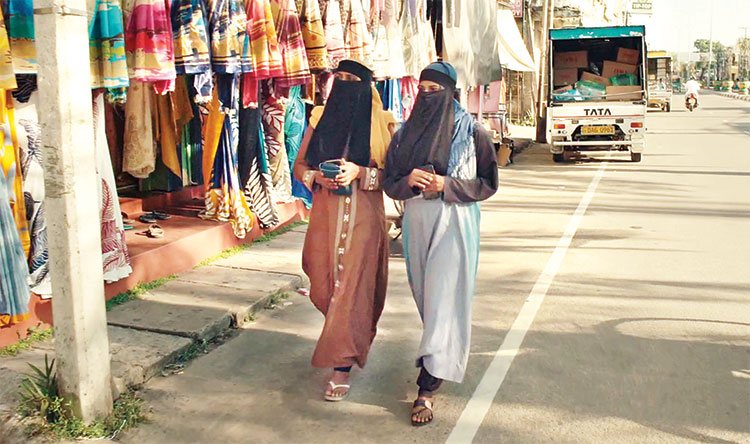
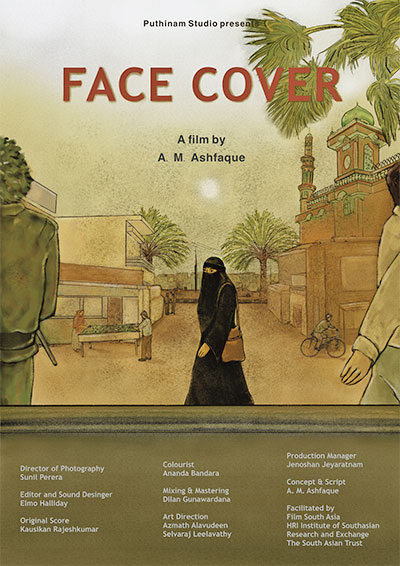
‘Face Cover’ by Ashfaque Mohamed
“Black cat, at the tip of my
fingers pulsates poetry,
Desiring hands, yours, nudgingly pluck those roses of mine
In the soft light of the moon
The dreams we picked from the foaming edges of waves of the sea.”
Jusla/Salani (in Face Cover)
PART II
First part of this article appeared yesterday (01)
by Laleen Jayamanne
I personally loved wearing a veil to church, especially my Spanish-mantilla. And then I remembered how most of the paintings of the Virgin-Mother Mary in the European tradition have presented her with her head covered as was the custom of Middle Eastern peoples of the Book (Jews, Christians and Muslims), who lived in desert lands. It is/was a cultural practice of peoples of the desert, first and foremost, before the three Middle Eastern religions of ‘The Book’ took it up in their own creative ways. And now it strikes me as strange that we thought it quite normal and proper that our dear Roman Catholic nuns at school wore white layered ‘habits’ and covered their head and hair completely with a long black cotton veil. The forehead was also covered with a white band of cloth. Cultural habits need so much contextualisation to comprehend in our globalised world with instant manufacture of opinion.
But the Persian theosophical idea of the ‘veil’ as a subtilisation of matter is a rich source for imagining the film image/sound, beyond its capitalist market value as a commodity that controls and extracts our sensations for profit. Henry Corbin, the celebrated Professor of Islam at the Sorbonne University in Paris and Teheran University, spent much of his life translating and editing the work of the Iranian theosophist/mystic Suhrawardi (1154-1191). Suhrawardi’s work offer glimpses of such a cosmoscentric-image, suspended, he says, as in a mirror, between the purely empirical sense perception and the purely intellectually abstract domain. Great filmmakers like Sergei Paradyanov reached towards such a vision of film in his last film Ashik Kerib, about a Sufi Minstrel’s wanderings across the deeply multi-cultural, war-torn, Caucasus where Christians and Muslims were killing each other in the name of their own religions. The scholarly literature on Henri Corbin refers to him as a mystic, while his guru Suhrawardi the Sufi mystic, was executed as a heretic. In recent times the shrines of popular Sufi saints have been desecrated in Pakistan and the followers subjected to violence by Islamic Fundamentalist who believe in the letter of the law rather than in its spirit.
One might then ask, towards what does Ashfaque’s film lure us, through an oblique use of the vernacular title? It takes us to the heart of a relationship between a young Muslim woman and her older and rather weary, but utterly devoted mother, played (as one Indian film distributor put it), ‘soulfully’, by Professor Sumathy Sivamohan, a Tamil. I thought this is worth mentioning, given the themes of the film. And through the intimacy of the mother-daughter relationship in their home, we who are Sinhala outsiders, are also made more receptive to look, listen and understand the recent micro-histories of the densely populated Muslim township of Kattankudy. We learn that it is a township of a majority of Muslim people who have suffered a great deal of violence during the civil war (caught between, the LTTE, IPKF and the Lankan army), and in its difficult aftermath, in the context of the 2019 Easter Sunday Bombings of churches and hotel across the country, by the ISIS influenced group, one of whom, Zaharan Hashim, was from this very place. In this film we experience the intricacies of ethnic relations from below, from where the suffering and violence are remembered and brought into speech, largely, but not only by women. Intra-ethnic sectarian and class conflicts among the Muslim populations are also brought into the discourse, not covered up. But the focus on the lives of several girls and that of the maternal figure anchors the film so that it can inter-weave their stories and cut-through laterally into the blood-soaked memories, without actually showing the violence enacted. This is an important political decision that several South Asian debut films at the festival have made. They testify to historical and current ongoing violence while refusing to represent it, show it. This is part of their politics.
 In the Lankan cinema, between 1947 to 1979, that I have studied, there has never been a feature film where the main protagonists are Muslim and set in a predominantly Muslim area. When a Muslim man occasionally appeared in a Sinhala film as a trader, it was more often than not as comic relief, making fun of the person’s accented Sinhala or his fez hat. Whereas, in Face Cover we have an entire Muslim community brought into focus through its young and older women and the elderly mother. This is a productive strategy because it allows Ashfaque to go right into the domestic sphere of women, the bedroom and kitchen as well, which he does with great tact as a Muslim ‘man with a movie-camera’. A surprising scene happens in the kitchen when the mother and a relative are preparing food packets for sale, it would appear, and gossiping about a potential suitor for Asifa. Hearing what is being said she comes in quietly and firmly tells her mother that she is not interested in a marriage to the man in question who drives the blue tuk tuk. The aunt, instead of addressing Asifa, tells the mother that it would be sensible to take up the offer because she has no help from a husband, as he is dead. Surprisingly, the mother sides with Asifa in saying, ‘he is short, I don’t think it will work’. This is delightfully modern dialogue, I think, assuming that the girl’s likes and dislikes do matter in the choice of a husband, in what we (Sinhala folk), tend to of think of as an ultra-traditional community. This strong point is made quietly, in understated humour, without any drama. And Asifa does get to marry the man of her choice (of a suitable height one imagines), despite initial objections from the boy’s more prosperous family.
The tact of Ashfaque’s camera is seen in the use of long to medium shots, in many scenes, even in emotional ones when a woman gives her personal testimony of the wrongful arrest of her husband for instance. The maintaining of a distance has an ethical force, though it is an actor who delivers the moving testimony, I learn later. Asifa who is seen wearing a head scarf at home is often filmed from either behind or from the side, sometimes her shadow, obliquely, in mid-to-close-shots and because of how she wears the head scarf her profile is not visible. At first, I was irritated by this but when it was repeated, while other young faces were quite visible, I came to realise that there were other values, rather than taboos, expressed in this oblique angle of the camera. As Jean Marie Straub, the great Marxist filmmaker, who recently died, said, where one places the camera is a political decision. Over the years, his films, made with his wife, the late Daniel Huillet, showed us how to understand this profound idea about the power built into the gaze of the camera. Ashfaque is from East Coast and has dedicated the film to his own mother, Ummu Rahuma. At times one feels that he might be filming his own mother in the way he collaborates with Sivamohan’s maternal figure. It is so very rare to see an older woman, who is a ‘house wife’, given so much screen time in the Lankan cinema and indeed in many other cinemas as well. Chantal Akerman’s classic feminist film Jean Dielman, 23 quai du Commerce, 1080 Bruxells (1975), comes to mind as a rare film centred on a house wife and her daily routines. Akerman said that it was made as a tribute to her mother and women like her. When the mother hears from Asifa that several bombs have gone off all over the island, she turns round and sits on the floor saying, ‘Those LTTE boys… More trouble for us!’, not remembering that the LTTE were defeated by the Lankan armed forces in 2009. Similarly, when Asifa shows her a Face Book video of the Supermarket scene where a Muslim girl is abused in Sinhala for wearing a mask, she looks at the cell phone for a while and returns it saying ‘I don’t understand…’ Despite this lack of connection with aspects of what’s going on politically around her, she tells her cousin regretfully that Asifa doesn’t have a Tamil friend, that she studied in a different school, a Muslim school. Then she says that they have lived there in Katankudy from very early times and for generations, when there was ‘no Muslim and Tamil, then’. These are communities where people of different ethnicities and religions have lived together for generations, peaceably, we learn.
So, I am wondering what sort of politics this film explores and brings forth within a blood- soaked history and memory of a town, (Kattankudy), a region (Batticoloa), and a country (Lanka). There is no militant gesture linked to big ‘P’ politics in the film but the effects of the civil war have marked people and they offer their thoughts and memories to the camera as witnesses to past crime whose effects are still felt. The attentive camera is a witness here, a part of its politics. An Imam of a large mosque speaks of the massacre that occurred there by LTTE gunmen, while the devotees were at prayer, on August 3, 1990, which he considers an event of world historical significance, as we are shown black & white photographs of dead bodies splattered in blood. The bullet holes on the walls of the mosque still remain as testimony to that crime.
*****
There is nearly a hundred-year history to the idea of ‘political cinema,’ linked to the State in the former Soviet Union. The first generation of Soviet filmmakers were all supporters of the Bolshevik revolution and tried in their own unique ways to both theorise their practice and also develop political films with vitality and imagination, perceptible even now. They also taught at the Soviet film school, the first of its kind in the world. Lenin famously said, ‘Of all the Arts, film is the most important one for us’, because of the large illiterate peasantry in Russia who he thought could be educated by filmed history of the revolution and its hopes for the future. Eisenstein, Pudovkin, Vertov, Dovzenko are among the most illustrious of Soviet filmmakers of the silent era, who made films to promote the revolution and its ideals in its several facets. More often than not their political sympathies are clearly stated in their films but they had very different, competing ideas, of how to make them, as is evident in their theories of Montage which has created a theoretical lineage with a deep history still alive.
The great Latin American film manifestoes from Argentina, Brazil and Cuba also promoted an explicit political activist cinema in the 1960s. Each of these countries issued Cine-Manifestoes (Towards a 3rd Cinema, Aesthetics of Hunger, Towards a Poor Cinema) declaring programmatically the kind of political cinema they wished to create, sometimes against great odds, fighting military rule. We don’t have such well formulated traditions of political cinema. In India Ritwick Ghatak was the key figure in developing ideas of political cinema by using Bengali traditions in tune with Brechtian Marxist ideas as well. He taught film making at the Pune film school and wrote about it as well. But Lankan cinema has evolved to engage critically with the social and political life of the country at least since the pioneering work of Dharmasena Pathiraja in the early 1970s, with Ahas Gaua (1971) and Ponmani (1987, Tamil).
What appears to be special in the digital era of filmmaking in South Asia, especially, is the relatively easy access to the technology and technical knowledge now and the evolution of film cultures and festivals across South Asia and elsewhere which have created a new cinematic public sphere, more democratically global than before. I hope there is also well thought out theoretical-critical writing that can feed into filmmaking practices so they can improve and imagine what is impossible. Also, studying film histories is essential and now so easily accessible as well. Cultural memory is sustained through writing because film festivals are intense events, but in their ephemerality, fade away.
******
Ashfaque’s Tracking-Shots:
Walking and Driving
asifa
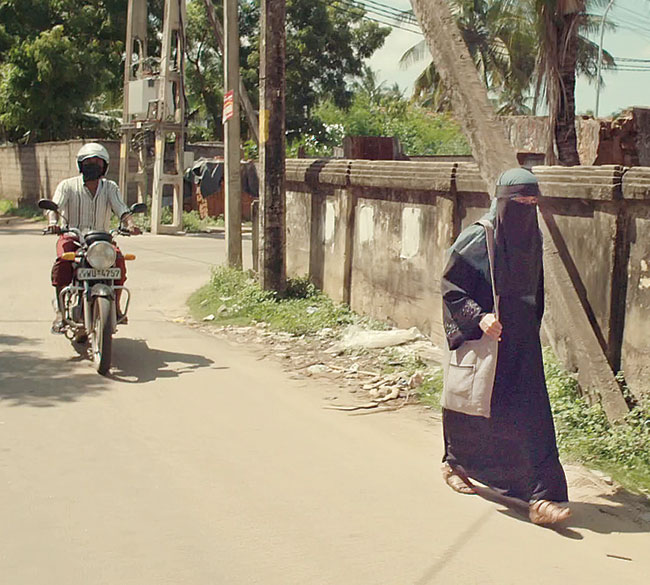
There is a sense of freedom of movement in Face Cover, in the way it’s filmed, which is surprising because of the immediate connotations of the title which conjures up a restriction on movement of girls. This is so also because of the cliches we have imbibed through the media, especially in the West, about what a Muslim woman is or what she can do in traditional Islamic cultures. Since 9/11 this hostile discourse on Islam has never ceased in the West. In Face Cover, at the end when the actress playing Asifa speaks as herself, unmasked, addressing us directly, about her character and her approach to the role, it is very surprising indeed. She introduces herself as a University student who has never acted and says that she didn’t think about her character much because she was told that the girl she played was an ordinary girl, not someone special. She also tells us that there are many cliches prevalent about what a Muslim girl or woman is. This self-reflexive discourse reconfigures the film in one’s mind. We then wonder which interviews were staged with actors and which are real people speaking of their personal experience. In luring us to do this the film gathers a density and richness such that the cliches we might have thought with, are dispelled or at the very least seen for what they are.
Women and girls are seen walking comfortably all over the town with relaxed ease, on beaches and on empty land with tall palm trees, and on streets, either by themselves or in twos. A small protest group of feminists carry lanterns and walk cross a bridge demanding an end to violence against women. We see a woman on a motor bicycle. Asifa’s mother is seen doing her daily routine to the shops, chatting with other women in passing. These movements form an integral part of the rhythm of the film. The other smooth, fast paced tracking-movement on main roads and in the suburbs are shot from a moving vehicle, while voice-overs narrate the numerous incidents of violence, internal displacement of Muslims by the LTTE for example and the difficulties of resettlement among Muslims who suspect them of Tiger sympathies. These broadly descriptive tracking shots give the film an elan, creating different rhythms from that of the tracking shots of walking and orient us spacially in the township. Sivamohan who was also a consultant on the film, uses the tracking shot stylistically, in her own films such as One Single Tumbler.
Cell Phones – Poetry – Bicycle Rides
The multiplicity of uses the cell phone is put to in the film is refreshing in its ability to shift our focus and sense of scale, casually. Asifa meets a boy on line and he proposes to her online and she has agreed to marry him and says so to the mother candidly, firmly and sweetly. She carries out a small business on line and of course chats with friends. The cell phone screen is shown in extreme close-up, of images of a girl wearing a head scarf but her face is cut in half by the framing and another of a full-face cover in black, which because of its enlarged scale, is quite a powerful image with only the eyes visible. They discuss the shaming of girls on Face Book and how it affects their reputations. But it is also shown as a portal, to by pass the patriarchal adult world of injunctions and restrictions that have proliferated since the remittance of wages and Wahabi Islamic ideas from Saudi Arabia began to arrive in the community and different Islamic associations are formed with varying ideologies. The cell phone’s use creates a sense of light humour too when the mother, standing outside her window, eavesdrops on a long girly chat between Asifa and a friend, about how she met her boyfriend.
A young woman poet introduces herself as Jusla and says she writes under the pen name of Salari. She recites a poem, seated near a man and a little girl. The young man who shyly listens to it is in fact her husband and the smiling little girl, her daughter. In one shot we see the husband seated near a vase of red flowers, listening pensively to his wife reading her poem and then there is an exchange between them. This intricate sequence of multiple shots of the poet and her young husband, is full of surprises about gender relations within a Muslim marriage and female creativity. I cite fragments from a poem Jusla recites, interspersed with bits of conversation with her husband, about her desire to write.
“All these poems were written before marriage…I had had dealings with some man before marriage. I want to talk about this poem in that connection;
Snakes Made of Glass!”
You speak slowly of who I am
(Jusla stands and then walks out of house as her voice-over continues the poem)
On the clothes hanger hangs a beautiful golden coloured pouch
I remember an intimacy swinging on that hanger.
(Husband seated at a table with a red vase of flowers, listening to the poem in VO)
It is the colour of the blue sea.
It was given to me for keeping small change and the phone card
(Jusla is now seated on a veranda in long shot, alone)
Overflowing with dreams
In the shape of an orange
And other sundry stuff
It is full of mysteries
It carries the memory of the man who struck me from behind
When he passed by
The beggar who caressed my hand when he received his coins”
(The two seated side by side)
“What have you written about me? Interesting stuff?” asks the husband smiling shyly, playfully.
Jusla laughs.
“It’s all good, People say they are good poems. I need to reengage with writing, only then will my mind be at peace. I need your permission. I have been waiting all this while for it.”
I have quoted from Jusla’s poem as a way of also remembering that Islam has given rise to so much love poetry in Urdu, in the Indian subcontinent alone. When artists in Delhi decided to create a response to anti-Muslim Hindutva violence in Gujarat, singers of Hindustani music and Muslim Ghazal singers sang together to a mass audience in Delhi.
Asifa’s Father
asifa and Father
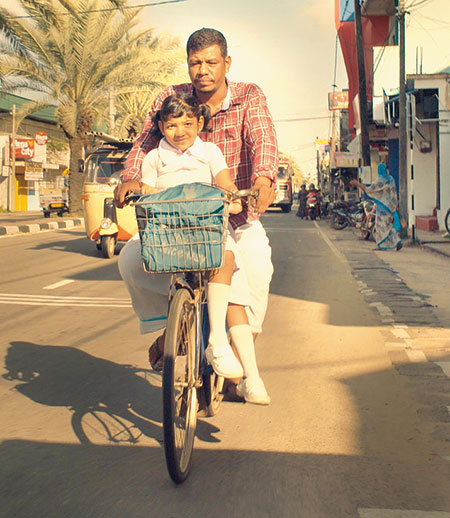
I will conclude with, what for me, is the most poignant image in the film. It is seen at the beginning and at the end of the film, accompanied with the sound of a violin or sita. It’s that of the little Asifa in her white uniform, knee high socks and white shoes, riding on the bar of her father’s bicycle to school. A fluid frontal tracking shot on a busy road, shows the well-built man (now dead), protectively cycling his little girl to school. In its repetition, it appears as a singular poetic refrain resonating across the film we have just watched. Asifa’s mother should, however, have the last words. She tells her cousin who acts as the marriage broker, that Asifa will inherit the house as her dowery and when this appears insufficient, she says, quietly and poignently, ‘but she likes him’. At another time she says that, unlike herself, she wanted Asifa to become ‘somebody’ through education. And she discusses her employment prospects with care and the pragmatism of a worldly woman.

 Israeli Prime Minister Benjamin Netanyahu’s message to Israel’s enemies was blunt and stark.‘We’re going to win; we have no choice.’ He said so while the majority of attendees at a recent UN General Assembly session walked out of the conference hall when the Israeli Prime Minister took the podium; many of them booing in derision.
Those commentators who have been studying Israel’s handling of her enemy states over the decades are unlikely to dismiss the entirety of Netanyahu’s address as rhetoric. The general pattern has been for the Israeli state to stand up firmly against its enemies in the battle field. On most occasions, these adversaries have been beaten back.
It is also little realized in particularly the Southern hemisphere that Israel, for the most part, could defend herself without much US assistance. The history of the conflict bears this out.
However, from the viewpoint of working towards a just and equitable peace in the Middle East the Israeli hard line stance has proved and will prove incalculably detrimental. The sworn enemies of Israel are not going to be in any way deterred by Netanyahu’s stark warnings. On the other hand, they would be only further provoked into taking on Israel by conventional or unconventional military means and seek its destruction.
The recent aborted mid-air hijacking of a Flydubai flight, consisting mainly of Israeli passengers, by an Omani extremist drives home the point. Israel’s enemies are bound to redouble their efforts to annihilate Israel rather than be deterred by the latter’s warnings about standing firm against them. This too history has proved.
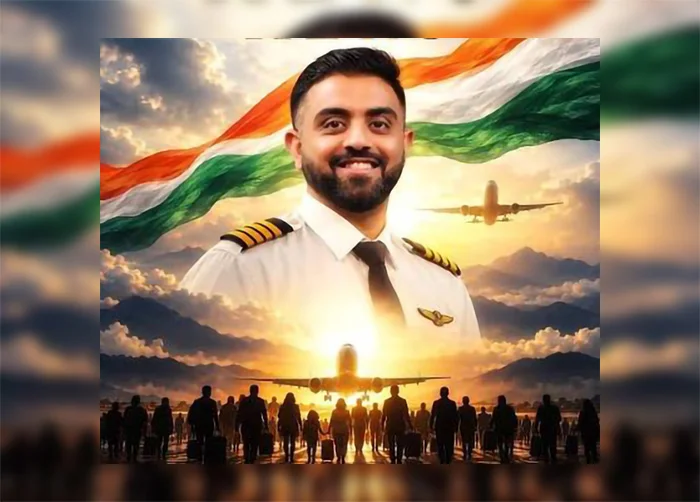
It would be in the fitness of things at this juncture to pay a tribute to the professionalism, courage and humanity of the relevant airline pilot, Captain Machchhar, whose timely action proved decisive in botching the hijack attempt. His intervention averted what could very well have been another 9/11 type tragedy. History is not going to forget his daring and resourcefulness.
Meanwhile, the ground realities in West Asia are undergoing further complications that portend increasing regional instability. For example at the time of writing Turkiye, Pakistan and Saudi Arabia have agreed under the recently established ‘Mecca Alliance for Defence’ to deploy ‘deterrence measures’ collectively in the event of any member of the alliance coming under military strikes from a non-member state.
The agreement is modeled on the NATO collective defence pact and should help in defusing any threat perceptions experienced by the alliance members in the short term. However, the group would need to be cognizant of the major and potentially divisive role Iran could play in the interstate politics of the Middle East region going forward.
Iran’s reported support, for example, for Yemen’s Houthi rebels, who are engaged in attacking Saudi national assets, could at some point in time compel the alliance, under the terms of the pact, to initiate deterrent military measures against Iran.
The implications for regional peace from such a turn of events hardly require elaboration. A full blown regional war emerges as a distinct possibility if Iran sees itself as being excessively antagonized by the alliance. A further complication is that antagonistic sectarian identities of an Islamic kind could come to play hugely divisive roles in it. Shiite Islamic states would be inclined to back Iran while those countries seen as Sunni Islamic in orientation are bound to support Saudi Arabia.
Accordingly, West Asia is a region rife with manifold aggravated insecurities. If the latter are not defused dexterously they could escalate into a conflict of extra regional dimensions. The latter development would render the world a collective loser.
Unfortunately, no constructive help could be expected from the US at this juncture by way of working towards regional and international peace even of short durance. Its war against Iran has only aggravated the world’s current insecurities.
For example, the world has been compelled to face the possibility of compounded economic woes as a consequence of the Hormuz crisis remaining unresolved. The world is currently experiencing what could be seen as a ‘winter of economic discontent’ of unprecedented proportions.
Unfortunately, the international community is to all intents and purposes helpless in the face of this multifaceted crisis. Substantial intervention is expected of the UN but since it has failed to reform itself over the years it is compelled to stand idly by while the world’s insecurities heighten and multiply.
Yet, it is the seemingly paralyzed UN system that has some potential to contain the current tide of international disorder to even a small measure. Given the persisting divergent and conflicting interests among the world’s principal power blocs, the G7 and BRICS for instance, it is mainly the UN and its principal agencies that could carry some credibility as peace brokers and mediators.
However, as an initial step towards bringing the principal protagonists to the negotiating table the UN would need to convince the principal powers of the UN Security Council of the need for a substantive broad-basing of the membership of the Council so as to reflect more accurately the current global political and economic realities. Such reforms would render the Council more representative and help in strengthening its credibility and effectiveness.
The above reforms call for years of dynamism, hard work and resourcefulness on the part of the international community, read the UN. Yet the aims are not impossible to achieve if strong leadership is brought to bear by the UN.
Meanwhile, the UN agencies and allied organizations need to pay stepped-up attention to the West Asian theatre and its wasting conflicts and wars. Here too there is immense hard work to be put in.
There is, for instance, identity politics and its issues that need to be managed urgently. While internal political matters of countries could not be addressed directly by UN agencies, awareness-raising programs and projects could be energetically carried out by them to blunt the appeal of identity-based slogans, relating to, for instance, religion and race.
Besides, values at the heart of democratic politics need to be freshly and enthusiastically propagated. Vast reserves of energy and resources are needed, to be sure, to consistently champion and implement these crucial projects but they need to be pursued single-mindedly if even a dent is to be made in the current runaway global disorder.
The aborted hijacking of the Flydubai flight pointed to the dehumanizing impact of identity politics on the human consciousness. It was also an indication that those sections endowed with humanity cannot stand idly by while identity politics continues to destroy civilizational values. The time to act is ‘now’.
by Professor Ranjith Bandara
Emeritus Professor of Economics, University of Colombo
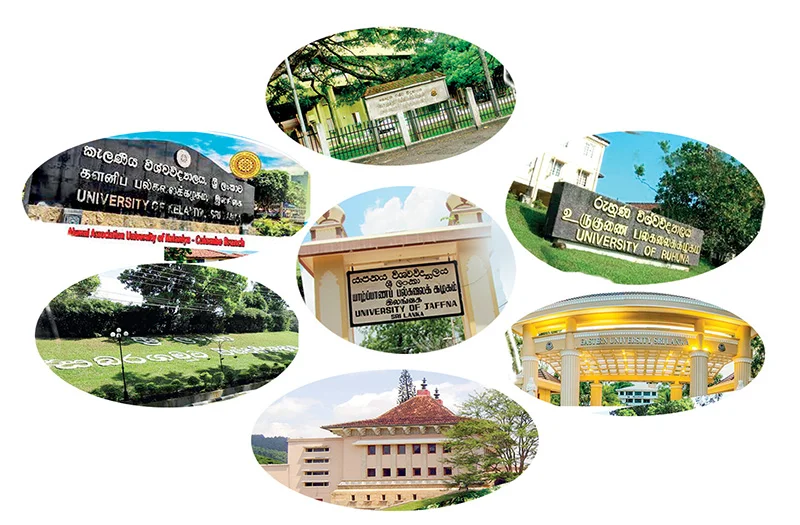
My life has been closely connected with Sri Lanka’s state university system for more than four decades. Its doors opened to me first as a student and later as an academic. The system gave me knowledge, opportunities and a life. Therefore, when I speak about its future, I do so not as an outsider, but as someone who owes much to it and genuinely wishes to see it become better.
Over the years, our university system has expanded significantly. New institutions, faculties, degree programmes and opportunities for students have been created. For 2024, the government expected to admit 43,204 students to national universities. By the time the relevant report was prepared, 42,282 students had been admitted through the general admission process, which had not yet been completed. This is an achievement that should not be dismissed.
However, expanding the system does not necessarily mean that its quality has improved. The real question is not simply how many students we have allowed through the doors, but what kind of education they receive after entering. (Source: Ministry of Education Annual Performance Report 2024.)
We often proudly declare that “our university is number one.” Yet a university does not become number one through publicity. Its true standing depends on the quality of its teaching, the strength of its research and the contribution it makes to society. A vice-chancellor writing about the institution’s, or his or her own, achievements on Facebook does not improve the quality of a university. What matters is good teaching, an education that encourages students to think, credible research and new knowledge that benefits society. A reputation must be earned through meaningful work, not through self-promotion.
The fundamental purpose of a university is clear: to create knowledge, to teach it and to train students to examine and understand it critically. To fulfil this purpose, academics need freedom, responsibility and time. Students must be free to ask questions, disagree and develop their own views based on evidence. Without such an environment, a university may award degrees, but it cannot fulfil the true purpose of university education.
The most serious danger I see is the growing tendency for political activity to take precedence over the academic mission of universities. Over the past five decades, this problem has gradually become more serious. In some universities today, it has become difficult even to hold or express an opinion that differs from the dominant political view.
Members of a university community have every right to hold political views and express them peacefully. A university should not be a place inhabited by silent people. However, when political loyalties, power blocs and struggles for positions become more important than research, teaching and learning, the university moves away from its true purpose. When the political camp to which an academic belongs matters more than the value of that academic’s ideas, the respect that should belong to knowledge is transferred to power.
These criticisms are not ideas I have borrowed from books. They are based on experiences from my own professional life. One such experience was the manner in which I had to leave the university nearly twenty years ago. In my view, the improper exercise of political power within the administration of the University of Colombo at that time, and the strong desire to retain that power, had a serious effect on my professional life. Although this was a personal experience, I mention it with regret because it reveals a deeper institutional problem.
The lesson I learned from that experience is not merely about one person or one incident. When there are no strong institutional safeguards to ensure that power is exercised fairly and individuals are protected, even an academic may be forced to leave an institution he deeply loves.
To those who criticise my later decision to enter national politics, my answer is this: when the university’s institutional system failed to provide me with fairness and professional protection in the face of the injustice I experienced, I had to choose another path through which I could use my knowledge and experience in the service of the country.
This does not mean that all vice-chancellors, academics or students behave in the same way. I personally know many people who, despite difficult circumstances, have taught with dedication, undertaken meaningful research and transformed the lives of their students. Scholars such as Professor W. D. Lakshman, Professor Arjuna Aluwihare and Professor Lakshman Jayatilake may be recognised among the distinguished vice-chancellors in the history of Sri Lanka’s university system. Their service deserves our respect and appreciation.
Nevertheless, the presence of a few good and committed individuals cannot, by itself, strengthen a weak institutional system. We must also create an institutional environment in which such people can work independently, fairly and effectively.
First, university leaders must be selected through a process based on clearly defined qualifications, transparent evaluation and accountability. Once a vice-chancellor has been appointed, his or her performance should be assessed according to the support provided for research, the quality of teaching, student welfare, the institution’s financial discipline and the fairness of its decisions. Personal loyalties and publicity skills cannot replace these measures of performance.
Second, academics must be given the time and space required to carry out their core responsibilities. It is meaningless to demand “world-class universities” without providing adequate time, facilities and reasonable funding for research. Teaching, too, should not be treated merely as delivering lectures. Students must be trained to reason, write, investigate and apply their knowledge to real-world problems. The quality of a degree programme should be measured not by its title, but by the capabilities of the graduates it produces.
Third, universities must establish an honest connection with the needs of the country. The problems confronting our economy, schools, healthcare system, agriculture, environment and wider society are all legitimate subjects for research. Seeking answers to these problems does not diminish the dignity of a university; it increases its value to society.
At the same time, research must not be controlled by short-term political demands. Knowledge can serve the country only when researchers are free to communicate what they discover. Sri Lanka’s World Bank-supported AHEAD higher education programme similarly connected the expansion of enrolment in priority disciplines with improving the quality of degree programmes and promoting research and innovation. These goals were linked because meaningful expansion cannot be separated from educational quality. (Source: World Bank overview of the AHEAD programme.
Fourth, the responsibilities of students must be clearly emphasised. The duty to protect the academic environment of a university cannot be placed solely on administrators and academics. Every student has a fundamental responsibility to give priority to his or her education, respect the right of other students to learn and allow the free exchange of ideas.
Student activities, social debate and political engagement all have an important place in university life. However, none of them should be allowed to disrupt education or prevent other students from learning.
When students abandon their primary purpose of learning and create an environment that obstructs education, the university system cannot fulfil one of its most important functions: producing knowledgeable and responsible graduates. A university may continue to award degree certificates, but if lectures, research, open discussion and intellectual inquiry do not receive sufficient attention, it risks producing graduates who lack depth of knowledge, critical thinking and professional competence.
The result may be the emergence of a group of “half-educated” graduates, individuals who possess certificates but have not received a complete intellectual education. Therefore, just as we discuss student rights, we must also have an honest and open discussion about student responsibilities within the university system.
My position on the current professional struggle of university academics is also clear. If they are demanding fair conditions of employment, those demands should be discussed seriously. If their struggle is also intended to free universities from political interference and restore research, teaching and learning to the centre of university life, I stand with them.
The rights of academics and the educational rights of students should not be presented as opposing interests. Both can be protected and respected only within a well-functioning university.
When I say that “the state university system should be shut down and reopened,” I do not mean that we should close the door on the future of our students. I mean that we must close the door on systems in which power matters more than knowledge.
Students have the right to hold political views and participate actively in debates on national issues. A university needs a student community that thinks about the country’s problems and speaks out against injustice. However, student politics should not shut down the university, deprive other students of their education or become a means of displaying organisational power. The right to fight for one’s beliefs comes with the responsibility to respect another person’s right to an education.
Simply attempting to establish another 50 universities will not solve these problems. Sri Lanka needs a higher education system that brings together the contributions of state, state-affiliated and private institutions while applying clear standards and responsibilities to all of them.
Strict discipline within such a system should not mean suppressing freedom of thought. It should mean ensuring that everyone fulfils their responsibilities in relation to teaching, research, examinations, institutional governance and student welfare. A degree certificate will then have value not merely because of the name of the institution that issued it, but because the knowledge and capabilities of the person who earned it can be trusted.
We should learn from advanced higher education systems, but we should not simply copy them. We must develop institutional autonomy, reliable quality-assurance mechanisms and publicly accountable governance in ways that suit our own needs. What we owe future generations is not merely a country with a larger number of universities, but a country in which people can trust the education those universities provide.
What we must close down, therefore, is not the universities themselves, but the outdated system that closes the door on knowledge, freedom and responsibility. What we must reopen is a genuine university system devoted to learning, inquiry, research and the creation of new knowledge in the service of the country.
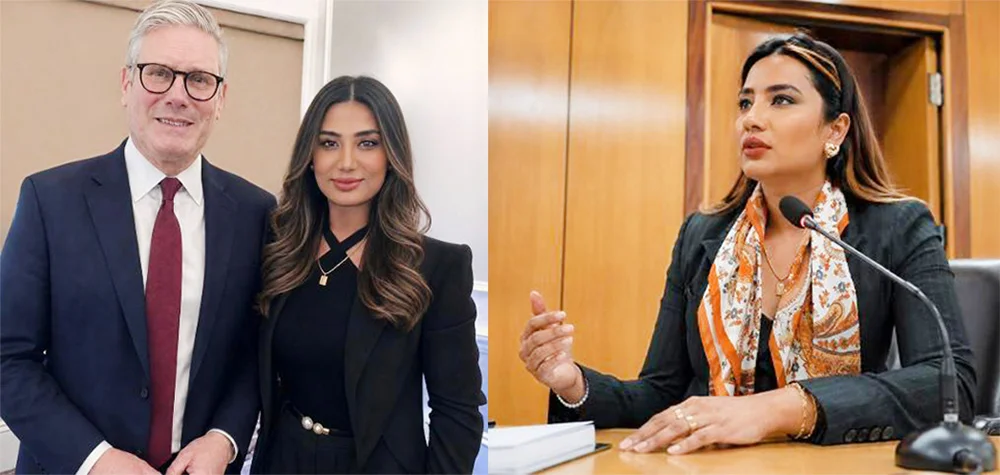
 From beauty pageants and medical science to challenging British immigration policy and making political history in Scotland, yes, that’s Sri Lankan Deena Tissera, born into privilege, in Chilaw, but exposed to poverty and the realities of war.
Now, after 15 years in British politics, she tells Ivan Alvis why she is no longer interested in fitting anyone else’s image of a leader.
She was educated at The British school in Colombo and her father was a doctor-entrepreneur-philanthropist, and mother a former beauty queen and movie star.
She studied Medical Science, moved into Global Health and began a PhD in Public Health, competed in Miss Sri Lanka for Miss World, and, in 2022, made history as the first woman of colour elected to Aberdeen City Council; the first politician of Sri Lankan descent elected in Scotland.
The moment that set it all in motion came during the worst period of her life. Her father had died. She was 24 and missed her university examinations to attend his funeral.
“My father’s greatest wish for me was that I completed my education. However, I was being told that my education would be delayed because I had missed examinations to attend his funeral.”
She refused to accept it. She challenged the university, protested, went before its board and represented herself — and won.
“I went from fighting for myself to realising there were thousands of students who sometimes needed somebody to fight with them.”
She was elected Students’ Union Vice President. Soon her campaigning grew larger. As an international student she had experienced Britain’s immigration system, first-hand, and helped build a UK-wide movement, campaigning for international student rights, and contributing to campaigns that helped achieve changes to immigration rules.
“That taught me one of the most important lessons of my life. Politics isn’t about having a title. Politics is understanding where power sits, organising the people who don’t have it and knowing how to make the people who do have it, listen.”

Deena: Beauty pageant
contestant
The instinct to challenge inequality began earlier. Though born to privilege, her father took her into communities affected by the war through his philanthropic work.
“I grew up with opportunities, but I was surrounded by poverty. That contradiction affected me enormously. My father taught me that privilege isn’t something you should feel guilty about. But you should understand the responsibility that comes with it.”
If her father gave her a sense of service, her mother gave her confidence. Inspired by her, Deena took to modelling … and the Miss Sri Lanka pageant.
“People sometimes expect serious women to edit the glamorous parts out of their history. I can, and have been in a beauty pageant, and still understand economic policy.”
Her academic background continues to shape her politics: “Medical science teaches you evidence. Global health teaches you systems. Public health teaches you that someone’s health can be determined by poverty, housing, education and employment long before they reach a hospital.”
While at the University of Aberdeen she joined Labour Students, later becoming Vice-Chair of her Constituency Labour Party. What followed was more than a decade of door-knocking, organising, strategising, winning and losing.
The overnight success took 15 years. In 2022 she won Hilton, Woodside and Stockethill in Aberdeen.
The historic label came with a complicated reality. She remembers entering rooms with qualifications, campaign experience and leadership credentials — and still sensing she was not the person others imagined as leader.
“There have been tables where I have looked around and known I may be the most accomplished person sitting there, but I wasn’t necessarily the person people saw as the leader. And that’s because I didn’t fit the look.”
Her answer was to work harder — another qualification, another campaign. Then she realised the flaw in that strategy.
“If you wait for everybody else to decide you’re good enough, you can spend your entire life auditioning for a position you’re already qualified to occupy. I owned my identity and started leading with the confidence of my competence.”
At 39, successful and unmarried, she speaks with unusual candour. “Being unmarried is a marital status. It isn’t a performance review.”
Her message to young Sri Lankan and migrant women is direct: “Do not shrink your ambition to make yourself easier for somebody else to digest.”
Her blog series ‘Taboo Tuesdays’ — with titles like “Politics Is a Blood Sport – And We Pretend It Isn’t” — examines ambition, envy, ego and power from inside the room.
Since her election, she has led on anti-poverty and inequality, served as Labour’s Energy Spokesperson for Aberdeen covering net zero, environment and transport, and served as Chief Whip of the Labour group.
She was adviser to former Prime Minister Gordon Brown on his Our Scottish Future commission, took part in the Jo Cox Women in Leadership programme, and served as Scottish executive representative for the northeast, Highlands and Islands at her party’s top table.
Recognition has followed — 35 Under 35 Scotland’s rising political stars, Exceptional Achiever of the Year, Politician of the Year nomination, and Outstanding Woman in Governance and Public Policy by Women in Management UK.
As Energy Spokesperson for Aberdeen, one of Europe’s key energy cities, she sits at the centre of Britain’s energy debate. She supports transition but warns: “A just transition cannot mean asking one community to carry the economic cost of everybody else’s environmental ambition.”
Ask her if she wants more power and her answer is simple: “Yes. I am ambitious. But power without purpose is just status.”
Perhaps her most personal answer is about representation: “The first Sri Lankan elected in Scotland means something to me because it means the next Sri Lankan isn’t the first.
“I didn’t have to become less Sri Lankan to become Scottish. I didn’t have to become less feminine to become politically serious. And I didn’t have to look like somebody else’s idea of leadership before I was allowed to lead.”
In conclusion, Deena Tissera had this to say: “There was a time when I wanted to prove I deserved a seat at the table. Now I walk in knowing I do.”

Showers above 100 mm are likely at some places in the Western, Sabaragamuwa, Central, Uva and Southern provinces and in Anuradhapura district

PSTA worse than PTA: FSP

Shiranthi R remanded until 13 Oct.

Former NSB Chairman Kariyawasam granted bail

Katchatheevu row: India SC urges fishermen to avoid Sri Lankan waters

Remembering Juvenal, Coke, Acton and Machiavelli

‘Dates have the highest sugar content to fight Coronavirus’

Sunday Island 27 December – Headlines

#SundayIsland 17th December – Headlines

Sunday Island – 28th March

Sunday Island Headlines – 21 March

Sunday Island – 21st February – Headlines
-

 Editorial6 days ago
Colombo Port drug bust: The plot thickens
-

 Features4 days ago
The first woman in the foreign service or Ceylon Overseas Service it was then called
-

 News3 days ago
Geneva takes up Sallay’s case and govt. ignores opportunity to answer accusations
-

 Editorial5 days ago
Fuelling discontent and protest
-

 Latest News5 days ago
Tharindu Rathnayake, bowlers secure Asian Games Bronze for Sri Lanka
-

 Features3 days ago
Sri Lanka Cricket Bill: Governance reform is not yet a cricket strategy
-

 Foreign News5 days ago
Ten injured after car crashes into rugby supporters in Australia
-

 News4 days ago
Nearly 20 Iranian tankers stranded off Lanka amid US sanctions