
News
Nipah outbreak in India triggers alarm: Sri Lanka urged to act before first human case

Sri Lanka must urgently step up airport screening, hospital surveillance and public health preparedness following a deadly Nipah virus outbreak in India’s West Bengal state, health experts warn, as heavy regional travel begins ahead of the Lunar New Year holidays.
Five confirmed Nipah infections – all among healthcare workers – have been reported from a private hospital in Barasat, near Kolkata, with nearly 100 contacts placed under quarantine.
Several Asian jurisdictions, including Thailand, Nepal, Taiwan and Hong Kong, have already activated enhanced airport health screening protocols.
The warning for Sri Lanka is particularly stark: Nipah virus has already been detected in local flying fox (Mawavula) populations, confirming that the pathogen is present in the country’s wildlife.
“This means Nipah is not a distant threat. The virus exists here, and that changes the entire risk equation,” said Professor Inoka C. Perera, Principal Investigator of the IDEA Laboratory and IDEAnet project at the University of Colombo.
Unlike many previous outbreaks linked to direct bat-to-human transmission, the West Bengal cluster involves human-to-human spread inside a hospital, one of the most dangerous scenarios for outbreak escalation.
Indian health officials say the outbreak began after a patient with severe respiratory symptoms died before Nipah infection was identified. Two nurses who treated the patient in late December later tested positive. Three additional cases – including a doctor – were subsequently confirmed, all linked to the same facility. One nurse remains in critical condition.
Public health experts note that similar hospital-based transmission drove earlier outbreaks, including the 2001 Siliguri incident in India, where three-quarters of infections occurred among hospital staff and visitors.
Nipah virus is among the world’s most lethal zoonotic diseases, with fatality rates ranging from 40% to 75%. It can cause severe respiratory illness and acute encephalitis, often progressing rapidly to coma and death.
There is no approved vaccine and no specific cure. Treatment depends on intensive supportive care, while monoclonal antibodies – available only in limited quantities – must be given immediately after diagnosis. Delayed detection dramatically increases mortality and the risk of onward transmission.
Sri Lanka’s risk is heightened by frequent travel with India and the widespread presence of Pteropus fruit bats. However, scientists say the country has one critical advantage: advance warning.
He told The Island: “We know the virus is circulating in bats, but we have not yet seen human cases. That gives Sri Lanka a rare opportunity to prepare before lives are lost.”
The IDEA Laboratory, working with the Robert Koch Institute of Germany, has established RT-PCR diagnostic capacity for Nipah virus, trained healthcare professionals nationwide, and built a hospital-based surveillance network capable of early detection.
Health experts are calling for immediate measures, including: Health screening at international airports, particularly for arrivals from India, strengthened infection prevention and control protocols in hospitals, heightened surveillance for unexplained fever, respiratory illness and encephalitis, expanded monitoring of flying fox populations, clear public guidance on food safety and early symptom recognition.
The West Bengal outbreak is the first major Nipah incident in the state in nearly 20 years and has emerged near Kolkata, one of India’s most densely populated cities. With the virus capable of spreading person-to-person, experts stress that this is a regional health emergency, not a local anomaly.
Kerala’s experience has shown that swift diagnosis, strict isolation and aggressive contact tracing can contain Nipah outbreaks. Sri Lanka, scientists warn, must act before the first human case appears.
“Every day without a Nipah case is a chance to build defences,” Prof. Perera said. “Waiting until the virus reaches hospitals is a mistake we cannot afford.”
By Ifham Nizam

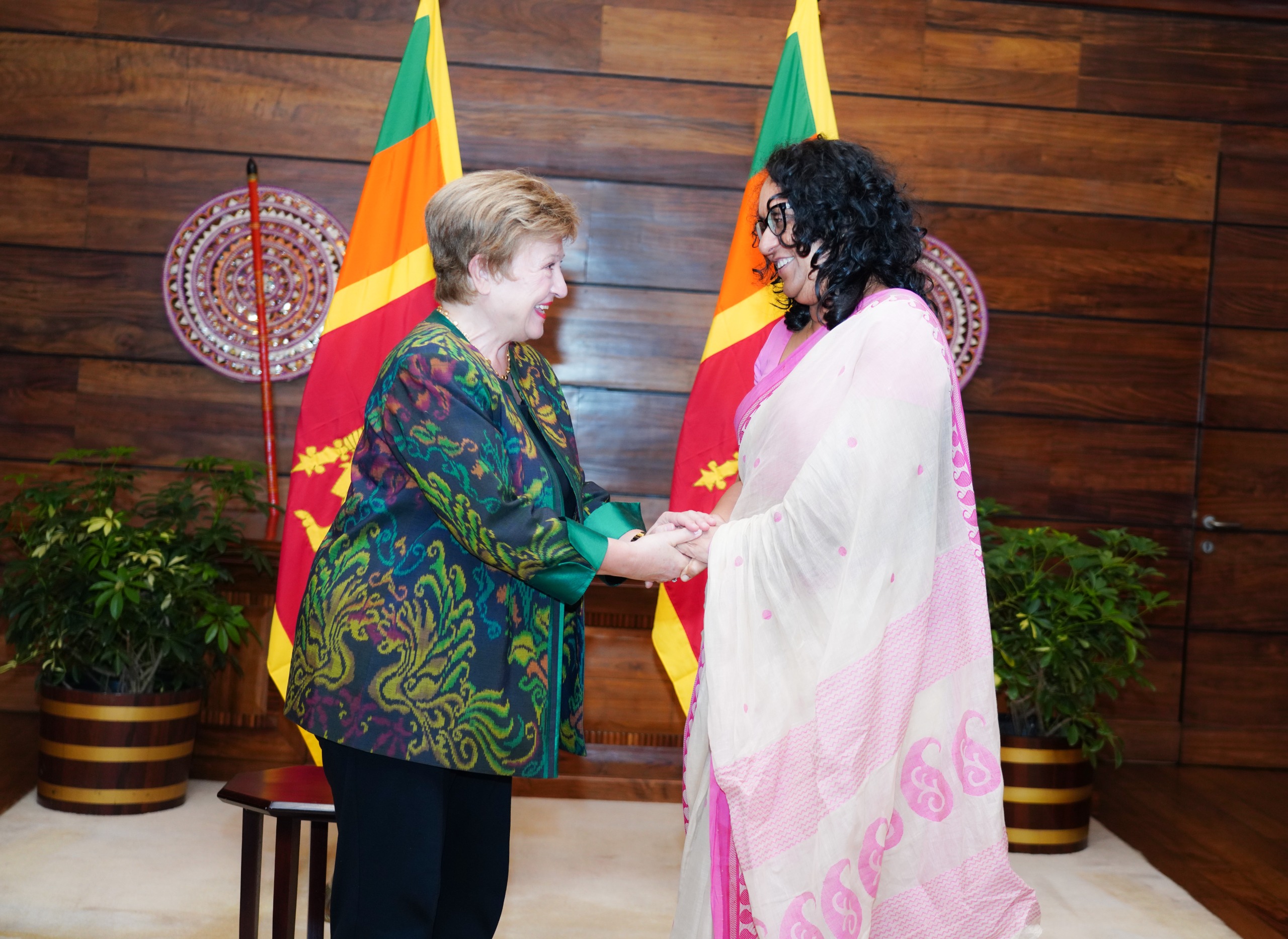
Prime Minister Dr. Harini Amarasuriya met with the Managing Director of the International Monetary Fund (IMF), Dr. Kristalina Georgieva, at Temple Tress on the 17th of February
Dr. Georgieva, commended the Government’s efforts in stabilizing the country’s economy and in managing recent economic and natural shocks. She noted that Cyclone Ditwah had caused severe impacts, especially on economically vulnerable communities, underscoring the importance of targeted support and resilience-building measures.
The Prime Minister expressed appreciation for the IMF’s continued support to Sri Lanka, particularly in the aftermath of Cyclone Ditwah. The PM further emphasized that real economic recovery and development must directly benefit the economically vulnerable groups and ensure inclusive growth, highlighting the need for Sri Lanka to attract quality and sustainable investments, particularly in the tourism sector.
The importance of reforming the education system to focus not only on knowledge acquisition but also on skills development and employability was also discussed
The meeting was attended by the Chief of Staff of the IMF Managing Director Andreas Bauer, Director, Asia and Pacific Department, Dr. Krishna Srinivasan Division Chief (Strategic Communications), Communications Department, Pierre Mejlak Resident Representative for Sri Lanka Dr. Martha Woldemichael, Governor of the Central Bank of Sri Lanka Dr. P. Nandalal Weerasinghe, and Deputy Governor Dr. C. Amarasekara, Secretary to the Prime Minister Pradeep Saputhanthri and Additional Secretary to the Prime Minister Ms. Sagarika Bogahawatta.
[Prime Minister’s Media Division]

The Cabinet of Ministers approved the resolution forwarded by the Minister of Health and Mass Media to relocate the Deniyaya Base Hospital after constructing a new hospital with a capacity of 300 beds at an estimated cost of Rupees 6,000 million.
The Southern Provincial Department of Health has acquired a plot of land in Handford estate which is approximately 03 kilometres away from the town for this purpose.
News
Cabinet nod to legally empower methodology for implementing the ‘Praja Shakthi’ poverty alleviation national movement


The Cabinet of Ministers granted approval for the resolution furnished by the Minister of Rural Development, Social Security and Community Empowerment to instruct the Legal Draftsman to draft a bill to legally empower the implementation of ‘Praja Shakthi’ (Strength of the Community) poverty alleviation national movement

Muscular South Africa stroll into Super Eight with all-win record

Pakistan bat first, drop Shaheen Afridi in must-win encounter against Namibia

New Bangladesh sports minister wants to fast track cases against Shakib and Mortaza

Climber on trial for leaving girlfriend to die on Austria’s highest mountain

IMF MD commends government’s efforts in stabilizing the country’s economy

India look to go into Super Eight stage with all-win record

‘Dates have the highest sugar content to fight Coronavirus’

Sunday Island 27 December – Headlines

#SundayIsland 17th December – Headlines

Sunday Island – 28th March

Sunday Island Headlines – 21 March

Sunday Island – 21st February – Headlines
-

 Life style4 days ago
Marriot new GM Suranga
-

 Business3 days ago
Ministry of Brands to launch Sri Lanka’s first off-price retail destination
-

 Features4 days ago
Monks’ march, in America and Sri Lanka
-

 Opinion6 days ago
Will computers ever be intelligent?
-

 Features4 days ago
The Rise of Takaichi
-

 Features4 days ago
Wetlands of Sri Lanka:
-

 News3 days ago
Thailand to recruit 10,000 Lankans under new labour pact
-

 News3 days ago
Massive Sangha confab to address alleged injustices against monks