
Business
New Japanese volunteers arrive in Sri Lanka

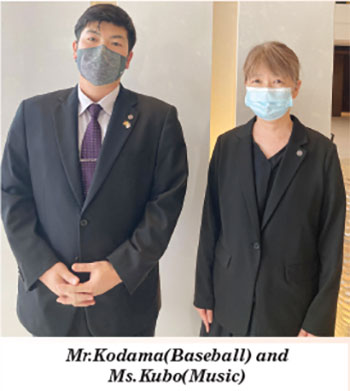
Two new Japan Overseas Cooperation Volunteers (JOCV) arrived in Sri Lanka on August 12, marking the 40th anniversary of the JICA Volunteer Program in the country, JICA stated in a press release.
This also marks the recommencement of the volunteer program after two years and four months of halted operations due to the Easter Sunday attack in April 2019 and the COVID pandemic situation which followed when volunteers here returned to Japan, JICA said.
A JICA release further said: “JICA’s volunteer program dispatches eager Japanese citizens who wish to participate in assisting developing countries with economic and social development, deepening mutual understanding and building trust with various communities with different cultural background across the world at grassroots level.
 Since the introduction of the program in 1981, exactly 1,149 JICA volunteers have served in Sri Lanka up until now. All these volunteers undergo prior training in the languages of their host countries, and with regard to Sri Lanka, they conduct their activities in Sinhala or Tamil, depending on the region they are assigned to.”
“The two Japanese volunteers who arrived in Sri Lanka to resume the JOCV program, will be providing services in their specific fields of expertise namely; Western Music Education and Baseball coaching in the Colombo district. The volunteers will be attached to institutions coming under the Ministry of Education and Ministry of Youth and Sports respectively, and will serve for a period of 5 months, which can be extended as per the request of the Sri Lankan government.”
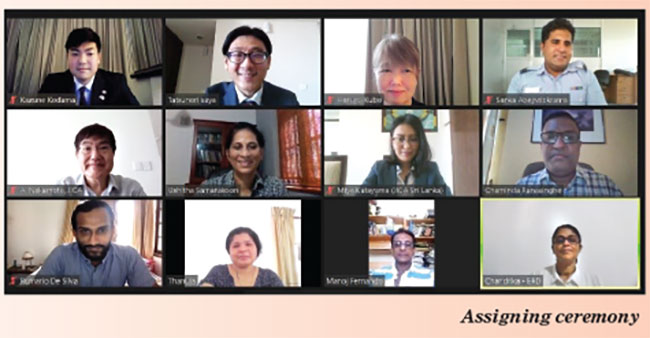
“The new Japanese volunteers were introduced to their host organizations at an assigning ceremony, which was held online on the 31st of August, in connection with the Department of External Resources (ERD). The occasion was graced by officials representing the ERD, JICA and the host organizations. After the assigning, the two volunteers have started their work online, from the 1st of September, in their respective Sri Lankan host organizations.”
“Japan International Cooperation Agency (JICA) is the executing agency of Japan’s Bilateral Official Development Assistance (ODA). JICA, the world biggest bilateral aid agency, works in over 150 countries and regions. In accordance with its vision of “Inclusive and Dynamic Development,” JICA supports the resolution of development issues in developing countries. In Sri Lanka, Japan has been providing financial and technical assistance since 1954 and is one of the largest donors to the country. On behalf of the people of Japan, JICA contributes to improve the lives of people in Sri Lanka.” JICA said.



A newly launched initiative, the Sri Lanka Brand Forum (SLBF), seeks to redefine the role of business in national development, urging companies to move beyond profit and become “institutions of trust, clarity, and progress.”
At a recent press conference in Colombo, founders announced the forum as a response to what they described as a BANI world – an acronym for Brittle, Anxious, Nonlinear, and Incomprehensible – where uncertainty has become the norm.
Central to the forum’s launch is its flagship event, the Leadership Summit, themed ‘Resilience Redefined: Leadership for a New Era.’
The upcoming Summit will gather business leaders, policymakers, and innovators to explore how leadership must evolve amid rapid disruption and global uncertainty. It will feature global experts including David Aaker (UC Berkeley), Sanjiv Mehta (former Unilever South Asia chairman), and Prof. Kulvant Singh (NUS Business School).
Rohan Somawansa, Co-Founder of Sri Lanka Brand Forum said, “Today’s launch of Sri Lanka Brand Forum marks a defining moment for our nation. Sri Lanka’s potential has always been undeniable. What we need now is to harness that potential with strategic intent, meaningful leadership, and collective action. The Brand Forum will be a catalyst for that change.”
“Sri Lanka Brand Forum is not just an initiative – it is a movement to reimagine the future of business and the future of Sri Lanka,” said Chairman Shariful Islam.
When The Island Financial Review asked why no Sri Lankan business leaders were featured even as guest speakers despite the summit’s inclusive vision, Islam confirmed that several Sri Lankan business leaders will indeed be speaking at the event.
By Sanath Nanayakkare

A sweeping regulatory move to safeguard public health came into force April 1, banning the manufacture and sale of baby feeding bottles and reusable plastic bottles containing harmful chemicals such as Bisphenol A (BPA), while making Sri Lanka Standards (SLS) certification mandatory across the sector.
The new regulation, issued by the Consumer Affairs Authority under Extraordinary Gazette No. 2456/42 dated October 1, 2025, requires all manufacturers, importers, distributors and traders to comply with strict safety standards or face a complete prohibition on their products.
Under the directive, no plastic bottle falling within the specified categories can be manufactured, imported, transported, stored or sold unless it carries the official SLS certification mark issued by the Sri Lanka Standards Institution.
The regulation covers two key product categories: reusable plastic bottles used for carrying potable liquids, governed by SLS 1616, and polymer-based feeding bottles, regulated under SLS 1306.
Environmental Scientist Hemantha Withanage welcomed the move, describing it as “long overdue and critically important” in addressing the silent health risks posed by chemical leaching from low-quality plastics.
“Bisphenol A is a known endocrine disruptor. Its presence in food and beverage containers, especially those used by infants, is extremely dangerous. This regulation is not just about standards — it is about protecting future generations,” Withanage told The Island Financial Review.
He stressed that substandard plastic products have long flooded the local market due to weak enforcement and lack of consumer awareness.
“For years, Sri Lanka has been a dumping ground for inferior plastic products. Without strict compliance mechanisms, regulations remain on paper. What is important now is rigorous enforcement and continuous market surveillance,” he said.
Withanage also pointed out the broader environmental dimension, noting that improved standards could indirectly reduce plastic pollution by encouraging higher-quality, longer-lasting products.
“Better standards mean fewer disposable plastics and less environmental damage. This is an opportunity to shift towards safer and more sustainable consumption patterns,” he added.
Industry stakeholders, however, are expected to face short-term adjustment pressures, particularly smaller importers and retailers who may struggle to meet certification requirements. Analysts say the regulation could temporarily tighten supply but will ultimately elevate product quality and consumer trust.
Officials of the Consumer Affairs Authority said that raids and inspections will be intensified islandwide to ensure compliance, warning that legal action will be taken against violators.
The move aligns Sri Lanka with growing global restrictions on BPA and unsafe food-contact materials, reinforcing the country’s commitment to consumer safety and environmental protection.
Withanage added that as regulation takes hold, its success will hinge not only on enforcement but also on public awareness — ensuring that consumers actively seek out certified products and reject potentially hazardous alternatives.
By Ifham Nizam

Sri Lanka has made steady progress under the International Monetary Fund Extended Fund Facility (EFF) programme, with the fifth and sixth reviews now under close assessment, informed officials said following high-level discussions held at the Presidential Secretariat yesterday.
A visiting delegation led by IMF Mission Chief for Sri Lanka Evan Papageorgiou met President Anura Kumara Dissanayake and senior government leaders to evaluate the country’s performance against key reform benchmarks, including fiscal consolidation, revenue mobilisation and external sector stability.
“Informed officials indicated that Sri Lanka has demonstrated notable resilience despite a challenging global environment,” sources familiar with the discussions told The Island Financial Review. “There has been measurable progress in stabilising macroeconomic conditions, particularly in terms of rebuilding foreign reserves and strengthening public finance management.”
The talks focused extensively on maintaining the current reform momentum, with both sides acknowledging that policy consistency would be critical to sustaining recent gains.
“Officials emphasised that the economy is now in a more shock-resilient position compared to the height of the crisis,” a senior source said. “However, they also cautioned that this stability remains fragile and requires continued fiscal discipline and structural reforms.”
Particular attention was paid to Sri Lanka’s revenue performance, which has been a cornerstone of the IMF-supported programme.
“The improvement in revenue collection has been a key positive,” an official noted. “It reflects both policy measures and better administration, but sustaining this trajectory will be essential to meeting programme targets.”
The discussions also addressed the buildup of foreign reserves, a critical buffer against external vulnerabilities.
“Rebuilding reserves has strengthened confidence,” another official said. “It provides a degree of insulation against global shocks, although the country is not yet fully out of risk territory.”
Officials acknowledged that emerging geopolitical tensions—particularly the ongoing instability in the Middle East—pose a fresh external challenge.
“The impact from the Middle East situation is unavoidable,” a source said. “Higher energy prices and supply uncertainties are already exerting pressure, and these factors could affect inflation and the balance of payments.”
In response, the government has prioritised targeted relief measures to cushion vulnerable groups from rising costs, particularly in relation to fuel and energy.
“There is a clear focus on ensuring that any shocks are managed without derailing the broader reform programme,” an official explained. “Targeted support, rather than broad subsidies, remains the preferred approach.”
Energy security and pricing were also
key areas of discussion, given their direct impact on both fiscal stability and household welfare.
“Maintaining cost-reflective pricing while protecting the most vulnerable is a delicate balance,” a senior official said. “But it is essential for the sustainability of the sector.”
The IMF team is expected to continue its assessment in the coming days, with outcomes of the fifth and sixth reviews likely to play a crucial role in determining the next phase of disbursements under the programme.
“Informed officials stressed that successful completion of these reviews would send a strong signal to international markets and development partners,” sources said.
They added that Sri Lanka’s reform trajectory has already contributed to improved investor sentiment, although sustained confidence will depend on consistent policy implementation.
“The message from both sides is clear—stay the course,” an official said. “The foundations for recovery are being laid, but the process is far from complete.”
By Ifham Nizam

Heat Index at Caution Level in the Western, Sabaragamuwa, Southern, Eastern, North-western, Northern and North-central provinces and in Monaragala district

Kuwait desalination plant, oil refinery hit by missile and drone strikes

Chamodi Prabodha to lead Sri Lanka women’s U19 National Team for the tour of Australia

Sri Lanka Cricket Appoint National coaches for Bowling, Fielding and Spin Bowling

Trump fires Pam Bondi as US attorney general, elevates Todd Blanche

Klaasen fifty, Travishek onslaught hand Sunrisers Hyderabad first points of the season

‘Dates have the highest sugar content to fight Coronavirus’

Sunday Island 27 December – Headlines

#SundayIsland 17th December – Headlines

Sunday Island – 28th March

Sunday Island Headlines – 21 March

Sunday Island – 21st February – Headlines
-

 Features7 days ago
A World Order in Crisis: War, Power, and Resistance
-

 News4 days ago
Tariff shock from 01 April as power costs climb across the board
-

 News7 days ago
Minister Jayakody indicted in Colombo High Court over alleged corruption
-
 News5 days ago
Inquiry into female employee’s complaint: Retired HC Judge’s recommendations ignored
-

 News7 days ago
Police look for male partner of Chinese woman found stabbed to death at an apartment in Kohuwala
-
 News2 days ago
2025 GCE AL: 62% qualify for Uni entrance; results of 111 suspended
-
 Features5 days ago
New arithmetic of conflict: How the drone revolution is inverting economics of war
-
 Features6 days ago
When seabed goes dark: The Persian Gulf, cable sabotage, and race for space-based monopoly