
News
New ILO data confirm women face higher workplace risks from AI than men


Colombo (ILO News) Generative artificial intelligence (GenAI) is reshaping the world of work, with the potential to boost productivity, support job creation and improve job quality, but its impacts are far from gender-neutral. A new research brief from the International Labour Organisation (ILO) warns that GenAI is set to affect women’s jobs more than men’s, with female-dominated occupations almost twice as likely to be exposed to the technology.
The brief, GenAI, occupational segregation and gender equality in the world of work, shows that women are disproportionately exposed to GenAI for three main reasons: they are overrepresented in jobs most susceptible to automation; they remain underrepresented in AI-related and science, technology, engineering and mathematics (STEM) occupations; and AI systems themselves often reflect and reproduce the gender biases embedded in societies.
Across countries with available data, occupations dominated by women are almost twice as likely to be exposed to GenAI as male-dominated ones, the study finds. Around 29 percent of female-dominated occupations are exposed to GenAI, compared to just 16 percent of male-dominated occupations. The difference is even starker when looking at high automation risk: 16 percent of female-dominated occupations fall into the highest exposure categories, compared to only three percent of male-dominated ones.
These risks are closely linked to occupational segregation. Women are heavily concentrated in clerical, administrative and business support roles, such as secretaries, receptionists, payroll clerks and accounting assistants, where many tasks are routine and codifiable and, therefore, at higher risk of substitution by GenAI. By contrast, men are more represented in construction, manufacturing and manual trades, where tasks are less easily automated.
At the country level, women are more exposed to GenAI than men in 88 percent of countries analysed. In several economies, more than 40 percent of women’s employment is exposed to GenAI, including Switzerland, the United Kingdom and the Philippines, as well as small island developing States in the Caribbean and the Pacific. In high-income countries overall, 41 percent of jobs are exposed to GenAI, compared with just 11 percent in low-income countries, reflecting differences in occupational structures and digital readiness.
“Generative AI is not entering a neutral labour market,” said Anam Butt, co-author of the ILO research. “Discriminatory social norms, unequal care responsibilities and economic and labour market policies that do not fully address the needs of women and men to continue to shape who enters which occupations and on what terms. As a result, women are concentrated in occupations that are more likely to be exposed to automation and remain underrepresented in AI-related jobs, facing higher risks but fewer opportunities from this technological shift.”
While GenAI is expected to drive job growth in technology-intensive sectors, women remain largely excluded from these opportunities. Globally, women accounted for only about 30 percent of the AI workforce in 2022, only four percentage points higher than in 2016. They are also underrepresented in STEM jobs more broadly, particularly in high-demand fields such as engineering and software development.
This imbalance matters. When women are missing from AI-related jobs and decision-making roles, they are less likely to benefit from new employment opportunities and skills development. At the same time, enterprises lose out on talent, diversity and innovation.


The Cabinet of Ministers approved the resolution furnished by the Minister of Public Security and Parliamentary Affairs to appoint Iraj Chaminda Pathiraja, an officer in the Special Grade of the Sri Lanka Administrative Service to the post of Controller General of Immigration and Emigration on a permanent basis.
Latest News
Implementation of the recommendations of the Report submitted by the Presidential Commission appointed to Inquiry on the Easter Sunday attacks and the Then Sectoral Oversight Committee on National Security.

Approval was granted at the Cabinet Meeting held on 17-05-2021 to implement the recommendations submitted by the Presidential Commission appointed to Inquire on the Easter Sunday attacks and to propose measures to prevent the recurrence of such incidents, as well as the recommendations of the then Sectoral Oversight Committee on National Security.
However, since no systematic, formal, and sustainable mechanism has yet been established to monitor the practical implementation of the said recommendations, there is currently no effective mechanism to evaluate the progress of the
implementation of the aforementioned recommendations.
Therefore, the need has been identified to establish a mechanism with a broad organized structure prioritizing public and national security, to ensure the successful implementation of the aforementioned recommendations and the Cabinet of Ministers has approved the resolution furnished by the President, in his capacity as the Minister of Defence, to appoint a committee comprising an expert in the field of counter-terrorism and national security along with the representatives of the relevant ministries and institutes under the supervision of the Presidential Secretariat.
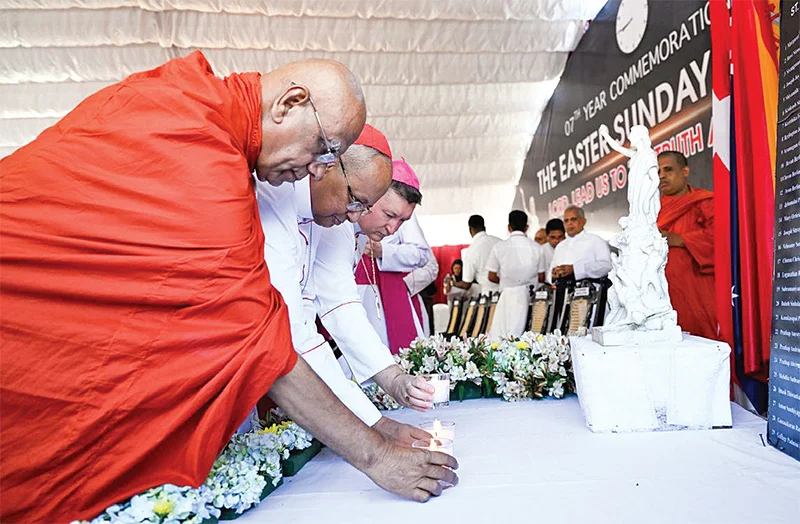
… successive governments sat on PCoI report handed over in Feb. 2021
His Eminence Malcolm Cardinal Ranjith yesterday (21) alleged that those who were in power from 2019 to September 2024 sabotaged investigations into the Easter Sunday carnage (2019).
Addressing the Seventh Year Commemoration of the Easter Sunday suicide attacks, at St. Anthony’s Church Kochchikade, Colombo, the Archbishop of Colombo said that unlike the present leaders of the country, almost all the power holders, since the 2019 April attacks, including former Presidents, Heads of the Police and the AG’s department officials, instead of sincerely finding out as to who and what was behind the horrific crime, tried their best to confuse the public, muddle up the investigations and appointing all kinds of committees, with highly suspect investigators, in order to come out with conclusions crafted by them, and tried to sabotage the truth from emerging.
In spite of the change of government, in September 2024, certain officials of the “deep state” were seeking to obstruct the smooth flow of ongoing investigations.
Regardless of the Presidential Commission of Inquiry (PCOI) giving clear directives to the Attorney General and to that department to take clear legal and disciplinary actions against some of the political figures, officials of the security establishment and organisations for criminal neglect of duty, very little has so far been done on this matter by them.
The PCoI handed over its report to President Gotabaya Rajapaksa in February 2021.
The Catholic leader emphasised the need to investigate possible links between the Easter Sunday massacre and attacks, targeting the Muslim community, on the night of 5th May and, once again, on 11th, 12th and 13th May, starting from the Nattandiya-Madampe area, through Kotaramulla to Minuwangoda. The Cardinal said: “This may have a link to the main attacks on 21st April 2019. One must also verify as to whether anyone in the security establishment prevented those responsible from controlling these attacks as and when they began.”

Iraj Chaminda Pathiraja appointed Controller General of Immigration and Emigration
Implementation of the recommendations of the Report submitted by the Presidential Commission appointed to Inquiry on the Easter Sunday attacks and the Then Sectoral Oversight Committee on National Security.

All-round Athapaththu helps Sri Lanka level series against Bangladesh

Dates Set for Lanka Premier League 2026

Wasim Khan to step down as ICC’s general manager

Abhishek’s 135 not out blows Delhi Capitals away

‘Dates have the highest sugar content to fight Coronavirus’

Sunday Island 27 December – Headlines

#SundayIsland 17th December – Headlines

Sunday Island – 28th March

Sunday Island Headlines – 21 March

Sunday Island – 21st February – Headlines
-

 News1 day ago
Rs 13 bn NDB fraud: Int’l forensic audit ordered
-

 Business4 days ago
Harnessing nature’s wisdom: Experts highlight “Resist–Align” path to resilience
-

 News7 days ago
PNS TAIMUR & ASLAT set sail from Colombo
-

 News4 days ago
Gratiaen Trust announces longlist for the 33rd Annual Gratiaen Prize
-

 News3 days ago
From Nuwara Eliya to Dubai: Isha Holdings markets Agri products abroad
-

 Opinion2 days ago
Shutting roof top solar panels – a crime
-

 News4 days ago
Heroin haul transported on 50-million-rupee contract
-

 Latest News6 days ago
Singapore Zoo’s first Sri Lankan leopard cubs make their public debut