
Features
Neighbourhood Lost: The End is Nigh for SAARC’s South Asian University

Of Man’s First Disobedience, and the Fruit
Of that Forbidden Tree, whose mortal taste
Brought Death into the World, and all our woe,
With loss of Eden …· John Milton (Paradise Lost)
 On 26th February 2025, Yashada Sawant, an Indian female student from the South Asian University (SAU), an international University in New Delhi, was publicly assaulted by Ratan Singh, a male student from the same university, along with a gang of goons with clear affiliations to the Akhil Bharatiya Vidyarthi Parishad (All India Students’ Council) a.k.a. ABVP. That ABVP is a right-wing student organisation affiliated to the Rashtriya Swayamsevak Sangh (RSS), a known Hindu nationalist organisation in India, is no secret.
Their grouse was that fish was being served on Maha Sivaratri and Ms Sawant’s ‘crime’, as the Mess Secretary elected by students to oversee canteen operations, was trying to stop the fish curry from being thrown away by them. This is when the assault ensued, with Sawant being punched in the face and inappropriately touched by these students, who are yet to be punished by the university.
What is of concern is that the university does not have a good track record when it comes to women’s safety. Apoorva Yarabahally, a former legal studies student had earlier lodged a complaint against her Dean of harassment and also described her entire ordeal on X in April 2023. To date, however, the university has failed to take any action.
The university’s canteens have always served both vegetarian and non-vegetarian food. On the day in question, special arrangements had also been made for those observing the religious holiday. While there have often been on-and-off caste-based arguments over the ‘purity’ of food, this has never reached the depths of the recent incident. Sadly, this is not a freak mishap.
Since SAU’s current India-nominated President A.K. Aggarwal, who has no experience in running an international university, took over, his tolerance and even sponsorship of absolute parochialism, especially where the Hindutva agenda is concerned, has led to this deplorable state of affairs.
In her recent detailed tweet, Sawant has clearly described the role of different university officials who have attempted to sweep numerous sexual harassment complaints under the carpet. The same Proctor, who was reprimanded by the Delhi High Court in an earlier case for not following SAU regulations, still holds the reins and has been instrumental in pushing the overtly misogynistic agenda in SAU.
SAU’s South Asian sensibility dismantled
SAU was established by the South Asian Association for Regional Cooperation (SAARC) as an international university in 2010 with taxpayer’s money from all eight member countries. Therefore, the legal and institutional ownership of the university is with SAARC.
It was meant to be a secular, English language university where no single political ideology, language or any one form of nationalism was to dominate. Its founding provisions and principles were meant to preserve the university’s South Asian character. The intention of the university’s founders was to bring in an element of parity and equality in the broader space of inequity and hegemony in which the university is physically located.
Unfortunately, notwithstanding these laudable efforts, a mere 15 years into its establishment, the downward spiral of the institution is driven by the incumbent president, with alarming signs of an imminent and total crash.
The bottom line is, SAU is no longer effectively owned by SAARC and it is certainly not South Asian by any stretch of the imagination. In cultural and social outlook, it has become blatantly North Indian, to the extent that it is even making students from other regions in India feel extremely unsafe.
While Aggarwal and his handpicked coterie of yes-men and women are dismantling the institution, its academics have hypocritically stood by in tacit support, pusillanimously hiding behind lofty pronouncements in the regional and global conference circuit. Its feminists who call themselves ‘critical feminists’ have fallen silent.
With an overwhelmingly Indian student body at present and very few non-Indian officers in administration, the university has become a largely Indian entity. Among others, the proctor of the university, dean of students, registrar, directors of various departments, deans and department heads and almost all non-academic staff are Indians.
The mandatory student ratio with 50% being Indian and the rest from other South Asian countries, has been breached with the introduction of new India-oriented courses (such as BTech degrees) and the expansion of all intakes benefiting mostly Indian applicants. From 2024 onwards, non-Indian students have been reduced to mere spectators on campus.
This could be the final nail in the coffin for the university’s South Asian Character.
SAARC & SAU Governing Board’s Culpability
As a formal intergovernmental effort in New Delhi, the university’s rapid parochialisation is a telling example of the utter ineffectiveness of both SAARC and SAU’s Governing Board members representing the eight SAARC countries.
The brick-by-brick dismantling of the institution, that held considerable promise until seven years ago, is propped up by their lackadaisical attitude. By extension, this foreshadows the trajectory of what the Indian government claims to be its main vision and strategy in the region – the Neighbourhood First Policy – and is more like the figurative ‘fist’ in the neighbours’ faces.
The manner in which SAU marks the national days of the SAARC member states clearly exemplifies the path it is treading. Until December 2023, national days were not in the university’s calendar of events. Students from different countries, on their own volition, celebrated these occasions of national importance without any involvement of university administration. This was to consciously maintain a distance from politically sensitive occasions in the larger interest of preserving the university’s multinational character.
Aggarwal’s decision to make the national days part of the university’s calendar initially appeared to be a progressive step towards cartographically recognising South Asia. But as it ensued, only India’s Independence and Republic Days were celebrated with pomp and pageantry and the SAU President’s personal participation.
After he initiated this practice by celebrating India’s Republic Day in January 2024, Sri Lanka’s Independence Day which fell a week or so later, was not marked in any manner. I brought this to the attention of the then Sri Lanka High Commissioner in New Delhi. Neither Sri Lanka nor any other diplomatic mission in Delhi with citizens in SAU has shown any interest in rectifying this lapse. Since then, only political events important to India are being celebrated.
I recall suggesting to Aggarwal, it would be best to help minority nationalities observe their national days with university sponsorship, if this was indeed the declared policy of the university, or to stay away from such celebrations altogether in line with the past practice. But this advice was not heeded. My intention in making this suggestion was to establish inclusiveness and not institutionalize exclusion. It is evident, the latter is now the norm, a legacy which no discerning or self-respecting leader or institution would wish to leave behind.
SAU as a Hindi Language and Hindu Enclave
SAU has also become an unapologetic Hindi Language enclave, further crippling the South Asian character of the university. When the International Mother Language Day was celebrated at the university on 21st February 2025, a North Indian student wrote ‘Jai Sri Ram’ on a Tamil poster put up by Indian and Sri Lankan Tamil speakers, leading to a needless scuffle.
The occasion had been peacefully and gracefully celebrated at the university since 2011 until recent times, when every language spoken at the university was celebrated by its speakers, and their histories and literatures brought to the fore. This was a practice introduced by Bangladeshi students and embraced by all others.
The new language chauvinism does not operate in isolation. It is manifesting itself in a situation when the three-language formula of Independent India has effectively been disregarded by the present government. As anticipated, this already led to the reemergence of language nationalism as a counter force in southern states.
Students also do not feel comfortable in approaching the Dean of Students Navnit Jha, who only speaks fluently in Hindi, and whose office has been compromised due to his track record in harassing students who are considered ‘too independent’.
One of the salient features of the current administration is the weaponisation of the offices of the Dean of Students and Hostel Wardens and the deafening silence of the Gender Sensitisation Committee. They have been successful in silencing students with the everpresent threat of expulsion. The same threats to faculty have also succeeded spectacularly, with the suspension of four faculty members in 2023.
Hindi hegemony appears on many other fronts too. SAU’s sports festival this year is called ‘Khel Kumbh’, the word kumbh being written in Hindi on all official posters shared on social media. Khel means sports in Hindi.
Would it not have been more inclusive if the word had been adopted from one of the minority languages represented in the university’s student body? Why not kreeda in Sinhala; viḷaiyâṭṭu in Tamil; Khçlâdhulâ in Bengali; kaayikam in Malayaam and so on? This is one way in which people can be brought into the fold rather than by suppressing them with hegemony.
One should either use only English for such events and posters or the different South Asian languages represented in SAU for different events. But this can only be conceived by a leadership with intellectual sophistication.
In the same way, the word kumbh is also problematic, given its religious connotations with Hinduism via the Indian state sponsored Kumbh Mela in Allahabad. But this is the SAU administration’s ruse to signal to the government that it is looking after its interests given the way the latter has lately culturally upended this important religious festival.
Surely, there would have been many ways to conceptualise and name this sports event and many other university events within the cultural and linguistic plurality India and South Asia have to offer.
But this is not the only association SAU has with Hinduism officially. While freedom of faith existed in SAU, from its inception, it did not involve itself in religion. This very sensible approach was adopted by the two earlier presidents though both hailed from a Hindu background. My own position was that the university can have a dedicated space or spaces for worship for those who required them, while not sponsoring events or ideas belonging to any particular faith. My views came from a more open approach towards faith emanating from my own training and upbringing. But I was overruled on the basis that such openness would lead to intractable inter-religious competition and potential hegemony. They were clearly drawing from their own experiences in India. And seeing what SAU has become, I appreciate my senior colleagues’ foresight at the time. Such enlightenment is no longer prevalent in SAU.
Today, for all intents and purposes, SAU is a Hindu organisation. Though in theory, the university is not supposed to have dedicated places of worship, in practice the situation is different with a shrine informally set up in ‘Block A’, one of the hostel areas for students. But interested staff and faculty also freely visit this place. Though this is known, no opposition has been voiced, which is in effect tacit encouragement for the institutionalisation of Hinduism. If so, why not similar spaces for Jainism, Sikhism, Buddhism, Islam and Christianity which are all major faiths in the SAARC landscape and in the university too?
The situation gets worse: For an institution that hitherto has intentionally stayed away from sponsoring religious events, it does now just as consciously. On 19th February 2025, Lila Prabhuji, in collaboration with the educational wing of International Society for Krishna Consciousness (ISKCON), Delhi.
Moreover, the community dance typically associated with ISKCON activities was enacted with the active participation of faculty, staff and students. This can certainly be a regular practice if need be, but it would be non-discriminatory, only if the university also sponsors events by other religions and allows them the same space to practice aspects of their faith as well. This, however, is not the case.
These are just a few well-known examples. But the rot runs deeper, even into the dubious recruitment of teachers and new teaching program designs. Moreover, new ‘professorial’ recruits who are running newly established centres and schools such as the Faculty of Arts and Design and the Centre on Climate Change do not have serious academic credentials. Their academic trajectory of having worked in dozens of institutions of no great repute raises questions about their ability to initiate these centres and schools.
But significant scholarship on these areas have been produced across South Asia. For instance, Arts and Design are fields where Pakistan, Sri Lanka and Bangladesh have excelled in and produced good scholars. They were not even considered for positions in SAU. Moreover, Delhi itself has reputable institutions in these fields from JNU’s School of Arts and Aesthetics to College of Arts, from where well-trained academics or recent graduates could have been recruited.
It is evident that the administration is not interested in placing emphasis on academic rigour or established scholarship. Instead, it is looking for people it thinks can be controlled rather than seeking to benefit from their intellect and experience. This effectively results in the relentless pursuit of mediocrity, entrenchment of yes-men and women, compromising the future of the university in much the same way many other major universities in India have been in recent times.
One could argue, this downward spiral is contained within SAU and is not a reflection of the Indian government, the university’s Governing Board, or the SAARC Secretariat in Kathmandu. But this would not be a valid proposition. India is the only country that has had representation within the university for many years through a staffer of its Ministry of External Affairs. Hence, the Indian government is well aware of the situation in the university, and it’s wishes and diktats are often informally communicated to the SAU administration.
No other country has been accorded this privilege. Moreover, the responsibility of the Governing Board and the SAARC Secretariat is to ensure that the university is run according to the norms, rules and regulations which have already been collectively designed, approved and established, in the interest of the member states.
Regrettably, one cannot see this expected oversight from these mechanisms. Governing Board meetings are effectively mere rituals of scant significance, where members simply fly in from their respective countries for a free foreign trip and a few hundred US dollars per head. No one other than Indian representatives makes any contribution of substance. India for its part, dictates while the rest nod in uniform agreement.
The SAU administration’s self-assuredness in their illegalities and arrogance emanate partly from this situation where it is guaranteed protection by the Indian government come hell or high water, and there is silence from the rest of the board. This also comes from the fact that no other country other than India pays their dues at present, and that too in relatively smaller amounts. This institutionalised ‘loss of face’ by being cash-strapped does not help; nor does the resultant sense of superiority of India.
This combination does not augur well for the professional running of an institution, much like the United Nations which is driven by the vested interests of the five permanent members of the UN Security Council (P5) and the organisation’s major contributors.
If SAARC does not own up to its own creation, it should move away from SAU as should all member states so that the undeserving reputation the university is given by this association is formally and legally severed. Hapless students will thus not be misguided to an institution in search of a South Asian enclave in Delhi, and be marginalized and isolated in a toxic space, and end up being victims of the callous lack of regard and interest of their own Governing Board representatives.
On India’s part, it would behoove the government to legalize the de-facto hostile cultural and political coup that has already been allowed to take place. It can graciously do so by formally handing over the funds other member states have already poured into the university since inception. In fact, at an early stage of this de-facto transition, I made this very suggestion to Ramesh Chandra, an MEA functionary who had been appointed Acting President.
I proposed that he communicates this to the Indian government so that the pretense of SAU’s South Asianism can formally end and people like me who had come to Delhi to set up a very different institution can go back home in peace knowing we tried but failed due to India’s Big Brother attitude and other regional governments’ pusillanimity in countering this in an institution they collectively set up.
As far as the rest of South Asia is concerned, SAU should simply be left to its own desires, designs and devices — a mediocre and parochial institution spewing venomous cultural and nationalist ideologies. Let it be another case study of a grand idea doomed for failure, much like the Nalanda University, because of unchecked singular and toxic nationalism. The danger however, is its spillover effect on the neighbourhood, and the potential disruption of regional harmony. This also shows that South Asian countries, including India are incapable of managing a truly international university. The required cosmopolitanism of thought and outlook are absent, and these nations need to accept this reality.
—-
(An earlier version of this essay appeared in The Wire on 8 March 2025).


 (Article 04 of the 04-part series on Sri Lanka’s tourism stagnation)
If you want to understand why Sri Lanka keeps leaking value even when arrivals hit “record” numbers, stop staring at SLTDA dashboards and start talking to the people who face tourists every day: the tour guides.
They are the “unofficial ambassadors” of Sri Lankan tourism, and they are the weakest, most neglected, most dysfunctional link in a value chain we pretend is functional. Nearly 60% of tourists use guides. Of those guides, 57% are unlicensed, untrained, and invisible to the very institutions claiming to regulate quality. This is not a marginal problem. It is a systemic failure to bleed value from every visitor.
The Invisible Workforce
The May 2024 “Comprehensive Study of the Sri Lankan Tour Guides” is the first serious attempt, in decades, to map this profession. Its findings should be front-page news. They are not, because acknowledging them would require admitting how fundamentally broken the system is. The official count (April 2024): SLTDA had 4,887 licensed guides in its books:
* 1,892 National Guides (39%)
* 1,552 Chauffeur Guides (32%)
* 1,339 Area Guides (27%)
* 104 Site Guides (2%)
The actual workforce: Survey data reveals these licensed categories represent only about 75% of people actually guiding tourists. About 23% identify as “other”; a polite euphemism for unlicensed operators: three-wheeler drivers, “surf boys,” informal city guides, and touts. Adjusted for informal operators, the true guide population is approximately 6,347; 32% National, 25% Chauffeur, 16% Area, 4% Site, and 23% unlicensed.
But even this understates reality. Industry practitioners interviewed in the study believe the informal universe is larger still, with unlicensed guides dominating certain tourist hotspots and price-sensitive segments. Using both top-down (tourist arrivals × share using guides) and bottom-up (guides × trips × party size) estimates, the study calculates that approximately 700,000 tourists used guides in 2023-24, roughly one-third of arrivals. Of those 700,000 tourists, 57% were handled by unlicensed guides.
Read that again. Most tourists interacting with guides are served by people with no formal training, no regulatory oversight, no quality standards, and no accountability. These are the “ambassadors” shaping visitor perceptions, driving purchasing decisions, and determining whether tourists extend stays, return, or recommend Sri Lanka. And they are invisible to SLTDA.
The Anatomy of Workforce Failure
The guide crisis is not accidental. It is the predictable outcome of decades of policy neglect, regulatory abdication, and institutional indifference.
1. Training Collapse and Barrier to Entry Failure
Becoming a licensed National Guide theoretically requires:
* Completion of formal training programmes
* Demonstrated language proficiency
* Knowledge of history, culture, geography
* Passing competency exams
In practice, these barriers have eroded. The study reveals:
* Training infrastructure is inadequate and geographically concentrated
* Language requirements are inconsistently enforced
* Knowledge assessments are outdated and poorly calibrated
* Continuous professional development is non-existent
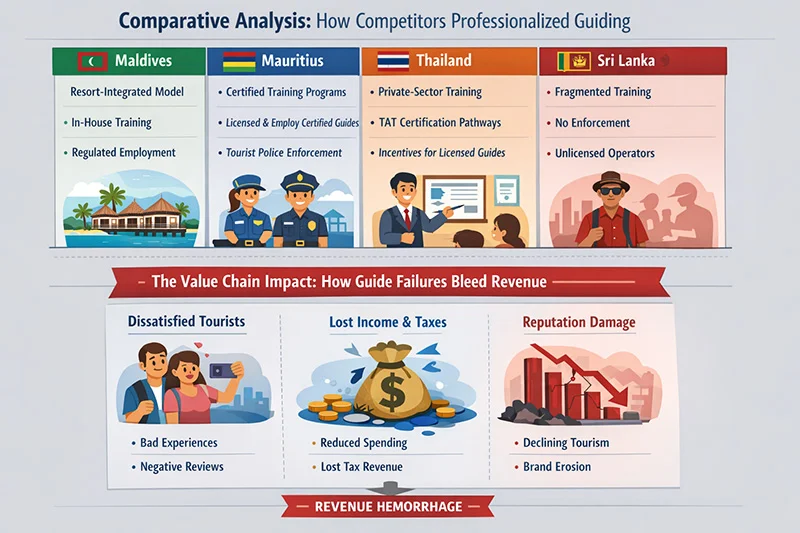
The result: even licensed guides often lack the depth of knowledge, language skills, or service standards that high-yield tourists expect. Unlicensed guides have no standards at all. Compare this to competitors. In Mauritius, tour guides undergo rigorous government-certified training with mandatory refresher courses. The Maldives’ resort model embeds guide functions within integrated hospitality operations with strict quality controls. Thailand has well-developed private-sector training ecosystems feeding into licensed guide pools.
2. Economic Precarity and Income Volatility
Tour guiding in Sri Lanka is economically unstable:
* Seasonal income volatility: High earnings in peak months (December-March), near-zero in low season (April-June, September)
* No fixed salaries: Most guides work freelance or commission-based
* Age and experience don’t guarantee income: 60% of guides are over 40, but earnings decline with age due to physical demands and market preference for younger, language-proficient guides
* Commission dependency: Guides often earn more from commissions on shopping, gem purchases, and restaurant referrals than from guiding fees
The commission-driven model pushes guides to prioritise high-commission shops over meaningful experiences, leaving tourists feeling manipulated. With low earnings and poor incentives, skilled guides exist in the profession while few new entrants join. The result is a shrinking pool of struggling licensed guides and rising numbers of opportunistic unlicensed operators.
3. Regulatory Abdication and Unlicensed Proliferation
Unlicensed guides thrive because enforcement is absent, economic incentives favour avoiding fees and taxes, and tourists cannot distinguish licensed professionals from informal operators. With SLTDA’s limited capacity reducing oversight, unregistered activity expands. Guiding becomes the frontline where regulatory failure most visibly harms tourist experience and sector revenues in Sri Lanka.
4. Male-Dominated, Ageing, Geographically Uneven Workforce
The guide workforce is:
* Heavily male-dominated: Fewer than 10% are women
* Ageing: 60% are over 40; many in their 50s and 60s
* Geographically concentrated: Clustered in Colombo, Galle, Kandy, Cultural Triangle—minimal presence in emerging destinations
This creates multiple problems:
* Gender imbalance: Limits appeal to female solo travellers and certain market segments (wellness tourism, family travel with mothers)
* Physical limitations: Older guides struggle with demanding itineraries (hiking, adventure tourism)
* Knowledge ossification: Ageing workforce with no continuous learning rehashes outdated narratives, lacks digital literacy, cannot engage younger tourist demographics
* Regional gaps: Emerging destinations (Eastern Province, Northern heritage sites) lack trained guide capacity
1. Experience Degradation Lower Spending
Unlicensed guides lack knowledge, language skills, and service training. Tourist experience degrades. When tourists feel they are being shuttled to commission shops rather than authentic experiences, they:
* Cut trips short
* Skip additional paid activities
* Leave negative reviews
* Do not return or recommend
The yield impact is direct: degraded experiences reduce spending, return rates, and word-of-mouth premium.

2. Commission Steering → Value Leakage
Guides earning more from commissions than guiding fees optimise for merchant revenue, not tourist satisfaction.
This creates leakage: tourism spending flows to merchants paying highest commissions (often with foreign ownership or imported inventory), not to highest-quality experiences.
The economic distortion is visible: gems, souvenirs, and low-quality restaurants generate guide commissions while high-quality cultural sites, local artisan cooperatives, and authentic restaurants do not. Spending flows to low-value, high-leakage channels.
3. Safety and Security Risks → Reputation Damage
Unlicensed guides have no insurance, no accountability, no emergency training. When tourists encounter problems, accidents, harassment, scams, there is no recourse. Incidents generate negative publicity, travel advisories, reputation damage. The 2024-2025 reports of tourists being attacked by wildlife at major sites (Sigiriya) with inadequate safety protocols are symptomatic. Trained, licensed guides would have emergency protocols. Unlicensed operators improvise.
4. Market Segmentation Failure → Yield Optimisation Impossible
High-yield tourists (luxury, cultural immersion, adventure) require specialised guide-deep knowledge, language proficiency, cultural sensitivity. Sri Lanka cannot reliably deliver these guides at scale because:
* Training does not produce specialists (wildlife experts, heritage scholars, wellness practitioners)
* Economic precarity drives talent out
* Unlicensed operators dominate price-sensitive segments, leaving limited licensed capacity for premium segments
We cannot move upmarket because we lack the workforce to serve premium segments. We are locked into volume-chasing low-yield markets because that is what our guide workforce can provide.
The way forward
Fixing Sri Lanka’s guide crisis demands structural reform, not symbolic gestures. A full workforce census and licensing audit must map the real guide population, identify gaps, and set an enforcement baseline. Licensing must be mandatory, timebound, and backed by inspections and penalties. Economic incentives should reward professionalism through fair wages, transparent fees, and verified registries. Training must expand nationwide with specialisations, language standards, and continuous development. Gender and age imbalances require targeted recruitment, mentorship, and diversified roles. Finally, guides must be integrated into the tourism value chain through mandatory verification, accountability measures, and performancelinked feedback.
The Uncomfortable Truth
Can Sri Lanka achieve high-value tourism with a low-quality, largely unlicensed guide workforce? The answer is NO. Unambiguously, definitively, NO. Sri Lanka’s guides shape tourist perceptions, spending, and satisfaction, yet the system treats them as expendable; poorly trained, economically insecure, and largely unregulated. With 57% of tourists relying on unlicensed guides, experience quality becomes unpredictable and revenue leaks into commission-driven channels.
High-yield markets avoid destinations with weak service standards, leaving Sri Lanka stuck in low-value, volume tourism. This is not a training problem but a structural failure requiring regulatory enforcement, viable career pathways, and a complete overhaul of incentives. Without professionalising guides, high-value tourism is unattainable. Fixing the guide crisis is the foundation for genuine sector transformation.
The choice is ours. The workforce is waiting.
This concludes the 04-part series on Sri Lanka’s tourism stagnation. The diagnosis is complete. The question now is whether policymakers have the courage to act.
For any concerns/comments contact the author at saliya.ca@gmail.com
(The writer, a senior Chartered Accountant and professional banker, is Professor at SLIIT, Malabe. The views and opinions expressed in this article are personal.)

 by Kaushalya Perera
Time has, by and large, stood still in the business of academic staff recruitment to state universities. Qualifications have proliferated and evolved to be more interdisciplinary, but our selection processes and evaluation criteria are unchanged since at least the late 1990s. But before I delve into the problems, I will describe the existing processes and schemes of recruitment. The discussion is limited to UGC-governed state universities (and does not include recruitment to medical and engineering sectors) though the problems may be relevant to other higher education institutions (HEIs).
How recruitment happens currently in SL state universities
Academic ranks in Sri Lankan state universities can be divided into three tiers (subdivisions are not discussed).
* Lecturer (Probationary)
– recruited with a four-year undergraduate degree. A tiny step higher is the Lecturer (Unconfirmed), recruited with a postgraduate degree but no teaching experience.
* A Senior Lecturer can be recruited with certain postgraduate qualifications and some number of years of teaching and research.
* Above this is the professor (of four types), which can be left out of this discussion since only one of those (Chair Professor) is by application.
State universities cannot hire permanent academic staff as and when they wish. Prior to advertising a vacancy, approval to recruit is obtained through a mind-numbing and time-consuming process (months!) ending at the Department of Management Services. The call for applications must list all ranks up to Senior Lecturer. All eligible candidates for Probationary to Senior Lecturer are interviewed, e.g., if a Department wants someone with a doctoral degree, they must still advertise for and interview candidates for all ranks, not only candidates with a doctoral degree. In the evaluation criteria, the first degree is more important than the doctoral degree (more on this strange phenomenon later). All of this is only possible when universities are not under a ‘hiring freeze’, which governments declare regularly and generally lasts several years.
Problem type 1
– Archaic processes and evaluation criteria
Twenty-five years ago, as a probationary lecturer with a first degree, I was a typical hire. We would be recruited, work some years and obtain postgraduate degrees (ideally using the privilege of paid study leave to attend a reputed university in the first world). State universities are primarily undergraduate teaching spaces, and when doctoral degrees were scarce, hiring probationary lecturers may have been a practical solution. The path to a higher degree was through the academic job. Now, due to availability of candidates with postgraduate qualifications and the problems of retaining academics who find foreign postgraduate opportunities, preference for candidates applying with a postgraduate qualification is growing. The evaluation scheme, however, prioritises the first degree over the candidate’s postgraduate education. Were I to apply to a Faculty of Education, despite a PhD on language teaching and research in education, I may not even be interviewed since my undergraduate degree is not in education. The ‘first degree first’ phenomenon shows that universities essentially ignore the intellectual development of a person beyond their early twenties. It also ignores the breadth of disciplines and their overlap with other fields.
This can be helped (not solved) by a simple fix, which can also reduce brain drain: give precedence to the doctoral degree in the required field, regardless of the candidate’s first degree, effected by a UGC circular. The suggestion is not fool-proof. It is a first step, and offered with the understanding that any selection process, however well the evaluation criteria are articulated, will be beset by multiple issues, including that of bias. Like other Sri Lankan institutions, universities, too, have tribal tendencies, surfacing in the form of a preference for one’s own alumni. Nevertheless, there are other problems that are, arguably, more pressing as I discuss next. In relation to the evaluation criteria, a problem is the narrow interpretation of any regulation, e.g., deciding the degree’s suitability based on the title rather than considering courses in the transcript. Despite rhetoric promoting internationalising and inter-disciplinarity, decision-making administrative and academic bodies have very literal expectations of candidates’ qualifications, e.g., a candidate with knowledge of digital literacy should show this through the title of the degree!
Problem type 2 – The mess of badly regulated higher education
A direct consequence of the contemporary expansion of higher education is a large number of applicants with myriad qualifications. The diversity of degree programmes cited makes the responsibility of selecting a suitable candidate for the job a challenging but very important one. After all, the job is for life – it is very difficult to fire a permanent employer in the state sector.
Widely varying undergraduate degree programmes.
At present, Sri Lankan undergraduates bring qualifications (at times more than one) from multiple types of higher education institutions: a degree from a UGC-affiliated state university, a state university external to the UGC, a state institution that is not a university, a foreign university, or a private HEI aka ‘private university’. It could be a degree received by attending on-site, in Sri Lanka or abroad. It could be from a private HEI’s affiliated foreign university or an external degree from a state university or an online only degree from a private HEI that is ‘UGC-approved’ or ‘Ministry of Education approved’, i.e., never studied in a university setting. Needless to say, the diversity (and their differences in quality) are dizzying. Unfortunately, under the evaluation scheme all degrees ‘recognised’ by the UGC are assigned the same marks. The same goes for the candidates’ merits or distinctions, first classes, etc., regardless of how difficult or easy the degree programme may be and even when capabilities, exposure, input, etc are obviously different.
Similar issues are faced when we consider postgraduate qualifications, though to a lesser degree. In my discipline(s), at least, a postgraduate degree obtained on-site from a first-world university is preferable to one from a local university (which usually have weekend or evening classes similar to part-time study) or online from a foreign university. Elitist this may be, but even the best local postgraduate degrees cannot provide the experience and intellectual growth gained by being in a university that gives you access to six million books and teaching and supervision by internationally-recognised scholars. Unfortunately, in the evaluation schemes for recruitment, the worst postgraduate qualification you know of will receive the same marks as one from NUS, Harvard or Leiden.
The problem is clear but what about a solution?
Recruitment to state universities needs to change to meet contemporary needs. We need evaluation criteria that allows us to get rid of the dross as well as a more sophisticated institutional understanding of using them. Recruitment is key if we want our institutions (and our country) to progress. I reiterate here the recommendations proposed in ‘Considerations for Higher Education Reform’ circulated previously by Kuppi Collective:
* Change bond regulations to be more just, in order to retain better qualified academics.
* Update the schemes of recruitment to reflect present-day realities of inter-disciplinary and multi-disciplinary training in order to recruit suitably qualified candidates.
* Ensure recruitment processes are made transparent by university administrations.
Kaushalya Perera is a senior lecturer at the University of Colombo.
(Kuppi is a politics and pedagogy happening on the margins of the lecture hall that parodies, subverts, and simultaneously reaffirms social hierarchies.)

 This week, too, the spotlight is on an outfit that has gained popularity, mainly through social media.
Last week we had MISTER Band in our scene, and on 10th February, Yellow Beatz – both social media favourites.
Talento is a seven-piece band that plays all types of music, from the ‘60s to the modern tracks of today.
The band has reached many heights, since its inception in 2012, and has gained recognition as a leading wedding and dance band in the scene here.
The members that makeup the outfit have a solid musical background, which comes through years of hard work and dedication
Their portfolio of music contains a mix of both western and eastern songs and are carefully selected, they say, to match the requirements of the intended audience, occasion, or event.
Although the baila is a specialty, which is inherent to this group, that originates from Moratuwa, their repertoire is made up of a vast collection of love, classic, oldies and modern-day hits.
The musicians, who make up Talento, are:
Prabuddha Geetharuchi:

Geilee Fonseka: Dynamic and charismatic vocalist
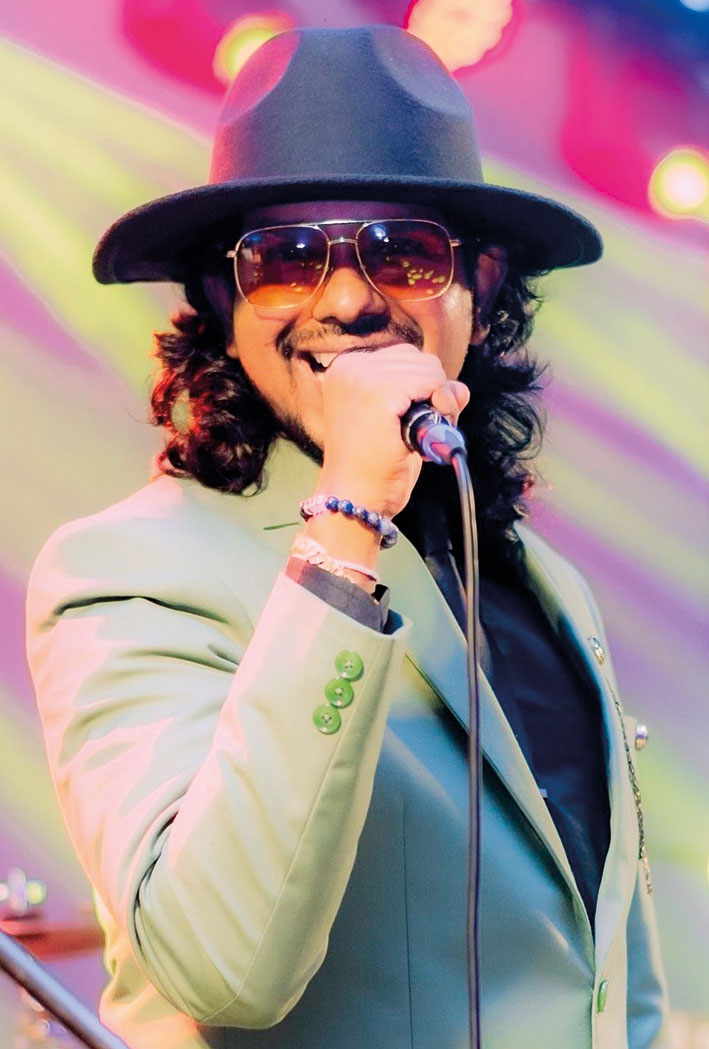
Prabuddha Geetharuchi: The main man behind the band Talento
(Vocalist/ Frontman). He is an avid music enthusiast and was mentored by a lot of famous musicians, and trainers, since he was a child. Growing up with them influenced him to take on western songs, as well as other music styles. A Peterite, he is the main man behind the band Talento and is a versatile singer/entertainer who never fails to get the crowd going.
Geilee Fonseka (Vocals):
A dynamic and charismatic vocalist whose vibrant stage presence, and powerful voice, bring a fresh spark to every performance. Young, energetic, and musically refined, she is an artiste who effortlessly blends passion with precision – captivating audiences from the very first note. Blessed with an immense vocal range, Geilee is a truly versatile singer, confidently delivering Western and Eastern music across multiple languages and genres.
Chandana Perera (Drummer):
His expertise and exceptional skills have earned him recognition as one of the finest acoustic drummers in Sri Lanka. With over 40 tours under his belt, Chandana has demonstrated his dedication and passion for music, embodying the essential role of a drummer as the heartbeat of any band.
Harsha Soysa:
(Bassist/Vocalist). He a chorister of the western choir of St. Sebastian’s College, Moratuwa, who began his musical education under famous voice trainers, as well as bass guitar trainers in Sri Lanka. He has also performed at events overseas. He acts as the second singer of the band
Udara Jayakody:
(Keyboardist). He is also a qualified pianist, adding technical flavour to Talento’s music. His singing and harmonising skills are an extra asset to the band. From his childhood he has been a part of a number of orchestras as a pianist. He has also previously performed with several famous western bands.
Aruna Madushanka:
(Saxophonist). His proficiciency in playing various instruments, including the saxophone, soprano saxophone, and western flute, showcases his versatility as a musician, and his musical repertoire is further enhanced by his remarkable singing ability.
Prashan Pramuditha:
(Lead guitar). He has the ability to play different styles, both oriental and western music, and he also creates unique tones and patterns with the guitar..

Cabinet nod to accept Japanese government grant of 08 used low floorboard buses

Payment of the financial subsidy for fertilizer to farmers cultivating paddy lands for the Yala season 2026.

Ministerial Committee appointed to submit recommendations on proposed program to mitigate loss of crops to wild animals

New Zealand elect to bowl first at Eden Gardens

Cabinet approves import of Maize to meet shortfall

Cabinet nod for the removal of Cess tax imposed on imported good

‘Dates have the highest sugar content to fight Coronavirus’

Sunday Island 27 December – Headlines

#SundayIsland 17th December – Headlines

Sunday Island – 28th March

Sunday Island Headlines – 21 March

Sunday Island – 21st February – Headlines
-

 Features3 days ago
Brilliant Navy officer no more
-

 Opinion6 days ago
Jamming and re-setting the world: What is the role of Donald Trump?
-
 Features6 days ago
An innocent bystander or a passive onlooker?
-
 Features7 days ago
Ratmalana Airport: The Truth, The Whole Truth, And Nothing But The Truth
-

 Opinion3 days ago
Sri Lanka – world’s worst facilities for cricket fans
-
 Business7 days ago
IRCSL transforms Sri Lanka’s insurance industry with first-ever Centralized Insurance Data Repository
-

 Business6 days ago
An efficacious strategy to boost exports of Sri Lanka in medium term
-
 Features4 days ago
Overseas visits to drum up foreign assistance for Sri Lanka