
News
Navaliya marks 43 years of empowering Lankan women, with fresh look and digital leap


Sri Lanka’s leading women’s newspaper, Navaliya, celebrates its 43rd anniversary today (1), marking over four decades of informative and empowering content for women across the country. First launched on August 2, 1982, as part of Upali Newspapers, Navaliya has evolved significantly over the years to become one of the nation’s most beloved and influential publications.
To commemorate this milestone, Navaliya unveiled a refreshed look for its print edition, which hit the market on August 1. The redesign is aimed at staying relevant to the changing needs of its readers while maintaining its core mission of providing valuable information, inspiration, and entertainment for Sri Lankan women.
Speaking at the anniversary celebrations, the editorial team reflected on Navaliya’s journey from a traditional print publication to a modern, dynamic voice for women. The newspaper has consistently adapted to the evolving media landscape, meeting readers where they are whether in print or online.
In recent years, Navaliya has embraced digital platforms, ensuring that its content is accessible to a broader audience. Now, in addition to its widely circulated print edition, readers can access the newspaper online via www.navaliya.lk, keeping pace with the digital transformation that has reshaped how news and stories are consumed.
The publication was also recently recognized for its ongoing contributions to the empowerment of women, receiving accolades on Women’s Day for its continued impact in the media industry.


Proposed education reforms have drawn sharp criticism from education professionals, teacher unions and student organisations, who warned on Thursday that the changes risk undermining child safety, widening inequality and imposing unaffordable costs on parents.
Addressing a press conference in Colombo, Dr Ayomi Irugalbandara of the Faculty of Education at the Open University of Sri Lanka said the proposed reforms appeared to be largely modelled on foreign education systems without adequate consideration of local realities.
She took particular issue with proposals to integrate social media use into the school curriculum, noting that several developed countries have moved in the opposite direction by preventing children under the age of 15 from accessing social media platforms.
“Most of these modules are not appropriate for this country,” Dr Irugalbandara said. “We warn parents that these reforms place children at risk.”
Concerns were also raised over digital content linked to the revised curriculum. Inter-University Students’ Federation Convener Madushan Chandrajith said the Grade Six Information and Communication Technology (ICT) module included QR codes that directed students to a controversial YouTube channel.
“Who will take responsibility for children accessing such content?” he asked, calling for clear accountability mechanisms for material linked through digital platforms used in schools.
Secretary of the Workers’ Struggle Centre, Duminda Nagamuwa, criticised the government’s approach to the reform process, comparing it to the fertiliser policy introduced under former President Gotabaya Rajapaksa. He alleged that the authorities were pushing ahead with education reforms despite opposition from academics, teachers and other stakeholders.
Nagamuwa also highlighted the economic burden on families, noting that Sri Lanka’s poverty rate had increased from 12.5 percent to 25 percent. He questioned how parents were expected to afford smartphones or tablet computers required for students to access QR code-linked educational content.
“The government is asking parents to bear costs they simply cannot afford,” he said.
Ceylon Teachers’ Union General Secretary Joseph Stalin said schools had already begun collecting money from parents in anticipation of the reforms, including funds to purchase smart boards.

Opposition and SJB Leader Sajith Premadasa on Friday told Parliament that the Buddhism textbook contained a “serious error,” citing the use of the Ashoka Chakra instead of the Dharmachakra.
He said the Dharmachakra depicted in the book differs from the one featured in the state symbol and called on the Education Minister to correct the mistake.
Responding, Education Minister and Prime Minister Harini Amarasuriya said the Dharmachakra used in the textbook had been approved by the Ministry of Buddhist Affairs. She added that the advisory board on Buddhism had also endorsed it.
The Premier further noted that during her recent visit, Mahanayake Theras confirmed that the Dharmachakra in the textbook was the officially approved version.
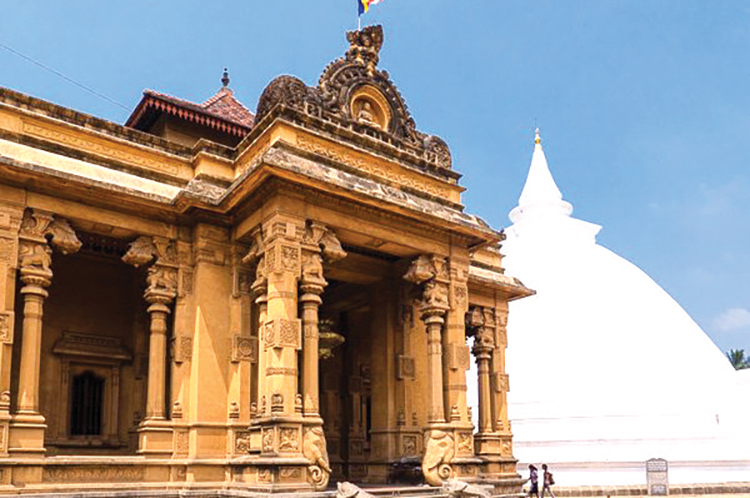
The Annual Kelaniya Duruthu Perahera at the historic Kelaniya Raja Maha Viharaya lit up the streets once again, concluding on Saturday night after three days of colourful pageantry.
First held in 1927 thanks to the vision of philanthropist Don Walter Wijewardene, son of Helena Wijewardene Lamathani of Sedawatte, the Kelaniya Duruthu Maha Perahera has grown into one of Sri Lanka’s most elaborate and grand low-country Buddhist pageants.
The Perahera commemorates the sacred visit of the Buddha to Kelaniya, the most revered temple in Sri Lanka’s Western Province. Celebrated annually during Duruthu Poya in January, the event showcases a fusion of historic, cultural, and religious traditions.
This year, under the guidance of Chief incumbent Venerable Professor Mahinda Sangarakkitta Nayaka Thera and Dayaka Sabha President Dr. Saman Weerasinghe, the festivities began with the ceremonial handover of the Sacred Relic Casket by Chancellor of Kelaniya University, Agra Maha Panditha Ven. Professor Kollupitiya Mahinda Sangharakkita Nayake Thera, to Chief Basnayake Nilame Dhammika Attygalle.
The sacred relic procession was followed by three Devale Peraheras dedicated to God Vibishana, God Kataragama, and God Vishnu, captivating devotees and tourists alike with traditional drumming, vibrant costumes, and ceremonial elephants.
The Perahera festivities also featured Pahalamaluwe Perahera on 8th January, Sacred City Perahera on 9th January, and the Grand Duruthu Maha Perahera on 10th January, with all events commencing at 8:00 pm. Special enclosures were arranged to accommodate foreign tourists, providing an immersive view of Sri Lanka’s rich cultural heritage.
As lanterns faded into the night sky and devotees paid homage, the Kelaniya Duruthu Perahera once again reaffirmed its place as a cornerstone of Sri Lanka’s cultural and religious calendar.

Rescuers race to find dozens missing in deadly Philippines landfill collapse

Trump seeks $100bn for Venezuela oil, but Exxon boss says country ‘uninvestable’

US military strikes Islamic State group targets in Syria, officials say

Gardner and Wareham lead Giants to opening-game victory

Experts: NPP education reforms unsuitable for SL

Sajith: Ashoka Chakra replaces Dharmachakra in Buddhism textbook

‘Dates have the highest sugar content to fight Coronavirus’

Sunday Island 27 December – Headlines

#SundayIsland 17th December – Headlines

Sunday Island – 28th March

Sunday Island Headlines – 21 March

Sunday Island – 21st February – Headlines
-

 News5 days ago
Interception of SL fishing craft by Seychelles: Trawler owners demand international investigation
-
 News5 days ago
Broad support emerges for Faiszer’s sweeping proposals on long- delayed divorce and personal law reforms
-

 Opinion2 days ago
The minstrel monk and Rafiki, the old mandrill in The Lion King – II
-

 Features2 days ago
The Venezuela Model:The new ugly and dangerous world order
-

 Latest News1 day ago
Rain washes out 2nd T20I in Dambulla
-
 Business1 day ago
Sevalanka Foundation and The Coca-Cola Foundation support flood-affected communities in Biyagama, Sri Lanka
-

 News4 days ago
Prez seeks Harsha’s help to address CC’s concerns over appointment of AG
-
 News6 days ago
Private airline crew member nabbed with contraband gold