
Features
Motley collection of superheroes lined up on MCU


By Tharishi Hewavithanagamage
More than a decade after its inception, the Marvel Cinematic Universe reached the end of an era in 2019 with ‘Avengers: Endgame’. Endgame closed the Infinity Saga, wrapping up numerous storylines and character arcs that had been ongoing over 22 films. As the end of an era paved the way for a new slate of characters, Phase 4 kicked off with Disney+ series ‘WandaVision’ and ‘Falcon’, and the ‘Winter Soldier’ which successfully ended earlier this year. The unprecedented changes brought on by the COVID-19 pandemic pushed the scheduled movies further and further away.
While fans now eagerly await the arrival of ‘Loki’, starring Tom Hiddleston, next month, Marvel shared a video celebrating the love of storytelling and the Marvel Cinematic Universe’s most memorable moments. The mega trailer titled ‘Marvel Studios Celebrates the Movies’ opened with a message from the late Stan Lee and even shows footage of audiences on the opening night cheering the climax of ‘Avengers: Endgame,’ back when theatres were still open. The rest of the video gave fans a hint of what’s to come in Phase 4 with previously unseen footage of the upcoming movies. Marvel’s habit of saving the best twists for last paid off as they dropped the iconic number 4 and teased a new ‘Fantastic Four’ movie, currently reported to be directed by Jon Watts. Marvel wants to see their beloved audiences back at the movies cheering for their favorite characters once again.
Originally scheduled for release in 2020, ‘Black Widow’ has been pushed back so many times. The movie will release in theatres and Disney+ simultaneously on July 9, 2021. The prequel has Scarlett Johansson reprising her role Natasha Romanoff. Romanoff must confront the darker parts of her life, deal with her history and her broken relationships. New footage gave fans action packed scenes featuring the newest and mysterious baddie, Taskmaster.
‘Shang-Chi and the Legend of the Ten Rings’ recently revealed an intense trailer and introduced Marvel fans to new characters. The film stars Simu Liu as Shang-Chi, making it the first Marvel movie to feature an Asian lead superhero. Liu’s Shang-Chi must confront the past he thought he left behind when he is drawn into the web of the Ten Rings organization. Starring alongside Liu are Tony Leung, Awkwafina, Michelle Yeoh, Fala Chen, Meng’er Zhang, Florian Munteanu and Ronny Chieng. Shang-Chi is scheduled for release on September 3, 2021.
‘Eternals’ originally created by the legendary Jack Kirby is joining the MCU for the first time. Directed by the recent Oscar-winner Chloe Zhao, the movie features an impressive cast with the likes of Angelina Jolie, Richard Madden, Kumail Nanjiani, Lauren Ridloff, Brian Tyree Henry, Salma Hayek, Lia McHugh, and Don Lee. Marvel Studios shared its first ever trailer and without too many spoilers only featured some scenes with the characters in extraterrestrial-looking locations. The official synopsis noted that the Eternals are ancient aliens who have been living on Earth in secret for thousands of years and are tasked with protecting humanity from the Deviants. Fans can expect Eternals on November 5, 2021.
Although no footage was released, the Spider-Man franchise continues with the next title ‘Spider-Man: No Way Home’, releasing on December 17, 2021. Jon Watts returns to direct with the trio Tom Holland, Zendaya and Jacob Batalon reprising their respective roles. Major characters like Alfred Molina’s Doctor Octopus from the first Spider-Man trilogy and Jamie Foxx’s Electro from the second are set to appear in the film. Rumors have also emerged that Willem Dafoe’s Green Goblin will make an appearance. Many also have high hopes on appearances from Tobey Maguire and Andrew Garfield, but nothing has been confirmed.
‘Doctor Strange in the Multiverse of Madness’ is described as the MCU’s first horror film and is expected to dive deep into the MCU’s multiverse as well. Sam Raimi takes the role of director, while Benedict Cumberbatch, Benedict Wong, Chiwetel Ejiofor and Rachel McAdams return as Doctor Strange, Wong, Karl Mordo, and Christine Palmer respectively. In addition, because the movie will tie in with WandaVision, Elizabeth Olsen will reprise her role as Wanda Maximoff/Scarlet Witch alongside newcomer Xochitl Gomez who will portray America Chavez. Like other Marvel productions, much of the content still remains a mystery, but the film has the potential to introduce a variety of new characters. ‘Doctor Strange in the Multiverse of Madness’ arrives on March 25, 2022.
‘Thor: Love and Thunder’ is the fourth instalment in the Thor movie franchise with Taika Waititi coming back to direct after Thor: Ragnarok. Chris Hemsworth, Tessa Thompson and Natalie Portman reprise their roles as Thor, Valkyrie and Jane Foster. More returnees include Jaimie Alexander as Sif and Jeff Goldblum as the cosmic Grandmaster, along with the cast of Guardians of the Galaxy – Chris Pratt as Star-Lord, Dave Bautista as Drax, Karen Gillan as Nebula, Pom Klementieff as Mantis, Sean Gunn as Kraglin, Vin Diesel as the voice of Groot, and Bradley Cooper as the voice of Rocket Raccoon. Making their MCU debuts are Christian Bale and Russell Crowe as Gorr the God Butcher and Zeus, respectively. Love and Thunder arrives on May 6, 2022.
Marvel revealed the official sequel titles for Black Panther and Captain Marvel. The next Black Panther will be titled ‘Black Panther: Wakanda Forever’ and is scheduled for release on July 8, 2022. Captain Marvel 2 is titled ‘The Marvels’. Brie Larson will reprise her role as Captain Marvel alongside Teyonah Parris as Monica Rambeau and Man Vellani, who is currently slated to portray Kamala Khan in Disney+ series ‘Ms. Marvel’.
The year 2023 will kick off with ‘Ant-Man and the Wasp: Quantmania’, slated for release on February 17, 2023. Paul Rudd, Evangeline Lilly, Michael Douglas, Michelle Pfeiffer and Kathryn Newton will reprise their roles as Ant-Man, Wasp, Dr. Hank Pym, Janet Van Dyne and Cassie Lang respectively. Jonathan Majors will debut in the MCU as the villain Kang the Conqueror.
The space misfits return on May 5, 2023 with their adventures. James Gunn returns to pen and direct Guardians of the Galaxy Vol. 3, welcomes back Chris Pratt’s Star-Lord, Dave Bautista’s Drax the Destroyer, Pom Klementieff’s Mantis, Vin Diesel’s Groot, Bradley Cooper’s Rocket and Karen Gillan’s Nebula. Possibilities remain high for Zoe Saldana’s Gamora from an alternate timeline to make an appearance.



A recent discussion by former Environment Minister, Eng. Patali Champika Ranawaka on the Derana 360 programme has reignited an important national conversation on how Sri Lanka plans, builds and rebuilds in the face of recurring disasters.
His observations, delivered with characteristic clarity and logic, went beyond the immediate causes of recent calamities and focused sharply on long-term solutions—particularly the urgent need for smarter land use and vertical housing development.
Ranawaka’s proposal to introduce multistoried housing schemes in the Gannoruwa area, as a way of reducing pressure on environmentally sensitive and disaster-prone zones, resonated strongly with urban planners and environmentalists alike.
It also echoed ideas that have been quietly discussed within academic and conservation circles for years but rarely translated into policy.
One such voice is that of Professor Siril Wijesundara, Research Professor at the National Institute of Fundamental Studies (NIFS) and former Director General of the Royal Botanic Gardens, Peradeniya, who believes that disasters are often “less acts of nature and more outcomes of poor planning.”

Professor Siril Wijesundara
“What we repeatedly see in Sri Lanka is not merely natural disasters, but planning failures,” Professor Wijesundara told The Island.
“Floods, landslides and environmental degradation are intensified because we continue to build horizontally, encroaching on wetlands, forest margins and river reservations, instead of thinking vertically and strategically.”
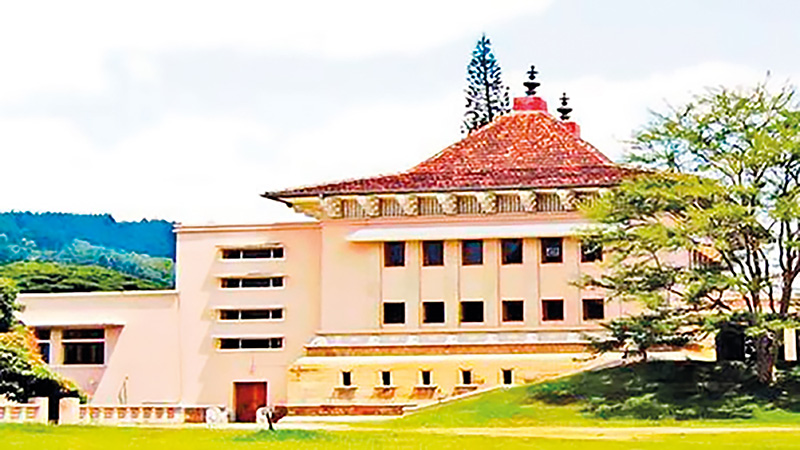
The former Director General notes that the University of Peradeniya itself offers a compelling case study of both the problem and the solution. The main campus, already densely built and ecologically sensitive, continues to absorb new faculties, hostels and administrative buildings, placing immense pressure on green spaces and drainage systems.
“The Peradeniya campus was designed with landscape harmony in mind,” he said. “But over time, ad-hoc construction has compromised that vision. If development continues in the same manner, the campus will lose not only its aesthetic value but also its ecological resilience.”
Professor Wijesundara supports the idea of reorganising the Rajawatte area—located away from the congested core of the university—as a future development zone. Rather than expanding inward and fragmenting remaining open spaces, he argues that Rajawatte can be planned as a well-designed extension, integrating academic, residential and service infrastructure in a controlled manner.
Crucially, he stresses that such reorganisation must go hand in hand with social responsibility, particularly towards minor staff currently living in the Rajawatte area.
“These workers are the backbone of the university. Any development plan must ensure their dignity and wellbeing,” he said. “Providing them with modern, safe and affordable multistoried housing—especially near the railway line close to the old USO premises—would be both humane and practical.”
According to Professor Wijesundara, housing complexes built near existing transport corridors would reduce daily commuting stress, minimise traffic within the campus, and free up valuable land for planned academic use.
More importantly, vertical housing would significantly reduce the university’s physical footprint.
Drawing parallels with Ranawaka’s Gannoruwa proposal, he emphasised that vertical development is no longer optional for Sri Lanka.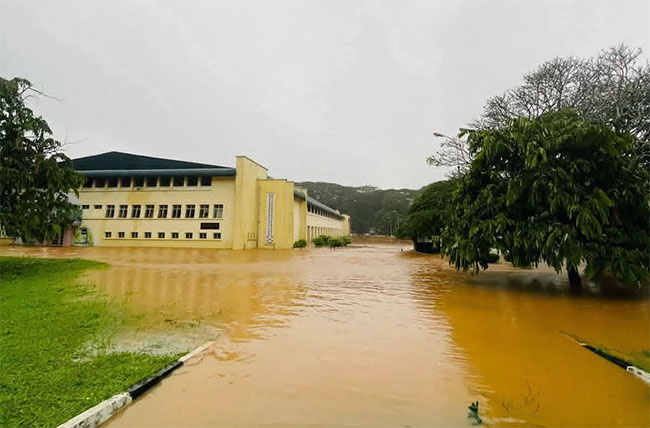
“We are a small island with a growing population and shrinking safe land,” he warned.
“If we continue to spread out instead of building up, disasters will become more frequent and more deadly. Vertical housing, when done properly, is environmentally sound, economically efficient and socially just.”

Peradeniya University flooded
The veteran botanist also highlighted the often-ignored link between disaster vulnerability and the destruction of green buffers.
“Every time we clear a lowland, a wetland or a forest patch for construction, we remove nature’s shock absorbers,” he said.
“The Royal Botanic Gardens has survived floods for over a century precisely because surrounding landscapes once absorbed excess water. Urban planning must learn from such ecological wisdom.”
Professor Wijesundara believes that universities, as centres of knowledge, should lead by example.
“If an institution like Peradeniya cannot demonstrate sustainable planning, how can we expect cities to do so?” he asked. “This is an opportunity to show that development and conservation are not enemies, but partners.”
As climate-induced disasters intensify across the country, voices like his—and proposals such as those articulated by Patali Champika Ranawaka—underscore a simple but urgent truth: Sri Lanka’s future safety depends not only on disaster response, but on how and where we build today.
The challenge now lies with policymakers and planners to move beyond television studio discussions and academic warnings, and translate these ideas into concrete, people-centred action.
By Ifham Nizam ✍️

At the initial stage of my six-year involvement in uplifting society through skill-based initiatives, particularly by promoting handicraft work and teaching students to think creatively and independently, my efforts were partially jeopardized by deep-rooted superstition and resistance to rational learning.
Superstitions exerted a deeply adverse impact by encouraging unquestioned belief, fear, and blind conformity instead of reasoning and evidence-based understanding. In society, superstition often sustains harmful practices, social discrimination, exploitation by self-styled godmen, and resistance to scientific or social reforms, thereby weakening rational decision-making and slowing progress. When such beliefs penetrate the educational environment, students gradually lose the habit of asking “why” and “how,” accepting explanations based on fate, omens, or divine intervention rather than observation and logic.
Initially, learners became hesitant to challenge me despite my wrong interpretation of any law, less capable of evaluating information critically, and more vulnerable to misinformation and pseudoscience. As a result, genuine efforts towards social upliftment were obstructed, and the transformative power of education, which could empower individuals economically and intellectually, was weakened by fear-driven beliefs that stood in direct opposition to progress and rational thought. In many communities, illnesses are still attributed to evil spirits or curses rather than treated as medical conditions. I have witnessed educated people postponing important decisions, marriages, journeys, even hospital admissions, because an astrologer predicted an “inauspicious” time, showing how fear governs rational minds.
While teaching students science and mathematics, I have clearly observed how superstition acts as a hidden barrier to learning, critical thinking, and intellectual confidence. Many students come to the classroom already conditioned to believe that success or failure depends on luck, planetary positions, or divine favour rather than effort, practice, and understanding, which directly contradicts the scientific spirit. I have seen students hesitate to perform experiments or solve numerical problems on certain “inauspicious” days.
In mathematics, some students label themselves as “weak by birth”, which creates fear and anxiety even before attempting a problem, turning a subject of logic into a source of emotional stress. In science classes, explanations based on natural laws sometimes clash with supernatural beliefs, and students struggle to accept evidence because it challenges what they were taught at home or in society. This conflict confuses young minds and prevents them from fully trusting experimentation, data, and proof.
Worse still, superstition nurtures dependency; students wait for miracles instead of practising problem-solving, revision, and conceptual clarity. Over time, this mindset damages curiosity, reduces confidence, and limits innovation, making science and mathematics appear difficult, frightening, or irrelevant. Many science teachers themselves do not sufficiently emphasise the need to question or ignore such irrational beliefs and often remain limited to textbook facts and exam-oriented learning, leaving little space to challenge superstition directly. When teachers avoid discussing superstition, they unintentionally reinforce the idea that scientific reasoning and superstitious beliefs can coexist.
To overcome superstition and effectively impose critical thinking among students, I have inculcated the process to create a classroom culture where questioning was encouraged and fear of being “wrong” was removed. Students were taught how to think, not what to think, by consistently using the scientific method—observation, hypothesis, experimentation, evidence, and conclusion—in both science and mathematics lessons. I have deliberately challenged superstitious beliefs through simple demonstrations and hands-on experiments that allow students to see cause-and-effect relationships for themselves, helping them replace belief with proof.
Many so-called “tantrik shows” that appear supernatural can be clearly explained and exposed through basic scientific principles, making them powerful tools to fight superstition among students. For example, acts where a tantrik places a hand or tongue briefly in fire without injury rely on short contact time, moisture on the skin, or low heat transfer from alcohol-based flames rather than divine power.
“Miracles” like ash or oil repeatedly appearing from hands or idols involve concealment or simple physical and chemical tricks. When these tricks are demonstrated openly in classrooms or science programmes and followed by clear scientific explanations, students quickly realise how easily perception can be deceived and why evidence, experimentation, and critical questioning are far more reliable than blind belief.
Linking concepts to daily life, such as explaining probability to counter ideas of luck, or biology to explain illness instead of supernatural causes, makes rational explanations relatable and convincing.
Another unique example that I faced in my life is presented here. About 10 years ago, when I entered my new house but did not organise traditional rituals that many consider essential for peace and prosperity as my relatives believed that without them prosperity would be blocked. Later on, I could not utilise the entire space of my newly purchased house for earning money, largely because I chose not to perform certain rituals.
While this decision may have limited my financial gains to some extent, I do not consider it a failure in the true sense. I feel deeply satisfied that my son and daughter have received proper education and are now well settled in their employment, which, to me, is a far greater achievement than any ritual-driven expectation of wealth. My belief has always been that a house should not merely be a source of income or superstition-bound anxiety, but a space with social purpose.
Instead of rituals, I strongly feel that the unused portion of my house should be devoted to running tutorials for poor and underprivileged students, where knowledge, critical thinking, and self-reliance can be nurtured. This conviction gives me inner peace and reinforces my faith that education and service to society are more meaningful measures of success than material profit alone.
Though I have succeeded to some extent, this success has not been complete due to the persistent influence of superstition.
by Dr Debapriya Mukherjee
Former Senior Scientist
Central Pollution Control Board, India ✍️

 Australian Prime Minister Anthony Albanese has done very well to speak-up against and outlaw race hate in the immediate aftermath of the recent cold-blooded gunning down of several civilians on Australia’s Bondi Beach. The perpetrators of the violence are believed to be ardent practitioners of religious and race hate and it is commendable that the Australian authorities have lost no time in clearly and unambiguously stating their opposition to the dastardly crimes in question.
The Australian Prime Minister is on record as stating in this connection: ‘ New laws will target those who spread hate, division and radicalization. The Home Affairs Minister will also be given new powers to cancel or refuse visas for those who spread hate and a new taskforce will be set up to ensure the education system prevents, tackles and properly responds to antisemitism.’
It is this promptness and single-mindedness to defeat race hate and other forms of identity-based animosities that are expected of democratic governments in particular world wide. For example, is Sri Lanka’s NPP government willing to follow the Australian example? To put the record straight, no past governments of Sri Lanka initiated concrete measures to stamp out the evil of race hate as well but the present Sri Lankan government which has pledged to end ethnic animosities needs to think and act vastly differently. Democratic and progressive opinion in Sri Lanka is waiting expectantly for the NPP government’ s positive response; ideally based on the Australian precedent to end race hate.
Meanwhile, it is apt to remember that inasmuch as those forces of terrorism that target white communities world wide need to be put down their counterpart forces among extremist whites need to be defeated as well. There could be no double standards on this divisive question of quashing race and religious hate, among democratic governments.
The question is invariably bound up with the matter of expeditiously and swiftly advancing democratic development in divided societies. To the extent to which a body politic is genuinely democratized, to the same degree would identity based animosities be effectively managed and even resolved once and for all. To the extent to which a society is deprived of democratic governance, correctly understood, to the same extent would it experience unmanageable identity-bred violence.
This has been Sri Lanka’s situation and generally it could be stated that it is to the degree to which Sri Lankan citizens are genuinely constitutionally empowered that the issue of race hate in their midst would prove manageable. Accordingly, democratic development is the pressing need.
While the dramatic blood-letting on Bondi Beach ought to have driven home to observers and commentators of world politics that the international community is yet to make any concrete progress in the direction of laying the basis for an end to identity-based extremism, the event should also impress on all concerned quarters that continued failure to address the matters at hand could prove fatal. The fact of the matter is that identity-based extremism is very much alive and well and that it could strike devastatingly at a time and place of its choosing.
It is yet premature for the commentator to agree with US political scientist Samuel P. Huntingdon that a ‘Clash of Civilizations’ is upon the world but events such as the Bondi Beach terror and the continuing abduction of scores of school girls by IS-related outfits, for instance, in Northern Africa are concrete evidence of the continuing pervasive presence of identity-based extremism in the global South.
As a matter of great interest it needs mentioning that the crumbling of the Cold War in the West in the early nineties of the last century and the explosive emergence of identity-based violence world wide around that time essentially impelled Huntingdon to propound the hypothesis that the world was seeing the emergence of a ‘Clash of Civilizations’. Basically, the latter phrase implied that the Cold War was replaced by a West versus militant religious fundamentalism division or polarity world wide. Instead of the USSR and its satellites, the West, led by the US, had to now do battle with religion and race-based militant extremism, particularly ‘Islamic fundamentalist violence’ .
Things, of course, came to a head in this regard when the 9/11 calamity centred in New York occurred. The event seemed to be startling proof that the world was indeed faced with a ‘Clash of Civilizations’ that was not easily resolvable. It was a case of ‘Islamic militant fundamentalism’ facing the great bulwark, so to speak, of ‘ Western Civilization’ epitomized by the US and leaving it almost helpless.
However, it was too early to write off the US’ capability to respond, although it did not do so by the best means. Instead, it replied with military interventions, for example, in Iraq and Afghanistan, which moves have only earned for the religious fundamentalists more and more recruits.
Yet, it is too early to speak in terms of a ‘Clash of Civilizations’. Such a phenomenon could be spoken of if only the entirety of the Islamic world took up arms against the West. Clearly, this is not so because the majority of the adherents of Islam are peaceably inclined and want to coexist harmoniously with the rest of the world.
However, it is not too late for the US to stop religious fundamentalism in its tracks. It, for instance, could implement concrete measures to end the blood-letting in the Middle East. Of the first importance is to end the suffering of the Palestinians by keeping a tight leash on the Israeli Right and by making good its boast of rebuilding the Gaza swiftly.
Besides, the US needs to make it a priority aim to foster democratic development worldwide in collaboration with the rest of the West. Military expenditure and the arms race should be considered of secondary importance and the process of distributing development assistance in the South brought to the forefront of its global development agenda, if there is one.
If the fire-breathing religious demagogue’s influence is to be blunted worldwide, then, it is development, understood to mean equitable growth, that needs to be fostered and consolidated by the democratic world. In other words, the priority ought to be the empowerment of individuals and communities. Nothing short of the latter measures would help in ushering a more peaceful world.

CPC delegation meets JVP leadership in Colombo

eChannelling introduces ‘eHomecare’ as SL’s first doctor-led elderly care service

NDB shows strong growth, rising investment potential

Sri Lankan tea sees a week of robust activity

Export earnings report $ 15.8 billion underscoring Sri Lanka’s trade competitiveness

Dockyard rally breaks CSE’s sluggish spell

‘Dates have the highest sugar content to fight Coronavirus’

Sunday Island 27 December – Headlines

#SundayIsland 17th December – Headlines

Sunday Island – 28th March

Sunday Island Headlines – 21 March

Sunday Island – 21st February – Headlines
-

 News4 days ago
Members of Lankan Community in Washington D.C. donates to ‘Rebuilding Sri Lanka’ Flood Relief Fund
-

 Latest News7 days ago
Landslide early warnings issued to the districts of Badulla, Kandy, Kurunegala, Matale and Nuwara-Eliya extended till 8AM on Sunday (21)
-

 News2 days ago
British MP calls on Foreign Secretary to expand sanction package against ‘Sri Lankan war criminals’
-

 Business6 days ago
Browns Investments sells luxury Maldivian resort for USD 57.5 mn.
-

 News5 days ago
Air quality deteriorating in Sri Lanka
-

 Editorial7 days ago
Cops as whipping boys?
-
 Features6 days ago
Hatton Plantations and WNPS PLANT Launch 24 km Riparian Forest Corridor
-

 News5 days ago
Cardinal urges govt. not to weaken key socio-cultural institutions