
Features
Kumar Sangakkara brings pride to Sri Lanka yet again

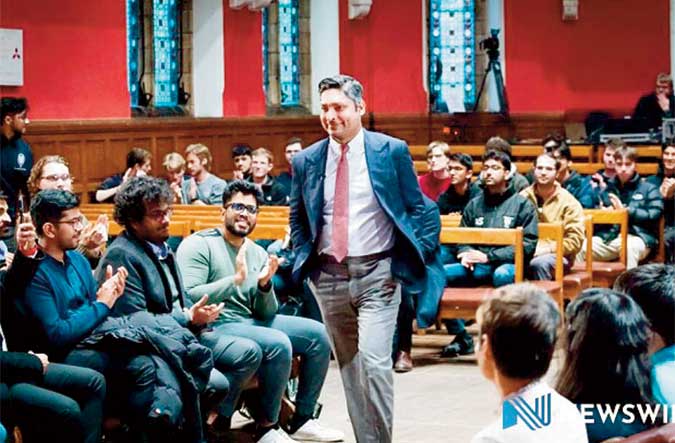
MTV 1 in its night news bulletin on March 27, mentioned that Kumar Sngakkara had addressed the Oxford Union and presented a short visual. Interest kindled, I googled and watched the entire Union session on video.
There he sat comfortable and so at ease, looking his handsomest best, dressed near casual in a dark blazer like jacket with grey slacks and subdued tie. He spoke excellently with the slightest of attractive accent, as English should be spoken. Also, no er…s and um…s at all. His talk, whether recounting incidents from his life or answering questions about cricket, was even paced and smooth flowing. Listeners’ reaction seemed to be riveted interest; questions at the end were many and penetrating.
A note on the Oxford Union is apt here. It is a debating society named the Oxford Union Society, commonly referred to as the Oxford Union, in the city of Oxford, England, whose membership is drawn primarily from the University. Founded in 1823, “it is one of Britain’s oldest university unions and one of the world’s most prestigious private students’ unions. It exists independently from the university and is distinct from the Oxford University Students Union.” Women were admitted as late as 1963. “The Union has the tradition of hosting some of the world’s most prominent individuals across politics, academia and popular culture.”
Please do note that sentence. Thus Sangakkara has been accepted by a most prestigious association as one of the worlds’ most prominent individuals. (In contrast local figures that stomp our stages hubris-filled come derisively to mind: granted PhDs from potty institutions and using Dr with names; claiming educational/professional qualifications that never were and strutting puffed up with self-inflation)
The Event
Kumar Sangakkara addressed the Oxford Union on February 23 this year. Seeing him walk up to the small platform filled me with justified pride. The convener, probably President of the Oxford Union, asked the first question on how Kumar got started in cricket. Kumar replied he was more into tennis and swimming as a schoolboy in Kandy, but at around 18 or 19, he moved to cricket and liked it as it was a team game calling for collaboration and playing as a cohesive group. He mentioned his father, several times later too, as being his guide and promoter, wanting him to always excel; while his mother was keener on his studies and educational success. His father had advised him to learn to change and never stop learning. “He threw a book at me each week – Tolstoy or philosophy or whatever and on Friday came question-time. He kept at me throughout. When in Australia for a test match, the hotel reception phoned me one night to say I had received a fax from my father. Initial alarm gave way to suspicion he was being usual. I told reception to put it under my door in the morning. As I had expected it was an entire page from the biography of Don Bradman and advice I should follow him.”
From his talk it was obvious he grew up in a closely knit family of three siblings and now his own family is very important to him. He referred to his wife several times.
He modestly said he was far from being a superior cricketer. “Talent is an overused word. Was I talented? Yes. Super-talented? No, not at all. I went through a learning curve and became self aware. What is identity – mine? Cricket for a short while, philosophy of life now. Personal relationships have been very favourable to me always.” He mentioned that leadership is basically stewardship.
Speaking of cricket per se, he stressed the fact that when they played matches it was more for the people of SL than for themselves individually or for the team or the Board or SLC. “People looked up to us and in a generous manner, more than in most countries; and we represented their yearning. In our country people go through so much they deserve to be given wins on the field. We are looked upon as an integral part of them. Hence winning a match or a series was more than a victory; it was a fulfillment of people’s hopes and dreams. To be Captain of the team carried an extra dimension to it.”
He mentioned that cricket in Sri Lanka, like much else was/is highly politicized and calls for enlightened leadership with vision and transparency. He very sensibly did not elaborate on politicization though we remember full well how after winning a World Cup he and Mahela were subject to probing. Worse was to come after he delivered that excellent ‘Spirit of Cricket’ address at Lords, invited by the MCC, for which he received a rarely given standing ovation. No, the yakkos back home, meaning Colombo, were waiting to question and blacklist him. The then Minister of Sports – Mahindananda Aluthgamage – still a VIP in the present government, pronounced that Kumar’s speech would be ‘investigated’. I commented soon after, in this column, that the use of that word itself showed ignorance. What one can do to fault a speech is analyze it. With hindsight I now wonder whether Aluthgamage was puppet stringed to behave as he did, by other/s who thought they were the kings of sport.
Question time had many hands being raised. One undergrad seemingly from South Asia wanted to know the highpoints of his life. Prompt came the answer: “Leading five winning teams.” Another queried about memorabilia. Kumar said he had no attachment to collecting souvenirs of his cricketing career, he did not know what happened to some of his medals won.
He was asked about cricket in Britain which he answered at length. Then came the question from a young woman how he felt about the Cowdrey lecture. Kumar elaborated that he hesitated at first on accepting the invitation but the people concerned persisted. So he agreed and then thought of what his topics/subjects should be. He decided to speak from a personal perspective about cricket as it is perceived by the common man and other strata of Sri Lankan society; what significance it carries; how it is the most favoured sport – even more than other team sports like rugby. The inherited game from the British colonial rulers was adapted and evolved to be representative of the country with its cultural heritage and ideals et al. Little by little ideas that came to him fell into place and fitted well. His writing the script, however, only ended just before he got dressed to proceed to the venue. He did not mention even in passing how his ‘Spirit of Cricket’ address was received and his excellence acknowledged.
Advice was sought. His answer included: “Think freely, critically, acquire wisdom which is different from education, and be honest. Stand up against policy and politicians that have been negative and caused trouble.” He was asked what his political stand was. He replied that it was of sports and politics; they being interdependent and unfortunately not a healthy relationship as of now. He said his wife more than him was out with the initial Aragalaya and was involved with protest marches and gatherings, “We have an obligation to speak for the greater good of our country.”
I do so sincerely hope more people would listen to his address to the Oxford Union, more so politicians, most of them third rate but preening themselves as the best. A personal opinion I dare place before you is that Kumar Sangakkara has never been given the honour, even public mention, that he richly deserves. Some would bring in the words jealousy and envy – two emotions I personally despise and cannot believe people harbour. But of course there was and still is this from lesser men and some so self-called sportsmen. Also, he was not a ‘hail fellow well met’ type. Not at all that Kumar made himself thus or was elitist in manner and behavior. He just was of a better breed and school from those who harboured within them innate inferiority complexes.
The final question asked of him by an Oxford Unionist was: What now? What next? Kumar smiled broadly and gave no definite answer, except to indicate spend more time being a family man which he always was in boyhood and continues in manhood as well.
He met and spent time with Sri Lankan Oxford University students, including it was mentioned, Insaf Bakeer Markar, Pres of the SL Society of the U of O. I add that the details given when googling his name are that he is a cricket commentator, former professional cricketer, ICC Hall of Fame inductee, businessman and former president of the MCC.



 The current outbreak of anti-immigrant protests in Durban, South Africa is bound to have taken many a subscriber to value-based politics or political idealism quite by surprise. After all, this is evidence that despite the historic accomplishments of nation-builders of the stature of the late President Nelson Mandela it cannot be taken for granted that identity politics, including racism in its worst forms, is no more in South Africa.
At the time of this writing details are scarce on the substantive root causes of the protests but it could very well be that economic grievances, particularly on the part of the majority community in South Africa, are contributing considerably to the disaffection. Shrinking employment and material prospects are likely to figure majorly among the factors igniting the unrest.
Fortunately, the local authorities in Durban are losing no time in calling for peaceful co-existence among the relevant communities and are pointing to the vital importance of stepping-up national integration processes. Apparently, immigrants in sizable numbers from neighbouring countries are present in Durban. However, international TV footage of the protests quoted some local authorities as saying that the majority of the immigrants in some centres that housed them were not illegal migrants and had the documents that entitle them to be in Durban.
In the Durban protests the world has fresh proof of the socially divisive consequences of the gathering globe-wide economic disaffection, touched off particularly by the continuing crisis in West Asia. Going ahead, the world would need to brace for increasing identity-based unrest of the kind it is just witnessing in South Africa.
Considering that the material lot of ordinary people everywhere could only aggravate progressively, with the US and Iran showing no signs of negotiating an end to their confrontation any time soon, it will be left to the more democratic and progressive sections of the world community to initiate positive measures collectively to bring a measure of relief to the discontented.
The swiftness with which such relief will be provided would depend crucially on the importance those sections taking up these undertakings attach to value-based politics as opposed to Realpolitik of power politics.
Going by these yardsticks, Italy could be considered to be moving in the right direction. Recently Italy came to the fore in initiating the collective named, ‘Rome Coalition for Food Security and Access to Fertilizer’, which has as one of its aims the swift provision of fertilizer to economically weak African countries.
In a recent statement Italian Minister of Foreign Affairs and International Cooperation, Antonio Tajani, said that a principal aim of the project was to ensure that the farmers of Africa gained easy access to fertilizer, considering that food security is a growing concern among some of Africa’s economically vulnerable countries.
The statement went on to mention that some 30 countries hailing from the Mediterranean region, the Middle East, the Balkans as well as the FAO had been invited to join the coalition. The venture is far-seeing in that food security is main among the reasons for social discontent which in turn could degenerate into endemic political turmoil and bloodshed. Separatist violence and geographical fragmentation of countries wouldn’t be too far behind these developments, as Africa itself has often proved.
It is hoped that more G7 countries would take the cue from Italy and do what they could to ease the hardships of economically distressed countries, particularly of the global South. In these efforts they would need to break rank with the US, which is today brutally indifferent to the consequences of its policy of making ‘America First’, come what may.
Going by current developments, the Trump administration seems to be blithely oblivious to the wider, deleterious effects of its policy course in West Asia. Besides rendering Iran militarily and otherwise impotent nothing else seems to matter to Washington, as regards West Asia. This is policy short-sightedness of an extreme kind. After all, right now West Asia could be said to be sitting on the proverbial powder keg.
On the other hand, Iran is not giving the world the impression that it is doing anything constructive to get out of the policy straitjacket that it wove for itself decades ago. Rather than enter into a policy of ‘live and let live’ in relation to Israel in particular and initiate a process of reconciliation with the latter, it has chosen to operate within policy parameters that continue to damn Israel. This has put Israel always on the ‘defensive’ so to speak and prevented the opening up of space for meaningful dialogue.
That said, Israel is obliged to explore the possibilities of entering into a negotiatory process with the Arab-Islamic world that could lead to a de-escalation of tensions and bloodshed. It cannot continue to look at its neighbours through lenses that distort them as archetypal enemies who should be ‘wiped off completely from the face of the earth.’
In other words, the need is urgent for Realpolitik to give way to value-based politicks. Italy is beginning to prove that the latter approach could be pursued with some success. May be the EU and the UK could throw their weight behind these initiatives as well and establish that international politics could be refashioned on the basis of humane, civilized norms. The UN would need to be fully supportive of these moves and prove an organizational nucleus of the operations that follow.
In fact the time is ripe for people of conscience to collectively stand up on the side of peace and say ‘No’ to war and violence. Organizations such as the ICRC, the WHO and Medicines Sans Frontiers have already taken up this call. Referring to the widespread destruction of health facilities and their dehumanizing results these organizations have said, among other things, that ‘This is not a failure of the law. It is a failure of political will.’
True, ‘failure of political will’ among those powers that matter accounts for the runaway, uncontrollable nature of war and destruction in contemporary times, but more fundamentally it is a failure of the human conscience. It could very well be that the phenomenal levels to which violence and war have been unleashed today have had the effect of deadening consciences. This is a matter for urgent study and wide discussion.

 I would describe Indunil Kaushalya Dissanayaka as innovative and creative, and she operates under the name of Cuteefly.
Indunil always comes up with something novel to celebrate special occasions, and she does it with candles … and that’s her profession.
She was in the spotlight when she created a happening scene, with candles, for Christmas, Sinhala and Tamil New Year, and Valentine’s Day.
As lanterns light up Sri Lanka for Vesak, the Colombo-based candle maker is quietly turning wax and wick into little pieces of the festival.

Candles reflecting Vesak themes
Her candles reflect Vesak themes – light, peace, remembrance, giving, etc., to enable you to fill your Vesak celebration with devotion and beauty.
Among her Vesak creations is a lotus-shaped soy candle, scented with sandalwood, lavender, etc., meant to burn during this Vesak Poya Day.

Indunil Kaushalya Dissanayaka: Customers
praise her for her creativity
These handcrafted Vesak candles are perfect for offering at the temple, she says.
What makes her creations so novel is that they come in different shapes, scents, themes, and all are handmade.
What’s more, her customers have heaped praise on her for her creativity.
According to Indunil, her creations are perfect as a thoughtful gift … to bring beauty, unity, and light into every moment.
Says Indunil: “Our beautifully handcrafted Unity candles are designed with premium detail and love, making them perfect for celebrations, gifts, and meaningful occasions.”
Cuteefly, says Indunil, is available online.
Readers could contact Indunil on 0778506066 for more details.
He Facebook Page is: Cuteefly.

Handmade with love

 Yes, dark spots do crop up on the skin, especially with sun exposure and, of course, as the skin ages.
However, these tips should be of immense benefit to those who are faced with dark spots.
* Lemon and Honey Glow Mask:
You will need 01 teaspoon lemon juice and 01 teaspoon honey.
Mix the lemon juice and honey well and then apply this mixture, only on the dark spots.
Leave for 10–15 minutes and then rinse with cool water.
Benefits:
Lemon helps brighten pigmentation.
Honey moisturises and heals skin.
Gives a natural glow.
* Aloe Vera Gel Treatment:
All you need is fresh aloe vera gel.
Apply the gel apply on dark spots, before going to bed.
Leave overnight and wash in the morning.
Benefits:
Reduces acne marks and pigmentation.
Soothes irritated skin.
Helps skin repair naturally.
* Turmeric and Yoghurt Paste:
You will need 01 teaspoon yoghurt and a pinch of turmeric
Mix the yoghurt and turmeric into a smooth paste and apply on affected areas.
Leave for 15 minutes and then wash gently with lukewarm water.
Benefits:
Turmeric brightens skin naturally.
Yoghurt removes dead skin cells.
Helps fade dark spots gradually.
Use these packs 02-03 times a week as results are generally seen over time.
You can also try this out: Mix a ripe papaya into a smooth paste and apply to the face, or directly on to the dark spots. Leave for 15-20 minutes and then wash with lukewarm water.

State Vesak Festival held with the participation of the President

Let us all build a society valued with peace and harmony, guided by unity and solidarity beyond all differences – PM

Showers will occur at times in the Western, Sabaragamuwa and North-western provinces and in Galle, Matara, Kandy and Nuwara-Eliya districts

Rajitha calls for combined lists, denounces those unwilling to join as traitors

20 lawmakers, four officials visiting China

More Japanese funds for demining operations in the north

‘Dates have the highest sugar content to fight Coronavirus’

Sunday Island 27 December – Headlines

#SundayIsland 17th December – Headlines

Sunday Island – 28th March

Sunday Island Headlines – 21 March

Sunday Island – 21st February – Headlines
-

 Business6 days ago
Historic launch of CCWE Fashion Week & International Summit 2026
-

 News4 days ago
All-New GRAVITE launches at LKR 6.99 Mn
-
 Features4 days ago
The NPP’s pivot to the past
-
 News3 days ago
Police probe underway to ascertain links between criminals deported from UAE and local politicians
-
 News2 days ago
Easter Sunday carnage: Court told Maulana’s statement cannot be accepted without cross-examination
-

 Opinion6 days ago
The need to reform Buddhist ecclesiastical order
-
 Features4 days ago
End of Peacekeeping
-
 Opinion2 days ago
Undermining the democratic political framework