
News
Ministry Secretary makes contradictory statement

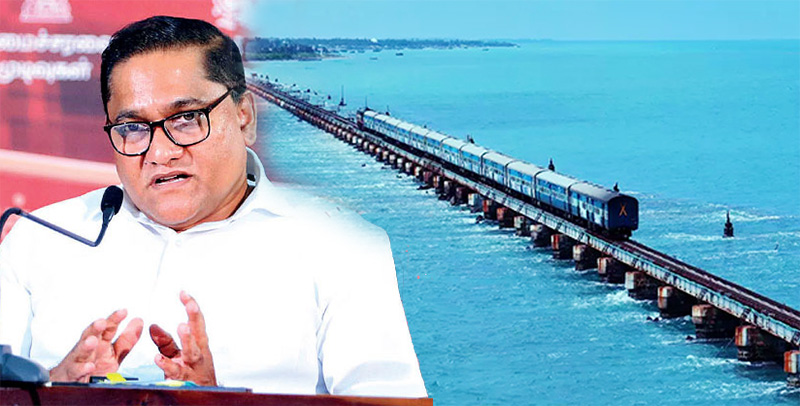
Indo-Lanka road and rail link:
In the wake of Foreign Minister and Cabinet Spokesperson Vijitha Herath’s declaration that decision on controversial Indian projects would be taken up after the parliamentary election on Nov 14, Environment Secretary Prabath Chandrakeerthi, in an interview with Mint has said the discussions are in the final stages for a $5 billion road-and-rail link between India and Sri Lanka with India set to bear the cost of the strategic project.
This is the first big bilateral infrastructure project announced by Sri Lanka since the recent election of President Anura Kumara Dissanayake amidst efforts by New Delhi to counter Chinese influence, according to Mint.
India is Sri Lanka’s largest trade partner and one of the largest foreign direct investment (FDI) contributors. Indian investment in Sri Lanka amounted to about $142 million in 2021.
“Last month, I participated in one meeting with India in New Delhi, and we are going to establish the highway and railway line connectivity between Rameswaram in India and Trincomalee in Sri Lanka,” B. K. Prabath Chandrakeerthi told Mint. “This is being planned as businessmen in both countries have to pay more and with the road and rail connectivity, both parties can get help because it will help in trade with European and other countries. Indian businessmen can also get some benefits from Sri Lanka as well,” Chandrakeerthi said.
“Last month I participated in one meeting with India in New Delhi, and we are going to establish the highway and railway line connectivity between Rameswaram in India and Trincomalee in Sri Lanka,” B. K. Prabath Chandrakeerthi told Mint. “This is being planned as businessmen in both countries have to pay more and with the road and rail connectivity, both parties can get help because it will help in trade with European and other countries. Indian businessmen can also get some benefits from Sri Lanka as well,” Chandrakeerthi added.
The Sri Lankan government proposed a land bridge between Rameswaram in Tamil Nadu of India and Talaimannar, a village in Mannar Island of Sri Lanka in 2002 and signed an agreement on it.
As per the agreement, road and rail bridge links were to be developed, offering economic benefits to both sides of the Palk Strait. However, after the agreement was signed, the Tamil Nadu government opposed the construction of the land bridge.
As per the agreement, road and rail bridge links were to be developed, offering economic benefits to both sides of the Palk Strait. However, after the agreement was signed, the Tamil Nadu government opposed the construction of the land bridge.
The talks resumed in 2015 when India asked the Asian Development Bank to carry out pre-feasibility study for financing a road and rail link between India’s Rameswaram and Sri Lanka’s Talaimannar. But it has been decided to build the rail and road link up to Trincomalee, the official informed.
There is no land connection between Sri Lanka and India through road or railway. The closest Indian town to Sri Lanka, Dhanushkodi, had a railway station but this was washed out in a cyclone in 1964. A short boat ride till 1966 connected the railway stations at Talaimannar in Sri Lanka and Dhanushkodi in India.
“The cost of the project is still not finalized. We have to have more discussion about that, but I think it is estimated to be nearly $5 billion,” the Lankan official said, and added: “It will entirely be borne by the Indian government. We have to get some approval for environmental clearance.”
He said the project may involve bridges and underwater tunnels to allow unhindered movement of ships.
Queries sent to the spokespeople and secretaries of Indian road transport and highways, ports, shipping and waterways, railways, external affairs and environment ministries remained unanswered at the time of going to press.






Latest News
Sun directly overhead Chilaw, Bingiriya, Halmillawewa, Panduwasnuwara, Gokarella, Kawudupelella, Koppaveli and Kirankulam about 12:12 noon. today (09)


On the apparent northward relative motion of the sun, it is going to be directly over the latitudes of Sri Lanka from the 05th to 15th of April this year.
The nearest areas of Sri Lanka over which the sun is overhead today (09th) are Chilaw, Bingiriya, Halmillawewa, Panduwasnuwara, Gokarella, Kawudupelella, Koppaveli and Kirankulam about 12:12 noon.
Latest News
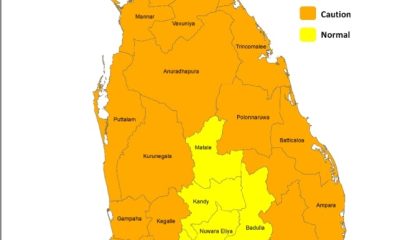
Heat Index at Caution Level in the Western, Sabaragamuwa, Southern, Eastern, North-western, Northern and North-central provinces and in Monaragala district

Warm Weather Advisory
Issued by the Natural Hazards Early Warning Centre
Issued at 4.30 p.m. on 08 April 2026, valid for 09 April 2026.
The Heat index, the temperature felt on human body is likely to increase up to ‘Caution level’ at some places in the Western, Sabaragamuwa, Southern, Eastern, North-western, Northern and North-central provinces and in Monaragala district.
The Heat Index Forecast is calculated by using relative humidity and maximum temperature and this is the condition that is felt on your body. This is not the forecast of maximum temperature. It is generated by the Department of Meteorology for the next day period and prepared by using global numerical weather prediction model data.

Effect of the heat index on human body is mentioned in the above table and it is prepared on the advice of the Ministry of Health and Indigenous Medical Services.
ACTION REQUIRED
Job sites: Stay hydrated and takes breaks in the shade as often as possible.
Indoors: Check up on the elderly and the sick.
Vehicles: Never leave children unattended.
Outdoors: Limit strenuous outdoor activities, find shade and stay hydrated.
Dress: Wear lightweight and white or light-colored clothing.
Note:
In addition, please refer to advisories issued by the Disaster Preparedness & Response Division, Ministry
of Health in this regard as well. For further clarifications please contact 011-7446491.

The Auditor General has warned that delays in coal procurement and continued reliance on suppliers of questionable standards could disrupt the supply of electricity.
The special audit report on coal imports was presented to Parliament on Tuesday (07) by Bimal Ratnayake, Leader of the House, at the commencement of proceedings.
However, Opposition MPs complained to Speaker Dr Jagath Wickramaratne that copies of the report had not been distributed to Members of Parliament. Responding to the complaint, the Speaker said it was the responsibility of the Parliamentary Secretariat to ensure the report was provided to MPs.
The special audit, requested by the Committee on Public Enterprises (COPE), examined the coal procurement process of the Lanka Coal Company for the Lakvijaya Power Plant and purchases planned for the 2025/2026 season.
The audit revealed several irregularities in the tender process. It found that the laboratory issuing quality reports at the loading port for the controversial supplier Trident Company had its licence cancelled. The report also disclosed that at the time advertisements were published calling for tenders,the company had not completed its registration but was awarded the tender. In addition, three other suppliers who had not confirmed their registration were allowed to submit bids.
Coal shipments for the Lakvijaya Power Plant are tested at both loading and unloading ports. According to the audit, Mitra SK South Africa had been appointed to conduct testing at the loading port, but due to the absence of accreditation the task was assigned to PT Mitra SK Analisa Testama Samarinda, an Indonesian firm whose licence had been cancelled on December 29, 2025. Auditor General S. Jayarathne has noted that the audit could not confirm whether the licence had been renewed by March 31, 2026, and that all 12 shipment reports issued at the loading port lacked accreditation.
The report has further pointed to discrepancies between loading port laboratory reports and data recorded at the plant’s main control unit. Despite the availability of alternative verification methods, the Lanka Coal Company failed to use them to confirm the accuracy of the reports.
The audit also highlighted that no coal shipments were brought to Sri Lanka between November 13 and December 30, 2025, despite the need to secure maximum stocks during that period.
As a result of the shortage, an emergency procurement was carried out on March 18 this year, selecting Taranjot Resource Pvt Ltd. as the supplier. However, the Auditor General revealed that this company had failed within the previous 36 months to supply coal with the required calorific value of 5,900 or above to the Lakvijaya Power Plant.
The report warns that delays in coal imports and dependence on suppliers with questionable standards could adversely affect the continuous supply of electricity from the plant.
The National Audit Office of Sri Lanka has further estimated that the use of substandard coal has caused losses amounting to nearly Rs. 2.24 billion.
According to the report, losses incurred from individual shipments included more than Rs. 160 million from the first vessel (consignment No. 456), over Rs. 90 million from the second vessel (No. 457), more than Rs. 310 million from the third vessel (No. 458), and over Rs. 150 million from the fourth vessel (No. 459). Additional losses included nearly Rs. 180 million from the fifth vessel (No. 460), about Rs. 30 million from the sixth vessel (No. 461), over Rs. 240 million from the seventh vessel (No. 462), more than Rs. 390 million from the eighth vessel (No. 463) and over Rs. 390 million from the tenth vessel (No. 464).
The report has also noted that because the available coal stocks cannot generate electricity at the plant’s full capacity of 300 megawatts, additional power may have to be obtained from alternative sources. The estimated additional energy requirement for this purpose is 76,354,087 kilowatt-hours, the report has pointed out.
By Saman Indrajith

BCCI curbs movement of benched IPL players in latest rules

Prasidh trumps Miller in last-ball finish as Gujarat Titans clinch thriller

Greece to ban social media for under-15s from next year

Showers will occur at a few places in the Western, Sabaragamuwa and North-western provinces and in Galle, Matara, Kandy, Nuwara-Eliya and Mannar districts after 2.00 p.m.

Sun directly overhead Chilaw, Bingiriya, Halmillawewa, Panduwasnuwara, Gokarella, Kawudupelella, Koppaveli and Kirankulam about 12:12 noon. today (09)

Heat Index at Caution Level in the Western, Sabaragamuwa, Southern, Eastern, North-western, Northern and North-central provinces and in Monaragala district

‘Dates have the highest sugar content to fight Coronavirus’

Sunday Island 27 December – Headlines

#SundayIsland 17th December – Headlines

Sunday Island – 28th March

Sunday Island Headlines – 21 March

Sunday Island – 21st February – Headlines
-

 Features4 days ago
Ranjith Siyambalapitiya turns custodian of a rare living collection
-

 News4 days ago
Global ‘Walk for Peace’ to be held in Lanka
-

 News2 days ago
Lankan-origin actress Subashini found dead in India
-
 Opinion6 days ago
Hidden truth of Sri Lanka’s debt story: The untold narrative behind the report
-

 Features4 days ago
Beyond the Blue Skies: A Tribute to Captain Elmo Jayawardena
-

 Features4 days ago
Aspects of Ceylon/Sri Lanka Foreign Relations – 1948 to 1976
-

 Features6 days ago
The Ramadan War
-

 Editorial5 days ago
Brouhaha over a book