
Features
Metals rule the world


Metals are shiny, malleable, and fusible hard materials readily conducting heat and electricity. The mobility of electrons within the bulk solid accounts for their peculiar properties useful for technological applications. Different metals also allow mixing to form alloys, possessing properties suited to applications.
Matter we see on the earth is constituted of 93 chemical elements, of which 66 have metallic properties. Prehistoric man identified metals incidentally and exploited them for advantage using empirical techniques. Later, chemists studied metals for curiosity, and their findings paved the way for numerous applications that transformed the world.
Metals rule the world. They profoundly shaped human civilisation, advancing technology and therefore social structure in distinctive leaps. For that reason, the historical periods after the Neolithic are often named after metals: copper, bronze and iron. Metals, subsequently introduced through the efforts of chemists and engineers, opened new eras of technology.
Today, we see things made of aluminum everywhere, but no one saw aluminum until 1825, when the metal was first extracted by the Danish physicist Christian Oersted. Four decades later, an electrolytic method was developed to obtain aluminum from the ore bauxite. Thereafter, the metal previously considered to be the most precious, owing to its resistance to extraction via conventional methods, reached the status of a versatile metal superior to iron and copper in many applications. Today, it would be hard for us to live without aluminum. Indispensable aluminum artifacts are part of our routine.
Uranium, the heaviest metal on earth, progressed our understanding of matter and the cosmos, changed the political landscape and remains as an ample source of energy.
Now we are witnessing the dawn of another era defined by a series of metals known as rare earths. Crucial sectors of advanced technology indispensably rely on these metals. Rare earth metal processing continues to be a monopoly of China, producing nearly 90 percent of the global demand. Recently, other industrial nations have expressed concerns regarding secure supplies of rare earth metals, because of the possibility of trade embargoes and sensitive political issues.
Copper, Bronze and Iron Ages
Metallic chemical elements are abundant in the earth’s crust. However, a few occur as free metal. Of these copper, silver and gold were the only ones known to the ancients. Melting in fire and the malleability of copper, unlike stone and wood, fascinated the prehistoric man who innovated tools out of the metal. The Copper Age began independently in several regions of the world around 5500 – 3000 BCE. Implements made from copper eased the construction of dwellings and agriculture, expanding settlements that turned into states regulated by law and order. States originate when a group of people working collectively exceeds a critical size.
The discovery of bronze, an alloy of copper and tin, provided better metal artifacts, as bronze is harder and more durable than copper. Tin does not exist in nature as the elemental metal but is readily liberated when the ore is incinerated in charcoal fire. The benefits of the improved quality of the alloyed metallic products stood disproportionately high. The Bronze Age flourished, advancing all spheres of human activity, until it abruptly ended around 1200 BCE. The reason why the Bronze Age collapsed remains an unresolved puzzle in history. Possibly the dwindling supply of tin constrained the production of bronze. Tin ores are scarce. Even today, the short supply of tin affects industries involving its usage.
After the collapse of the Bronze Age, there had been a dark period lasting for several centuries. Being unable to maintain itself, civilizations declined economically, partly destroying the established infrastructure. Famine, war and other calamities were common in this period.
During the Bronze Age, smiths meddled with iron and methods of mining were available. Yet the form of iron they extracted was brittle and inferior to bronze in toolmaking. The shortage of metal tin prompted them to explore alternative arts of smelting iron. Finally, methods of making steel evolved. The techniques alloyed iron with a small percentage of carbon to derive steel. Durable and strong steel tools facilitated clearing a larger acreage of land for agriculture and the erection of more secure large buildings. Just like other technical breakthroughs, the advent of steel influenced society negatively as well. It allowed sharper dangerous weapons used to inflect cruelty on fellow human beings and animals.
Iron is still the most widely used metal and no other metal would replace it. Nevertheless, historians assume that the Iron Age was closed around 550 BCE, when bronze was almost completely replaced by steel in the making of tools.
Aluminum Age
After iron, the next most widely used metal in recent times is aluminum. Although aluminum stands topmost in the list of relative abundance of metals in the earth’s crust, the elemental metal does not occur naturally and resists extraction by conventional methods. A sample of metallic aluminum was first prepared in 1825. Subsequently, costly methods produced kilogram quantities sold at exorbitant prices. Those days, aluminum happened to be the most precious metal. Only kings and emperors could afford to possess aluminum artifacts. The Emperor of France, Napoleon III, owned an aluminum dinnerware set, occasionally used to serve exceptionally distinguished guests. Other honored visitors got gold plates, spoons and forks.
An electrolytic process for the extraction of aluminum in the late 1800s changed the situation. Aluminum production and its use as a structural material escalated exponentially. Good electrical conductivity and lightweight reduced the cost of electricity transmission by replacement of copper cables by aluminum. Current global aluminum production exceeds 60 million metric tons a year.
Uranium: key that opened the door to explore the nature of matter, source of energy and cause of conflicts
Uranium impacted the world intellectually, technologically and politically. It is the heaviest metallic element naturally existing on earth. In 1896, French physicist Henry Becquerel discovered uranium emanating radiation spontaneously (radioactivity). Subsequent work by Marie Curie, Ernest Rutherford and others culminated in the elucidation of the atomic structure and the discovery of quantum mechanics. And later a deep understanding of the nature of fundamental forces and particles. Fission of uranium atoms to less heavier atoms with liberation of large quantities of energy was first observed in 1938. Seven years later, the first atomic bomb was tested and months later they were used in war. The atom bomb altered the political landscape of the world. Despite the risk of weapons development, uranium awaits as a ready promise to solve fossil-dependent energy production. Today, 10 percent of the global energy supply is derived from uranium. The estimated global uranium reserve is sufficient to power the world for a century.
Rare earth metals
‘Rare earth metals’ is a common phrase in news headlines these days, poised as a technological and political issue. We see things turned out of common metals; iron, copper and aluminum – and understand their essential importance. Rare earth metals are not visibly manifested that way and the laity are largely unaware of their existence and importance. What are rare earth metals? Why are they important?
The occurrences of chemical elements in the earth’s crust in the concentrated forms as minable minerals are determined by their chemistry. Electrons in the atoms of chemical elements distribute around the nucleus as shells. The number of allowed electrons in the outermost shell, dictated by laws of quantum mechanics, fixes the chemistry of the element. Rare earths represent a series of seventeen metallic elements having a similar outer shell electronic structure. They are not so rare but found diluted and mixed owing to the similarity of chemistry. Chemists identified and separated them lately. For that reason, they were named rare earths.
Rare earth metals are used in small quantities but essential to advanced technologies and are referred to as vitamins of modern industry. Hi-tech devices contain crucial components that incorporate rare earth metals. Smartphones, television, medical instrumentation, electric vehicles, wind turbines, aircraft engines, etc., have parts made of rare earth metals or their compounds. Countries strive hard to reduce fossil fuel consumption by optimizing renewable energy sources. Wind turbines require powerful permanent magnets made of rare earth neodymium and dysprosium alloys. Other specialized magnets that resist heat require the rare earth samarium. Colored LED lights use the rare earths yttrium, europium and terbium. The demand for rare earths will increase with developments in AI hardware, robotics and quantum technologies.
Processing of rare earth minerals offers several technical and environmental constraints that require specially designed chemical engineering procedures. Material resources and scientific know-how, largely a monopoly of China. Other technically competent nations who neglected the rare earth sector for decades are concerned about the availability of rare earth metal for their industries including weapons development.
Iron, copper, aluminum, uranium and rare earths stand out as the metallic elements that impacted human civilization most. There are dozens of other metals driving modern technology, without which we would not enjoy the comforts we have.
Metals we have in Sri Lanka
Sri Lanka extracted metallic iron and made implements as far back as 3000BC. Around 100 CE, Sri Lankans invented an extraordinary process for making quality steel – intricately designed blast furnaces utilizing the blow of the monsoon winds. The Samanalawewa archeological project identified 41 iron smelting furnaces. The ore had been gathered from local deposits scattered throughout the Northern region. Currently, commercially viable extraction of iron from locally available ores may not be unprofitable because Sri Lanka has no coal to derive coke required to reduce the iron oxide. We must be vigilant about future iron extraction technologies using hydrogen or direct electrolysis. Alternatively, iron can be used as a hydrogen storing agent. The oxide ore is reduced to iron using hydrogen and stored fine grains of iron reacting with steam to generate hydrogen.
Archaeological evidence indicates copper technology existed in Sri Lanka as far back as 4th. BCE. Sri Lanka Geological Survey discovered the Seruwila iron-copper deposit in 1971 – a source from which copper was mined. If copper was mined from the Seruwila deposit thousands of years ago. Why can’t we do it today? The average Seruwila ore contains about 0.6 percent copper and 30 percent iron – copper sufficiently high for commercial exploitation. Recently, the International Energy Agency warned that a global copper shortage is on the horizon and by 2030 mines could meet only 80 percent of the projected global demand. It would be prudent for Sri Lanka to conduct studies to develop processes for the extraction of copper from the Seruwila deposit. We should go out-of-the- box and innovate new ideas.
The metallic treasure of Sri Lanka resides in mineral sands. They accumulate along the beaches as the result of a natural separation of heavier and lighter grains. There are two categories of valuable metals in our mineral sands. So-called transition elements: titanium in Ilmenite and rutile, zirconium and hafnium in zircon, and rare earth metals (cerium, lanthanum, neodymium, samarium, promethium, gadolinium, yttrium) in monazite. Monazite also contains radioactive heavy elements uranium and thorium.
Ilmenite is used to obtain the widely used paint base titanium dioxide and the metal titanium essential for aerospace and marine engineering. Today, physically separated ilmenite is exported without conversion to oxide losing considerable profit. One conversion process (the older) requires sulfuric acid and the other, chorine and coke. We have no raw materials to produce sulfuric acid and coke. There is a newer process that uses hydrochloric acid (HCl). This acid can be manufactured in Sri Lanka using salt. In fact, Paranthan Chemicals- Chlor- Alkali Industry in the Northern Province made HCl years ago. Sri Lanka needs to resume Chlor-Alkali industry immediately to produce vital chemicals: chlorine, hydrochloric acid and sodium hydroxide. Alternatives apart from established processes to beneficiate ilmenite would not be impossible. Researchers and students should understandingly meddle with chemical substances for curiosity.

Bronze age tools
Currently, Sri Lanka Mineral Sands Limited exports 100 metric tons of monazite a year. The recipient countries use the ore primarily to produce rare earth metals needed for the hi-tec industry. Radioactive bye products, thorium and uranium are probably stockpiled. Monazite is a phosphate mineral containing 19 metals in different proportions. The reason why so many elements are bonded to phosphate is that they all have similar chemistries. Therefore, their separation is also cumbersome and poses environmental issues. The crucial techniques kept trade secrets. Should Sri Lanka begin chemical processing of monazite? There are two routes of monazite processing, acid and alkaline, depending on the chemical initially used to crack the mineral. The former uses sulfuric acid and the other sodium hydroxide. If Chlor- Alkali industry is established, Sri Lanka would be able to process monazite via the alkaline process and alkali neutralization carried out with HCL. It would be premature for Sri Lanka to jump into rare earth chemical processing immediately. What we need at this juncture is preparedness, feasibility studies and analysis of commercial prospects in a global context.
Thorium, a metal abundant in Sri Lanka, could be the ultimate solution to the energy crisis and decarbonization of the world to ensure a livable environment. The cleanest and greenest energy source is nuclear. Modern technology has largely addressed safety and radioactive disposal issues. Unlike uranium, thorium is not fissionable but convertible to a fissionable isotope of uranium by neutron bombardment. Thorium contains 200 times more energy than uranium. The feasibility of thorium reactors was first proved by the Oak Ridge National Laboratory, United States, in 1968 and abandoned a few years later. The interest in thorium reactors has been rekindled recently and vigorous developmental work pursued in the United States, China, India, Europe, Canada, Japan and Indonesia. Thorium is special to Sri Lanka. The thorianite containing a high percentage of thorium was first discovered in Sri Lanka by Ananda Coomaraswamy in 1903. Sri Lanka thorianite was used by the pioneers of atomic physics to uncover deep secrets of nature. Lord Rutherford (discoverer of atomic structure), in his famous address to the Canadian Astronomical Society, titled “Cosmical aspects of radioactivity “said: “I have some crystals of a new mineral thorianite found in Ceylon.” It contains 12 percent uranium and 70 percent thorium. In the early 1900s tons of thorianite collected from gem gravel and stream sediments in Sri Lanka were shipped to Europe. Today, no effort is made to separate thorianite from discarded gem gravel. This valuable mineral should be collected and stockpiled. Sri Lanka’s nuclear energy plans should also focus on thorium for future energy prospects.
Thousands of years ago, Sri Lanka was foremost in metal extraction (copper and iron) and workmanship. Today we are poor in metallurgical science, engineering and industry. The main cause is our weakness in chemical innovations. Chemistry is taught and learned in tuition classes as an essential to enter the medical and engineering streams in our universities. Writing papers to earn promotions and ranks: a purpose of chemical research.
The illustrious chemist Humphery Davy, who extracted seven metallic elements for the first time, learned chemistry by home experimentation while working as an apprentice to an apothecary. To initiate chemical industries in the local context, we need people who have chemistry in their blood.
by Prof. Kirthi Tennakone

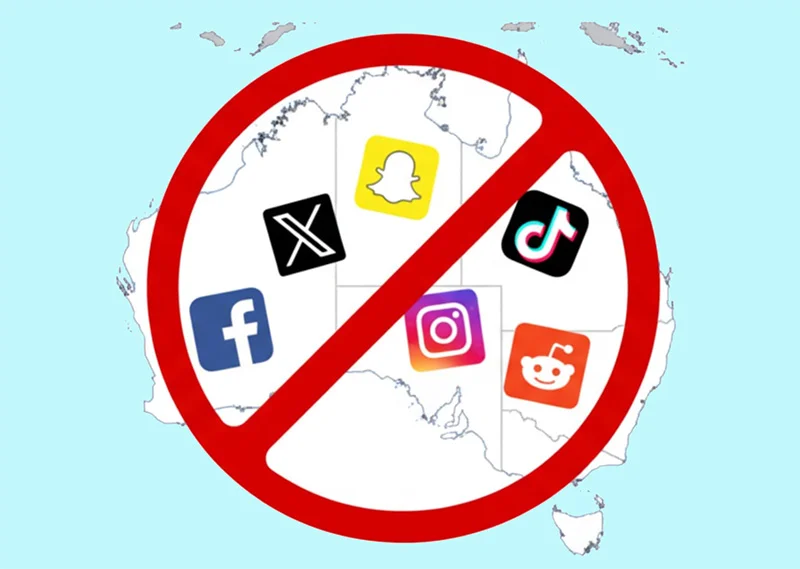
 When governments panic, they legislate. When they legislate in panic, they create monsters. Australia’s world-first ban on social media for under-16s, which came into force on 10 December, 2025, is precisely such a monster, a clumsy, authoritarian response to a legitimate problem that threatens to do more harm than good.
Prime Minister Anthony Albanese hailed it as a “proud day” for Australian families. One wonders what there is to be proud about when a liberal democracy resorts to blanket censorship, violates children’s fundamental rights, and outsources enforcement to the very tech giants it claims to be taming. This is not protection; it is political theatre masquerading as policy.
The Seduction of Simplicity
The ban’s appeal is obvious. Social media platforms have become toxic playgrounds where children are subjected to cyberbullying, addictive algorithms, and content that can genuinely harm their mental health. The statistics are damning: 40% of Australian teens have experienced cyberbullying, youth self-harm hospital admissions rose 47% between 2012 and 2022, and depression rates have skyrocketed in tandem with smartphone adoption. These are real problems demanding real solutions.
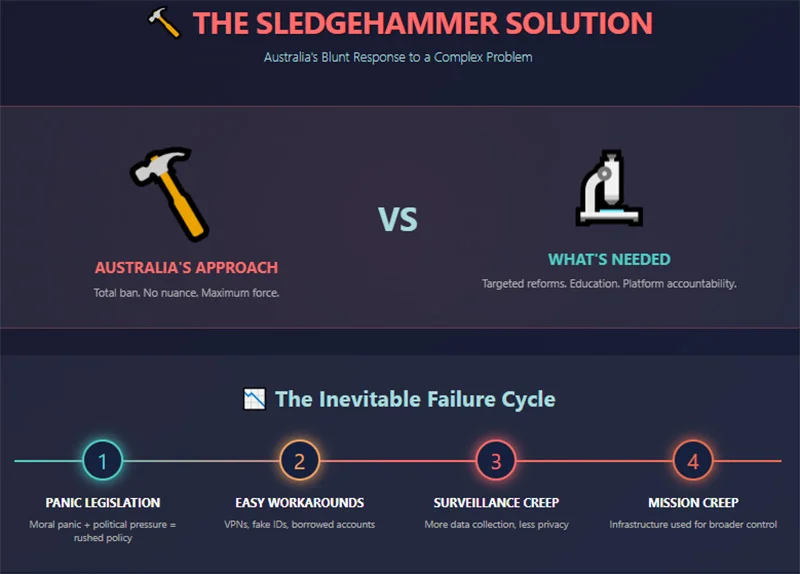
But here’s where Australia has gone catastrophically wrong: it has conflated correlation with causation and chosen punishment over education, restriction over reform, and authoritarian control over empowerment. The ban assumes that removing children from social media will magically solve mental health crises, as if these platforms emerged in a vacuum rather than as symptoms of deeper societal failures, inadequate mental health services, overworked parents, underfunded schools, and a culture that has outsourced child-rearing to screens.
Dr. Naomi Lott of the University of Reading hit the nail on the head when she argued that the ban unfairly burdens youth for tech firms’ failures in content moderation and algorithm design. Why should children pay the price for corporate malfeasance? This is akin to banning teenagers from roads because car manufacturers built unsafe vehicles, rather than holding those manufacturers accountable.
The Enforcement Farce
The practical implementation of this ban reads like dystopian satire. Platforms must take “reasonable steps” to prevent access, a phrase so vague it could mean anything or nothing. The age verification methods being deployed include AI-driven facial recognition, behavioural analysis, government ID scans, and something called “AgeKeys.” Each comes with its own Pandora’s box of problems.
Facial recognition technology has well-documented biases against ethnic minorities. Behavioural analysis can be easily gamed by tech-savvy teenagers. ID scans create massive privacy risks in a country that has suffered repeated data breaches. And zero-knowledge proof, while theoretically elegant, require a level of technical sophistication that makes them impractical for mass adoption.
Already, teenagers are bragging online about circumventing the restrictions, prompting Albanese’s impotent rebuke. What did he expect? That Australian youth would simply accept digital exile? The history of prohibition, from alcohol to file-sharing, teaches us that determined users will always find workarounds. The ban doesn’t eliminate risk; it merely drives it underground where it becomes harder to monitor and address.
Even more absurdly, platforms like YouTube have expressed doubts about enforcement, and Opposition Leader Sussan Ley has declared she has “no confidence” in the ban’s efficacy. When your own political opposition and the companies tasked with implementing your policy both say it won’t work, perhaps that’s a sign you should reconsider.
The Rights We’re Trading Away
The legal challenges now percolating through Australia’s High Court get to the heart of what’s really at stake here. The Digital Freedom Project, led by teenagers Noah Jones and Macy Neyland, argues that the ban violates the implied constitutional freedom of political communication. They’re right. Social media platforms, for all their flaws, have become essential venues for democratic discourse. By age 16, many young Australians are politically aware, engaged in climate activism, and participating in public debates. This ban silences them.
The government’s response, that child welfare trumps absolute freedom, sounds reasonable until you examine it closely. Child welfare is being invoked as a rhetorical trump card to justify what is essentially state paternalism. The government isn’t protecting children from objective harm; it’s making a value judgment about what information they should be allowed to access and what communities they should be permitted to join. That’s thought control, not child protection.
Moreover, the ban creates a two-tiered system of rights. Those over 16 can access platforms; those under cannot, regardless of maturity, need, or circumstance. A 15-year-old seeking LGBTQ+ support groups, mental health resources, or information about escaping domestic abuse is now cut off from potentially life-saving communities. A 15-year-old living in rural Australia, isolated from peers, loses a vital social lifeline. The ban is blunt force trauma applied to a problem requiring surgical precision.
The Privacy Nightmare
Let’s talk about the elephant in the digital room: data security. Australia’s track record here is abysmal. The country has experienced multiple high-profile data breaches, and now it’s mandating that platforms collect biometric data, government IDs, and behavioural information from millions of users, including adults who will need to verify their age to distinguish themselves from banned minors.
The legislation claims to mandate “data minimisation” and promises that information collected solely for age verification will be destroyed post-verification. These promises are worth less than the pixels they’re displayed on. Once data is collected, it exists. It can be hacked. It can be subpoenaed. It can be repurposed. The fine for violations, up to AUD 9.5 million, sounds impressive until you realise that’s pocket change for tech giants making billions annually.
We’re creating a massive honeypot of sensitive information about children and families, and we’re trusting companies with questionable data stewardship records to protect it. What could possibly go wrong?
The Global Domino Delusion
Proponents like US Senator Josh Hawley and author Jonathan Haidt praise Australia’s ban as a “bold precedent” that will trigger global reform. This is wishful thinking bordering on delusion. What Australia has actually created is a case study in how not to regulate technology.
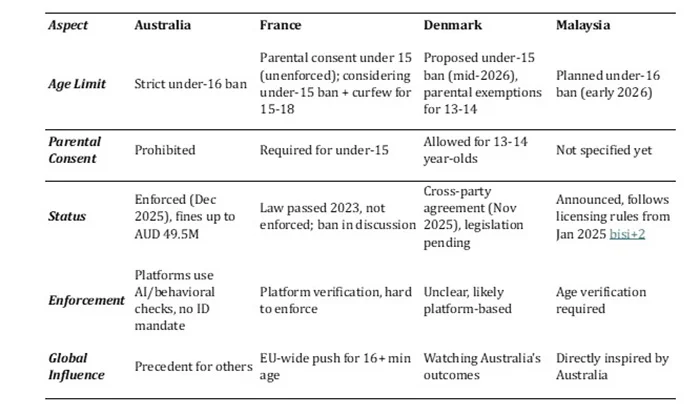
France, Denmark, and Malaysia are watching, but with notable differences. France’s model includes parental consent options. Denmark proposes exemptions for 13-14-year-olds with parental approval. These approaches recognise what Australia refuses to acknowledge: that blanket prohibitions fail to account for individual circumstances and family autonomy.
The comparison table in the document reveals the stark rigidity of Australia’s approach. It’s the only country attempting outright prohibition without parental consent. This isn’t leadership; it’s extremism. Other nations may cherry-pick elements of Australia’s approach while avoiding its most draconian features. (See Table)
The Real Solutions We’re Ignoring
Here’s what actual child protection would look like: holding platforms legally accountable for algorithmic harm, mandating transparent content moderation, requiring platforms to offer chronological feeds instead of engagement-maximising algorithms, funding digital literacy programmes in schools, properly resourcing mental health services for young people, and empowering parents with better tools to guide their children’s online experiences.
Instead, Australia has chosen the path of least intellectual effort: ban it and hope for the best. This is governance by bumper sticker, policy by panic.
Mia Bannister, whose son’s suicide has been invoked repeatedly to justify the ban, called parental enforcement “short-term pain, long-term gain” and urged families to remove devices entirely. But her tragedy, however heart-wrenching, doesn’t justify bad policy. Individual cases, no matter how emotionally compelling, are poor foundations for sweeping legislation affecting millions.
Conclusion: The Tyranny of Good Intentions
Australia’s social media ban is built on good intentions, genuine concerns about child welfare, and understandable frustration with unaccountable tech giants. But good intentions pave a very particular road, and this road leads to a place where governments dictate what information citizens can access based on age, where privacy becomes a quaint relic, and where young people are infantilised rather than educated.
The ban will fail on its own terms, teenagers will circumvent it, platforms will struggle with enforcement, and the mental health crisis will continue because it was never primarily about social media. But it will succeed in normalising digital authoritarianism, expanding surveillance infrastructure, and teaching young Australians that their rights are negotiable commodities.
When this ban inevitably fails, when the promised mental health improvements don’t materialize, when data breaches expose the verification systems, and when teenagers continue to access prohibited platforms through VPNs and workarounds, Australia will face a choice: double down on enforcement, creating an even more invasive surveillance state, or admit that the entire exercise was a costly mistake.
Smart money says they’ll choose the former. After all, once governments acquire new powers, they rarely relinquish them willingly. And that’s the real danger here, not that Australia will fail to protect children from social media, but that it will succeed in building the infrastructure for a far more intrusive state. The platforms may be the proximate target, but the ultimate casualties will be freedom, privacy, and trust.
Australia didn’t need a world-first ban. It needed world-class thinking. Instead, it settled for a world of trouble.
(The writer, a senior Chartered Accountant and professional banker, is Professor at SLIIT, Malabe. The views and opinions expressed in this article are personal.)
A prominent feature of the first year of the NPP government is that it has not engaged in the institutional reforms which was expected of it. This observation comes in the context of the extraordinary mandate with which the government was elected and the high expectations that accompanied its rise to power. When in opposition and in its election manifesto, the JVP and NPP took a prominent role in advocating good governance systems for the country. They insisted on constitutional reform that included the abolition of the executive presidency and the concentration of power it epitomises, the strengthening of independent institutions that overlook key state institutions such as the judiciary, public service and police, and the reform or repeal of repressive laws such as the PTA and the Online Safety Act.
The transformation of a political party that averaged between three to five percent of the popular vote into one that currently forms the government with a two thirds majority in parliament is a testament to the faith that the general population placed in the JVP/ NPP combine. This faith was the outcome of more than three decades of disciplined conduct in the aftermath of the bitter experience of the 1988 to 1990 period of JVP insurrection. The manner in which the handful of JVP parliamentarians engaged in debate with well researched critiques of government policy and actions, and their service in times of disaster such as the tsunami of 2004 won them the trust of the people. This faith was bolstered by the Aragalaya movement which galvanized the citizens against the ruling elites of the past.
In this context, the long delay to repeal the Prevention of Terrorism Act which has earned notoriety for its abuse especially against ethnic and religious minorities, has been a disappointment to those who value human rights. So has been the delay in appointing an Auditor General, so important in ensuring accountability for the money expended by the state. The PTA has a long history of being used without restraint against those deemed to be anti-state which, ironically enough, included the JVP in the period 1988 to 1990. The draft Protection of the State from Terrorism Act (PSTA), published in December 2025, is the latest attempt to repeal and replace the PTA. Unfortunately, the PSTA largely replicates the structure, logic and dangers of previous failed counter terrorism bills, including the Counter Terrorism Act of 2018 and the Anti Terrorism Act proposed in 2023.
Misguided Assumption
Despite its stated commitment to rule of law and fundamental rights, the draft PTSA reproduces many of the core defects of the PTA. In a preliminary statement, the Centre for Policy Alternatives has observed among other things that “if there is a Detention Order made against the person, then in combination, the period of remand and detention can extend up to two years. This means that a person can languish in detention for up to two years without being charged with a crime. Such a long period again raises questions of the power of the State to target individuals, exacerbated by Sri Lanka’s history of long periods of remand and detention, which has contributed to abuse and violence.” Human Rights lawyer Ermiza Tegal has warned against the broad definition of terrorism under the proposed law: “The definition empowers state officials to term acts of dissent and civil disobedience as ‘terrorism’ and will lawfully permit disproportionate and excessive responses.” The legitimate and peaceful protests against abuse of power by the authorities cannot be classified as acts of terror.
The willingness to retain such powers reflects the surmise that the government feels that keeping in place the structures that come from the past is to their benefit, as they can utilise those powers in a crisis. Due to the strict discipline that exists within the JVP/NPP at this time there may be an assumption that those the party appoints will not abuse their trust. However, the country’s experience with draconian laws designed for exceptional circumstances demonstrates that they tend to become tools of routine governance. On the plus side, the government has given two months for public comment which will become meaningful if the inputs from civil society actors are taken into consideration.
Worldwide experience has repeatedly demonstrated that integrity at the level of individual leaders, while necessary, is not sufficient to guarantee good governance over time. This is where the absence of institutional reform becomes significant. The aftermath of Cyclone Ditwah in particular has necessitated massive procurements of emergency relief which have to be disbursed at maximum speed. There are also significant amounts of foreign aid flowing into the country to help it deal with the relief and recovery phase. There are protocols in place that need to be followed and monitored so that a fiasco like the disappearance of tsunami aid in 2004 does not recur. To the government’s credit there are no such allegations at the present time. But precautions need to be in place, and those precautions depend less on trust in individuals than on the strength and independence of oversight institutions.
Inappropriate Appointments
It is in this context that the government’s efforts to appoint its own preferred nominees to the Auditor General’s Department has also come as a disappointment to civil society groups. The unsuitability of the latest presidential nominee has given rise to the surmise that this nomination was a time buying exercise to make an acting appointment. For the fourth time, the Constitutional Council refused to accept the president’s nominee. The term of the three independent civil society members of the Constitutional Council ends in January which would give the government the opportunity to appoint three new members of its choice and get its way in the future.
The failure to appoint a permanent Auditor General has created an institutional vacuum at a critical moment. The Auditor General acts as a watchdog, ensuring effective service delivery promoting integrity in public administration and providing an independent review of the performance and accountability. Transparency International has observed “The sequence of events following the retirement of the previous Auditor General points to a broader political inertia and a governance failure. Despite the clear constitutional importance of the role, the appointment process has remained protracted and opaque, raising serious questions about political will and commitment to accountability.”
It would appear that the government leadership takes the position they have been given the mandate to govern the country which requires implementation by those they have confidence in. This may explain their approach to the appointment (or non-appointment) at this time of the Auditor General. Yet this approach carries risks. Institutions are designed to function beyond the lifespan of any one government and to protect the public interest even when those in power are tempted to act otherwise. The challenge and opportunity for the NPP government is to safeguard independent institutions and enact just laws, so that the promise of system change endures beyond personalities and political cycles.
by Jehan Perera

 A new batch arrived at our Faculty again. Students representing almost all districts of the country remind me once again of the wonderful opportunity we have for promoting social and ethnic cohesion at our universities. Sadly, however, many students do not interact with each other during the first few semesters, not only because they do not speak each other’s language(s), but also because of the fear and distrust that still prevails among communities in our society.
General education reform presents an opportunity to explore ways to promote social and ethnic cohesion. A school curriculum could foster shared values, empathy, and critical thinking, through social studies and civics education, implement inclusive language policies, and raise critical awareness about our collective histories. Yet, the government’s new policy document, Transforming General Education in Sri Lanka 2025, leaves us little to look forward to in this regard.
The policy document points to several “salient” features within it, including: 1) a school credit system to quantify learning; 2) module-based formative and summative assessments to replace end-of-term tests; 3) skills assessment in Grade 9 consisting of a ‘literacy and numeracy test’ and a ‘career interest test’; 4) a comprehensive GPA-based reporting system spanning the various phases of education; 5) blended learning that combines online with classroom teaching; 6) learning units to guide students to select their preferred career pathways; 7) technology modules; 8) innovation labs; and 9) Early Childhood Education (ECE). Notably, social and ethnic cohesion does not appear in this list. Here, I explore how the proposed curriculum reforms align (or do not align) with the NPP’s pledge to inculcate “[s]afety, mutual understanding, trust and rights of all ethnicities and religious groups” (p.127), in their 2024 Election Manifesto.
Language/ethnicity in the present curriculum
The civil war ended over 15 years ago, but our general education system has done little to bring ethnic communities together. In fact, most students still cannot speak in the “second national language” (SNL) and textbooks continue to reinforce negative stereotyping of ethnic minorities, while leaving out crucial elements of our post-independence history.
Although SNL has been a compulsory subject since the 1990s, the hours dedicated to SNL are few, curricula poorly developed, and trained teachers few (Perera, 2025). Perhaps due to unconscious bias and for ideological reasons, SNL is not valued by parents and school communities more broadly. Most students, who enter our Faculty, only have basic reading/writing skills in SNL, apart from the few Muslim and Tamil students who schooled outside the North and the East; they pick up SNL by virtue of their environment, not the school curriculum.
Regardless of ethnic background, most undergraduates seem to be ignorant about crucial aspects of our country’s history of ethnic conflict. The Grade 11 history textbook, which contains the only chapter on the post-independence period, does not mention the civil war or the events that led up to it. While the textbook valourises ‘Sinhala Only’ as an anti-colonial policy (p.11), the material covering the period thereafter fails to mention the anti-Tamil riots, rise of rebel groups, escalation of civil war, and JVP insurrections. The words “Tamil” and “Muslim” appear most frequently in the chapter, ‘National Renaissance,’ which cursorily mentions “Sinhalese-Muslim riots” vis-à-vis the Temperance Movement (p.57). The disenfranchisement of the Malaiyaha Tamils and their history are completely left out.
Given the horrifying experiences of war and exclusion experienced by many of our peoples since independence, and because most students still learn in mono-ethnic schools having little interaction with the ‘Other’, it is not surprising that our undergraduates find it difficult to mix across language and ethnic communities. This environment also creates fertile ground for polarizing discourses that further divide and segregate students once they enter university.
More of the same?
How does Transforming General Education seek to address these problems? The introduction begins on a positive note: “The proposed reforms will create citizens with a critical consciousness who will respect and appreciate the diversity they see around them, along the lines of ethnicity, religion, gender, disability, and other areas of difference” (p.1). Although National Education Goal no. 8 somewhat problematically aims to “Develop a patriotic Sri Lankan citizen fostering national cohesion, national integrity, and national unity while respecting cultural diversity (p. 2), the curriculum reforms aim to embed values of “equity, inclusivity, and social justice” (p. 9) through education. Such buzzwords appear through the introduction, but are not reflected in the reforms.
Learning SNL is promoted under Language and Literacy (Learning Area no. 1) as “a critical means of reconciliation and co-existence”, but the number of hours assigned to SNL are minimal. For instance, at primary level (Grades 1 to 5), only 0.3 to 1 hour is allocated to SNL per week. Meanwhile, at junior secondary level (Grades 6 to 9), out of 35 credits (30 credits across 15 essential subjects that include SNL, history and civics; 3 credits of further learning modules; and 2 credits of transversal skills modules (p. 13, pp.18-19), SNL receives 1 credit (10 hours) per term. Like other essential subjects, SNL is to be assessed through formative and summative assessments within modules. As details of the Grade 9 skills assessment are not provided in the document, it is unclear whether SNL assessments will be included in the ‘Literacy and numeracy test’. At senior secondary level – phase 1 (Grades 10-11 – O/L equivalent), SNL is listed as an elective.
Refreshingly, the policy document does acknowledge the detrimental effects of funding cuts in the humanities and social sciences, and highlights their importance for creating knowledge that could help to “eradicate socioeconomic divisions and inequalities” (p.5-6). It goes on to point to the salience of the Humanities and Social Sciences Education under Learning Area no. 6 (p.12):
“Humanities and Social Sciences education is vital for students to develop as well as critique various forms of identities so that they have an awareness of their role in their immediate communities and nation. Such awareness will allow them to contribute towards the strengthening of democracy and intercommunal dialogue, which is necessary for peace and reconciliation. Furthermore, a strong grounding in the Humanities and Social Sciences will lead to equity and social justice concerning caste, disability, gender, and other features of social stratification.”
Sadly, the seemingly progressive philosophy guiding has not moulded the new curriculum. Subjects that could potentially address social/ethnic cohesion, such as environmental studies, history and civics, are not listed as learning areas at the primary level. History is allocated 20 hours (2 credits) across four years at junior secondary level (Grades 6 to 9), while only 10 hours (1 credit) are allocated to civics. Meanwhile, at the O/L, students will learn 5 compulsory subjects (Mother Tongue, English, Mathematics, Science, and Religion and Value Education), and 2 electives—SNL, history and civics are bunched together with the likes of entrepreneurship here. Unlike the compulsory subjects, which are allocated 140 hours (14 credits or 70 hours each) across two years, those who opt for history or civics as electives would only have 20 hours (2 credits) of learning in each. A further 14 credits per term are for further learning modules, which will allow students to explore their interests before committing to a A/L stream or career path.
With the distribution of credits across a large number of subjects, and the few credits available for SNL, history and civics, social/ethnic cohesion will likely remain on the back burner. It appears to be neglected at primary level, is dealt sparingly at junior secondary level, and relegated to electives in senior years. This means that students will be able to progress through their entire school years, like we did, with very basic competencies in SNL and little understanding of history.
Going forward
Whether the students who experience this curriculum will be able to “resist and respond to hegemonic, divisive forces that pose a threat to social harmony and multicultural coexistence” (p.9) as anticipated in the policy, is questionable. Education policymakers and others must call for more attention to social and ethnic cohesion in the curriculum. However, changes to the curriculum would only be meaningful if accompanied by constitutional reform, abolition of policies, such as the Prevention of Terrorism Act (and its proxies), and other political changes.
For now, our school system remains divided by ethnicity and religion. Research from conflict-ridden societies suggests that lack of intercultural exposure in mono-ethnic schools leads to ignorance, prejudice, and polarized positions on politics and national identity. While such problems must be addressed in broader education reform efforts that also safeguard minority identities, the new curriculum revision presents an opportune moment to move this agenda forward.
(Ramya Kumar is attached to the Department of Community and Family Medicine, Faculty of Medicine, University of Jaffna).
Kuppi is a politics and pedagogy happening on the margins of the lecture hall that parodies, subverts, and simultaneously reaffirms social hierarchies.
by Ramya Kumar

Navy seizes an Indian fishing trawler poaching in Sri Lankan waters north of Talaimannar

Several spells of showers may occur in Central, Uva and Eastern provinces and in Polonnaruwa and Mullaittivu districts

India’s External Affairs Minister meets Sri Lanka PM

Shafali 69 not out , spinners lead India’s rout of Sri Lanka

Sri Lanka’s coastline faces unfolding catastrophe: Expert

SOC examines proposed amendments to the Microfinance and Credit Regulatory Authority Bill

‘Dates have the highest sugar content to fight Coronavirus’

Sunday Island 27 December – Headlines

#SundayIsland 17th December – Headlines

Sunday Island – 28th March

Sunday Island Headlines – 21 March

Sunday Island – 21st February – Headlines
-

 News2 days ago
Members of Lankan Community in Washington D.C. donates to ‘Rebuilding Sri Lanka’ Flood Relief Fund
-
 News7 days ago
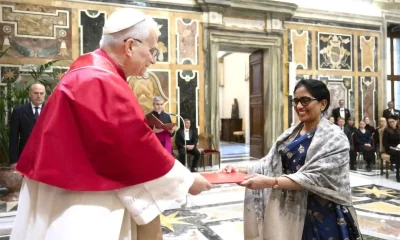
Pope fires broadside: ‘The Holy See won’t be a silent bystander to the grave disparities, injustices, and fundamental human rights violations’
-

 News7 days ago
Pakistan hands over 200 tonnes of humanitarian aid to Lanka
-

 Business6 days ago
Unlocking Sri Lanka’s hidden wealth: A $2 billion mineral opportunity awaits
-

 News6 days ago
Army engineers set up new Nayaru emergency bridge
-

 News7 days ago
Officials of NMRA, SPC, and Health Minister under pressure to resign as drug safety concerns mount
-

 News7 days ago
Expert: Lanka destroying its own food security by depending on imported seeds, chemical-intensive agriculture
-

 Editorial7 days ago
Flawed drug regulation endangers lives