
Business
Measures will be taken to establish a unit under the Presidential Secretariat to integrate all sectors associated with the tourism industry – President


A discussion aimed at identifying strategies to attract tourists during the off-season was held on Friday (06) afternoon at the Presidential Secretariat, chaired by President Anura Kumara Disanayake, with the participation of key stakeholders in the tourism industry.
The conversation focused on promoting Sri Lanka as a year-round travel destination, particularly during the off-season, enhancing the country’s tourism brand through digital marketing, strengthening human capital in the sector through skill development and training as well as attracting more foreign investment into the tourism sector.
Attention was also drawn to the current challenges facing the tourism industry. Stakeholders were briefed on the initiatives already undertaken by the Sri Lanka Tourism Promotion Bureau to address these issues and advance the sector.
President Disanayake revealed intentions to establish a dedicated unit at the Presidential Secretariat to coordinate all institutions related to tourism in a cohesive manner.
The government’s Clean Sri Lanka programme also received positive feedback from industry stakeholders and its potential integration into tourism promotion efforts was discussed in depth.
The meeting was attended by Minister of Foreign Affairs, Foreign Employment and Tourism, Vijitha Herath, Senior Additional Secretary to the President, Roshan Gamge, Chairman of the Sri Lanka Tourism Promotion Bureau, Buddhika Hewawasam, Chairman of the Sri Lanka Association of Inbound Tour Operators (SLAITO) Nalin Jayasundara as well as hotel owners, tourism industry entrepreneurs and investors.


The era of privatising loss-making state-owned enterprises may be drawing to a close, with SLT-MOBITEL emerging as proof that strategic management can deliver profitability without a change in ownership, Deputy Minister of Digital Economy Eng. Eranga Weeraratne said.
“There was a massive public outcry asking the previous governments to sell the loss-making state-owned enterprises. Now it is not there as it was used to be heard,” Weeraratne said. “SLT-MOBITEL has proven that the proper management strategy can turn any loss-making SOE into profit. Gone are the days we heard ‘sell, sell, sell’.”
The remarks came as Sri Lanka’s national ICT provider reported a decisive financial turnaround in FY 2025, driven by disciplined cost management, operational efficiency, and steady growth across fixed and mobile businesses.
The company has simultaneously rolled out a pioneering 24/7 operational model – the industry’s first – with 14 Outside Plant Maintenance Centres operating round-the-clock in metro areas, Kandy, and Jaffna to ensure uninterrupted connectivity.
“Our strong financial results reflect the resilience of SLT-MOBITEL and the trust customers place in us,” said Dr. Mothilal de Silva, Chairman, SLT Group. “With the roll-out of the 24/7 OPMC operations, we are raising the bar for service reliability.”
SLT-MOBITEL has also made 5G publicly available in Sri Lanka and continues to support the Ministry of Digital Economy with secure data centre infrastructure, reinforcing its role as a catalyst of national development.
By Sanath Nanayakkare

Kia Motors Lanka has launched the all-new Kia Tasman, the brand’s first-ever pickup truck – engineered to redefine the double cab segment by combining rugged capability with SUV-like refinement.
Built on a robust body-on-frame platform, the Tasman offers best-in-class strength with a payload capacity of 1,151kg, towing up to 3,500kg, and water wading up to 800mm. Advanced 4WD systems and terrain modes ensure unmatched off-road performance.
Inside, the cabin surprises with best-in-class rear legroom, sliding and reclining rear seats – a segment-first – and a panoramic display with premium Harman Kardon sound.
Powered by a 2.2-litre diesel engine (210PS, 441Nm), the Tasman is backed by a 5-year or 150,000km warranty.
“This is a vehicle conceived without compromise,” said Kia Motors Lanka Chairman Mahen Thambiah. “For customers who demand durability, capability, and everyday comfort, the Tasman delivers on every front.”
Business
Chief Risk Officers rise globally to drive smarter risk-taking while Sri Lanka’s boardrooms remain silent


As geopolitical tensions, economic volatility, and technological disruption reshape global markets, the Chief Risk Officer (CRO) is emerging as a strategic pillar in boardrooms worldwide. In Sri Lanka, however, the role remains largely absent.
Once confined to major banks, the CRO is now gaining traction across industries including finance, logistics, technology, and manufacturing. According to the 2025 Global Risk Survey by EY, nearly 78% of organisations now place risk management at the heart of strategic planning, signalling a shift from reactive crisis management to proactive risk leadership.
The CRO is tasked with identifying and preparing for threats to financial stability, operations, reputation, and compliance – ranging from cyberattacks and supply-chain disruptions to regulatory shifts and climate risks. “The CRO is no longer just the person who says ‘no’ to risky decisions,” a Singaporean banking executive said. “Today, the CRO helps companies take smarter risks and build resilience.”
The role’s growing importance will be highlighted at the upcoming Chief Risk Officer Conference (20–21 May 2026 in Singapore), organised by the Asian Bankers Association in partnership with Trueventus. Key topics include AI-driven risk modelling, geopolitical shocks, and ESG integration.
For Sri Lankan firms where risk functions are often distributed across finance, compliance, and audit – the rise of the CRO offers a clear signal. As an Indian risk consultant noted, “Companies today don’t just compete on profits. They compete on how well they manage uncertainty.”
By Sanath Nanayakkare

Inquiry into female employee’s complaint: Retired HC Judge’s recommendations ignored

Motor Traffic CG remanded

Petition launched seeking resignation of Energy Minister Jayakody

SC e-filing portal operational

New arithmetic of conflict: How the drone revolution is inverting economics of war

SLT-MOBITEL turnaround signals new era for SOEs, says deputy minister

‘Dates have the highest sugar content to fight Coronavirus’

Sunday Island 27 December – Headlines

#SundayIsland 17th December – Headlines

Sunday Island – 28th March

Sunday Island Headlines – 21 March

Sunday Island – 21st February – Headlines
-

 News5 days ago
Senior citizens above 70 years to receive March allowances on Thursday (26)
-

 Features2 days ago
A World Order in Crisis: War, Power, and Resistance
-

 News3 days ago
Energy Minister indicted on corruption charges ahead of no-faith motion against him
-

 News4 days ago
US dodges question on AKD’s claim SL denied permission for military aircraft to land
-

 Business4 days ago
Dialog Unveils Dialog Play Mini with Netflix and Apple TV
-

 Sports3 days ago
SLC to hold EGM in April
-

 News5 days ago
CEB Engineers warn public to be prepared for power cuts after New Year
-
 Business6 days ago
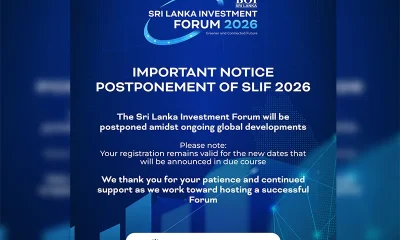
Postponement of Sri Lanka Investment Forum 2026