
Sports
Mayon in a zone of his own

by Reemus Fernando
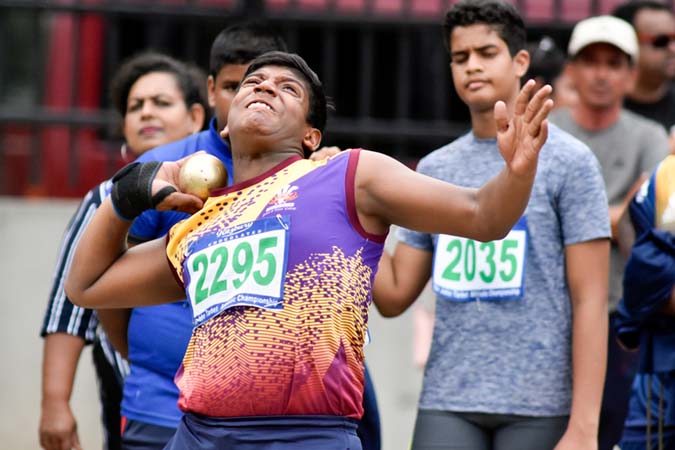
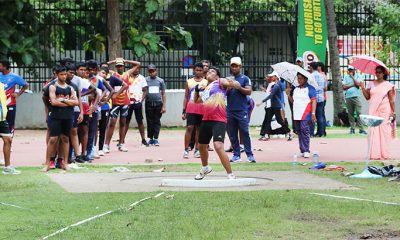
Emerging young talent Mayon Chiran of Prince of Wales College, Moratuwa lived up to his billing winning the Under 14 shot put with a new record mark on day one of the Sir John Tarbat Junior Athletics Championship at the Sugathadasa Stadium on Friday.
He was scheduled to compete in the other two throwing events on Saturday and Sunday and will be the hot favourite to win the best athlete title in his age category at the end of the championship today.While almost all of his counterparts struggled to clear the 13 metres mark, the athlete trained by his father easily cleared the 15 metres mark in his very first attempt.
He was the winner of the best athlete title of his age category at the recently held All Island Schools Games where he cleared a distance of 15.13 metres in the shot put to own the Games record. Mayon has produced record breaking performances at all major national level schools competitions this year.
Though he could excel in shot put at all major competitions, Sir John Tarbat Junior Athletics Championships is the only competition where athletes in the Under 14 age category can compete in the shot put, javelin and discus throw.
The strongly built youngster was in a zone of his own as he powered his way to records. Not many young throwers have displayed the power and speed showcased by this youngster at this age category. Even the very few athletes who have shown such prowess at lower age categories have later gone onto take up other sports.
At a time when track and field sports has received a shot in the arm following historic victories at the recently held Asian Games it is incumbent upon authorities to take care of the emerging athletes like Mayon who have the potential to excel at international level one day.









Kolkata Knight Riders (KKR) got their first points of IPL 2026 but without a victory against their name after their home clash against Punjab Kings (PBKS) was washed out on Monday night. Desperate for a win after starting the campaign with two losses on the bounce, KKR were reeling against swing of Xavier Bartlett and were 25 for 2 in 3.4 overs when drizzle stopped the game.
It soon turned into heavy rain with gusts of wind and the entire ground went under white covers. From 7.48pm IST, when the players went off the field, the spectators waited until 11pm when play was called off.
PBKS top the table for now as the only team with five points; three teams are on their heels with four points each.
Rain stopped at around 10.30pm, and hopes of a shortened game lingered briefly as the covers started to come off, but with plenty of water coming off the covers and accumulating near the boundary areas, it was not possible to get the field ready in time for a five-overs-a-side contest.
KKR’s struggles with the bat continued after their captain Ajinkya Rahane surprisingly chose to bat. They were also without their spin twins of Sunil Narine and Varun Chakravarthy; the last time KKR had played a match without either was back in 2019. While Narine was unwell, Varun had injured his left hand while fielding in their previous game, against Sunrisers Hyderabad. Varun was seen in the dugout with strapping on his hand.
Arshdeep Singh started well for PBKS, swinging the ball both ways in the first over, before Bartlett took over with his hooping outswingers. He beat Finn Allen three times in a row with outswing at the start of the second over before extracting his outside edge to send him back for 6. Next ball, he drew a thick edge from Cameron Green that went for four, and he then pounded in another zippy outswinger that kissed Green’s outside edge for another caught-behind.
In just three balls, KKR had slipped from 12 for 0 to 16 for 2 as Rahane watched from the other end. It had drizzled a bit through that period of action, and the umpires called for the covers in the fourth over.
The only reason for the KKR faithful to cheer was when franchise co-owner Shah Rukh Khan was shown on the big screen and when he later appeared on the balcony to wave to the fans.
Scores: Match abandoned
Kolkata Knight Riders 25 for 2 in 3.4 overs (Ajinkya Rahane 08*, AngkrishnRaguvanshi 07*; Xavier Bartlett 2-9) vs Punjab Kings
[Cricinfo]

Matheesha Pathirana and Wanidu Hasaranga are among 15 Sri Lankan players under central contracts yet to take their mandatory fitness tests, Sri Lanka Cricket (SLC) has confirmed. Six others are understood to have failed at least one attempt, which means that of the 45 centrally-contracted players, currently only 24 have passed the test.
The reasons for those yet to take the test vary from injuries to logistical issues. The timelines for Hasaranga and Pathirana remain most pertinent, with the pair set to represent Lucknow Super Giants and Kolkata Knight Riders respectively in IPL 2026.
Hasaranga’s scenario looks the most bleak, with sources close to the player saying it’s unlikely he will play “anytime soon,” while a source at SLC said that “Hasaranga has not as yet requested for an NOC (No Objection Certificate).” The legspinner has been out of action since tearing his left hamstring in Sri Lanka’s T20 World Cup opener against Ireland in February, and there is no clear idea on when he will undergo his fitness evaluation.
Pathirana, who strained his calf in the T20 World Cup match against Australia, is understood to have begun bowling in the nets as he ups his recovery, with sources close to the player hopeful of him being in India for the IPL by mid-April. While no date has been officially set for his SLC-mandated fitness test, it is likely to take place next week.
SLCs overhauling of their fitness culture has also extended to the domestic National Super League tournament, which began on Monday. The testing for that is less stringent; players only need to complete a 2km run and a skin-fold test. No points are allocated, they simply need to pass the minimum threshold. Whereas centrally-contracted players have a 20m sprint, a 5-0-5 agility test, and a Counter Movement Jump (CMJ) – each offering points ranging from one to five each – with a potential seven points each up for grabs in the 2km run and skin-fold test. Seventeen out of 29 points are needed to pass the test.
Of the 87 players taking part in the tournament, 23 failed to clear the minimum fitness requirements and have been given an April 19 deadline to pass the test. If they fail to do so, they will be allowed to continue playing but will be denied their match fees, with future representation in the tournament also likely to come under scrutiny.
[Cricinfo]


Open batsman Aveesha Samash produced a superb century to power St. Joseph’s College to a commanding first-day total against Prince of Wales College in their Under 19 Division I Tier ‘A’ semi-final encounter at the D.H.H. Ground, Madampella on Monday.
Samash top scored with a brilliant 122 runs, striking 14 fours and three sixes, as the Josephians piled up an imposing 354 in their first innings.
Asked to take first lease of the wicket, St. Joseph’s suffered an early setback, losing two wickets for just 16 runs. However, Samash steadied the innings with a crucial third wicket partnership alongside Pamoda Dalpadado. The pair added a valuable 173 runs to turn the match in favour of the Josephians.
Batting for more than thirty overs together, Samash played the aggressor’s role while Dalpadado provided steady support, ensuring the Joes rebuilt strongly and maintained control of the contest. Dalpadado contributed a well-compiled 64 before being caught by Rusandu Silva off the bowling of Oshan Maneesha, who emerged as the pick of the Prince of Wales bowlers.
Samash continued his fluent innings to reach a well-deserved century before being dismissed after laying a solid platform for his side.
Following their departures, Chethina Kavinda added a useful 34 while Nushan Perera accelerated the scoring with an entertaining 60 off 68 balls, which included nine boundaries and a six, helping the Josephians reach their formidable total of 354.
For Prince of Wales, Oshan Maneesha led the bowling effort with good support from Nethul Anuhas and Rusandu Silva, who claimed two wickets each.
At stumps on the opening day, the Cambrians safely negotiated one over each from Nushan Perera and Vishwa Peiris without losing a wicket, beginning their reply cautiously.
Scores:
St. Joseph’s 354 all out in 78.3 overs (Aveesha Samash 122, Pamoda Dalpadado 64, Nushan Perera 60, Chethina Kavinda 34; Oshan Maneesha 4/91, Nethul Anuhas 2/83, Rusandu Silva 2/39).
Prince of Wales
3 for no loss in 2 overs. (RF)

Artemis II crew head for home after travelling further from Earth than anyone before

Washout gives Kolkata Knight Riders first point after Bartlett’s new-ball burst

Hasaranga, Pathirana yet to undergo SLC-mandated fitness tests

Sun directly overhead Dehiwala, Maharagama, Pannipitiya, Padukka, Eheliyagoda, Maskeliya, Siyambalanduwa and Pottuvil at about 12:13 noon. today (07th)

Showers will occur at several places in the Northern, North-central, Central, Sabaragamuwa, Uva and Southern provinces after 1.00 p.m.

Heat Index at Caution Level in the Northern, North-central, North-western and Eastern provinces and Monaragala and Hambantota districts.

‘Dates have the highest sugar content to fight Coronavirus’

Sunday Island 27 December – Headlines

#SundayIsland 17th December – Headlines

Sunday Island – 28th March

Sunday Island Headlines – 21 March

Sunday Island – 21st February – Headlines
-

 Features2 days ago
Ranjith Siyambalapitiya turns custodian of a rare living collection
-

 News5 days ago
2025 GCE AL: 62% qualify for Uni entrance; results of 111 suspended
-

 News2 days ago
Global ‘Walk for Peace’ to be held in Lanka
-

 Business6 days ago
Hour of reckoning comes for SL’s power sector
-

 Editorial5 days ago
Search for Easter Sunday terror mastermind
-

 Opinion4 days ago
Hidden truth of Sri Lanka’s debt story: The untold narrative behind the report
-
Editorial6 days ago
Ideological confusion and identity crisis
-

 Opinion5 days ago
Is there hope for Palestine?