
Latest News
Mandhana, Amanjot, Rana power India to tri-series title


India posted the highest women’s ODI score in Sri Lanka, and their fourth-highest total in the format, which set them up for a statement win in the tri-series final in Colombo. After piling on the runs, they dismissed Sri Lanka for 245 to underline their dominance over a side they have only lost to three times in 34 completed ODIs.
Smriti Mandhana scored her 11th ODI century, and first against Sri Lanka, and was the senior partner in the two stands that formed the spine of the Indian batting effort. She put on 70 for the first wicket with Pratika Rawal and 120 for the second with Harleen Deol as India raced to 190 inside 33 overs. Deol, Harmanpreet Kaur and Jemimah Rodrigues all contributed scores in the 40s and India scored 90 runs off the last ten overs to top 340.
That meant Sri Lanka had to complete the highest successful chase in women’s ODIs – a record they already hold – and had to score at a shave under seven runs an over from the get-go. Although the surface and outfield were suited to run-scoring, the task was too tough. They had three half-century stands and one individual fifty from Chamari Athapaththu but could not keep up with the required run rate. Seamer Amanjot Kaur picked up three wickets and offspinner Sneh Rana bagged 4 for 38 to finish as the series’ leading wicket-taker.
But India did not have it all their way early on. Rawal could have been out third ball when she flicked Malki Madara into the leg side, where Harshitha Samarawickrama got hands to the ball but could not hold on. Mandhana was aggressive in the powerplay but she could have been out immediately afterwards when Inoka Ranaweera was brought on. Mandhana, on 21, hit her straight to mid-off where Piumi Wathsala palmed the chance over her head. In her next over, Ranaweera drew both Mandhana and Rawal’s edge but in the first instance, the ball flew through point for four and in the second, it fell short of backward point. Sri Lanka eventually broke through when Rawal handed a catch to Wathsala at mid-on and she made no mistake.
The fall of the wicket prompted Athapaththu to bring herself on and it did not take long before Mandhana got stuck in. She sent the first ball of Athapaththu’s second over back over her head for six. In the next over, Mandhana brought up fifty with a sweep for four through backward square leg in what became a favourite scoring area for her. She scored 34 runs in that section of the ground, exactly the same as the number of runs she scored through the covers and an indication of how well she used her feet to open up areas on the off and on side.
Mandhana dominated the second-wicket partnership, and scored 80 runs to Deol’s 37 and was particularly severe on Vihanga and Athapaththu. She scored 33 runs from the 23 balls she faced from Athapaththu, including 17 runs from Athapaththu’s seventh over. Her runs came with four successive sweeps for four and the third brought up Mandhana’s century, off 92 balls.
Just when Sri Lanka may have wondered where they would get a wicket from, Mandhana sliced Vihanga to backward point where Samarawickrama took a simple catch. Four overs later, Vihanga also removed Deol, whom she caught off her own bowling, to collect her 11th wicket of the series and put her level with Rana at the top of the bowling charts albeit temporarily.
Harmanpreet and Rodrigues were energetic at the crease and shared a 48-run stand in 32 balls, and both fell trying to play big shots off Sugandika Kumari. Harmanpreet top-edged an attempted sweep and was caught at short fine and Rodrigues was caught at long-on. Deepti Sharma added the finishing touches with 20 off 14 balls.
India’s defence got off to a perfect start when Amanjot bowled Hasini Perera with her third ball and Sri Lanka were 0 for 1. Athapaththu came in at No. 3 and announced herself when she smashed Amanjot through point and then hooked her over fine leg; it was clear India would have something of a fight on their hands. But Athapaththu struggled to sustain her fluency and though her stand with Vishmi Gunaratne grew 68, the required run rate climbed to 7.5 an over. When Amanjot returned for a second spell, Gunaratne was bowled as she moved too far across her stumps and missed a flick.
Athapaththu was on 25 off 39 balls then and upped her tempo to reach a 19th ODI half-century off 63 balls but had already offered India a chance. She was on 43 when she smashed the ball back at Rana and it burst through the Indian offspinner’s hands. Rana also appeared to injure herself attempting the catch but returned to get her own back. She lured Athapaththu forward with a full ball that snuck under the bat and bowled her. Sri Lanka were 121 for 3 in the 24th over and still needed 222 runs from 26.4 overs and it seemed only a matter of time before India would get their hands on the trophy.
Sri Lanka put up some late resistance through Samarawickrama, who scored 26 off 32 balls before sending Amanjot to backward point. Rana picked up a second when Nilakshika Silva was caught at long-off. Sri Lanka’s eighth-wicket pair of Sanjeewani and Kumari frustrated India’s attack and put on 47 in 53 balls. It took a run-out and a double-strike from Rana in her final spell to finish things off. Still, India sounded a warning ahead of this year’s World Cup, where they are among the favourites. Sri Lanka, who don’t have any more matches scheduled before the tournament, have some work to do.
Brief scores:
India Women 342 for 7 in 50 overs (Pratika Rawal 30, Smriti Mandhana 116, Harlene Deol 47, Harmanpreet Kaur 41, Jemimah Rodrigues 44, Deepti Sharma 20*; Malki Madara 2-74, Dewmi Vihanga 2-69, Sugandika Kumari 2-59) beat Sri Lanka Women 245 in 48.2 overs (Vishmi Gunaretne 36, Chamari Athapaththu 51, Nilakshika Silva 48, Harshitha Samarawickreme 26, Anushka Sanjeewani 28, Sugandika Kumari 27; Sneh Rana 4-38, Amanjot Kaur 3-54) by 97 runs
[Cricinfo]

Latest News
Heat Index likely to increase up to ‘Caution level’ at some places in the Western, Sabaragamuwa, Southern and North-western provinces and in Anuradhapura, Monaragala, Mannar and Vavuniya districts

Warm Weather Advisory
Issued by the Natural Hazards Early Warning Centre of the Department of Meteorology
at 3.30 p.m. on 21 March 2026, valid for 22 March 2026.
Heat index, the temperature felt on human body is likely to increase up to ‘Caution level’ at some places in the Western, Sabaragamuwa, Southern and North-western provinces and in
Anuradhapura, Monaragala, Mannar and Vavuniya districts.
The Heat Index Forecast is calculated by using relative humidity and maximum temperature and this is the condition that is felt on your body. This is not the forecast of maximum temperature. It is generated by the Department of Meteorology for the next day period and prepared by using global numerical weather prediction model data.

Effect of the heat index on human body is mentioned in the above table and it is prepared on the advice of the Ministry of Health and Indigenous Medical Services.
ACTION REQUIRED
Job sites: Stay hydrated and takes breaks in the shade as often as possible.
Indoors: Check up on the elderly and the sick.
Vehicles: Never leave children unattended.
Outdoors: Limit strenuous outdoor activities, find shade and stay hydrated.
Dress: Wear lightweight and white or light-colored clothing.
Note:
In addition, please refer to advisories issued by the Disaster Preparedness & Response Division, Ministry of Health in this regard as well. For further clarifications please contact 011-7446491.

The Ceylon Petroleum Corporation (Ceypetco) has announced a revision of fuel prices, effective from midnight today (21).
Accordingly,
Auto Diesel – Rs. 382 (increased by Rs. 79)
Super Diesel – Rs. 443 (increased by Rs. 90)
Petrol 92 Octane – Rs. 398 (increased by Rs. 81)
Kerosene – Rs. 255. (increased by Rs. 60)
Petrol 95 Octane – Rs. 455 (increased by Rs. 90)

Latest News
Advisory for Severe Lightning issued for Galle, Matara, Kaluthara and Rathnapura districts
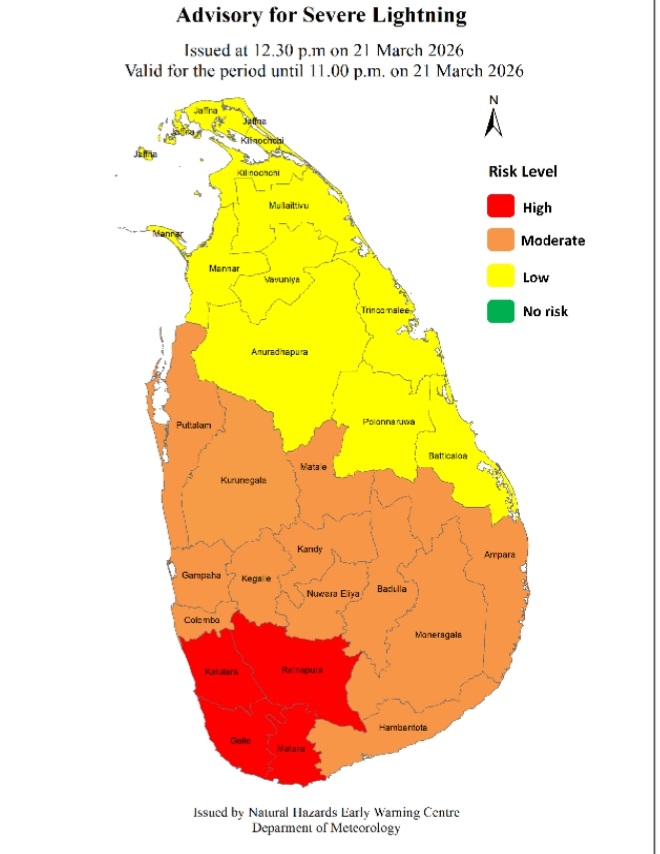
Advisory for Severe Lightning Issued by the Natural Hazards Early Warning Centre Issued at 12.30 p.m. 21 March 2026, valid for the period until 11.00 p.m. 21 March 2026
Thundershowers accompanied with severe lightning are likely to occur at some places in the Galle, Matara, Kaluthara and Rathnapura districts after 1.00 p.m.
There may be temporary localized strong winds during thundershowers. General public is kindly requested to take adequate precautions to minimize damages caused by lightning activity.
ACTION REQUIRED:
The Department of Meteorology advises that people should:
Seek shelter, preferably indoors and never under trees.
Avoid open areas such as paddy fields, tea plantations and open water bodies during thunderstorms.
Avoid using wired telephones and connected electric appliances during thunderstorms.
Avoid using open vehicles, such as bicycles, tractors and boats etc.
Beware of fallen trees and power lines.
For emergency assistance contact the local disaster management authorities.

Heat Index likely to increase up to ‘Caution level’ at some places in the Western, Sabaragamuwa, Southern and North-western provinces and in Anuradhapura, Monaragala, Mannar and Vavuniya districts

CEYPETCO Fuel prices increased from midnight today (21)

Advisory for Severe Lightning issued for Galle, Matara, Kaluthara and Rathnapura districts

Sri Lanka says it denied US request to land two aircraft at Mattala airport

Eid celebrations dimmed by war and displacement across Middle East

Showers may occur at several places in the Western, Sabaragamuwa, Northwestern and Uva provinces and in Galle, Matara, Kandy and Nuwara-Eliya districts after 1.00 pm.

‘Dates have the highest sugar content to fight Coronavirus’

Sunday Island 27 December – Headlines

#SundayIsland 17th December – Headlines

Sunday Island – 28th March

Sunday Island Headlines – 21 March

Sunday Island – 21st February – Headlines
-

 Business6 days ago
Browns EV launches fast-charging BAW E7 Pro at Rs. 5.8 million
-

 Life style7 days ago
From culture to empowerment: Indonesia’s vision for Sri Lanka
-

 News4 days ago
CIABOC questions Ex-President GR on house for CJ’s maid
-

 Life style7 days ago
Ranjith Fernando celebrates cricketing journey with Hob Nails to Spikes
-

 News5 days ago
Sri Lankan marine scientist Asha de Vos honoured at UNGA opening
-

 Features6 days ago
Achievements of the Hunduwa!
-

 Latest News7 days ago
QR code system will be implemented for fuel with effect from 06.00 a.m. today (15th)
-

 News5 days ago
Australian HC debunks misleading travel risk claims for Sri Lanka