
Features
Mandate of Ministry of Power – Some ambiguities, conflicts and barriers

By Dr. Janaka Ratnasiri
The Gazette Notification Extraordinary No. 2187/27 of 09.08.2020 stipulates the mandates of ministries, both Cabinet and State, and the institutes coming under their purview. One common requirement of these mandates is that they should align with the President’s policy document “Vistas of Prosperity and Splendour (VPS)”. In assigning functions among ministries, one deviation from the past practice hitherto followed is the division of Ministry of Power and Energy into two separate ministries, Ministry of Power and Ministry of Energy. There is some sense in this decision (See also The Island of 14.08.2020). It is hoped this change is for the better and not for the worse, as usually happens.
MANDATE OF MINISTRY OF POWER AND STATE MINISTRY OF RENEWABLE ENERGY
The key mandate of the Power Ministry is given as:
Meeting the electricity needs of all urban and rural communities, based on the long-term generation expansion (LTGE) plan prepared by the Ceylon Electricity Board (CEB).
 Supplying electricity to business enterprises in Sri Lanka enabling them to be competitive in the global market, and ensuring energy security.
Among the special priority areas identified for the Power Ministry are the following:
Expand the capacity of the Puttalam coal power plant, with additional investment.
Balance the generation mix from renewable energy plants, thermal power plants and natural gas power plants while minimizing the cost of generation and eliminating any uncertainties in generation.
Implement the long-term generation expansion plan.
Improve the efficiency of transmission and distribution systems.
Minimize the cost of electricity for manufacturing industries enabling their competitiveness in global markets.
Special priority areas identified for the State Ministry Renewable Energy, are the following:
Convert the Kelanitissa power plant to a natural gas turbine plant, and expand the Kerawalapitiya power plant.
Develop a smart network ensuring generation efficiency and optimizing its use.
Encourage the use of roof-top solar PV panels in households, commercial establishments and factories, enabling supply of electricity at low cost.
Encourage the private sector and entrepreneurs to establish renewable energy projects.
Add to the national grid the Broadlands Hydropower (HP) plant by 2020, Uma Oya HP plant by 2021, Moragolla HP plant by 2023, Thalapitigala and Seethawaka HP plants by 2024.
Add to the national grid the Mannar 100 MW wind power plant by 2021 and add 800 MW of wind and solar systems set up at Mannar, Pooneryn and Moneragala.
PROVISIONS IN “VISTAS OF PROSPERITY AND SPLENDOUR”
The VPS document has no separate section on Power Sector, but has only a section on Renewable Energy (RE), highlighting the President’s desire to give priority for renewable energy. The preamble to this section says “Renewable energy has now become a widely discussed subject and is needed as part of the overall energy mix of a country, which consists of Hydro, Thermal, Coal and alternative renewable energies. It will ensure that the country has access to low cost energy needed for rapid economic acceleration. By 2030, we expect the country’s renewable energy mix to be 40% of the total portfolio. We also anticipate that hydro and renewable energy together would account for 80% of the overall energy mix by 2030”.
The following targets on power sector development are also given in the VPS document.
According to the current plan, we will take actions to add 230MW of power to the national grid by installing the Broadland hydropower station by 2020, Uma Oya by 2021, Moragolla by 2023, Talapitigala and Seethawaka by 2024.
Immediate actions will be taken to convert the Kelanitissa plant to a natural gas turbine plant, where similar two plants will be implemented in Kerawalapitiya and Hambantota before 2023.
As part of the environmental-friendly policy, we will convert the fuel-powered plants located around the Colombo area to natural gas turbine plants within the next year.
With respect to transformation towards Renewable Energy, the VPS document says:
We will add 100 MW of wind energy in Mannar by 2021. Additionally, we expect to add 800 MW of solar energy to the national grid by executing a wind and solar power project with a public-private partnership in potential locations around the country including Mannar, Poonareyn and Monaragala.
Roof top solar systems will be encouraged so that households and small businesses wo

uld have access to low cost energy, which will be done in the course of the next five years.
We will remove all impediments and incentivize the private sector and entrepreneurs interested in setting up renewable energy projects i.e. solar and wind, and to this end, the government will provide assistance.
We will also introduce an efficient energy generation programme using industrial waste in each city.
We will introduce new policies and legislation to ensure the efficient use of energy in construction sector.
AMBIGUITY IN TARGETS GIVEN IN THE VPS DOCUMENT
The preamble to the section on Renewable Energy in the VPS document says “By 2030, we expect the country’s renewable energy mix to be 40% of the total portfolio. We also anticipate that hydro and renewable energy together would account for 80% of the overall energy mix by 2030”. There is much ambiguity in this statement. Firstly, it is not clear what is meant by “total portfolio”. Secondly, it is not clear whether the term “overall energy” means energy consumed in all sectors including power, transport, industries, commercial and households or whether it means energy consumed in the power sector only. On the face of it, overall energy would mean the former.
But the State Minister of Solar Power, Wind and Hydro Power Generation Projects Development was heard over the TV recently saying that his Ministry’s target is to generate electricity up to 80% of the total electricity generation from renewable energy sources by 2030, in compliance with the VPS document. Obviously, the author of this document has erred when he said that 80% target is in respect of overall energy, if the State Minister’s word is taken as correct.
In an article published by the author in The Island of 19, 20, and 21 of February, 2020, he described, in detail a scheme to meet 80% of the total energy consumption from renewable energy sources by 2030 considering all sectors, including power, industries, transport, commercial and households. The scheme included operating wind power and solar power units as stand-alone systems generating direct current for electrolyzing water and producing hydrogen. There are several options available to use hydrogen to meet the energy needs in power, industries and transport sectors. Another option given in the article is to convert biomass into a liquid fuel for use in transport and households.
Energy generation and consumption data in different sectors in Sri Lanka is given in the Energy Balance Statement (EBS) prepared annually by the Sri Lanka Sustainable Energy Authority (SLSEA). The latest EBS is available only in respect of 2017. Table 1 gives data taken from the EBS and it shows that Sri Lanka has already achieved 45% of renewable energy share in the total energy mix in 2017. Hence, to give a target of 40% to be achieved in 2030 has no meaning.
Table 1 Overall Energy consumption given in 2017 EBSFuelQuantityUnitEnergy Content
(PJ)Share %Petroleum oil 5,375kt232.0 43.9Coal 2,156kt 56.9 10.7Sub-Total (Fossil Fuels) 54.6Major hydro 3,075GWh 30.9 5.8Biomass11,810kt192.9 36.5Other Renewables 1,650GWh 16.2 3.1Sub-Total (Renewables) 45.4Total528.9100.0 ELECTRICITY DEMAND BY 2030
The CEB prepares biennially a long-term generation expansion (LTGE) plan outlining the least cost options of generation plants that need to be added to the system annually for the next 20 years. The latest plan is in respect of the period 2020 – 2039 which is still in the draft form yet to be approved by the Public Utilities Commission, Sri Lanka (PUCSL) and scrutinized by the public. The Plan includes a Base Case that will meet the needs of average demand as well as other cases to meet the needs of high and low demand. Table 2 gives the capacity of different types of generating units that need to be added during 2020 – 2030 as given under Base Case.
Table 2. Capacity additions proposed in LTGE Plan 2020-39Type of plantCapacity to be added during 2020-2030
MWMajor hydropower plants627Solar PV plants900Wind power plants675Biomass plants55Mini-hydro plants165Diesel plants665Gas turbine plants70Combine cycle gas turbine plants1,500New Coal power plants 1,200
The LTGE Plan has also worked out the average generation from each plant type annually and the values obtained for 2030 are given in Table 3, extracted from the data given in Annex 8.4 of LTGE Plan. It is to be noted that it is not possible to forecast exact values for generation from each category in the future because it depends on many extraneous factors such as rainfall, cloud cover, wind regime, fuel prices and demand which are not known accurately in advance. Annex 8.4 gives both average values as well as high and low extreme values anticipated considering the uncertainties. Table 3 gives only the average values anticipated.
It is seen that according to CEB’s LTGE Plan for 2020-39, generation from renewable sources could reach only 35% by 2030, which is far below the 80% target given in President’s VPS Policy Document, assuming what is intended by “total energy” appearing in this document is total electricity generation. In order to align with the President’s policy, CEB will therefore have to come out with a revised plan for capacity additions reducing the thermal plant capacity and correspondingly increasing the RE systems enabling to raise the RE share in total electricity generation from 35% to 80% by 2030.
Table 3. Forecasted average generation in 2030 Plant categoryCapacity MWGeneration GWhMajor hydropower plants1,607 4,364Other renewable energy plants2,700 6,738Sub-total – RE sources4,30711,102Reciprocating plants 136 413Existing coal power plant 810 4,781Existing combined cycle plants 594 1,825New gas turbine plant 70 113NG combined cycle plants 1,500 5,783New coal power plants1,200 7,721Sub-total – Thermal4,31020,636Total31,738Share of RE generation35.0%
OPTIONS FOR MEETING THE PRESIDENT’S TARGET
The obvious choice for meeting the President’s target is to shift from coal power to solar and wind power. In an article written by the author appearing in the Island of July 31st and August 1st, 2020, he showed that by shifting from coal power to solar and wind power, CEB can save over 100 billion rupees annually. This is based on the price of LKR/kWh 10 offered in an on-going wind power project and bids received for solar power projects as divulged by CEB Chairman (Island of 24.07.2020). This is much less than the average cost of generation incurred by CEB which is LKR/kWh 23. In addition to the expenditure saved, adopting solar and wind power gives a bonus of providing pollution free generation.
Several proposals for building large scale solar power plants and wind power plants have been granted Cabinet approval in 2016 and 2017, but there have been no follow up measures taken to pursue them by the CEB. This is despite their economic and environmental advantages. With the announcement of President’s policy on promoting renewable energy, it is hoped that the officials in the Power Ministry and CEB will change their mindset and implement the proposed RE projects without delay. In order to get the private sector involved in this exercise, the present limitation of 10 MW for the development of RE projects by the private sector has to be removed.
The officials of the Power Ministry as well as of the CEB need to be reminded of the statement “We will remove all impediments and incentivize the private sector and entrepreneurs interested in setting up renewable energy projects i.e. solar and wind, and to this end, the government will provide assistance” appearing in the VPS policy document under Renewable Energy section. It is essential that they change their lackadaisical attitude towards renewable energy, if the President’s targets are to be achieved.
The mandate of the State Ministry of Renewable Energy includes building of large scale solar and wind power plants as priority areas. However, their implementation will be possible only with the concurrence of CEB, which was lacking in the past RE projects. There were also media reports of India offering a large solar park under the International Solar Alliance initiated by the Indian Prime Minister together with the French President at the Climate Change Summit Conference held in 2015. Sri Lanka should accept this offer and accelerate building up its solar power capacity.
Another option available is to increase the large hydropower capacity. The general thinking on this is that there are no more suitable sites available to build large hydropower plants in Sri Lanka. However, it is possible to build a large hydro power plant by building a new reservoir on Kotmale Oya below St. Clair’s waterfall and linking it to the existing shaft of the Upper Kotmale Power Plant. This will enable it to operate during the day increasing its plant factor rather than operate only as a peaking plant as done now. Water spilling over the Upper Kotmale Reservoir as well as water flowing down Devon’s water fall can be collected in this new reservoir.
This proposal was made by the Central Engineering Consulting Bureau (CECB) during the planning stage of Upper Kotmale project but not accepted by the Japanese Contractors. It has the potential to add about 160 MW of capacity, generating additional 520 GWh of RE annually. This is a better option than diverting water from Pundalu Oya to the shaft of the Upper Kotmale Project as proposed by CEB in its 2020-39 Plan.
The CEB’s LTGE Plan has given low priority for biomass power plants, adding only 5 MW capacity annually. This can be easily enhanced by setting up dedicated energy plantations and mixed plantations which will generate more renewable energy. It will also provide more opportunities for income generation to rural people and providing fodder to maintain a livestock industry. The colossal sum of money spent annually on importing fuel for thermal power plants presently could be retained in the country by developing biomass power plants.
It has been estimated that 1 ha of dedicated plantation of a crop such as gliricidia will yield 10 t of biomass annually. Assuming combustion of 1 t of biomass with 33% efficiency will generate 1.5 MWh of electricity, 1 ha of plantations has the capacity to generate energy equivalent to 15 MWh. Hence, to replace 1 MW of thermal power plant, about 500 ha energy plantations are required. This could be on new land or on home gardens and abandoned cropland including fallowed paddy land.
In 2019, the Cabinet declared 2022 as the year of Biomass Energy with the objective of promoting energy generation from biomass. Already, SLSEA is pursuing a project funded partly by UNDP and FAO for “Promoting Sustainable Biomass Energy Production and Modern Bio-Energy Technologies” with the specific objective of removing obstacles to the realization of sustainable biomass plantation, increase of market share of biomass energy generation and adoption of biomass- based energy technologies in Sri Lanka. Currently, a survey is planned to identify land available and suitable for energy plantations. Findings of this study will help developing more biomass power capacity at commercial scale by 2030.
CONFLICT BETWEEN THE POWER MINISTRY MANDATE AND VPS POLICY DOCUMENT
The Power Ministry mandate has the following provisions pertaining to the LTGE Plan and Puttalam Coal power plant.
Meeting the electricity needs of all urban and rural communities based on the long-term generation expansion (LTGE) plan prepared by the Ceylon Electricity Board (CEB).
Expand the capacity of the Puttalam coal power plant with additional investment.
Implement the long-term generation expansion plan.
As mentioned previously, CEB’s current plan envisages building 1,200 MW of coal power plants by 2030. Though it is consistent with the above mandate of the Power Ministry, its implementation will result in achieving only 35% share for RE plants out of total generation by 2030. This is in violation of the VPS targets. Hence, either the State Ministry should pursue more RE projects disregarding what was specified in the CEB’s LTGE Plan or the CEB revise its Plan to align with the President’s VPS document.
The VPS document has the following statement:
As part of the environmental-friendly policy, we will convert the fuel-powered plants located around the Colombo area to natural gas turbine plants within the next year.
It is gratifying to note that the new Government has decided to adopt an environment-friendly policy. However, it should apply not only to Kelanitissa Complex, but also to Puttalam Power Plant as well where the pollution is much severe than at Kelanitissa, particularly arising out of million tonnes of ash accumulated over the years containing many toxic heavy metals including mercury and arsenic.
Hence, in keeping with this policy, the proposal to add another 300 MW coal power plant to Puttalam Complex should be scrapped and instead the government should build a NG operated power plant of similar capacity which will be cheaper and easier to operate and maintain. Further, it will not emit any polluting gases such as Sulphur Dioxide or any particulates or any ash at all. Even the emission of other gases such as Carbon Dioxide contributing to global warming and Oxides of Nitrogen will be very much less.
Also, the LTGE Plan is highly flawed. It is supposed to determine which power technology will be the cheapest in 20 years hence based on current prices. With the cost of generation depending on plant capital cost and fuel prices both of which could vary widely within a span of 20 years, it is futile to make forecasts now as to which technology is the cheapest in 20 years hence and to adopt it. The technology should be selected after calling for bids for different technologies and selecting the most economic plant that meets detailed performance specifications as well as specifications on emission limits. This should be done at the time of building the plant and not based on flawed forecasts. Hence, stipulating a mandate to follow a flawed plan does not make sense.
BARRIERS AGAINST THE STATE MINISTRY AND VPS MANDATE
The State Ministry mandate has the following requirement:
Convert the Kelanitissa power plant to a natural gas turbine plant, and expand the Kerawalapitiya power plant.
The VPS document has the following requirements:
Immediate actions will be taken to convert the Kelanitissa plant to a natural gas turbine plant, where similar two plants will be implemented in Kerawalapitiya and Hambantota before 2023.
As part of the environmental-friendly policy, we will convert the fuel-powered plants located around the Colombo area to natural gas turbine plants within the next year.
Conversion to natural gas operation is possible with gas turbine power plants, both open cycle gas turbines (OCGT) and combined cycle gas turbines (CCGT). The latter comprises of two generating units, a gas turbine and a steam turbine which operates with hot exhaust gas released by the gas turbine without consuming additional fuel. Hence, a CCGT plant has a high efficiency exceeding 50%.
At Kelanitissa Complex, there are two OCGT plants with capacities 80 MW and 115 MW commissioned in 1981/82 and 1997, respectively, and two CCGT plants with capacities 165 MW and 163 MW commissioned in 2001/03 and 2003, respectively. All these power plants currently operate with auto diesel, except that the CEB owned 165 MW plant operates partly with diesel and partly with naphtha produced as a surplus in the refinery. All these plants can be converted to operate with NG after modifying their fuel injection systems, if it is found economical to do so considering their age. However, the non-availability of NG is a barrier to convert them within the specified time targets given in the mandates.
In order to convert these gas turbine plants to operate on NG, first NG will have to be imported in the form of liquefied natural gas (LNG) for which special unloading jetties on land or floating units need to be built which takes several years. Though negotiations were held with India and Japan for several years after signing memoranda of understanding with them for building a terminal and importing LNG, no progress has been made public on this project. It was also reported in the media that CEB is seeking assistance from the Asian Development Bank (ADB) to establish a terminal for importing LNG.
Originally, the Ministry of Petroleum had the mandate for importing LNG, but because of the ministry’s inaction, the CEB obtained Cabinet approval for them to import LNG directly. However, under the new government, all matters relating to petroleum including NG comes under the purview of the Ministry of Energy. It is to be seen how the two ministries will coordinate to supply NG for operating not only these existing gas turbine power plants but also the proposed new gas turbine power plants. Importing of LNG needs to follow international protocols and has to be handled by competent operators after having in place the necessary regulatory framework on safety aspects and issuing licenses for operators.
CONCLUSION
The mandate given to the Ministry of Power recommends the establishment of coal power plants in keeping with the long-term generation expansion plan of CEB. On the other hand, the mandates given to the State Ministry for Renewable Energy recommends conversion of existing thermal power plants to operate on natural gas in keeping with the environment-friendly policy of the government. Therefore, to be consistent in applying this policy, the proposed 300 MW coal power plant to be built at Puttalam should also be converted into a gas power plant.
This could be best done by expediting the building of the 300 MW gas power plant at Kerawalapitiya for which the Cabinet approval has already been granted after a procurement process which got dragged for nearly 4 years. This plant, which could be built much faster than the coal power plant, will be able to meet any power deficit anticipated in a few years’ time. It appears that the Ministry is holding back this project for reasons best known to them and the new Minister should use his good office to expedite the project without listening to officials who were responsible for delaying it. The most practicable way of achieving these targets is to appoint a new set of young honest officers not allergic to renewable energy and gas power to take decisions on these matters.




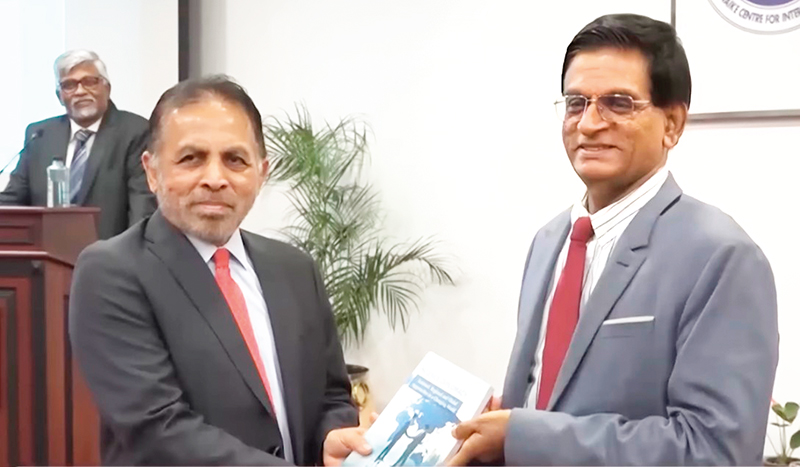
Today marks a truly historic and momentous occasion in the realm of transdisciplinary diplomacy in our country. We gather here with a twofold purpose of profound national and global significance: the establishment of the Science Diplomacy Forum, and the launch of the volume Science Diplomacy: National, Regional and Global Approaches in a Changing World.
This volume brings together valuable and timely contributions from internationally renowned experts representing all key regions of the world — North America, Latin America, Europe, Africa, West Asia, South Asia, and Oceania. It reflects a rich diversity of perspectives, experiences, and insights that speak to the increasingly interconnected nature of science, policy, and diplomacy in our rapidly transforming world.
I am deeply heartened — and indeed humbled — by the presence of such a distinguished constellation of leaders, professionals, intellectuals, scholars, and luminaries from diverse domains, including international relations, science and technology, higher education, and governance. It is rare to witness such an extraordinary and diverse assembly of intellectual, professional, and academic excellence under one roof. Your presence affirms the importance of the cause we serve and the promise of the path we are charting together. Your support, encouragement, and engagement give life, purpose, and direction to this vital endeavour.
As Chief Editor of this volume, it is both a great honour and a profound responsibility to extend a warm and heartfelt welcome to all our distinguished guests and invitees. I am conscious that this august gathering is not assembled to listen to a lengthy welcome address, but rather to engage with the substantive proceedings of this event, enriched by five eminent personalities, four distinguished speakers, and an able and competent moderator — all of whom possess exceptional mastery of the subject. I shall therefore be brief.
Among us today are former and current Ministers and people’s representatives, members of the diplomatic corps, Secretaries to Ministries, distinguished panelists, valued contributors to the volume, Vice-Chancellors, Members of the Board of Management and Academic Affairs Board of the BCIS, Heads of institutions, professors, senior government officials, professionals, journalists, and many others — too numerous to acknowledge individually, yet each of you is most warmly welcomed. I receive you all, whether present in person or online, with the utmost warmth, respect, and appreciation.
The panel discussion constitutes the pièce de résistance of this event. We are deeply honoured to be joined by four eminent personalities:
Her Excellency Siri Walt, Ambassador of Switzerland to Sri Lanka;
Professor Pierre-Bruno Ruffini, former Chair of the EU Science Diplomacy Alliance; and former Ambassadors Mr. Bernard Goonatilleke and Dr. Palitha Kohona — all of whom bring exceptional depth of experience and insight to this important subject.
Their discussion will be guided by our distinguished moderator, Mr. Naushard Cader, a truly cosmopolitan personality, widely respected for his breadth of knowledge and his keen understanding of global affairs and science diplomacy. I extend to all our speakers and our moderator a very warm welcome and my sincere appreciation for their willingness to share their wisdom with us this evening.
Allow me, however, to place this event in perspective.
We gather this evening not merely to introduce a book, nor solely to inaugurate a forum, but to reflect together on an idea whose time has unquestionably arrived.
We meet at a moment of profound global transition and conflict. The international landscape is marked by turbulence, uncertainty, and rapid transformation. The world is shifting from a relatively stable post–Cold War configuration toward an increasingly multipolar order. While multipolarity carries the promise of greater balance and strategic autonomy, it also brings intensified competition among major powers, fluid alliances, and growing unpredictability.
At the same time, the rules-based international order — which for decades provided smaller nations with a measure of predictability and protection — is under visible strain and threat. Institutions are contested. Norms are challenged. Economic interdependence deepens even as geopolitical fragmentation intensifies. Supply and value chains now account for nearly seventy percent of global trade, binding nations in complex webs of mutual dependence. Yet such interdependence has not prevented trade wars, sanctions regimes, technological decoupling, and regional conflicts.
For small and economically vulnerable states, this evolving environment is especially daunting. When global rules weaken, asymmetries of power become more pronounced. Bilateral negotiations between unequal partners can leave smaller nations disadvantaged. Without adequate legal, geological, scientific, technological, and diplomatic expertise, such states may struggle to safeguard their long-term national interests and sovereignty. Vulnerability, in the absence of knowledge and capacity, risks translating into marginalisation.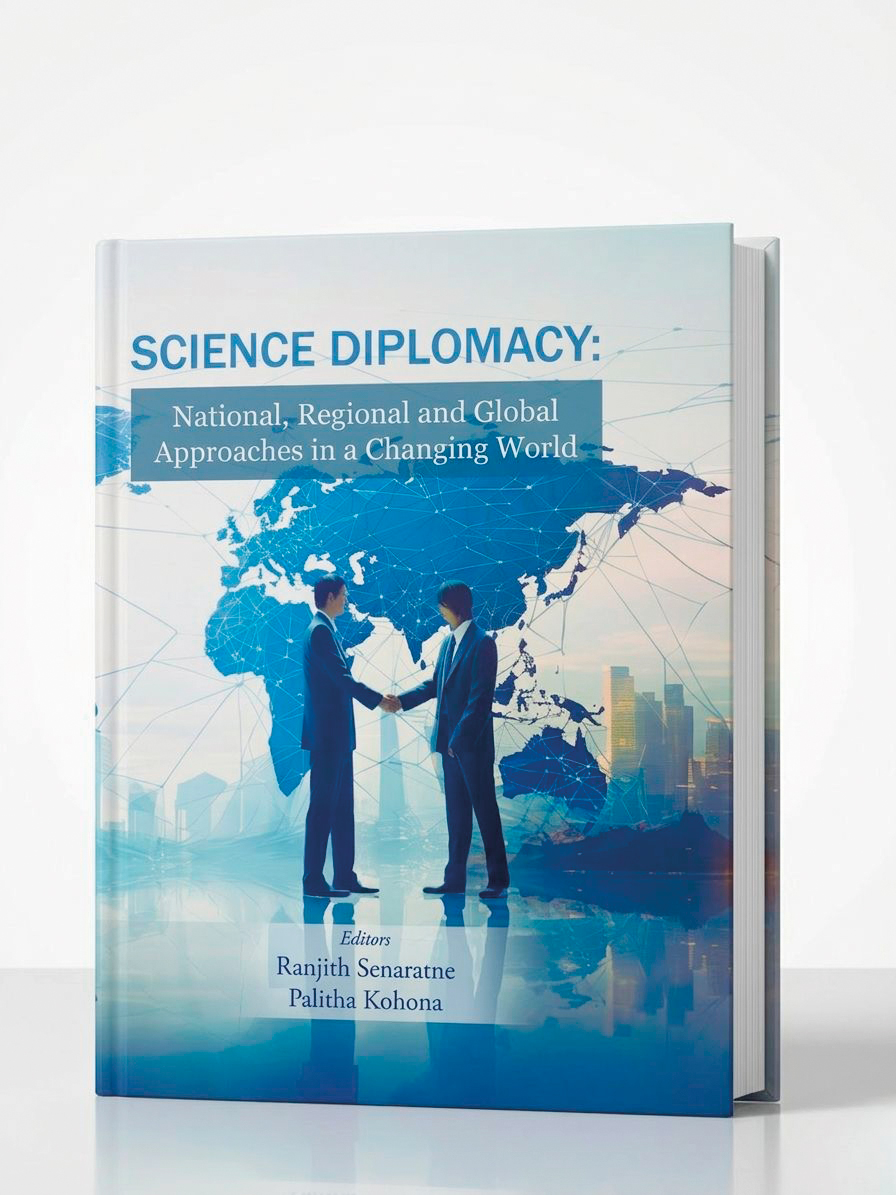
Overlaying this geopolitical transformation is a constellation of interconnected global challenges. Climate change is no longer a distant projection; it is a lived reality. Sea levels are rising. Extreme weather events are intensifying. Food, water, and energy security remain fragile. Pandemics have exposed vulnerabilities in global health systems. Cyber threats transcend borders. Environmental degradation, biodiversity loss, and marine pollution threaten livelihoods and ecosystems alike.
These challenges are systemic and transboundary. Almost every major issue — whether global, regional, or national in scale — involves science and technology, either in understanding root causes or in devising effective solutions.
Traditional diplomacy, while indispensable, is no longer sufficient on its own. The defining issues of our time are not purely political or military; they are scientific, technological, environmental, and societal. They demand evidence-based policymaking, interdisciplinary collaboration, and sustained transnational cooperation.
It is within this context that science diplomacy emerges — not as an academic abstraction, but as a strategic necessity.
Nowhere are these realities more visible than in the Indian Ocean.
Unlike the Atlantic or Pacific Oceans, which possess longstanding institutional architectures and extensive scientific mapping, the Indian Ocean remains comparatively underexplored and under-institutionalised. Covering roughly one-fifth of the world’s oceanic expanse, it carries a substantial share of global energy shipments and maritime trade. Its seabed resources — including critical and rare-earth minerals — remain only partially surveyed. Many of its coastal and island nations are developing economies with limited scientific and technological capacity to explore, monitor, and sustainably manage these resources.
The Indian Ocean is unique. It is bordered predominantly by developing and emerging states. It hosts remarkable cultural, religious, and political diversity. It is home to some of the world’s most climate-vulnerable communities. Increasingly, it has become a central theatre of global strategic competition, viewed by some nations through distinct geostrategic lenses.
This maritime space is simultaneously a lifeline and a fault line. It sustains global commerce and local livelihoods. Yet it is also a theatre where geopolitical interests intersect — sometimes converge, sometimes collide.
At the heart of this ocean lies Sri Lanka.
Geographically, our island sits astride one of the busiest East–West shipping routes in the world. Historically, Sri Lanka has been a hub of commercial, cultural, and intellectual exchange. Today, that strategic location presents both opportunity and responsibility.
Sri Lanka’s history, enriched by iconic figures such as Dr. Gamini Corea, Hon.
Lakshman Kadirgamar, Judge Christopher Weeramantry, Dr. Neville Kanakaratne and Dr. Jayantha Dhanapala, stands as a powerful testament to our long-standing contributions to global diplomacy and international governance. Our nation provided leadership within the Non-Aligned Movement, positioning itself as a bridge between civilizations at a time of deep ideological division. We also made history by producing the world’s first woman Prime Minister, affirming our commitment to political progress and inclusive governance.
Today, we are called upon once again to build upon this distinguished legacy — by championing regional unity, promoting sustainable development, and addressing critical contemporary challenges such as climate change, maritime security, and environmental sustainability.
We must navigate complex geopolitical currents while safeguarding sovereignty and strengthening economic resilience. We face vulnerabilities common to island and littoral states: climate change, coastal erosion, marine pollution, and supply chain disruptions. Our development aspirations must be balanced with environmental stewardship and maritime security considerations.
Yet within these challenges lies profound opportunity.
Sri Lanka can position itself as a regional convener — a hub for ocean science, climate research, marine biodiversity studies, disaster risk reduction, and blue economy innovation. Through platforms such as BIMSTEC, the Indian Ocean Rim Association, and SAARC, we can advance cooperative marine research, harmonise environmental standards, strengthen early warning systems, and promote sustainable maritime governance grounded in international law.
But to do so effectively, we must invest in knowledge — and in the diplomacy of knowledge.
Science diplomacy operates along three mutually reinforcing dimensions:
First, science in diplomacy — where scientific evidence informs foreign policy decisions.
Second, diplomacy for science — where diplomatic engagement enables international research collaboration and shared infrastructure.
Third, science for diplomacy — where scientific cooperation itself becomes a bridge for confidence-building, even when political relations are strained.
Importantly, science diplomacy extends beyond the natural sciences. The humanities and social sciences are equally vital. Technology must be guided by ethics. Data must be interpreted within cultural contexts. Policy must consider equity and justice. Diplomats of the future must be fluent not only in international law and negotiation, but also in scientific literacy and interdisciplinary thinking.
In a fragmented world, science offers a neutral vocabulary. It encourages transparency, peer review, and open data. It shifts discourse from rhetoric to evidence. It fosters long-term thinking in political environments often dominated by short-term calculations.
For small and vulnerable nations, science diplomacy is empowerment. It strengthens capacity. It enhances credibility. It enables engagement with larger powers on firmer ground — armed not merely with moral argument, but with data, research, and technical expertise.
The book we launch today reflects a diversity of experience and insight. It is intentionally transdisciplinary because the problems we face are transdisciplinary. It is intentionally global because no region can address these challenges in isolation.
In Sri Lanka, science diplomacy remains at a formative stage. The establishment of the Science Diplomacy Forum signals our determination to move beyond dialogue toward sustained institutional engagement. It envisions training programmes for diplomats and scientists, embedding scientific advisory mechanisms within governance structures, and building networks among universities, research institutes, industry, and policymakers. It seeks to cultivate a new generation equipped to navigate the interface between knowledge and negotiation.
We aspire for the Science Diplomacy Forum to be transformative — a true game changer.
Excellences, Ladies and Gentlemen,
We live in an era of mounting uncertainty — but also of extraordinary human ingenuity. The same interconnectedness that transmits crises also enables collaboration. The same technologies that disrupt can also heal and transform.
Change is inevitable. The deeper question is whether we will shape that change cooperatively, constructively, and inclusively.
For Sri Lanka, for the Indian Ocean region, and for the broader global community, science diplomacy offers a pathway beyond zero-sum thinking. It channels competition into collaboration around shared public goods. It aligns national interest with regional stability. It transforms vulnerability into resilience through knowledge.
Let this book be not merely a publication, but a platform for sustained reflection and action.
Let the Science Diplomacy Forum be not merely an institution, but a living bridge between evidence and policy, between research and responsibility, between nations and neighbours.
Let Sri Lanka reaffirm its role as a bridge — not a battleground — in the Indian Ocean.
In a world where rules may falter, let evidence guide us.
In a world where tensions may rise, let dialogue endure.
In a world of turbulence, let science diplomacy be our compass — guiding us toward peace, stability, dignity, and shared prosperity.
Welcome Address and Opening Remarks made by Emeritus Prof. Ranjith Senaratne
Former General President,
Sri Lanka Association for the Advancement of Science recently on the occasion of the Founding of the Science Diplomacy Forum and the Launch of the Book Science Diplomacy:
National, Regional and Global Approaches in a Changing World

From one day of celebration to 364 days of transformation
The international women’s day was just celebrated all over the world. I saw many organiations share their slogans, and organize panel discussions, presentations, and exhibitions to support women empowerment. Slogans, themes, colors play vivid and vociferous role across the world, commemorating the international women’s day.
Alas, the colors are faded, slogans are weaned, themes are forgotten, over the next 364 days, pushing UN Chapter on Women’s Rights come up with more illustrious themes and slogans.
From Bread and Peace to Rights and Action
According to the recorded history, the Women’s day first introduced on 28th February 1909 in America, raising a voice of women against poor working conditions and poor pay in garment factories. This took a more revolutionary form in 1917 in Russia against World War I, where a mass of women protested under the theme of “Bread and Peace”.
Starting from basic needs such as bread and peace, the International Women’s Day theme has evolved towards freedom and independence, justice and inclusion.
Over the years, the rise of feminism brought cultural refinements and highlighted women’s rights. Looking back the historical evolution of women’s role, we see that matrimony has faded and patriarchy evolved with religious and geopolitical forces intertwined with the social expectation. The importance and respect for women, given in the ancient civilisations, diminished with medieval civilization, and subsequent colonisation. The rise of patriarchy domesticated women as homemakers, at the same time prompting their voices to rise for dignity and equitable treatment.
Rise of Feminism
In a typical Western-household of 20th century, husband was the bread winner of the family and the wife managed household affairs. In this era, women’s affairs were restricted to daily chores, creating a boundary wall restricting their access to corporate jobs, free voices. Betty Friedman was a remarkable lady who observed the domestic suffering of women and challenged ‘feminine mystique’ through her 1963 book. She disclosed the feminine mystique, which celebrated women as good housewives, and the belief that women could find satisfaction from domestic chores, home making, marriage, raising children, cooking, washing and taking care of husband’s needs. Betty disclosed that the unhappiness and boredom experienced by the domesticized women, and their inability to live up to the feminist mystique defined by the male dominant society had no name and difficult to express in words. Betty’s claim was supported by the theories of Abraham Maslow, who introduced motivation to grow along the hierarchy of needs. Betty, declared that feminine mystique denies basic growth needs of women, where their desires limited to shelter, food, safety and love only.
In this era women’s jobs were confined preeminently to teaching, and caregiving. STEM fields: science, technology, engineering and medicine were dominated by males, leaving less space for women. As you may have heard in the medieval era women who practiced medicine were branded as ‘witches’ and many were burned alive rooting out the knowledge and courage of women. Women who practiced and taught science and astronomy, were also branded for witch craft and condemned to death. The social pressure suppressed women confining them to domestic chores. In the industrial era women were hired for factory work under low wages and less facilities. In this period Women’s organisations were gathered demanding freedom and justice for women, calling for equal opportunities and rights enjoy their male counterparts. The evolution of women’s movements culminated in 1975, where the first International Women’s Day was commemorated on 8th March 1975.
Celebration and Contradiction
Since 1975, women were celebrated for a day in every year across the globe, with various themes and color codes to showcase the world that all women have rights and demanding fair treatment. The theme colors of International Women’s day are Purple, Green and White.
Purple stands for justice, dignity, and loyalty to the cause.
Green for hope and growth.
White for purity and unity.
In 1996, the International Women’s Day declared a theme to embrace, which is; “Celebrating the Past, Planning for the Future.” In the year 2023, the theme was ‘Embrace Equity’, which evolved to ‘Inspire inclusion’ in 2024, and the year 2025 theme was ‘Accelerate Action’. In 2026, there are three themes; 1. Give to Gain, 2. Balance the Scales, 3. Rights. Justice. Action.
Fragmented Focus Diminishes Values
Multiple themes and competing messages can unintentionally dilute momentum. Unity is not uniformity, but coherence matters; shared direction makes shared progress possible. Emerging three themes to celebrate international women’s day in 2026, implicate lack of solidarity, and unity among women’s organizations to share a common theme. Inclusion, equity and accelerated action have not yet achieved by the women globally, neither locally, nor in small communities. We are bound to question whether the women stay true to the meanings of theme colors that represent womanhood.
Thus, isn’t it vital to explore what goes wrong with our themes and slogans on this Women’s day, before setting foot without solid foundation for what we claim for? Or is it only a day that dawn women’s organisations to gather women in elite society, or identified group of women to enjoy a cup of tea over futuristic speeches of identical society, which treat women with high respect and equity?
One thing we must understand is the world is evolving, so does the roles, rights, and actions of women. Although, women shouted and pleaded for opportunities to enter male dominate world of work, today in many countries including Sri Lanka, women occupies majority of administrative positions and clerical level jobs. Even, the labour positions, dominated by males, are now occupied by the females in many sectors. However, women still bear the traditional homemaker role as well, while juggling with work, and studies to sustain jobs and promotions. This modern day scenario has made women more prone to chronic stress related deceases. The break of rest, too rigid demands coming from work and family, their own desires to move up the corporate ladder, outsmart neighbourers, and craving to make their children better than the others have made women’s lives miserable and breaching the themes and slogans that cater to the women’s prosperity.
Today’s environment has resulted many women to abandon dignity, purity, and hope, overlook unity and justice. If you see social media contents shared by women, you may not be surprised by my statements. The dignity, purity and hope for betterment of women is vanishing on screen. Young girls’ addiction to drugs, liquor and tobacco, sexual misbehaviour, and rising school-aged pregnancies are critical concerns that women’s movements must pay attention today.
What We Must Demand Now: Right Education and Just Acts
Women’s day slogans need a shift. Rather than demanding equal rights as men, we must demand right education for women and girls. We shall not stop at demanding justice as given to the men, but shout and make women and girls aware of ‘Just Acts’, and encourage them to act justly, for themselves, without exposing them to be victims of social media, and ill temptations.
Digital lives of women and girls can amplify comparison, quick outrage, and performative ideals. For girls and women, this can mean unrealistic bodies, curated success, and unsafe online spaces. What we need isn’t more judgment; it’s digital literacy, psychological safety, reproductive health awareness, and robust support systems, so women can flourish on and off‑line. We must educate women and nourish and foster the moral values among women and girls to stay pure in thoughts and actions, we must empower women and girls to keep hope and grow continuously. We must share a culture of inclusion among women to enhance solidarity and stay true to unified action for the betterment of women, and the society.
Women as Creators and Modifiers of the World
The history of International Women’s Day is a call for rights and justice. Today, the next horizon is to build cultures at home, at work, and society. Women are the creators and modifiers of the world. They are to add color to lives of those around them. In fact, WOMEN, do not need to call for justice, rights and action. WOMEN, need to call the hidden power, strength and courage within them and create a world that assures every being in it receives justice, and enjoys rights.
Thus, whether themes multiply or fade, the test is not in the rally or the ribbon, it is in the 364 days after. The colours may be vivid on stage, yet the colors are faded in practice if we do not live them. Let us re‑design life with dignity, unity, courage, and continuous growth. Let us educate, include, and act justly. Let us awaken strength within, so that every woman, every girl, and every community can thrive by being a Woman Who Re‑designs Life!
(The author is a senior education administrator, researcher,
management consultant and a lecturer.)
By Dr. Chani Imbulgoda
cv5imbulgoda@gmail.com)
Features
Illegal solar push ravages Hambantota elephant habitat: Environmentalist warns of deepening crisis
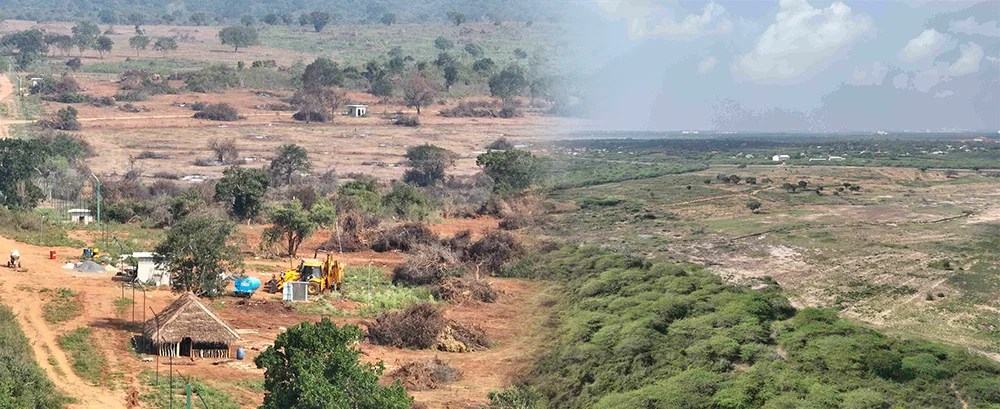
A large-scale move to establish solar power plants in Hambantota has triggered a major environmental and social crisis, with more than 1,000 acres of forest—identified as critical elephant habitat—cleared in violation of the law, environmental activist Sajeewa Chamikara said.
Chamikara, speaking on behalf of the Movement for Land and Agricultural Reform, said that 17 companies have already begun clearing forest land along the boundaries of the Hambantota Elephant Management Reserve. The affected areas include Sanakku Gala, Orukemgala and Kapapu Wewa, which are known to be key elephant habitats and long-used movement corridors.
He said that what is taking place cannot be described as development, but rather as a large-scale destruction of natural ecosystems carried out under the cover of renewable energy expansion.
According to Chamikara, the clearing of forests has been carried out using heavy machinery, while large sections have also been deliberately set on fire to prepare the land for solar installations. He said that electric fences have been erected across wide stretches of land, effectively blocking elephant movement and fragmenting their natural habitat.
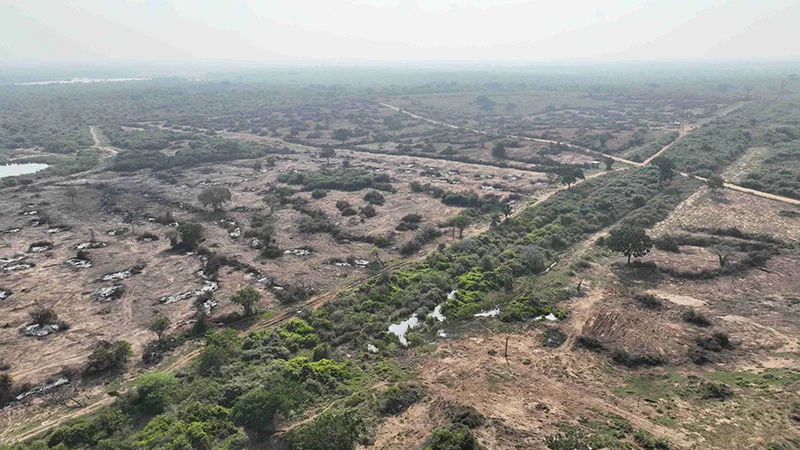
“These forests are not empty lands. They are part of a living system that supports wildlife and nearby communities. Once destroyed, they cannot be easily restored,” he said.
The projects in question include a 50 megawatt solar development undertaken by five companies and a larger 150 megawatt project implemented by 12 companies. The larger project is reported to be valued at around 150 million US dollars.
Chamikara stressed that these projects are being carried out in a coordinated manner and involve extensive land clearing on a scale that raises serious environmental concerns.
He further alleged that certain companies had paid about Rs. 14 million to secure support and move ahead with the projects. He said this points to a troubling failure of oversight by state institutions that are expected to protect forests and wildlife habitats.
“This is not only an environmental issue. It is also a serious governance issue. The institutions responsible for protecting these lands have failed in their duty,” he said.
Chamikara pointed out that under the National Environmental Act, any project of this scale must receive prior approval through a proper Environmental Impact Assessment process.
He said that clearing forest land before obtaining such approval is a direct violation of the law.
He added that legal requirements relating to archaeological assessments had also been ignored. Under existing regulations, large-scale land clearing requires prior evaluation to ensure that sites of historical or cultural value are not damaged.
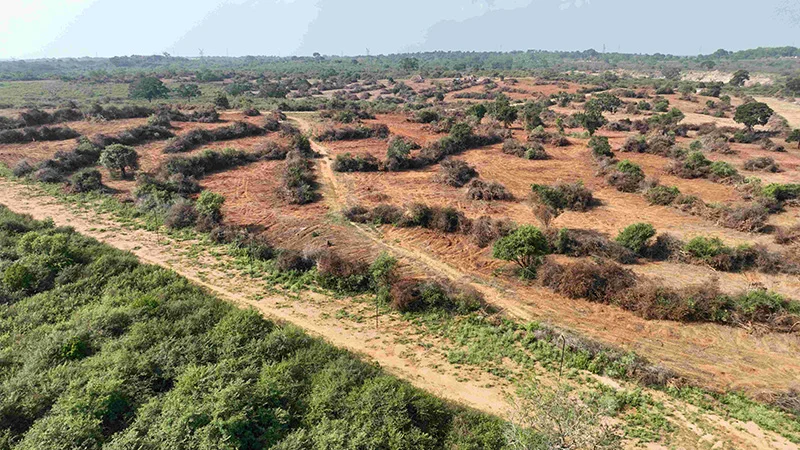
“The law is very clear. You cannot go ahead with projects of this nature without proper approval. What we are seeing is a complete disregard for legal procedure,” Chamikara said.
The environmental impact of these activities is already becoming visible. With their natural habitats destroyed, elephants are increasingly moving into nearby villages in search of food and shelter. This has led to a sharp rise in human-elephant conflict in several areas.
Areas such as Mayurapura, Gonnooruwa, Meegahajandura and Thanamalvila have reported increasing encounters between humans and elephants. According to Chamikara, more than 5,000 farming families in these areas are now facing growing threats to their safety and livelihoods.
He warned that farmers are being forced to abandon their lands due to repeated elephant intrusions, while incidents involving damage to crops and property are rising. There have also been increasing reports of injuries and deaths among both humans and elephants.
“This is turning into a serious social and economic problem. When farmers cannot cultivate their lands, it affects food production, income and rural stability,” he said.
Chamikara also raised concerns about the broader environmental consequences of clearing forests for solar power projects. While renewable energy is promoted as a solution to reduce carbon emissions, he said that destroying forests undermines that goal.
“Forests play a key role in absorbing carbon dioxide. When you clear and burn them, you are increasing emissions, not reducing them. That defeats the purpose of promoting solar energy,” he explained.
He added that large-scale deforestation in dry zone areas such as Hambantota could also affect local weather patterns and reduce rainfall, which would have further negative impacts on agriculture and water resources.
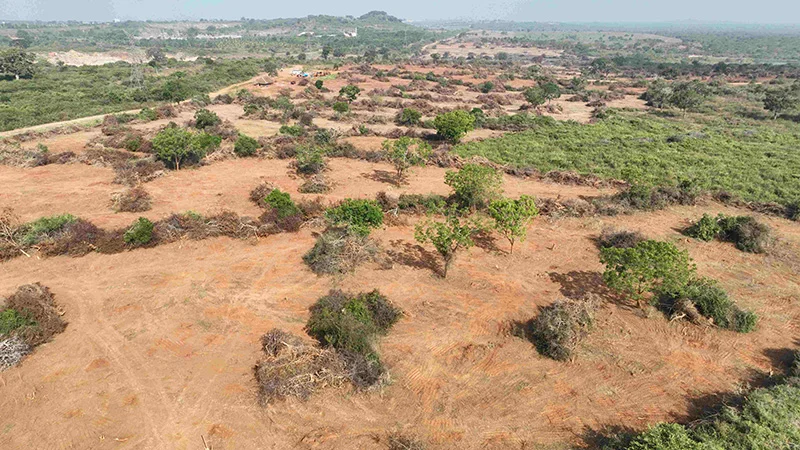
Chamikara called for a shift in policy, urging authorities to focus on more sustainable approaches to solar power development. He said that rooftop solar systems on homes, public buildings and commercial establishments should be given priority, as they do not require clearing large areas of land.
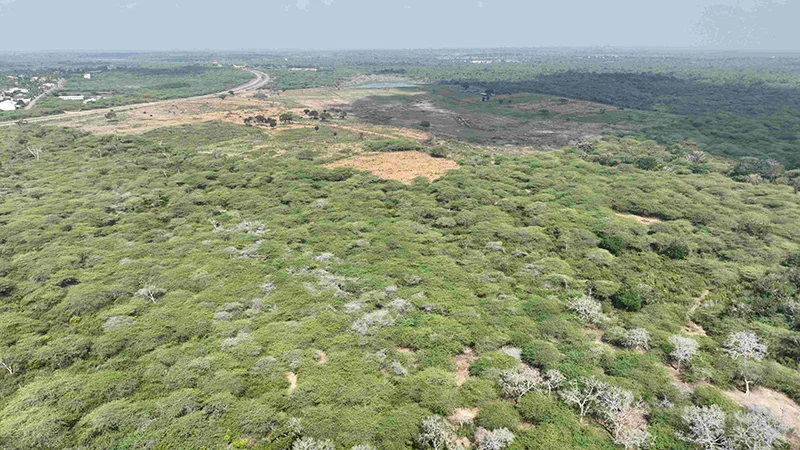
He also recommended that solar projects be located on degraded or abandoned lands, such as areas affected by past mining or other low-value lands, rather than forests or productive agricultural areas.
“Renewable energy development must be done in a way that does not destroy the environment. There are better options available if there is proper planning,” he said.
Chamikara urged the Central Environmental Authority and the Department of Wildlife Conservation to take immediate action to stop ongoing land clearing and investigate the projects. He stressed that all activities carried out without proper approval should be halted until legal requirements are met.
He warned that failure to act now would lead to long-term environmental damage that could not be reversed.
“If this continues, we will lose not only forests and wildlife, but also the balance between people and nature that supports rural life. The consequences will be felt for generations,” he said.
The situation in Hambantota is fast emerging as a critical test of whether development goals can be balanced with environmental protection. As pressure grows, the response of authorities in the coming weeks is likely to determine whether the damage can still be contained or whether it will continue to spread unchecked.
By Ifham Nizam

CEYPETCO Fuel prices increased from midnight today (21)

Advisory for Severe Lightning issued for Galle, Matara, Kaluthara and Rathnapura districts

Sri Lanka says it denied US request to land two aircraft at Mattala airport

Eid celebrations dimmed by war and displacement across Middle East

Showers may occur at several places in the Western, Sabaragamuwa, Northwestern and Uva provinces and in Galle, Matara, Kandy and Nuwara-Eliya districts after 1.00 pm.

Iranian strikes on bases used by US caused $800m in damage, new analysis shows

‘Dates have the highest sugar content to fight Coronavirus’

Sunday Island 27 December – Headlines

#SundayIsland 17th December – Headlines

Sunday Island – 28th March

Sunday Island Headlines – 21 March

Sunday Island – 21st February – Headlines
-

 Business6 days ago
Browns EV launches fast-charging BAW E7 Pro at Rs. 5.8 million
-

 Life style7 days ago
From culture to empowerment: Indonesia’s vision for Sri Lanka
-

 News4 days ago
CIABOC questions Ex-President GR on house for CJ’s maid
-

 Life style7 days ago
Ranjith Fernando celebrates cricketing journey with Hob Nails to Spikes
-

 News5 days ago
Sri Lankan marine scientist Asha de Vos honoured at UNGA opening
-

 Features6 days ago
Achievements of the Hunduwa!
-

 Latest News7 days ago
QR code system will be implemented for fuel with effect from 06.00 a.m. today (15th)
-

 News5 days ago
Australian HC debunks misleading travel risk claims for Sri Lanka