
Features
Maldives – Nation of 1.190 islands

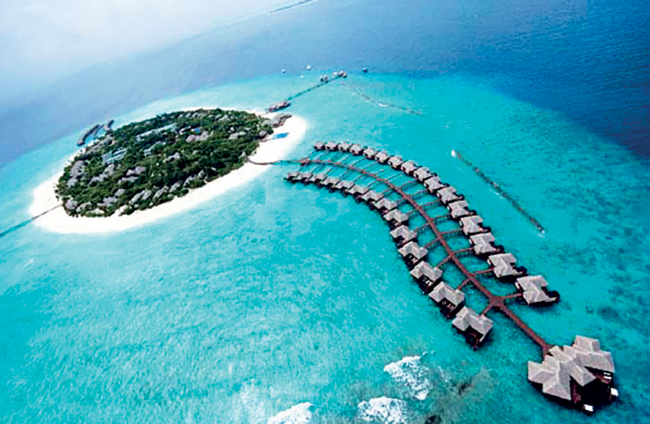
by ACB Pethiyagoda
(This article was written after a visit to the Maldives in the early nineties)
The beauty and splendor of these islands have been written of during the past several centuries by well known travellers. Marco Polo described them as “Flowers of the Indies”, Ibin Batuta said these were ‘One of the Wonders of the World,” Fah Hsien, the Chinese, Papas of Alexandria, Scholastics of Thebes and H.C.P. Bell of the Ceylon Civil Services are other notables who have written about this archipelagic nation.
It was Ibn Batuta, the Moroccan traveller, who remained in the Maldives for only about 18 months and lost no time in marrying four noble women of the Court of Kadihah, daughter of Sultan Ahbendjaly whose husband was her Chief Vizar. Unfortunately for Batuta, who having won the confidence of some members of the Royal family and having been offered the post of Kazi, was compelled to flee the country (with or without his wives it is not known) in about 1345 due to the apparent jealousy of the Chief Vizar who was himself the second husband of the lady Sultan Kadihah.
H.C.P. Bell, the first Commissioner of Archaeology of the Government of Ceylon, in Sessional Papers of 1881 which were laid before the Legislative Council of Ceylon wrote that the “Early history of these islands is buried in obscurity — the natural result of their complete isolation and comparative insignificance. Indeed, except for scant glimpses afforded by the accounts of a few causal travellers, whom accident has taken them there from time to time, the world in the later half of the 19th century knows little or nothing of the whole or part of the history of the Maldives.

“The Maldivians themselves possess no known historical records of any antiquity and would seem to be utterly ignorant of their antecedents beyond such vague and unreliable shreds of information as may have been handed down by traditions.” That is quite a mouthful, but it was Bell’s usual style.
From the earliest of times, trading contacts with the Arabs, Persians, Malaysians, Indians, Indonesians, Sinhalese and with even some African countries have certainly left their influence on the people and culture of the Maldivians. Their language itself, known as Dhivehi is derived from Sanskrit, with both Arabic and Hindi influence which is unmistakable to linguists.
After the Malabar raiders were got rid of the Maldivians formed a closer association, with strengthened diplomatic representations with Ceylon, a relationship which has existed from as far back as 1645. Thereafter, in 1887 the Maldivians accepted British Suzerainty for the benefit of military protection from them and this arrangement ended in 1965. The British did not station their representative in the islands nor did they interfere in their administration.
It is to the credit of the Maldivians that such a small nation was able to remain independent for so long with several powerful nations around them. This is on account of their farsighted diplomacy and on account of the country not being rich in natural resources except fish, which in those times was not as valuable as it is now because it could not be preserved for transport over long distances.
The period of British Suzerainty covered the years of the Second World War and Gan and Cocoa islands were important British bases with large numbers of Ceylonese serving in them with distinction and a few who were said to have not been amenable to discipline. That however, is another story.
Archaeological findings bear ample evidence of the prevalence and practise of Buddhism in the country prior to 1153 AD. In that year, Shaikh Yusuf ud-din of Tabriz, a pious Saint introduced Islam to the country during the rule of King Komala who changed his name to Mohommed Ibin Abdulla and assumed the Islamic title of Sultan after his conversion to Islam.
Ibn Batuta wrote of this conversion to Islam giving credit to Abdul Barakath Yusuf but that version does not appear to be accepted. It could be that Yusuf accompanied the Saint and remained in the islands to spread the religion. What is important is, historically, socially culturally and since 1153 AD the Maldivians have been true followers of Islam and that there is no other religion practised in the republic.
“Islam is the strength and backbone of Maldivians society permeating as it does the entire educational system….” It is the State Religion but there is, a “delicate blend of tradition and modernity.” Women are not in purdah and have equal opportunities with men in regard to education and employment. Hence, their contribution to the economic and social development of their country is no less than that of the contribution made by their men. They are seen and heard and listened to all over the republic.”
As mentioned earlier the country gained independence in 1965. This was during the tenure of office of the President, Ibrahim Nasir who was the Prime Minister under the titular Sultan. It became a Republic in 1968 with an elected President and a national Assembly. The current President, His Excellency Maumoon Abdul Gayoom assumed office on November 11, 1978, having polled 92.9% of the votes at a referendum. He is a Master of Arts in Islamic Studies from Alazhar University and lectured in Islamic Law and Philosophy at Ahmadu Bello University in Nigeria.
In his own country he held several high positions in Government since 1971 and was his country’s permanent representative at the United Nations in 1976 and 1977. He is a true friend of Sri Lanka and once said “Sri Lanka and the Maldives have embraced warm friendly relations for centuries. Our countries bondage of friendship stretches beyond geographical proximity.” President Gayoom’s administration is committed to an open Government ensuring the observance of the principles of democracy.
The first written Constitution of the Maldives was proclaimed in 1982 but is is said that there is evidence of the system of Government and administration accepting traditional principles of democracy as time honoured customs. The present constitution is that of a sovereign and independent Republic with Islam as its State Religion and Dhivehi as the State Language. However, English is widely used in Government’s administration and in the private sector.
The Maldive islands are on the equator in the Indian Ocean consisting of 26 atoll formations, the word atoll being derived from the word `atholu’ in Dhevehi. These atolls are groups of islands of varying numbers in each, all making a total of 1,190 islands. Of these, only 199 are inhabited and 74 others are set apart exclusively as tourist resorts.
The republic is some 720 km. South West of Sri Lanka and cover a total area of about 90,000 Square km. measuring 820 km. from North to South and 120 km. East to West at the longest and broadest points. The islands which consist of only about 1% of the total area are formed from layers of coral and none are more than six feet above sea level at the highest point. Gan with several garment factories, the longest island was developed by the British when they closed their base in Ceylon in 1956 by mutual agreement with the government of Ceylon which came into power that year. The British left Gan 20 years later leaving a fully developed island with roads and infrastructure which the Maldivians took over and set up industries with foreign investors.
The soils of the islands are poor and are alkaline due to their derivation from coral rock. There are no rivers or springs and all crops are dependent on the rains from the South West Monsoon. Hence the only crops grown are on a ‘chena’ or shifting agriculture basis in some of the inhabited islands and consist of various kinds of millets, tubers such as manioc, chillies, onions, cabbage, beans, brinjals, various gourds etc. and fruits such as watermelon, banana, papaw, mango and lemon. Coconut is an important crop and is found on many of the islands including the resorts.
To the tourist fishing is an important sport as diving. Fishing trips both by day and night are organized for modest fees for a few hours by local motorized Dhonis or baththal the traditional boat, or for very high fees in modern yachts and speed boats with sophisticated gear. The sportsmen and women bring in skipjack, groupers, snappers and other reef fish. Big game fish outside the atoll enclosures consist of marlin, barracuda, yellow fin tuna etc.
There are no indigenous animals but the islands area haven for large numbers and species of seabirds.Conservation of its wealth in its waters is important to the Maldivians. ‘Hence the use of harpoons and catching dolphins, whales, whale shark etc. is strictly prohibited and observed.
The most spectacular floral and fauna are found from just below the surface of the sea to hundreds of feet below. Fish with all the colours of the rainbow in their thousands, corals, crustaceans, turtles etc. and numerous varieties of sea weed make a world of psychedelic colour which defy description. Fishing accounts for about 40% of those in gainful employment with a catch of some 99,000 metric tons in 1993. This was for home consumption, local sale and for export, canned or frozen.
The per capita consumption of fish in the Maldives is about the highest in the world and is about the only form of animal protein consumed by its people. Skipjack is the main catch and upto about 1972, it was the main export product, in the form of Maldive Fish after a process of boiling, salting, smoking and sun drying. The sole buyer of the product was Sri Lanka and on account of our foreign exchange problems and restrictions on imports of all but essentials the Maldivians were forced to find other markets for their foreign exchange earnings from fish. They were thus compelled to freeze or can their exportable fish.
The climate in the Maldives is humid and hot (average 86 degrees Fahrenheit) in spite of the influence of the cool sea breeze. The South West Monsoon from April to November brings about 84 inches of rain while the North – East Monsoon from December to March is a dry period in most years.With little or no resources for significant industrial or agricultural development and to support a growing population with its increasing needs from outside the country, the Maldivians turned to tourism for its foreign exchange earnings.
Hence, from an almost non-existent industry in 1972 with just a handful of tourists 1993 recorded 241,000 arrivals, in 1994 it rose to 279,600 and in 1995 to 300,000 arrivals. The main reasons for this rapid growth is of course on account of ‘the gem like islands depict the rare vision of a tropical paradise. Palm fringed islands with sparkling white beaches, turquoise lagoons, clear warm waters and coral reefs teeming with abundant varieties of marine flora and fauna.” Apart from these, there are no ogling oafs and gawking peddlers of bead chains, cheap clothing or even other wares as in some Sri Lankan sea side holiday resorts.
This makes the Maldives an ideal destination for the holiday maker in search only of, and with no interest other than in tranquillity and peace with sunshine and warm clear waters to laze in. Other reasons for this phenomenal growth is the opening of the Male International Airport in late 1981 to receive wide bodied jets from Colombo, Singapore and Trivandrum; a Cabinet Minister solely in charge of the subject and more than likely the comparatively slower growth of the industry in Sri Lanka since about 1978. About 85% of the visitors are from Western Europe with West Germany and Italy forming the majority and with smaller numbers from France, Sweden etc.
A typical visit to the Maldives is one in which the visitor arrives at Hulule Airport and goes through immigration with little bother except that the odd official may want to know, particularly from dark skinned people, whether they have a minimum of US$ 25 for each day of stay. The Customs check is quick if one does not carry alcohol or firearms both of which are strictly taboo. After awhile, the Tour Guide with whose Company one has booked escorts him to a Dhoni many of which are now powered by 15 or 20 HP Honda or Yamaha diesel engines.
The journey starts with leaping from one Dhoni to another (if his particular boat is some distance away) with plenty of willing hands to ensure that he does not end up squashed between two boats in the lapping waters below!
Ziaraarafushi in Kaafu Atoll the destination in this case is two and half hour journey with the first hour or so on the open top deck on foam rubber cushions admiring the beauty of the changing colours of the waters from clear light blue to shades of green and finally to deep blue as the depth of the water increases. Fish, corals and other islands and their beaches in the distance add to the beauty of the view. Retirement to the enclosed lower deck becomes necessary as the sea gets rough and waves hit the upper deck. It is hot and humid down there and exhaust fumes from the engine somehow find their way adding to the discomfort.
The Captain of the boat has three helpers who once the going is steady hasten to the lower deck and promptly fall fast asleep on the cushioned benches. Fishing is second nature to the Maldivians hence on these trips too they throw a few lines and haul a skipjack or two every now and then; a bonus payment or a bigger fish curry for dinner!
The Captain stands with his back to the starpole and guides the boat with his bare foot or even his shoulder blades without the aid of a compass, and in total dependence on his experienced eye, never flinching even when accepting one of the many lighted cigarettes his assistants, when they are awake, pass on to him throughout the journey.
Ziaraarafushi is one of the 74 resort islands, leased to foreign developers and has some one hundred chalets. Visitors are met at the jetty by the staff with wheel barrows marked ‘Luggage’ in bold red letters. The complex consists of the single and double room chalets, large dining hall, a reception area with a shop displaying beach wear, toiletries, handicrafts made from bones of large fish, picture post cards etc.; the main indoor recreational area is a large hall with the bar at one end. Liquor is expensive, a can of beer is sold at US$ 3.5 to 4 with a peg of Sri Lankan Gin selling at about the same price. In these circumstances, the price of Scotch is prohibitive.

Floors of all common areas are sand covered with half walls all round. Roofs are covered with woven coconut palm fronds with wire mesh spread over as a protection against strong winds. The chalets have cement floors which are sometimes covered with linoleum and consist of a shower and toilet and sit-out. The furniture and linen are simple and adequate but the charges are about double or a little more for more comfortable accommodation and very much better food at Sri Lankan three or four star hotels in the coast.
The food is simple, consisting of baked or boiled fish with cabbage, beans, tomatoes and cucumber for both main meals and an egg with limited quantities toast for breakfast. The meals are bland and monotonous and the food served to the staff is more appetising to the Sri Lankan pallet as it consists of rice and hot fish curry with grated coconut. Talking about food, an European woman said “As long as I don’t have to cook and wash I don’t care as the sun, sea and sand are there for my annual holiday.” Perhaps she speaks for large numbers of the tourists who come to the Maldives. There are, however, some resorts which boast of several coffee shops and restaurants in each offering varied and excellent cuisine at relatively higher prices.
There are no Maldivians permanently resident on Ziaraarafushi just as in all the other resort islands as the Government wishes to preserve the culture of its people uninfluenced by foreign habits and customs. Likewise inhabited islands have no hotels and visits to them by tourists are allowed only with guides for a few hours in the day in what is described as ‘proper attire’. This is a most laudable practice.
The staff at all levels consist mostly of Sri Lankans, Indians and Pakistanis and they like the visitors are birds of passage leaving the unspoilt Maldivians to their traditions and religion uninterfered with.Those resorts in the islands, hotels and guest houses in Male, had a bed strength of just under 10,000 in 1993 with about 65% utilization bringing the Government about three fifths of its ‘visible export receipts.”
To service the tourists and the local population with their requirements of internal transport by sea, there were 1,434 mechanised Dhonis, a few luxury yachts and 313 trolling vessels in 1993. A mere 15 sailing Dhonis and 22 rowing boats were available mostly for pleasure rides.Male, the capital and Seat of Government and main commercial centre is entirely different from the resort islands “for, if the islands depend on Male for all their trading and administration, Male depends on the islands for its livelihood.” It is busy town with Government Offices, Schools, Shops of all grades and sizes, Hospitals and residences of all the important officials and the not so important with a population of around 60,000 out of a total of just over 238,000 in the Republic in 1993.
In that year, Male, Hulule and Gan had most of the 5,330 bicycles, 3,466 motor cycles and 454 cars, vans and trucks. The authorized vehicles, more often than not are driven on low gear most of the time due to the crowded and narrow roads.The President’s residence or Mulee Aage, the Grand Friday Mosque which can accommodate 5,000 worshipers at a time, National Museum in the Sultan Park, marine drive, docks and fish markets are important land marks in clean, tidy and bustling Male.



A positive feature of the government that is emerging is its responsiveness to public opinion. The manner in which it has been responding to the furore over the Grade 6 English Reader, in which a weblink to a gay dating site was inserted, has been constructive. Government leaders have taken pains to explain the mishap and reassure everyone concerned that it was not meant to be there and would be removed. They have been meeting religious prelates, educationists and community leaders. In a context where public trust in institutions has been badly eroded over many years, such responsiveness matters. It signals that the government sees itself as accountable to society, including to parents, teachers, and those concerned about the values transmitted through the school system.
This incident also appears to have strengthened unity within the government. The attempt by some opposition politicians and gender misogynists to pin responsibility for this lapse on Prime Minister Dr Harini Amarasuriya, who is also the Minister of Education, has prompted other senior members of the government to come to her defence. This is contrary to speculation that the powerful JVP component of the government is unhappy with the prime minister. More importantly, it demonstrates an understanding within the government that individual ministers should not be scapegoated for systemic shortcomings. Effective governance depends on collective responsibility and solidarity within the leadership, especially during moments of public controversy.
The continuing important role of the prime minister in the government is evident in her meetings with international dignitaries and also in addressing the general public. Last week she chaired the inaugural meeting of the Presidential Task Force to Rebuild Sri Lanka in the aftermath of Cyclone Ditwah. The composition of the task force once again reflects the responsiveness of the government to public opinion. Unlike previous mechanisms set up by governments, which were either all male or without ethnic minority representation, this one includes both, and also includes civil society representation. Decision-making bodies in which there is diversity are more likely to command public legitimacy.
Task Force
The Presidential Task Force to Rebuild Sri Lanka overlooks eight committees to manage different aspects of the recovery, each headed by a sector minister. These committees will focus on Needs Assessment, Restoration of Public Infrastructure, Housing, Local Economies and Livelihoods, Social Infrastructure, Finance and Funding, Data and Information Systems, and Public Communication. This structure appears comprehensive and well designed. However, experience from post-disaster reconstruction in countries such as Indonesia and Sri Lanka after the 2004 tsunami suggests that institutional design alone does not guarantee success. What matters equally is how far these committees engage with those on the ground and remain open to feedback that may complicate, slow down, or even challenge initial plans.
An option that the task force might wish to consider is to develop a linkage with civil society groups with expertise in the areas that the task force is expected to work. The CSO Collective for Emergency Relief has set up several committees that could be linked to the committees supervised by the task force. Such linkages would not weaken the government’s authority but strengthen it by grounding policy in lived realities. Recent findings emphasise the idea of “co-production”, where state and society jointly shape solutions in which sustainable outcomes often emerge when communities are treated not as passive beneficiaries but as partners in problem-solving.
Cyclone Ditwah destroyed more than physical infrastructure. It also destroyed communities. Some were swallowed by landslides and floods, while many others will need to be moved from their homes as they live in areas vulnerable to future disasters. The trauma of displacement is not merely material but social and psychological. Moving communities to new locations requires careful planning. It is not simply a matter of providing people with houses. They need to be relocated to locations and in a manner that permits communities to live together and to have livelihoods. This will require consultation with those who are displaced. Post-disaster evaluations have acknowledged that relocation schemes imposed without community consent often fail, leading to abandonment of new settlements or the emergence of new forms of marginalisation. Even today, abandoned tsunami housing is to be seen in various places that were affected by the 2004 tsunami.
Malaiyaha Tamils
The large-scale reconstruction that needs to take place in parts of the country most severely affected by Cyclone Ditwah also brings an opportunity to deal with the special problems of the Malaiyaha Tamil population. These are people of recent Indian origin who were unjustly treated at the time of Independence and denied rights of citizenship such as land ownership and the vote. This has been a festering problem and a blot on the conscience of the country. The need to resettle people living in those parts of the hill country which are vulnerable to landslides is an opportunity to do justice by the Malaiyaha Tamil community. Technocratic solutions such as high-rise apartments or English-style townhouses that have or are being contemplated may be cost-effective, but may also be culturally inappropriate and socially disruptive. The task is not simply to build houses but to rebuild communities.
The resettlement of people who have lost their homes and communities requires consultation with them. In the same manner, the education reform programme, of which the textbook controversy is only a small part, too needs to be discussed with concerned stakeholders including school teachers and university faculty. Opening up for discussion does not mean giving up one’s own position or values. Rather, it means recognising that better solutions emerge when different perspectives are heard and negotiated. Consultation takes time and can be frustrating, particularly in contexts of crisis where pressure for quick results is intense. However, solutions developed with stakeholder participation are more resilient and less costly in the long run.
Rebuilding after Cyclone Ditwah, addressing historical injustices faced by the Malaiyaha Tamil community, advancing education reform, changing the electoral system to hold provincial elections without further delay and other challenges facing the government, including national reconciliation, all require dialogue across differences and patience with disagreement. Opening up for discussion is not to give up on one’s own position or values, but to listen, to learn, and to arrive at solutions that have wider acceptance. Consultation needs to be treated as an investment in sustainability and legitimacy and not as an obstacle to rapid decisionmaking. Addressing the problems together, especially engagement with affected parties and those who work with them, offers the best chance of rebuilding not only physical infrastructure but also trust between the government and people in the year ahead.
by Jehan Perera

 When the government appointed a committee, led by Rienzie Arsekularatne, Senior President’s Counsel, to draft a new law to replace the Prevention of Terrorism Act (PTA), as promised by the ruling NPP, the writer, in an article published in this journal in July 2025, expressed optimism that, given Arsekularatne’s experience in criminal justice, he would be able to address issues from the perspectives of the State, criminal justice, human rights, suspects, accused, activists, and victims. The draft Protection of the State from Terrorism Act (PSTA), produced by the Committee, has been sharply criticised by individuals and organisations who expected a better outcome that aligns with modern criminal justice and human rights principles.
This article is limited to a discussion of the definition of terrorism. As the writer explained previously, the dangers of an overly broad definition go beyond conviction and increased punishment. Special laws on terrorism allow deviations from standard laws in areas such as preventive detention, arrest, administrative detention, restrictions on judicial decisions regarding bail, lengthy pre-trial detention, the use of confessions, superadded punishments, such as confiscation of property and cancellation of professional licences, banning organisations, and restrictions on publications, among others. The misuse of such laws is not uncommon. Drastic legislation, such as the PTA and emergency regulations, although intended to be used to curb intense violence and deal with emergencies, has been exploited to suppress political opposition.
International Standards
The writer’s basic premise is that, for an act to come within the definition of terrorism, it must either involve “terror” or a “state of intense or overwhelming fear” or be committed to achieve an objective of an individual or organisation that uses “terror” or a “state of intense or overwhelming fear” to realise its aims. The UN General Assembly has accepted that the threshold for a possible general offence of terrorism is the provocation of “a state of terror” (Resolution 60/43). The Parliamentary Assembly of the Council of Europe has taken a similar view, using the phrase “to create a climate of terror.”
In his 2023 report on the implementation of the UN Global Counter-Terrorism Strategy, the Secretary-General warned that vague and overly broad definitions of terrorism in domestic law, often lacking adequate safeguards, violate the principle of legality under international human rights law. He noted that such laws lead to heavy-handed, ineffective, and counterproductive counter-terrorism practices and are frequently misused to target civil society actors and human rights defenders by labelling them as terrorists to obstruct their work.
The United Nations Office on Drugs and Crime (UNODC) has stressed in its Handbook on Criminal Justice Responses to Terrorism that definitions of terrorist acts must use precise and unambiguous language, narrowly define punishable conduct and clearly distinguish it from non-punishable behaviour or offences subject to other penalties. The handbook was developed over several months by a team of international experts, including the writer, and was finalised at a workshop in Vienna.
Anti-Terrorism Bill, 2023
A five-member Bench of the Supreme Court that examined the Anti-Terrorism Bill, 2023, agreed with the petitioners that the definition of terrorism in the Bill was too broad and infringed Article 12(1) of the Constitution, and recommended that an exemption (“carve out”) similar to that used in New Zealand under which “the fact that a person engages in any protest, advocacy, or dissent, or engages in any strike, lockout, or other industrial action, is not, by itself, a sufficient basis for inferring that the person” committed the wrongful acts that would otherwise constitute terrorism.
While recognising the Court’s finding that the definition was too broad, the writer argued, in his previous article, that the political, administrative, and law enforcement cultures of the country concerned are crucial factors to consider. Countries such as New Zealand are well ahead of developing nations, where the risk of misuse is higher, and, therefore, definitions should be narrower, with broader and more precise exemptions. How such a “carve out” would play out in practice is uncertain.
In the Supreme Court, it was submitted that for an act to constitute an offence, under a special law on terrorism, there must be terror unleashed in the commission of the act, or it must be carried out in pursuance of the object of an organisation that uses terror to achieve its objectives. In general, only acts that aim at creating “terror” or a “state of intense or overwhelming fear” should come under the definition of terrorism. There can be terrorism-related acts without violence, for example, when a member of an extremist organisation remotely sabotages an electronic, automated or computerised system in pursuance of the organisation’s goal. But when the same act is committed by, say, a whizz-kid without such a connection, that would be illegal and should be punished, but not under a special law on terrorism. In its determination of the Bill, the Court did not address this submission.
PSTA Proposal
Proposed section 3(1) of the PSTA reads:
Any person who, intentionally or knowingly, commits any act which causes a consequence specified in subsection (2), for the purpose of-
(a) provoking a state of terror;
(b) intimidating the public or any section of the public;
(c) compelling the Government of Sri Lanka, or any other Government, or an international organisation, to do or to abstain from doing any act; or
(d) propagating war, or violating territorial integrity or infringing the sovereignty of Sri Lanka or any other sovereign country, commits the offence of terrorism.
The consequences listed in sub-section (2) include: death; hurt; hostage-taking; abduction or kidnapping; serious damage to any place of public use, any public property, any public or private transportation system or any infrastructure facility or environment; robbery, extortion or theft of public or private property; serious risk to the health and safety of the public or a section of the public; serious obstruction or damage to, or interference with, any electronic or automated or computerised system or network or cyber environment of domains assigned to, or websites registered with such domains assigned to Sri Lanka; destruction of, or serious damage to, religious or cultural property; serious obstruction or damage to, or interference with any electronic, analogue, digital or other wire-linked or wireless transmission system, including signal transmission and any other frequency-based transmission system; without lawful authority, importing, exporting, manufacturing, collecting, obtaining, supplying, trafficking, possessing or using firearms, offensive weapons, ammunition, explosives, articles or things used in the manufacture of explosives or combustible or corrosive substances and biological, chemical, electric, electronic or nuclear weapons, other nuclear explosive devices, nuclear material, radioactive substances, or radiation-emitting devices.
Under section 3(5), “any person who commits an act which constitutes an offence under the nine international treaties on terrorism, ratified by Sri Lanka, also commits the offence of terrorism.” No one would contest that.
The New Zealand “carve-out” is found in sub-section (4): “The fact that a person engages in any protest, advocacy or dissent or engages in any strike, lockout or other industrial action, is not by itself a sufficient basis for inferring that such person (a) commits or attempts, abets, conspires, or prepares to commit the act with the intention or knowledge specified in subsection (1); or (b) is intending to cause or knowingly causes an outcome specified in subsection (2).”
While the Arsekularatne Committee has proposed, including the New Zealand “carve out”, it has ignored a crucial qualification in section 5(2) of that country’s Terrorism Suppression Act, that for an act to be considered a terrorist act, it must be carried out for one or more purposes that are or include advancing “an ideological, political, or religious cause”, with the intention of either intimidating a population or coercing or forcing a government or an international organisation to do or abstain from doing any act.
When the Committee was appointed, the Human Rights Commission of Sri Lanka opined that any new offence with respect to “terrorism” should contain a specific and narrow definition of terrorism, such as the following: “Any person who by the use of force or violence unlawfully targets the civilian population or a segment of the civilian population with the intent to spread fear among such population or segment thereof in furtherance of a political, ideological, or religious cause commits the offence of terrorism”.
The writer submits that, rather than bringing in the requirement of “a political, ideological, or religious cause”, it would be prudent to qualify proposed section 3(1) by the requirement that only acts that aim at creating “terror” or a “state of intense or overwhelming fear” or are carried out to achieve a goal of an individual or organisation that employs “terror” or a “state of intense or overwhelming fear” to attain its objectives should come under the definition of terrorism. Such a threshold is recognised internationally; no “carve out” is then needed, and the concerns of the Human Rights Commission would also be addressed.
by Dr. Jayampathy Wickramaratne
President’s Counsel

 We generally have in our midst the famous JAYASRI twins, Rohitha and Rohan, who are based in Austria but make it a point to entertain their fans in Sri Lanka on a regular basis.
Well, rock and reggae fans get ready for a major happening on 28th February (Oops, a special day where I’m concerned!) as the much-awaited ROCK meets REGGAE event booms into action at the Nelum Pokuna outdoor theatre.
It was seven years ago, in 2019, that the last ROCK meets REGGAE concert was held in Colombo, and then the Covid scene cropped up.

Chitral Somapala with BLACK MAJESTY
This year’s event will feature our rock star Chitral Somapala with the Australian Rock+Metal band BLACK MAJESTY, and the reggae twins Rohitha and Rohan Jayalath with the original JAYASRI – the full band, with seven members from Vienna, Austria.
According to Rohitha, the JAYASRI outfit is enthusiastically looking forward to entertaining music lovers here with their brand of music.
Their playlist for 28th February will consist of the songs they do at festivals in Europe, as well as originals, and also English and Sinhala hits, and selected covers.
Says Rohitha: “We have put up a great team, here in Sri Lanka, to give this event an international setting and maintain high standards, and this will be a great experience for our Sri Lankan music lovers … not only for Rock and Reggae fans. Yes, there will be some opening acts, and many surprises, as well.”

Rohitha, Chitral and Rohan: Big scene at ROCK meets REGGAE
Rohitha and Rohan also conveyed their love and festive blessings to everyone in Sri Lanka, stating “This Christmas was different as our country faced a catastrophic situation and, indeed, it’s a great time to help and share the real love of Jesus Christ by helping the poor, the needy and the homeless people. Let’s RISE UP as a great nation in 2026.”

Showers in the Northern, North-central, Uva, Western, Eastern, Sabaragamuwa, North-western and Central provinces and Galle and Matara districts

Govt. extends ban on LTTE

Police obtain court order banning Wimal’s protest

Chinese Foreign Minister Wang Yi expresses optimism that Sri Lanka is on the right path to progres

India plans to restore northern regular train services to pre-Ditwah frequencies before traditional New Year 2026

Inauguration of first Bailey Bridge under Indian assistance package for post-Ditwah reconstruction

‘Dates have the highest sugar content to fight Coronavirus’

Sunday Island 27 December – Headlines

#SundayIsland 17th December – Headlines

Sunday Island – 28th March

Sunday Island Headlines – 21 March

Sunday Island – 21st February – Headlines
-
 News2 days ago
Sajith: Ashoka Chakra replaces Dharmachakra in Buddhism textbook
-

 Business2 days ago
Dialog and UnionPay International Join Forces to Elevate Sri Lanka’s Digital Payment Landscape
-

 Features2 days ago
The Paradox of Trump Power: Contested Authoritarian at Home, Uncontested Bully Abroad
-

 Features2 days ago
Subject:Whatever happened to (my) three million dollars?
-

 News2 days ago
Level I landslide early warnings issued to the Districts of Badulla, Kandy, Matale and Nuwara-Eliya extended
-

 News2 days ago
National Communication Programme for Child Health Promotion (SBCC) has been launched. – PM
-

 News2 days ago
65 withdrawn cases re-filed by Govt, PM tells Parliament
-

 Opinion4 days ago
The minstrel monk and Rafiki, the old mandrill in The Lion King – II