
Sports
Mahindananda’s faux pas


by Rex Clementine
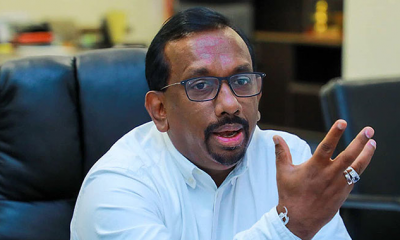
Senior politician Mahindananda Aluthgamage has told parliament how good our cricket was at the time he was the Sports Minister. Aluthgamage was Sports Minister ten years ago and let us go back in years to find out whether it was a rosy period as he mentions.
The MP says that Sri Lanka during his tenure as Sports Minister were ranked number one in T-20s, number two in ODIs and third in Tests. His crooked policies and his buddies running cricket at that time were one main reason why the national cricket team could not go onto achieve the number one rank in other formats as well.
One of the first things that Mahindananda did after assuming office as Minister of Sports was to pack the Cricket Board with his Royal College buddies.
The International cricket ground that was constructed at Hambantota under his watch not only became a white elephant, but SLC was bankrupt given the colossal amount of expenses in building the new stadium. With SLC insolvent and unable to pay Ports Authority and State Engineering Corporation that constructed the stadium, the government was left with Hobson’s Choice and the debts were written off costing the treasury billions and the taxpayer an arm and a leg.
Worse, players, coaches and board employees had to forgo salaries for months for the board was left penniless by Mahindananda’s friends who were running cricket.
There were also allegations of mass corruption during construction of the grounds and there was a police investigation. But mysteriously the computer disks that contained sensitive information went missing overnight.
Although Aluthgamage is harping on the need for the democratic process being followed in cricket governance, let us remind him that during his tenure, Interim Committees ran the affairs at the cricket board. Even when elections were conducted, they were very much staged dramas with individuals capable of winning elections being not allowed to contest. Leave alone SLC elections, Aluthgamage and his clan didn’t even spare club elections at that time. The AGM of Colts Cricket Club is a case in point.
The players were given a torrid time during Mahindananda’s time. Kumar Sangakkara’s Cowdrey Lecture at Lord’s that earned him a standing ovation was hailed by all and sundry, but our Sports Minister wanted the player probed.
Mitchell Johnson had left Sanga with a broken arm during the Boxing Day Test of 2012. A man who gives extreme importance for preparation, Sanga before his comeback against Bangladesh at home wanted to play a warm-up game. World’s number one ranked batsman was told to drive all the way to Matara for the game and upon reaching Uyanwatta Stadium was told that he was ineligible to play the game for he had not signed national contracts. Small minds at big places.
Mahindananda also has claimed that he introduced anti-doping regulations during his tenure as Sports Minister. Let him be reminded that during the same time, national cricketers were encouraged to visit Dr. Eliantha White, a controversial figure, for medication for ailments. The end result was poor Upul Tharanga being handed a suspension by ICC for using a banned substance.
Time to time Mahindananda by claiming that the 2011 World Cup final was fixed has brought disrepute to the game and our brilliant ambassadors. The 2011 World Cup final was a bitter pill to swallow, but no way that you can claim that there was foul play. Dropped catches are part and parcel of the game and Royal College needs to educate their future politicians about the glorious uncertainties of the game of cricket. We do not need anymore Mahindanandas bringing discredit to the game.
Following Mahindananda’s latest claims about match fixing the ICC issued a statement giving the 2011 World Cup final a clean bill of health. According to legislation passed in Parliament in 2019, making false corruption allegations in sports is a punishable offence and it must be probed whether Mahindananda has committed an offence.
The national cricket team achieved the unimaginable by beating South Africa in Durban in the Boxing Day Test match in 2011. Three weeks later, much to everyone’s dismay, Head Coach Geoff Marsh, captain T.M. Dilshan, Chairman of Selectors Duleep Mendis and Team Manager Anura Tennakoon were all unceremoniously sacked. Dilshan, Tennakoon and Mendis took the blow on the chin and moved on. But Marsh, the tough nosed Aussie, didn’t suffer fools gladly. He sued the board for improper termination of contract.
To this date, it has been a well-kept secret how much it cost SLC for wrongful termination of the coach’s contract. There should be another Parliament probe to find this out!
Moreover, it needs to be found out whether there was any deal to sack Dilshan and co even before the team left for South Africa that December? Did some big shots meet up at Perera Gardens in a bid to take the captaincy of the national cricket team back to the unofficial headquarters of the game? Was there a coup; a bloodless coup?











West Indies spinners set up a third straight victory as they strangled Sri Lanka’s batters before Stefanie Taylor steadied a nervy chase to see them home by five wickets in Bristol. The result brings the West Indies joint-top of Group 2 with England – only trailing on net run rate – while Sri Lanka’s hopes of progression took a bashing.
Hayley Matthews was central to West Indies’ effort, arguably setting up the win inside the opening powerplay. Having put Sri Lanka into bat, the West Indies reduced them to 24 for 4 inside the powerplay, a position from which Sri Lanka never truly recovered. Mathews picked up innings best figures of 3 for 15.
Then with the bat, Matthews did her part in a 28-run opening stand with Deandra Dottin, and while Sri Lanka plugged away with wickets through the middle overs, a combination of poor catching, excess extras and Taylor’s stewardship ensured West Indies’ chase was never truly under threat.
Even on a surface where batting isn’t the easiest, any opportunities need to be grabbed when defending a sub-par total – which is precisely what Sri Lanka had managed having been bowled out for 98.
Sri Lanka however struggled to capitalise on the opportunities afforded to them, while simultaneously gifting too many free runs. Twenty-three extras were given away across the innings, with 13 of those coming in wides.
Moreover Sri Lanka dropped three catches across the innings – two of them coming shortly after the fall of a wicket; momentum is everything in a low-scoring game, and Sri Lanka were guilty of giving it up too easily. There were also a handful of close run-out chances that went begging.
It meant that West Indies, who had looked uneasy across their chase, were not punished for their mistakes – which in itself was a result of mistakes induced by the pressure created by the Sri Lankan bowlers and fielders outside of their costly errors.
Having someone with the experience of Taylor in the middle order would be a boon for most any side, and she showed her value once again on Sunday. After a solid opening stand, West Indies had slipped from 2 for 36 to 5 for 70. Another couple of wickets and those remaining 29 runs might have felt closer to 50.
However Taylor offered just the calmness required in such a situation, content to deftly rotate the strike and ensure there were no further hiccups. Her six off a free hit was the only six of the game, but highlighted her ability to capitalise on the situation at hand. Fittingly she struck the winning runs – tellingly, dropped at midwicket.
Sri Lanka average barely over 6 an over against spin since the end of the last T20 World Cup, and West Indies were well-suited to exploit that potential weakness with a team stacked with spin options.
First on that list was skipper Matthews, who opened the bowling and struck three times in a three-over spell inside the powerplay. On a surface that was tacky, she cleverly didn’t attempt to do too much, simply keeping her lines and lengths tidy.
In a period that crippled the Lankan innings before it had even truly begun, Vishmi Gunaratne offered up a leading edge – one spectacularly plucked out of the sky by Matthews – before Chamari Athapaththu went far too early on a pull as she saw her left bail dislodged. Harshitha Samarawickrama meanwhile was done in by some extra bounce, which meant she struggled to keep down a cut straight to point.
When Chinelle Henry had Imesha Dulani caught at mid-on, Sri Lanka had lost their fourth wicket inside the powerplay with just 24 runs on the board.
Ashmini Munisar – drafted into XI to add even more spin options – and Karishma Ramharack picked up three wickets between them as well, as Sri Lanka lost seven of their 10 wickets to spin, eventually being bowled out for 98 with two balls to spare.
With the top and middle order offering little by way of impetus, a rescue job for the ages was needed and Nilakshika de Silva set about her task.
Her 30 off 26 came largely came across two stands of 34 and 23 with Kavisha Dilhari and Kawya Kavindi. Those were two of just three double-digit partnerships across the Sri Lankan innings, as Sri Lanka’s innings stuttered into gear.
But once Nilakshika fell, looking to take on the fielder at deep square leg, the innings once more ground to a halt. Sri Lanka managed 60 for 3 in the middle overs, but without Nilakshika the death overs fetched just 15, as West Indies’ spinners solidified their hold on the game.
SCORES:
West Indies women 99 for 5 in 16.1 overs (Hayley Matthews 17, Deandra Dottin 12, Stefanie Taylor 27*, Jannillea Glasgow 10*; Nimasha Meepage 1-18, Kavisha Dilhari 2-22, Chamari Athapaththu 1-13) beat Sri Lanka women 98 in 19.4 overs (Imesha Dulani 17, Kavisha Dilhari 21, Nilakshika Silva 30, Kavya Kavindi 17; Hayley Matthews 3-15, Chinelle Henry 1-12, Afy Fletcher 1-24, Aaliyah Alleyne 1-15, Ashmini Munisar 1-16, Karishma Ramharack 2-15) by five wickets
[Cricinfo]
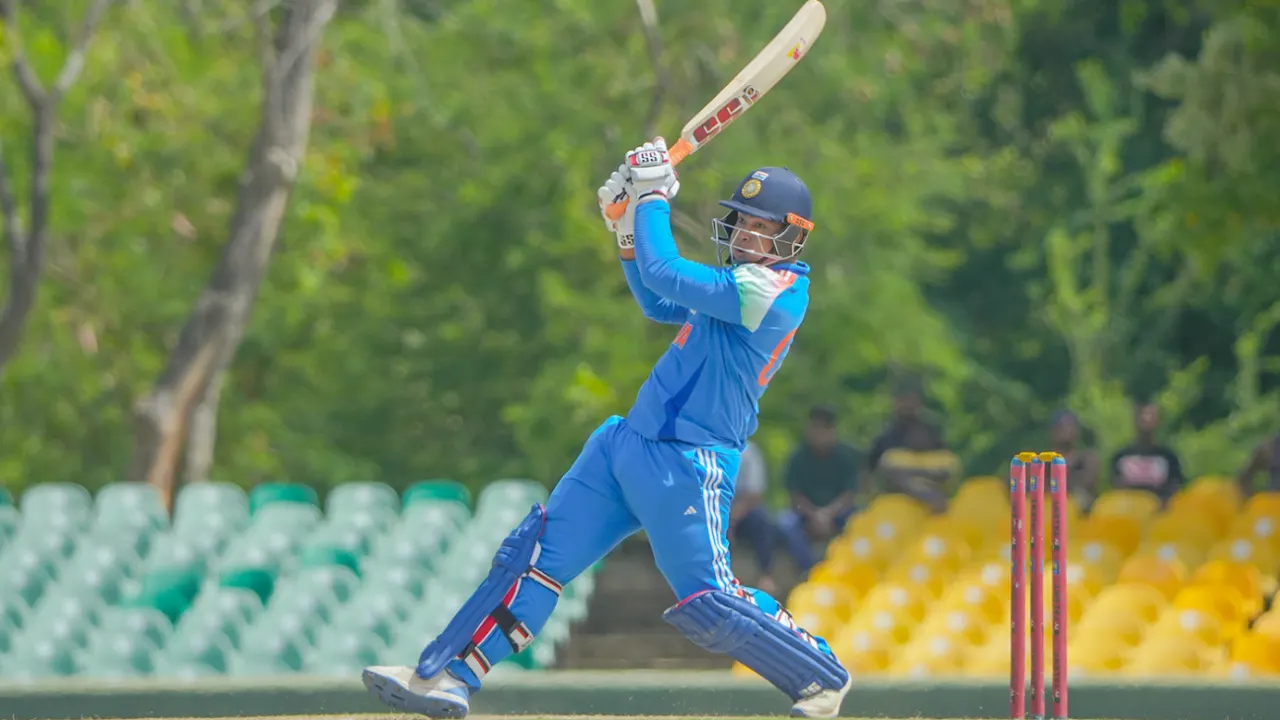
In what may have potentially been his last innings as an uncapped player, Vaibhav Sooryavanshi smashed the fastest List A half-century, off 11 balls, in an innings that eventually ended as an audacious 29-ball 94. That helped India A beat Sri Lanka A by 66 runs in the tri-series final in Dambulla on Sunday.
Sooryavanshi came into the final on the back of four starts that yielded 117 runs. But the focal point of his tour had been his scrap with the Sri Lanka A players at the end of a tense group fixture four days ago. Amid talks of a reprimand and a fine, Sooryavanshi returned to let his bat do all the talking this time.
His turbocharge laid the foundation of an India A innings that stuttered at different times to eventually post 377 for 9, when 400-plus looked well on the cards. That they finished with what they did was largely down to Anukul Roy, who, like Sooryavanshi, also comes from the town of Samastipur.
Roy smashed 39 off just 15 balls, courtesy four sixes, to give the India A innings a late lift after they had slumped to 334 for 8, and were in danger of being bowled out with a few overs to spare. As it turned out, that wasn’t Roy’s only contribution. He also picked up two vital wickets with his left-arm spin, including that of the set Vijaykanth Viyaskanth to break a 77-run seventh-wicket partnership that kept Sri Lanka A’s hopes alive.
However, the wicket of Wanuja Sahan for a 69-ball 62, the highest contribution of Sri Lanka A’s innings, proved to be the clincher, with Sri Lanka A eventually being bowled out for 311 in the 48th over. Roy aside, legspin-bowling allrounder Vipraj Nigam and fast bowler Yash Thakur picked up three wickets each to play their parts in a fine win.
The performance that would be long remembered, though, was Sooryavanshi’s. Before raising his half-century off just 11 deliveries, each of his first five balls was sent to the boundary. Sooryavanshi kept going hard, and had the fastest List A century in sights until he fell to Sahan Arachchige, the offspinner and Sri Lanka A captain, in the ninth over. By then, India A had raced to 132 in just 8.5 overs.
Sooryavanshi smashed an incredible ten fours and eight sixes in his innings, before falling while attempting to hit a ninth six, out caught at mid-off after failing to get the elevation. It was the second time in two games that he was dismissed by Arachchige. In the Super Over fixture against Sri Lanka A, Sooryavanshi had sliced a tossed-up delivery to point as he lost shape. On Sunday, he backed away to clear the infield, buy only managed to find Viyaskanth at mid-off.
Sooryavanshi’s hitting, especially over extra cover on the up – it was reminiscent of the shot he hit off the very first delivery he faced in the IPL last year – was mighty impressive. As was his ability to play on the minds of the bowlers by getting inside the line of short deliveries to pull or help them over the leg-side boundary. The one shot that exhibited Sooryavanshi’s range, and presence of mind, was the ramp over the wicketkeeper off a delivery from Kugathas Mathulan, whose lengths he had struggled to get underneath in a gun Super Over the last time they met.
Here, having seemingly been beaten for pace, Sooryavanshi still managed to lay a neat little deflection. although he had arched back, and was nearly squatting in an effort to initially bail out of the stroke. One ball prior to that, Sooryavanshi had a small crowd guffawing at his ability to scythe a wide yorker over backward point for six.
While Sooryavanshi was at the crease, India scored 35% of their eventual score of 377. After his dismissal, the rest managed just 245 off 41.1 overs, when it seemed like India A would sail past the 400-run mark. Through the middle overs, Tilak Varma and Ruturaj Gaikwad put together an 84-run partnership for the third wicket to consolidate the innings.
Tilak scored 67 but ended up consuming 90 balls. After his dismissal, India A lost three quick wickets and were in danger of being bowled out for under 350. However, Roy’s late fireworks and an entertaining cameo of 27 from Nigam, who had struck his maiden List A fifty in the previous game against the hosts, gave India A a much higher total to defend.
Sri Lanka A’s chase needed one of their top three batters to bat big. Instead, they were all removed by Yash Thakur. Niroshan Dickwella was bowled attempting to back away to flay a length ball over cover, Avishka Fernando was out nicking to slip, and Nuwanidu Fernando flicked a leg-stump half volley to the lone fielder at deep-backward square leg.
Thakur aside, India A debutant Ashok Sharma was mighty impressive with his speeds, even though he got taken apart for runs in his first spell. While speed guns were absent, Ashok repeatedly hustled batters with his pace and late movement. He also dismissed Sadeera Samarawickrama, one of Sri Lanka A’s most accomplished batters, for a 44-ball 52 just when he was beginning to shift gears. From there on, Sri Lanka A kept losing wickets until a late flourish from Sahan kept them alive, only for those hopes to be dashed by India A’s spinners.
SCORES:
India A 377 for 9 in 50 overs (Vaibhav Sooryavanshi 94, Rutraj Gaikwad 40, Tilak Varma 67, Anukul Roy 39; Kugathas Mathulan 2-82, Ravindu Fernando 2-72, Wanuja Sahan 2-39) beat Sri Lanka A 311 (Wanuja Sahan 62, Sadeera Samarawickrama 52, Vijayakanth Viyaskanth 39; Yash Thakur 3-45, Vipraj Nigam 3-60,Anukul Roy 2-42) by 66 runs
[Cricinfo]

Tunisia’s miserable World Cup continued as their inability to progress from the group stage was confirmed by defeat against Japan.
After a tumultuous week in which they suffered a 5-1 defeat by Sweden, sacked Sabri Lamouchi and appointed ex Saudi Arabia boss Herve Renard as head coach, it took less than four minutes for them to go behind in Guadalupe, Mexico.
An impressive Japan, who were well drilled throughout, broke the deadlock with a quick counter-attack which ended in Crystal Palace’s Daichi Kamada prodding home from close range at Monterrey Stadium.
It did not take long for a dominant Japan side to inflict a second blow as Ayase Ueda produced a lovely finish to arrow the ball through the legs of a defender and into the far corner from the edge of the box.
Tunisia looked devoid of ideas for much of the game and gifted Japan ample space, which they used to display their free-flowing possession-based style.
Junya Ito added another when he rolled a simple finish past Tunisia goalkeeper Aymen Dahmen after being threaded through one-on-one.
Ueda wrapped up victory when he tucked a looping header into the far corner.
Japan were constantly a cut above and were never threatened by a Tunisia side who were pedestrian and had every attack easily neutralised.
Japan have four points and are likely at least to progress as one of the best third-placed sides, but they will hope to earn a guaranteed spot in the last 32 when they take on Sweden on Friday in their final group game.
Tunisia play the Netherlands, who are top of the group, at the same time.
[BBC Sports]

US and Iran begin talks on initial peace deal in Switzerland

Matthews, Taylor make it three in three for West Indies

Sooryavanshi thumps fastest List A fifty as India A win tri-series

Tunisia out of World Cup after 0-4 defeat by Japan

Vance arrives in Switzerland for US-Iran talks

FFSL renews National Team Head Coach Abdullah Almutairi under “The Next Chapter” program

‘Dates have the highest sugar content to fight Coronavirus’

Sunday Island 27 December – Headlines

#SundayIsland 17th December – Headlines

Sunday Island – 28th March

Sunday Island Headlines – 21 March

Sunday Island – 21st February – Headlines
-

 News7 days ago
Release of 2025 O/L results likely to be delayed
-

 Sports7 days ago
Tharanga set for high-profile javelin clash in Ostrava
-

 News7 days ago
Theft of USD 2.5 mn from Treasury: CoPF accused of complicity in NPP cover-up
-

 News6 days ago
Beijing Capital Airlines to resume flights to Colombo signalling boost to tourism
-

 Features5 days ago
Killing of Colombo’s ancient trees — a warning on UN’s World Desertification Day – 17 June
-

 Opinion7 days ago
Decoding Trump’s 12.5% “Forced Labor Tariff” on Sri Lanka
-

 News2 days ago
Creditor not yet paid
-

 News3 days ago
Creditor receives USD 2.5 mn as Lankan public bears loss from theft of Treasury funds