
Latest News
Mahedi four-for, Tanzid fifty hands the series to Bangladesh

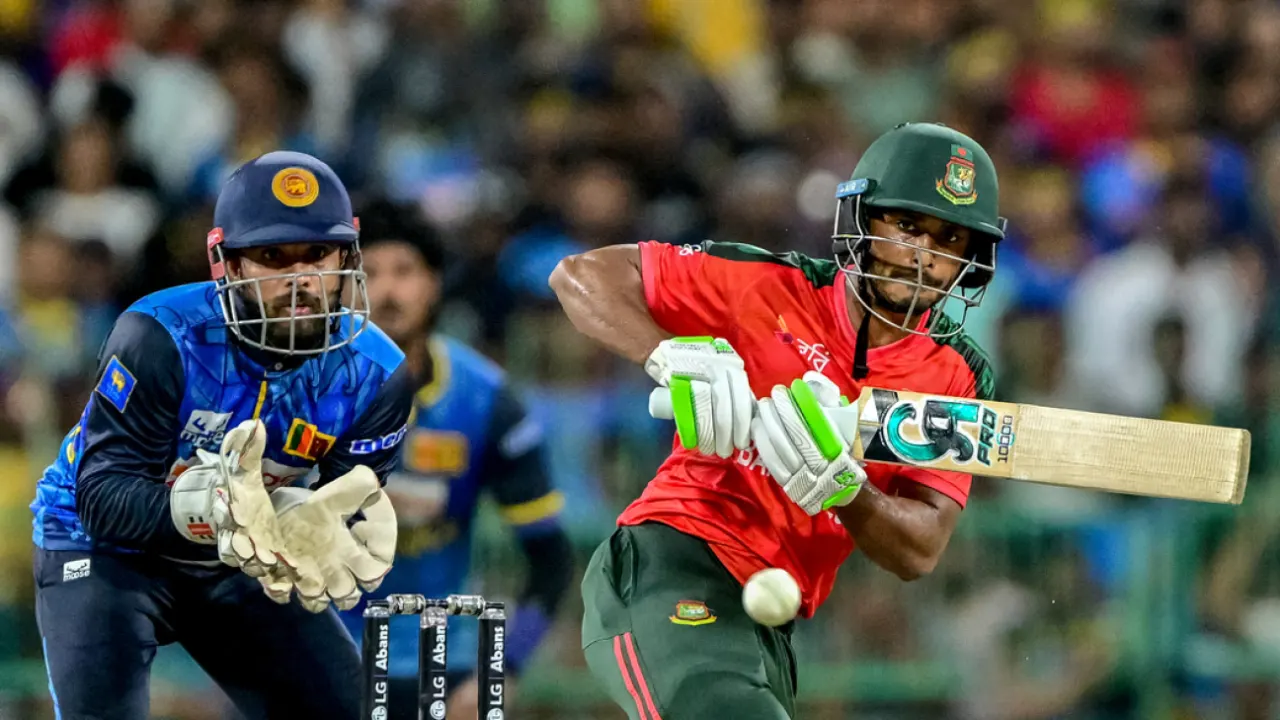
Career-best contributions from Mahedi Hasan and Tanzid Hasan powered Bangladesh to a series-winning eight-wicket win against Sri Lanka . The home side had blown away Bangladesh in the first game in Pallekele, but the visitors fought back in the second game in Dambulla, before this win in Colombo. Bangladesh have previously only once turned around from 1-0 down to win a three-match T20I series, against West Indies seven years ago.
Mahedi took 4 for 11, in a spell that never let Sri Lanka change gears due to constant wickets. This was an apt reward for a bowler who had been out of the side for Bangladesh’s previous four T20Is. By the time his spell was over, Bangladesh were in control, and they seldom looked in trouble thereafter.
Tanzid cracked an unbeaten 47-ball 73, ensuring Bangladesh strolled through their 133-run chase. He struck six sixes, all of them with a bit of class and nonchalance.
Sri Lanka had earlier chosen to bat at the toss – an unusual decision given the lopsided results for sides batting first at the R Premadasa Stadium. After the quick boundaries Pathum Nissanka and Kusal Mendis hit in the match’s first over, captain Charith Asalanka may have thought he had made the right call. As it turned out, by the end of the evening, the home side has lost every time they decided to bat first at this ground in night matches. 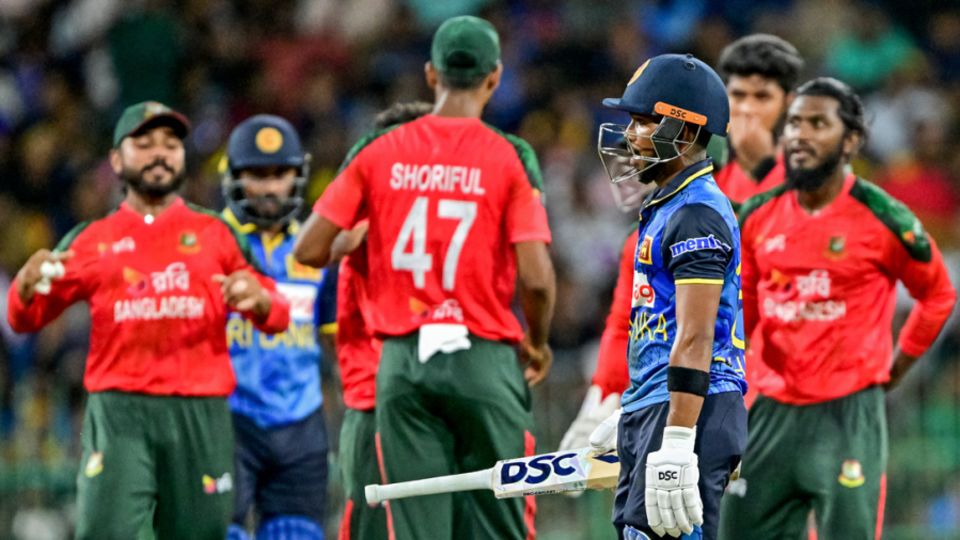
The game began at top speed. Shoriful Islam removed Kusal Mendis in the first over, caught at the deep backward square leg boundary. Mahedi, who had replaced Mehidy Hasan Miraz for this game, jumped into action from the other end. He had Kusal Perera caught at slip for a duck.
Chandimal, returning to the T20I side after more than three years, survived two out of three chances in the space of six balls – Tanzim Hasan Sakib and Mustafizur Rahman dropped catches off his bat. Soon after, Chandimal top-edged Mahedi with a slog and was caught at point.
Sri Lanka captain Charith Asalanka was next to go, on the receiving end of what might have been the ball of the series. Mahedi got the ball to turn just enough to beat Asalanka’s backfoot push, flattening the off-stump.
Nissanka was dismissed for 46, Mahedi completing a simple caught-and-bowled chance to claim his fourth wicket. Sri Lanka were 66 for 5 in the 11th over.
Bangladesh kept picking up Sri Lanka’s wickets through the middle and death overs, but could not dislodge Dasun Shanaka. He unleashed his shots in the last over, taking 22 off Shoriful, who finished with 1 for 50 from his four overs.
Shanaka hammered two fours and two sixes – one of which was hit out of the stadium – as the packed Khettarama crowd finally cleared their collective throats. The big-hitting bumped up Sri Lanka’s total to 132 for 7 in 20 overs, which had looked unlikely for most of an otherwise placid innings.
Nuwan Thushara gave Sri Lanka what they needed to defend 132: a wicket off the first ball. Thusara trapped Parvez Hossain Emon lbw with an in-dipper, which he perhaps telegraphed with his slinging action, but it dipped late on Emon. Litton Das survived another lbw appeal with a review in the next over, but he was constantly looking for boundaries.
Bangladesh’s counterattack came to the fore with Tanzid hitting Maheesh Theekshana over extra cover for the first six. Litton clattered Fernando over square-leg in the next over, before Tanzid launched Asalanka for two straight sixes. Tanzid’s fourth six was a slog against a Jeffrey Vandersay floater.
By the eighth over, Bangladesh had sped to 71 for 1.
Kamindu Mendis ended the second-wicket stand worth 74 runs when he had Litton caught at the deep square-leg boundary. Litton made 32 off 26 balls with two fours and a six – an excellent supporting act for the marauding Tanjid.
Tanjid didn’t let Litton’s dismissal – against the run of play – slow him down, as he struck a fifth six. He then followed it up with a tickled boundary to reach his fifth half-century in T20Is. Tanzid’s attack had Sri Lanka in disarray, who were guilty of several misfields. Theekshana dropped Tanzid on 60 – a straightforward chance he fluffed trying to run in too hard.
But the over ended with Tanzid hammering Kamindu for his sixth six. Hridoy also struck a maximum of his own, before taking the winning run in the 17th over.
Tanzid let out a loud yelp, although it was in front of a quiet home crowd.
Brief scores:
Bangladesh 133 for 2 in 16.3 overs (Tanzid Hasan 73*, Litton Das 32, Towhid Heidoy 27*; Nuwan Thushara 1-25, Kamindu Mendis 1-21) beat Sri Lanka 132 for 7 in 20 overs (Pathum Nissanka 46, Kamindu Mendis 21, Dasun Shanaka 35*; Shoriful Islam 1-50, Mahedi Hasan 4-11, Mustafizur Rahman 1-17, Shamim Hosain 1-10) by eight wickets
[Cricinfo]






Before Sunday, Mumbai Indians had never chased down a 220-plus target in their previous seven attempts. MI had never won their opening game of the IPL since 2012. On day two of IPL 2026, MI broke two jinxes as they chased down 221 in 19.1 overs to begin their season with a comfortable six-wicket win over Kolkata Knight Riders. Rohit Sharma wound back the clock, smashing 78 off 38 balls, while Ryan Rickelton thumped 81 off 43, the duo adding 148 runs for the opening wicket off 71 balls.
That KKR were coming into this opening game severely depleted on the bowling front was known. The extent of it was visible on Sunday night with Vaibhav Arora and Blessing Muzarabani toothless, Varun Chakravarthy ineffective and Sunil Narine a shadow of his former self.
At the halfway mark, KKR might have been happy reaching 220 for 4, their second-highest score against MI in the IPL. Ajinkya Rahane, who at the toss said that he had “never seen so much of grass at Wankhede”, scored 67 off 40 balls while Angkrish Raghuvanshi, another Mumbai lad, made 51 off 29 as KKR breached the 220 mark. But against a KKR unit missing several of their frontline seamers, MI barely had any hiccups, completing the highest-successful IPL chase at the Wankhede with five balls to spare.
It was a typical Rohit innings that Wankhede has witnessed so many times, laced with some of the most pristine shots. He was on 12 off eight at one stage, but once in, he lit up Mumbai like only he can. Coming into the game, he had a strike rate of less than 100 against Varun in T20s. So, what did he do? He lofted the spinner inside-out over covers first ball and then lifted him for six the next ball. By the time the powerplay was done, Rohit had raced to a 23-ball fifty, his fastest in the IPL and MI’s chase was on course.
They raced to 80 in the first six, past 100 in 8.1 overs and by the time Rohit fell, thanks to a lovely catch by Anukul Roy running back from mid-off, MI’s required rate had gone below nine, which at the start of the innings was above 11 an over.
There were a few raised eyebrows when Rickelton was picked over the more experienced Quinton de Kock , but the former justified his selection. Rickelton needed just the first couple of overs to get a hang of the surface and once he did, there was no stopping him. He deposited Arora for back-to-back sixes, one over extra cover and then over deep midwicket, and that kickstarted a brutal takedown of the KKR bowlers.
While he saw Rohit do his thing in the powerplay, Rickelton took on Narine after the six-over mark. He slog swept him over deep midwicket in his first over and then launched him over the ropes twice in three balls in the next to raise a 24-ball fifty.
He didn’t stop there and only fell courtesy a stunning direct hit from the deep by Anukul. Suryakumar Yadav, the Impact Sub, came and went, but Hardik Pandya and Tilak Varma took MI closer. Hardik finished on an unbeaten 18 off 11 balls, while Naman Dhir hit the winning runs off Anukul as MI started their IPL 2026 in style.
Finn Allen brought his stellar form international cricket to the IPL. After facing five dot balls against Hardik, he went after MI debutant AM Ghazanfar, pumping him to the deep square fence and then spanking him for an 86-metre six over wide long-on. Another six capped off Ghazanfar’s opening over. Rahane then went after Hardik, thumping him for back-to-back sixes and Allen then got on strike and went 4, 4, 4. A monster 26-run over against Hardik helped KKR race past fifty in 3.5 overs, their fastest against MI in the IPL.
Shardul Thqkur, on MI debut, then brought his experience into play and sent back Allen who shoveled a slower length ball to long-off but Rahane carried on. He struck two fours off Thakur as KKR finished on 78 for 1 in six overs.
Two Mumbai boys on opposite ends were critical to their team’s cause. After removing Allen, Thakur sent back Cameron Green, whose innings lasted just ten balls and he then dismissed Rahane with a hard length delivery outside off that was mistimed to extra cover. At this point, KKR were still going at over ten an over but had lost steam, thanks to some terrific bowling from Bumrah, Trent Boult and Thakur.
Enter the other Mumbai boy, Raghuvanshi. He was on 17 off 14 at one stage but found a new lease of life after being dropped by Rohit at long-on. He closed out the 15th over with a four and six against Ghazanfar and then launched Thakur over long-on. Raghuvanshi added 60 off 30 balls with Rinku Singh for the fourth wicket, reaching his fifty off 28 balls as KKR raced past 200 in the 19th over.
Rinku struck unbeaten on 33 off 21 as KKR finished on 220 for 4 but it wasn’t enough.
Brief scores:
Mumbai Indians 221 for 4 in 19.1 overs (Ryan Rickelton 81, Rohit Sharma 78, Suryakumar Yadav 16, Tilak Varma 20, HardikPandya 18*; Vaibhav Arora 1-52, Kartik Tyagi 1-43, Sunil Narine 1-30) beat Kolkata Knight Riders 220 for 4 in 20 overs (Ajinkya Rahane 67, Finn Allen 37, Cameron Green 18, Angkrish Raghuvanshi 51, Rinku Singh 33*; Hardik Pandya 1-39, Shardul Thakur 3-39) by six wickets
[Cricinfo]

Oil prices have surged to their highest level in nearly two weeks amid escalation on multiple fronts of the US-Israel war on Iran.
Brent crude, the global benchmark, rose more than 3 percent on Monday morning to top $116 a barrel.
The latest climb took the global benchmark to its highest point since March 19, when it briefly touched $119 a barrel.
The surge came after Iran said it was prepared for a US ground invasion, with the speaker of the country’s parliament warning that Tehran was waiting for the arrival of US troops to “set them on fire” and “punish” their regional allies.
Tehran’s warning came as the conflict deepened over the weekend, with the Iranian-backed Houthis launching missiles at Israel for the first time in the war, and Israel expanding its invasion of southern Lebanon.
Asia’s main stock indexes fell sharply in morning trading, with Japan’s Nikkei 225 and South Korea’s KOSPI both down more than 4 percent as of 1:30 GMT.
Iran’s effective closure of the Strait of Hormuz in retaliation for the US-Israel war has disrupted about one-fifth of global oil and liquified natural gas (LNG) supplies, plunging the world into its biggest energy crisis in decades.
Oil prices have risen nearly 60 percent since the start of the war, driving up fuel prices worldwide and forcing numerous countries to adopt emergency measures to conserve energy.
Analysts have warned that oil prices are likely to keep rising unless maritime traffic returns to normal levels in the strait.
US President Donald Trump has threatened to “obliterate” Iran’s energy infrastructure if Tehran does not relinquish its stranglehold on the waterway by a deadline of April 6.
Trump, who on Thursday extended his deadline by 10 days, has proposed a 15-point plan for ending the war with Iran and insisted that the two sides are making progress towards a deal in indirect talks being mediated by Pakistan.
Tehran has flatly rejected Trump’s plan and proposed its own terms for a ceasefire, including war reparations and recognition of Iran’s right to control the strait.
Greg Newman, CEO of Onyx Capital Group, which began as an oil derivatives trading house, said energy consumers were only beginning to feel the true fallout of the turmoil.
“Physical oil moves around the world in loading cycles, and Europe has taken around three weeks to really start feeling the effects of the oil shortage,” Newman told Al Jazeera.
“Brent is starting to reflect the reality, and we think it’s a steady rise from here towards $120 and beyond.”
Newman said the scale of the disruption had yet to be fully appreciated.
“No one in the market has ever seen the outages we are now suffering from – physical premiums are the highest ever. There is still a sense that the macro world is not taking this seriously enough, but it is worse than anything that has come before it,” he said.
“The reality will come out in the economic numbers over the coming months.”
While Iran has been allowing a growing number of transits by ships that are not aligned with the US or Israel, traffic remains a fraction of pre-war levels.
On Saturday, Pakistani Minister of Foreign Affairs Ishaq Dar announced that Tehran had agreed to allow 20 Pakistani-flagged vessels to pass the strait in what he described as a “meaningful step toward peace”.
Malaysian Prime Minister Anwar Ibrahim said last week that Iran had granted an unspecified number of Malaysian vessels permission to clear the strait.
Seven non-Iranian vessels passed the strait on Thursday, up from five on Wednesday and four on Tuesday, according to maritime intelligence firm Windward.
Before the start of the war on February 28, the strait saw an average of 120 daily transits, according to Windward.
[Aljazeera]

An Iranian attack on a power and water desalination plant in Kuwait has killed one Indian worker and damaged a building at the site, according to Kuwaiti authorities, as regional tensions heighten amid the United States – Israeli war on Iran.
“A service building at a power and water desalination plant was attacked as part of the Iranian aggression against the State of Kuwait, resulting in the death of an Indian worker and significant material damage to the building,” Kuwait’s Ministry of Electricity said in a statement on Monday.
Technical and emergency response teams were immediately sent to the site to deal with the aftermath of the attack and ensure the normal continuation of operations, it added.
There was no official comment from Iran, where state media quoted the Kuwaiti ministry as saying that there was extensive damage at the plant as a result of the attack.
Reporting from Kuwait City, Al Jazeera’s Malik Traina said Kuwait has been subjected to repeated attacks since the start of the US-Israeli war on Iran more than a month ago.
“Just yesterday evening, the Defence Ministry said that 14 missiles and 12 drones were detected in Kuwaiti airspace, and several of those drones were targeting a military camp, where 10 servicemen were injured,” he said. “They have since been taken to the hospital and have received medical treatment.”
Regional escalations have continued to spike since the start of the US and Israeli attacks on Iran, which have killed more than 2,000 people – including former Supreme Leader Ayatollah Ali Khamenei, several other top officials and at least 216 children, according to Iranian authorities – and destroyed critical infrastructure.
Iranian forces have hit back with drone and missile strikes targeting Israel and regional countries hosting US military assets, causing casualties and damage to infrastructure.
Iran has also effectively blocked the Strait of Hormuz, through which some 20 percent of global oil and liquefied natural gas passes, in a move that has driven up energy prices and rattled financial markets.
Last week, US President Donald Trump said he would pause threatened attacks on Iranian energy plants for 10 days until April 6. Iran said it would respond with its own attacks on energy sites across the Gulf region if its facilities came under attack.
The war has exposed the vulnerability of critical water infrastructure in a region that is among the most water scarce in the world.


A QR code system to be introduced for agricultural lands and other sectors requiring fuel

Rickelton, Rohit, Shardul break Mumbai’s first-game jinx

Oil tops $116 a barrel as Iran accuses US of preparing invasion

Iranian attack damages Kuwait power and desalination plant, kills worker

Warm weather conditions prevailing over the island are expected to continue

Inquiry into female employee’s complaint: Retired HC Judge’s recommendations ignored

‘Dates have the highest sugar content to fight Coronavirus’

Sunday Island 27 December – Headlines

#SundayIsland 17th December – Headlines

Sunday Island – 28th March

Sunday Island Headlines – 21 March

Sunday Island – 21st February – Headlines
-

 News5 days ago
Senior citizens above 70 years to receive March allowances on Thursday (26)
-

 Features2 days ago
A World Order in Crisis: War, Power, and Resistance
-

 News3 days ago
Energy Minister indicted on corruption charges ahead of no-faith motion against him
-

 News4 days ago
US dodges question on AKD’s claim SL denied permission for military aircraft to land
-

 Business4 days ago
Dialog Unveils Dialog Play Mini with Netflix and Apple TV
-

 Sports3 days ago
SLC to hold EGM in April
-

 News5 days ago
CEB Engineers warn public to be prepared for power cuts after New Year
-

 Business6 days ago
Postponement of Sri Lanka Investment Forum 2026