
Latest News
Magnificent Maxwell sinks South Africa in nail-biting T20I series decider

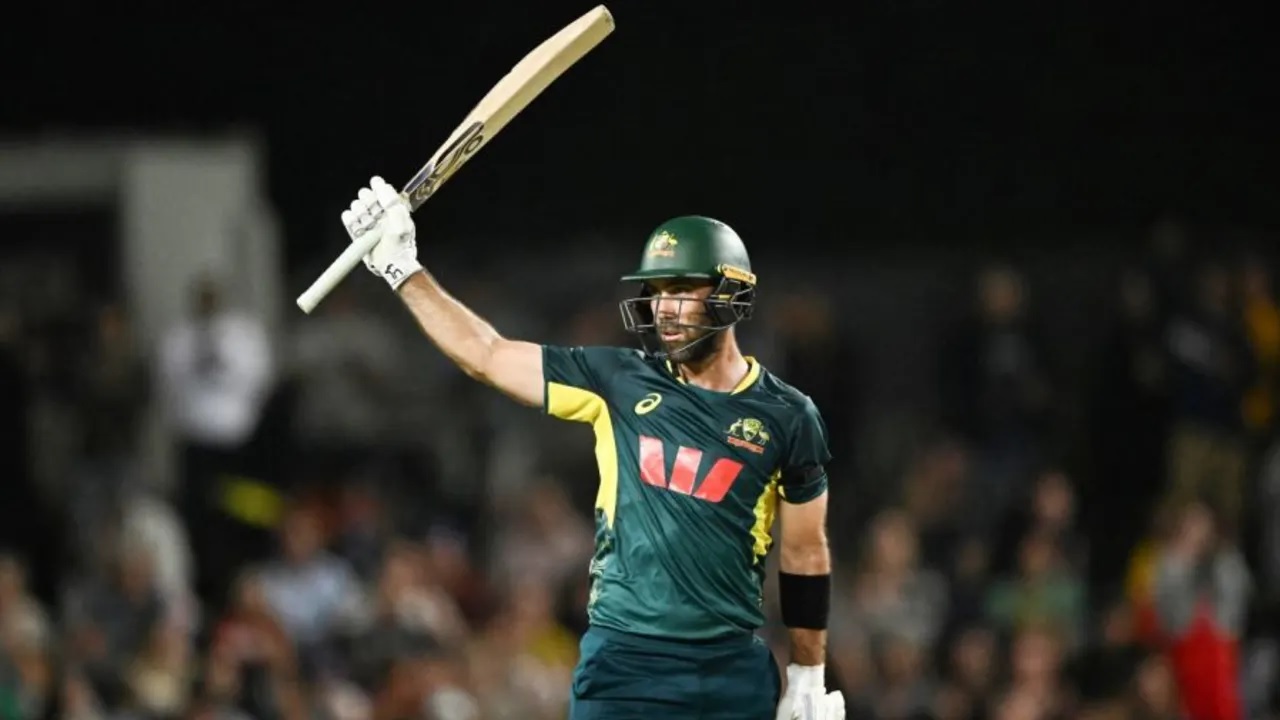
Glenn Maxwell had scored his first T20I fifty in a year and 11 innings to put Australia on track after they were teetering at 122 for 6, chasing 173, in the 14th. Australia needed 12 runs from 12 balls to complete their highest successful chase at home. Kagiso Rabada was bowled out. What could possibly go wrong from there?
Corbin Bosch took two wickets in two balls in a penultimate over that ended as a double-wicket maiden. Maxwell refused a run off the last ball to keep strike in the final over and Lungi Ngidi was tasked with defending nine runs. His first ball was hit out to deep wide long-on where Bosch flicked the ball back in-field as he leapt over the rope to save four. Then Maxwell beat Lhuan-dre Pretorius at deep cover for four and turned down another opportunity for a single with four runs to get. He reverse-hoicked Ngidi over short third to seal the deal off the second last ball of the match and confirm his status as the big show in a thrilling finale.
Australia are now undefeated in their last seven bilateral T20I series. Of those, this was the first one in that time that went down to a decider and they showed their mettle under pressure. South Africa, on the other hand, have only won one of their last 10 T20I series. They have lost their last three finals in the last over, dating back to last year’s T20 World Cup and including last month’s tri-series final against New Zealand in Zimbabwe, and questions about their ability to close out close games will continue.
The drama aside, South Africa simply did not have enough runs after a slow start. None of their top three got going and it was thanks to Dewald Brevis and Tristan Stubbs’ fourth wicket stand of 61 off 29 balls that they built towards a competitive total, which they made a fist of defending. They had Australia in trouble on 88 for 4 in the 11th over and 122 for 6 in the 14th over but Maxwell was strong square of the wicket, held his nerve and struck at 172.22 to finish with 62 not out off 36 balls and take Australia home.
With the Cairns surface noticeably slower than the Darwin one, the role of spin was always going to be a talking point and Adam Zampa had the first decisive say. He was brought on in the over after the powerplay and could have had a wicket with his first ball. Brevis miscued a pull but Maxwell could not get to the chance in time. Zampa only had to wait four more deliveries to get a reward. Ryan Rickelton misread the googly, played a premeditated sweep shot and top-edged straight up. Rassie van der Dussen was unable to get Zampa away and Stubbs, who reverse-swept Zampa for two fours, fell playing the conventional sweep. He moved across his stumps, missed the shot and was bowled to leave Zampa with an excellent return of 2 for 24 from his four overs.
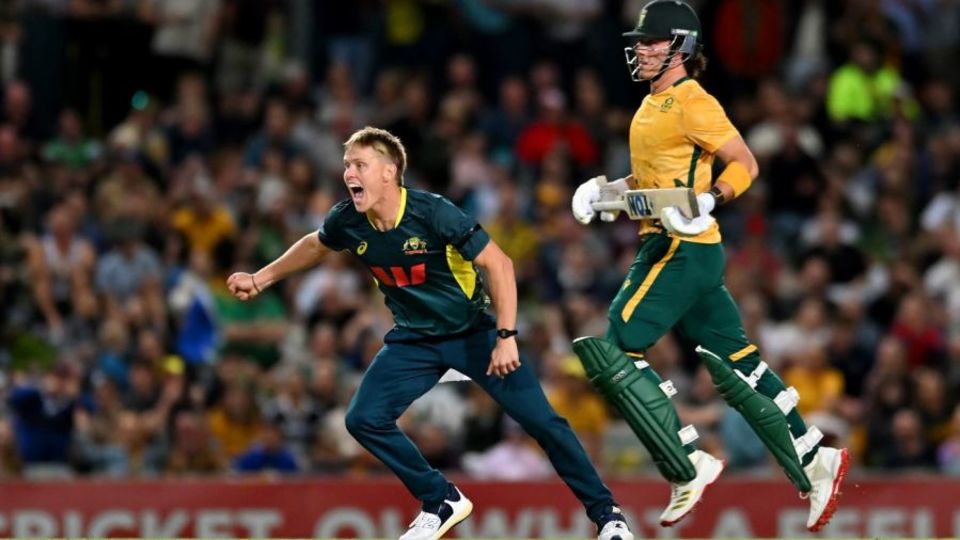
Nathan Ellis celebrates the key wicket of Dewald Brevis [Cricinfo]
Brevis picked up exactly where he left off after his unbeaten 125 in game two and swivel-pulled the fifth ball he faced over the stadium roof. He went on to top-edge Josh Hazlewood over backward square leg for another six and hit Aaron Hardie for four sixes in the 10th over, which cost 27 runs.
Brevis’ fifty came off 22 balls and he looked set for another century before Maxwell stopped him. As Brevis tucked into a slower short ball from Nathan Ellis and pulled it wide of long-on, Maxwell made significant ground and ran to his right, where he completed the catch diving forward. That was his second stunner of the series after catching Rickelton on the rope in the first match.
While South Africa’s captain Aiden Markram has now gone 31 T20I innings without a half-century, Australia’s skipper Mitchell Marsh broke his drought with a first fifty in 19 innings. He also played his part in Australia’s first half-century opening stand in eight matches.
Marsh got the chase underway when he pulled the last ball of Kagiso Rabada’s opening over – a slower one – into the crowd for six. He gave a Lungi Ngidi cross-seam delivery the same treatment and then hit Kwena Maphaka’s first delivery for four, over mid-off. Rabada could not hold on to a tough return chance when Marsh was on 25 and then saw the fifth ball of his second over flicked over square leg for another six. Left-arm spinner Senuran Muthusamy bore the brunt of Marsh’s big-hitting and was taken for 17 runs off the eight balls he bowled to him, including two sixes that bookended his opening over. Marsh’s fifty also came off Muthusamy, off the 35th ball he faced.
Australia were cruising on 64 without loss after seven overs when Markram brought himself back on in what he has called “gut feel” decision-making over when and how much to bowl. Four deliveries into his second over, Travis Head played a full-blooded pull back towards him. Markram dived to his left but couldn’t take the catch in what turned out to be a boundary-preventing stop. Two balls later, Head top-edged a sweep to short fine and Markram had sparked a collapse. In the next over, Bosch bowled Inglis for a golden duck, then Maphaka had Marsh and Cameron Green caught on the boundary. Australia lost four wickets for 22 runs in the space of 18 balls and South Africa were back in the game.
Australia needed 27 runs off the last three overs, Maxwell was on 39 off 25 balls and Rabada was about to bowl his final over. The balance of the game, it seemed, hung on those six balls. Rabada started off with a full toss that went over Maxwell’s head and was called a no-ball. Maxwell punished him by hitting the free hit, a low full toss, for six.
Two balls later, Maxwell guided Rabada over short third and then brought up fifty off 30 balls with a single to long-on. Rabada conceded 15 runs in that over as Maxwell took control. It looked like a simple win from there, with Australia needing 12 off 12 and with Maxwell at the crease they would always have backed him to finish the job.
Brief scores:
Australia 173 for 8 in 19.5 overs (Glenn Maxwell 62*, Mitchell Marsh 54, Travis Head 19, Tim David 17, Kagiso Rabada 2-32, Aisen Markram 1-06, Kwena Maphaka 2-36, Corbin Bosch 3-26 ) beat South Africa 172 for 7 in 20 overs (Ryan Rickelton 13, Lihuan-dre Pretorius 24, Dewald Brevis 53, Tristan Stubbs 25, Rassie van der Dussen 38; Josh Hazelwood 2-30, Nathan Ellis 3-31, Adam Zampa 2-24) by two wickets
[Cricinfo]


Building on its success in seizing major narcotic stocks in 2025, the Navy continued to support the “A Nation United” National Mission in 2026. In continuation of these efforts, during an
operation conducted on the high seas south of Sri Lanka, the Navy apprehended eleven (11) suspects aboard two local multi-day fishing trawlers suspected of drug smuggling.
Based on shared information, by the Sri Lanka Navy and Police, this special operation was conducted off the southern coast, deploying the Navy‟s Offshore Patrol Vessels. The operation
resulted in the interception of a multi-day fishing trawler suspected of smuggling narcotics, and the apprehension of five (05) suspects on board.
During further operations in the same area, naval units seized another multi-day fishing trawler (01), along with communication equipment and six (06) additional suspects, also believed to be involved in drug smuggling.
This morning (25 Jan 26), the two intercepted fishing trawlers, along with fourteen (14) sacks laden with suspected narcotics and the suspects, were brought to the Dikovita Fisheries Harbour.
An expert examination by the Police Narcotic Bureau confirmed that the fourteen (14) sacks contained more than 184 kilograms of heroin and over 112 kilograms of ‘Ice’ (crystal methamphetamine).
The Deputy Minister of Defence, Major General (Retd) Aruna Jayasekara, the Commander of the Navy, Vice Admiral Kanchana Banagoda, and the Inspector General of Police, Priyantha Weerasuriya, inspected the narcotics at the Dikovita harbour.
The Deputy Minister of Defence said that the current administration has initiated several projects for national development. As a flagship initiative, under the directives and guidance of the President, and under the supervision of the
Ministry of Defence, well-coordinated anti-narcotic raids have been launched.
This effort, part of “A Nation United” National Mission, involves the tri-forces, police, and all intelligence agencies working together under a coordinated plan to ensure that drug smugglers have no opportunity to bring narcotics into the country, he opined. He further stated that despite the national disaster situation, the state machinery, including the tri-forces, the police, and the public at large, remains united in rebuilding the nation, no room will be left for drug trafficking, which poses a severe threat to national security and public safety. Those
who engage in or support drug trafficking, under the cover of fishing activities, will find no escape, he added.
The Deputy Minister also reaffirmed that the tri-forces, police, and all law enforcement agencies are fully committed to their duty of suppressing this menace.
The Deputy Minister of Defence reported that, throughout 2025, a series of highly successful operations were conducted leading to numerous arrests. This was achieved through close coordination and mutual cooperation among the tri-services, the police, the Special Task Force, Police Narcotics Bureau, local law enforcement and international agencies. He noted that this
same spirit of cooperation and commitment has continued into 2026, resulting in the seizure of a large stockpile of drugs.
On behalf of the Honourable President, he extended gratitude to all who contributed to these efforts, specifically acknowledging the Commander of the Navy, the Inspector General of Police, the Police Narcotic Bureau, and the crews of the Navy’s Offshore
Patrol Vessels.
Moreover, the Deputy Minister declared that drug smuggling has become a national crisis, fueled by youth involvement and social crime. With borders secured under the “Nation United” National Mission, he warned traffickers to cease operations and urged users to abandon the destructive habit.
The Deputy Minister urged the public to report suspected drug smugglers to law enforcement via the hotlines 1818 or 1997 and also commended the role of media institutions and journalists in raising public awareness about the dangers of narcotics through responsible reporting.
Meanwhile, the two (02) multi-day fishing trawlers, along with a haul of narcotics, eleven (11) suspects, and communication equipment, were handed over to the Police Narcotic Bureau for
further investigation and legal proceedings.
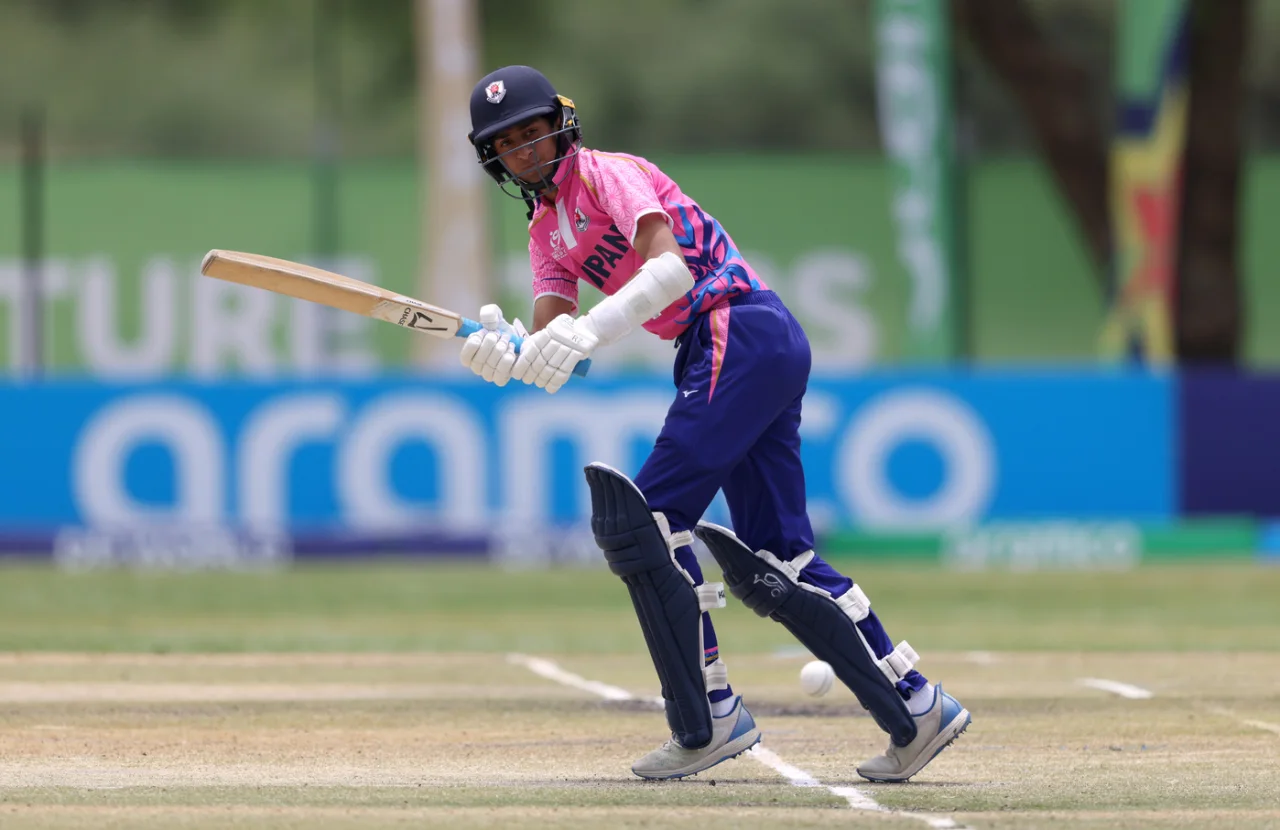
Tanzania 131 in 38.3 overs (Acrey Pascal 55; Nihar Parmar 4-30, Nikhil Pol 3-23) lost to Japan 136/1 in 28.2 overs (Nihar Parmar 53*, Taylor Waugh 47) by nine wickets
[Cricbuzz]
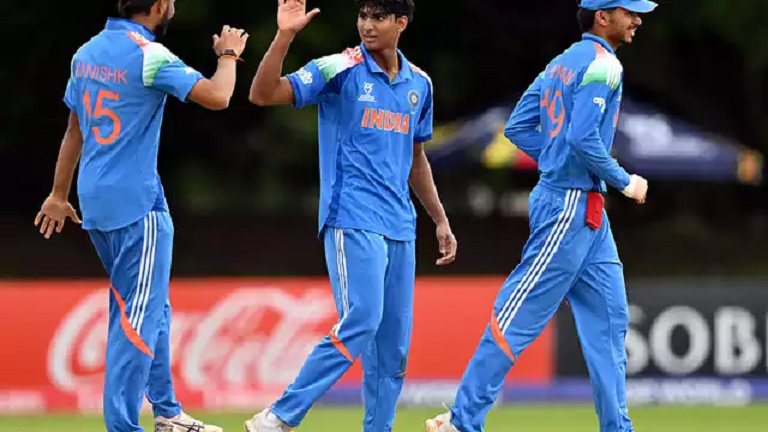
New Zealand 135 in 36.2 overs (RS Ambrish 4-29, Henil Patel 3-23) lost to India 130/3 in 13.3 overs (Vaibhav Suryavanshi 40, Ayush Mhatre 53) by 7 wickets [DLS Method]
[Cricbuzz]

Navy intercepts 02 narcotics-laden trawlers with 11 suspects in southern seas

U19 World Cup: Japan defeat Tanzania by nine wickets

U19 World Cup: Ambrish’s four-fer powers India to third straight win

Josh Hoey breaks world 800m short track record with 1:42.50 in Boston

Trump threatens Canada with 100% tariffs if it ‘makes a deal with China’

Showers will occur at times in the Northern, North-central, Eastern and Uva provinces and in Matale and Nuwara-Eliya districts

‘Dates have the highest sugar content to fight Coronavirus’

Sunday Island 27 December – Headlines

#SundayIsland 17th December – Headlines

Sunday Island – 28th March

Sunday Island Headlines – 21 March

Sunday Island – 21st February – Headlines
-

 Features6 days ago
Extended mind thesis:A Buddhist perspective
-

 Opinion5 days ago
American rulers’ hatred for Venezuela and its leaders
-

 Business3 days ago
CORALL Conservation Trust Fund – a historic first for SL
-
 Opinion3 days ago
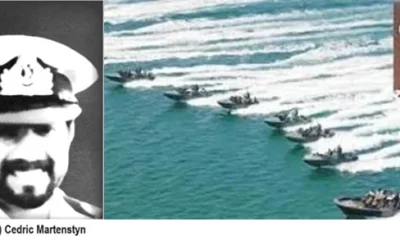
Remembering Cedric, who helped neutralise LTTE terrorism
-
 Opinion2 days ago
A puppet show?
-

 Opinion5 days ago
History of St. Sebastian’s National Shrine Kandana
-

 Business11 hours ago
ComBank advances ForwardTogether agenda with event on sustainable business transformation
-

 Features4 days ago
The middle-class money trap: Why looking rich keeps Sri Lankans poor