
News
Lokuge accused of overriding Covid-19 counter measures

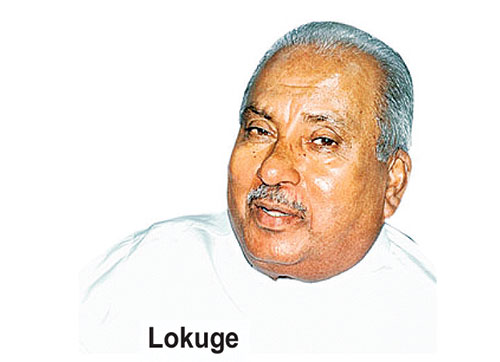
Piliyandala removed from isolation list: DGHS helpless
By Shamindra Ferdinando
Director General of Health Services (DGHS) Asela Gunawardena, who is the state authority for the national campaign against the rampaging Covid-19 pandemic, has acknowledged that his directive that Piliyandala police area be isolated on May Day was overridden.
Appearing on Hiru TV ‘Salakuna’ programme on Monday (3) night, Dr. Gunawardena admitted that the very basis of the mechanism in place to isolate areas threatened by the Covid-19 epidemic had been violated.
Dr. Gunawardena said so in response to ‘Salakuna’ anchor Chamuditha Samarawickrema repeatedly pressing the DGHS over the removal of the isolation directive issued effective at 6 am on May Day following Transport Minister Gamini Lokuge’s intervention. Samarawickrema sought an explanation as regards the removal of the directive at 5 pm and the subsequent isolation of five Grama Niladhari areas in the Piliyandala police area.
Samarawickrema pointed out to DGHS that politicians had been allowed to behave in a manner inimical to the entire national effort to counter the pandemic whereas the public and in some instances even the media were repeatedly criticized for not cooperating with government efforts.
Dr. Gunawardena recently issued a dire warning over the absence of sufficient hospital facilities in case the situation further deteriorated rapidly. The number of deaths reported till Monday stood at 709 with the country recording well over 1,000 new cases every day for about a week.
Responding to Samarawickrema, Dr. Gunawardena explained the mechanism in place to control the pandemic. According to the DGHS, the Medical Officer Health (MoH) responsible for a particular area brought the situation to the notice of the Provincial Authority who in turn alerted him. Once the DGHS decided to act on recommendation made by MoH and Provincial Authority, the Commander of the Army who is also the head of the Covid-19 Task Force General Shavendra Silva was informed, the DGHS explained.
Samarawickrema asked the DGHS how isolation of Piliyandala had been removed if such measures were taken in terms of scientific foundation as he mentioned.
In the wake of Samarawickrema challenging the DGHS to act on Minister Lokuge’s intervention, the latter promised to look into the matter.
Samarawickrema told The Island that he raised the issue at hand particularly against the backdrop of the government banning May Day rallies as part of the overall measures to curb the spread of Covid-19.
Samarawickrema said that Minister Lokuge had told the media, including Hiru that some persons on his staff, too, were tested positive. In spite of that the Minister accompanied by a group of people were on the move in the Piliyandala area, Samarawickrema said.
Responding to another query, Dr Gunawardena said that he announced the isolation of Piliyandala on Hiru at 6.25 am on May Day. Then several hours later, another statement was received regarding the removal of the isolation directive, Samarawickrema said.
The Island didn’t receive a response to sms sent to Minister Lokuge and Dr. Gunawardena seeking clarification regarding the issue at hand.
Minister Lokuge was shown on Hiru main news bulletin Monday night assuring the Piliyandala electorate as the people’s representative he had a right to look into their grievances.




By Shamindra Ferdinando
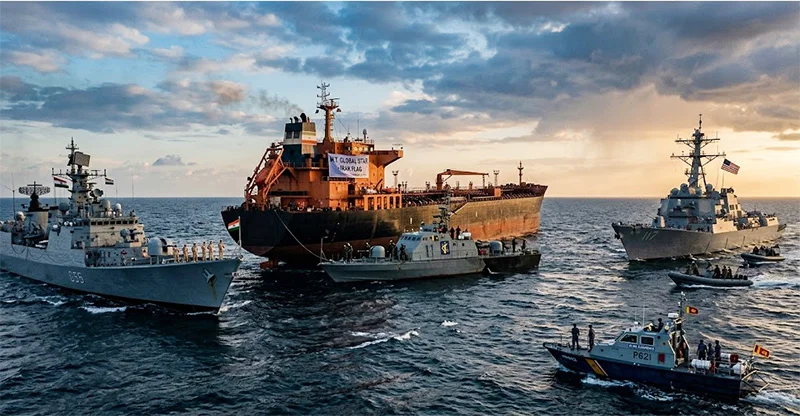
Iran has sought the Indian intervention, at the highest level, to provide lifesaving support to the crews of empty Iranian vessels stranded just outside Sri Lanka’s 12-nautical mile territorial waters off Galle.
Sources familiar with the issue said that Iran had brought the developing situation to the attention of New Delhi as the crews of almost 20 vessels, included Indian nationals. Sources stressed that the group of vessels that unloaded crude oil a couple of months back were now stranded within Sri Lanka’s Exclusive Economic Zone (EEZ).
The US Navy torpedoed an unarmed Iran frigate, returning from India, on 04 March, 2026, about 19 nautical miles off the Galle coast. The unprovoked attack killed nearly 100 Iranians.
The Iranian Embassy in Colombo has inquired from the Indian High Commission of their response to the situation, sources said. The US has issued a global warning against providing food, water, medicine and other services to the Iranian vessels. The outcome of Iran-India talks on the issue at hand was not known, though sources asserted India may not throw its weight behind Iranian efforts to address the issue.
Responding to The Island queries, sources said both Sri Lanka and India were in a dilemma due to the US warning. India couldn’t ignore the plight of the Indian crew members and the Iranian vessels in its backyard.
The Sri Lankan government remains tight-lipped about the vessels stranded in its EEZ. Our efforts to elicit a response from relevant authorities were in vain. In addition to Indians, there are Bangladeshis among the crew members. Iran has explicitly stated the responsibilities of the countries concerned to provide assistance in terms of international law.
The Iranian position was articulated by its Ambassador to Sri Lanka, Dr.Alireza Delkhosh, recently. In a special statement, Ambassador Delkhosh emphasised that in terms of the Convention on the Law of the Sea (Article 98) as well as SOLAS and SAR
Conventions, Sri Lanka couldn’t refrain from providing the needs of the Iranian vessels stranded in its EEZ.
SLMC leader Rauff Hakeem lambasted the NPP government in Parliament for failing to provide assistance to the Iranian ships. The former Minister alleged that the government was simply carrying out dictates of the US. He strongly criticised the way Foreign Minister Vijitha Herath was handling the issue.
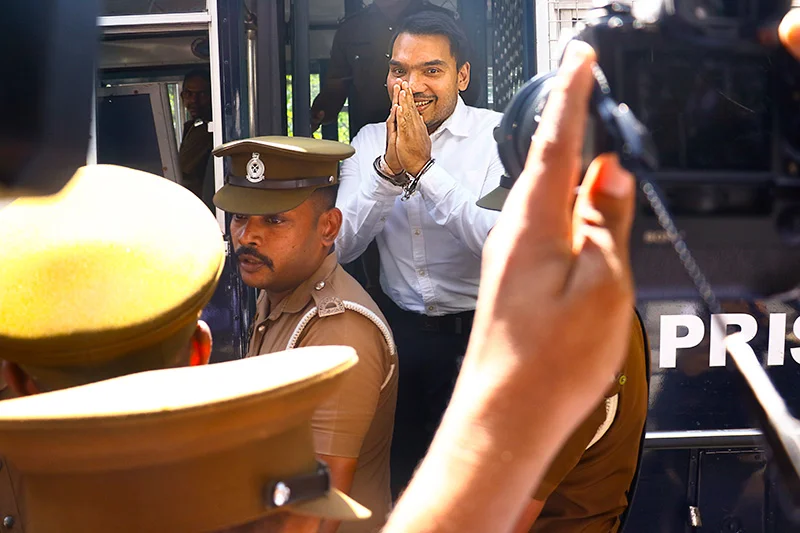
MP Namal Rajapaksa, who is in remand custody over the controversial Airbus deal, was further remanded until October 27 by the Colombo Magistrate’s Court yesterday (13).
Colombo Chief Magistrate Asanga S. Bodaragama made the order after considering submissions by officers of the Commission to Investigate Allegations of Bribery or Corruption and lawyers representing Rajapaksa.

Sri Lanka’s economy is expected to sustain its recovery over the next two years, although growth is projected to moderate amid mounting global uncertainties, according to the International Monetary Fund’s (IMF) latest World Economic Outlook.
In its World Economic Outlook 2026: Resilience Under Strain, Urgent Choices, the IMF projects Sri Lanka’s economy to expand by 4% in 2026, slowing to 3.7% in 2027, following estimated growth of 5% in 2025.
Inflation, meanwhile, is forecast to rise to 5.3% in 2026 and 5.4% in 2027, reversing the average deflation rate of 0.5% recorded in 2025.
Unemployment is expected to remain steady at 3.9% throughout the forecast period.
The projections come amid growing pressure on the global economy from the ongoing conflict in the Middle East, elevated energy prices, geopolitical tensions and trade disruptions.
Sri Lanka’s external position is also expected to weaken, with the current account balance projected to shift from a surplus of 1.6% of gross domestic product (GDP) in 2025 to deficits of 0.5% in 2026 and 0.3% in 2027.
The IMF’s outlook points to continued economic expansion in Sri Lanka, but with slower growth, rising inflation and a narrowing external surplus giving way to current account deficits over the forecast period.

Heavy showers above 100 mm are likely at some places in the Western, Sabaragamuwa, Southern, Central, and North-western provinces and in Anuradhapura district.

Sri Lanka, India caught in US-Iran ship crisis

Namal further remanded

IMF projects Lankan economic growth to moderate amidst mounting global uncertainties

Major Gen Pushpakumara assumes command of 56 Infantry Division

Dickwella axed, Bandara earns maiden Test call up

‘Dates have the highest sugar content to fight Coronavirus’

Sunday Island 27 December – Headlines

#SundayIsland 17th December – Headlines

Sunday Island – 28th March

Sunday Island Headlines – 21 March

Sunday Island – 21st February – Headlines
-

 Features6 days ago
The Sri Lankan who made Scottish history
-

 Sports6 days ago
Nissanka absence opens door for Sri Lanka’s young guns
-

 News5 days ago
NDB fraud Rs 60mn more than reported
-

 News5 days ago
Removing monk’s robes matter for Sangha to decide: Mahanayake Theras
-
 News6 days ago
Shiranthi R remanded until 13 Oct.
-

 Features6 days ago
Future of Sri Lanka’s state university system: Should it be shut down and reopened?
-

 News3 days ago
Sri Lanka escalates anti-graft drive with Shiranthi’s jailing
-
 Latest News4 days ago
Farhan, Sadaqat help Pakistan ace 183 chase to go 1-0 up