
News
Lanka’s Malik Peiris shares ‘China’s Nobel Prize’ of USD 1 mn with Yuen

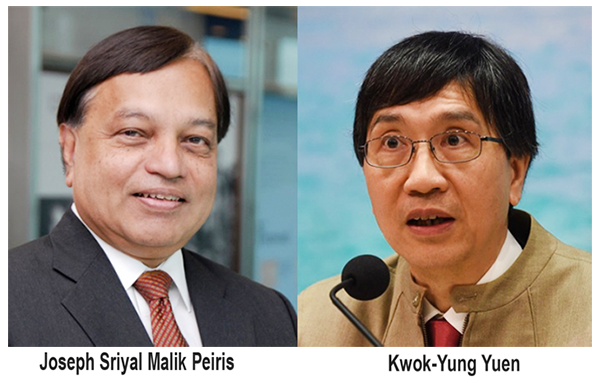
Hong Kong-based scientists Kwok-Yung Yuen and Sri Lanka’s Joseph Sriyal Malik Peiris won the prize in life sciences in the 2021 Future Science Prize, dubbed ‘China’s Nobel Prize’ for their major discoveries of SARS-CoV-1 as the causative agent of the global SARS outbreak in 2003 with impact on combating COVID-19 and emerging infectious diseases, the award organiser announced on Sunday.
The Chines Embassy in Colombo issued the following statement: “The Future Science Prize is a privately funded science honour established by a group of renowned scientists and entrepreneurs in 2016, aiming at recognising scientific breakthroughs and innovations in China with long-term significance to the world. The prize is given in three categories with $1 million for each award, namely the Life Science Prize, Physical Science Prize and Mathematics and Computer Science Prize.
Yuen, from the University of Hong Kong, told the Global Times in an exclusive interview on Sunday that “this is one of the most important prizes not just in China but also internationally. I am really honoured and grateful to get the recognition of the very eminent scientists of the selection committee for the prize.”
Wang Xiaodong, one of the reviewers of the award, said at Sunday’s press conference that “Chinese scientists were able to quickly identify the cause of the COVID-19 pandemic, thanks to their contributions.”
When asked how their discoveries affect people’s understanding of the cause of COVID-19, Yuen explained that since he and his team discovered in 2005 that the horseshoe bat was the natural animal reservouir for the ancestral SARS-CoV-1, they believe that SARSCoV-2 “also went from bats to another mammal(s) before jumping into humans”.
Moreover, SARS-CoV-2 replicates very well in both bat and human intestinal organs, which further supports the bat origin of SARS-CoV-2, he said. But there are also major differences between the two diseases, Yuen noted, in terms of “disease severity, asymptomatic or mildly symptomatic rates and the ability of the virus to suppress interferon and inflammatory responses.”
As world scientists call for the second phase of the coronavirus origins study, experts from the Chinese Centre for Disease Control and Prevention have suggested that investigations should be carried out in countries where horseshoe bats and pangolins reside, those with virus-positive animal data and which supplied Wuhan Huanan seafood market through cold-chain logistics, as more tests and molecular viral research suggest it is possible that the early outbreak in the Huanan market may have been sparked by cold-chain imports.
Jin Dongyan, a professor at the School of Biomedical Sciences at HKU, told the Global Times the same day that Yuen and his research team, where a group of world-leading researchers are gathered, are very valuable to the Hong Kong Special Administrative Region. “From SARS to COVID-19, the team has been engaged in coronavirus-related basic studies while combing through clinical studies. That working mode contributes to the outstanding work of the university to the study of infectious diseases,” Jin said.
Yuen and his research team are devoting their efforts to find out how to prevent potential re-emergence of a SARS and COVID-19-like public health crisis. Studies on the types of coronaviruses that exist in bats, the potential hosts of the cross-species transmission, as well as how humans transmitted the virus to animals are part of their research, Jin said.
Yuen also told the Global Times that he is working on many areas from the pathogenesis of the coronavirus to antivirals and vaccines. “My part of the awarded prize will go back to the HKU for teaching and research purposes,” he added.
Apart from Kwok-Yung Yuen and Joseph Sriyal Malik Peiris, Zhang Jie, a professor at Shanghai Jiao Tong University, won the Physical Science Prize for his development of laser-based fast electron beam technologies. Simon Sze from the “National Chiao Tung University” in the island of Taiwan won the prize in mathematics and computer science.
The science committee of the prizes, composed of 23 outstanding scientists, is at the core of the award selection. Mau-Chung Frank Chang, chairman of the committee, said that the nomination and selection of the prize was established in accordance with the Nobel Prize system, in which the committee invites international experts as nominators and then solicits evaluation letters from experts in relevant fields of the nominated work. Based on the evaluations, the committee then votes to select the final award winners.
In the previous five years, 20 winners were awarded the Future Science Prize, all of whom have been widely recognised both in scientific circles and society. The late Yuan Longping, known as “the father of hybrid rice,” was awarded the Life Science Prize in 2018 “for pioneering the use of hybrid vigor to achieve higher yield and increased stress resistance in rice.”


The Pakistan Navy Ship (PNS) TAIMUR and ASLAT arrived at the Port of Colombo on a goodwill visit on 12 Apr 26.
The visiting ships were welcomed by the Sri Lanka Navy in
compliance with naval traditions.
The duo of ships is commanded by Captain NIAMAT SAEED KHAN (PNS TAIMUR) and Captain NADIR MATEEN AFRIDI (PNS ASLAT).
Meanwhile, the ships are expected to conduct a Bilateral Naval Exercise LION STAR V with the Sri Lanka Navy in Colombo seas.
Latest News
Heat index likely to increase up to ‘Caution level’ at some places in the Northern, North-central, North-western, Western, Sabaragamuwa, Southern and Eastern provinces and Monaragala district


Warm Weather Advisory
Issued by the Natural Hazards Early Warning Centre at 3.30 p.m. on 11 April 2026, valid for 12 April 2026
The Heat index, the temperature felt on the human body is likely to increase up to ‘Caution level’ at some places in the Northern, North-central, North-western, Western, Sabaragamuwa, Southern and Eastern provinces and Monaragala district.
The Heat Index Forecast is calculated by using relative humidity and maximum temperature and this is the condition that is felt on your body. This is not the forecast of maximum temperature. It is generated by the Department of Meteorology for the next day period and prepared by using global numerical weather prediction model data.

Effect of the heat index on human body is mentioned in the above table and it is prepared on the advice of the Ministry of Health and Indigenous Medical Services.
ACTION REQUIRED
Job sites: Stay hydrated and takes breaks in the shade as often as possible.
Indoors: Check up on the elderly and the sick.
Vehicles: Never leave children unattended.
Outdoors: Limit strenuous outdoor activities, find shade and stay hydrated.
Dress: Wear lightweight and white or light-colored clothing.
Note: In addition, please refer to advisories issued by the Disaster Preparedness & Response Division, Ministry of Health in this regard as well. For further clarifications please contact 011-7446491.
Latest News
Sun directly overhead Cheddikulam, Kebithigollewa, Gomarankadawala and Nilaveli about 12:11 noon. today [12]

On the apparent northward relative motion of the sun, it is going to be directly over the latitudes of Sri Lanka from 05th to 15th of April in this year.
The nearest areas of Sri Lanka over which the sun is overhead today (12th) are Cheddikulam, Kebithigollewa, Gomarankadawala and Nilaveli about 12:11 noon.

PNS TAIMUR & ASLAT arrive in Colombo

Sanju Samson and Jamie Overton deliver first points for Chennai Super Kings

Arya, Prabhsimran and Shreyas help Punjab Kings ace another 200-plus chase

Beauty of Sri Lanka in focus: Global showcase blends art, diplomacy and conservation

Showers expected in the Western, Sabaragamuwa, Central, Southern, North-western and Uva provinces and in Ampara, Batticaloa and Polonnaruwa districts after 1.00 p.m.

Heat index likely to increase up to ‘Caution level’ at some places in the Northern, North-central, North-western, Western, Sabaragamuwa, Southern and Eastern provinces and Monaragala district

‘Dates have the highest sugar content to fight Coronavirus’

Sunday Island 27 December – Headlines

#SundayIsland 17th December – Headlines

Sunday Island – 28th March

Sunday Island Headlines – 21 March

Sunday Island – 21st February – Headlines
-

 News6 days ago
Lankan-origin actress Subashini found dead in India
-

 News4 days ago
AG: Coal procurement full of irregularities
-

 Business3 days ago
Israeli attack on Lebanon triggers local stock market volatility
-

 News23 hours ago
CEB orders temporary shutdown of large rooftop solar systems
-

 Business4 days ago
Hayleys Mobility introduces Premium OMODA C9 PHEV
-

 Business3 days ago
HNB Assurance marks 25 years with strategic transformation to ‘HNB Life’
-

 News6 days ago
UN Regional Director launches SL’s first Country Gender Equality Profile during official visit
-

 Sports4 days ago
DS to face St. Anthony’s in ‘Bridges of Brotherhood’ cricket encounter