
News
Lankans shouldering mountain of mental issues brought on by series of traumatic events since 2019 – experts


By Rathindra Kuruwita
Sri Lankans have been facing a series of traumatic events since 2019, and they have had a serious impact on their mental health, Dr. Kanthi Hettigoda, chartered clinical psychologist and senior lecturer, Department of Psychology, at the University of Peradeniya, says.
Asked whether the economic crisis can trigger trauma in individuals, Dr. Hettigoda said that it could occur, depending on their personality as well as the extent of the impact.
“Trauma can occur if someone experiences unexpected and significant changes. These changes can be those that affect them materially, or thinking patterns. Due to the economic crisis, a large number of people do not know what to expect next, and they might feel that the future will only be bad. Then they might experience trauma. There are people who have lost jobs, gone bankrupt, etc., due to the current crisis,” she said.
Dr. Hettigoda said that prior to the economic crisis, which began in 2022, Sri Lankans have been experiencing a series of economic and social crises. These events started from the Easter Sunday attacks, she said.
“Then we faced COVID, and now an economic crisis. So, a number of quite shocking events have accumulated. Easter Sunday attacks was definitely a trauma for all, COVID, too, can be traumatic, depending on the experiences someone faced, and the current socio-economic crisis have led to many negative emotions and outcomes,” she said.
Dr. Hettigoda opined that based on her practice and what she had observed at University, as an academic, most people were facing adjustment issues. There is a lot of anger, frustration, and disgust among Sri Lankans, in general. Unfortunately, given that Sri Lankans do not receive any education on mental health, a lot of people don’t know that they are showing symptoms of mental health issues, she said.
“Most don’t know what’s happening inside them. So, when they do not understand what’s going on, they fight within themselves and they fight with those who are closest to them. As a University academic, I see young people who are frustrated, and sometimes these frustrations are taken out on people around them and sometimes there is maladaptive behaviour”, she observed.
Meanwhile, Rushma Mohammed-Fronczak, clinical psychologist and ACE Certified Personal Trainer, who practises in Kandy, said that in the past year a lot of people had sought help for trauma, adjustment-related stresses, etc.
“There is severe anxiety about the future and this is the culmination of a series of events, over four years. Sri Lankans have a lot of problems, this is nothing new. Over the years, or even decades, they had developed coping mechanisms that helped them achieve mental wellbeing. What happened during COVID was that people were not able to engage in activities that helped them keep their wellbeing, things that helped you stay de-stressed. Couples discovered traumatic things about each other given that they were to spend the entire day with each other,” she said.
These led to many social issues, including an increase in domestic abuse during COVID. Mohammed-Fronczak said the economic crisis had occurred at a time when people started believing that things would get better following COVID-related restrictions.
“That hope got snatched away for a large part of the population. That brings in anxiety and hypervigilance. Crisis had the ripple effect of the crisis,” she said.
Dr. Hettigoda said given that once a person approaches a qualified mental health professional, identifying what’s wrong with a person is not difficult. However, most people do not seek health, mostly due to the lack of mental health literacy among Sri Lankans.
The Sri Lankan government, and other stakeholders ,in the mental health promotion sector, need to provide a good psychological education. Even University students, or executive level officers, are not aware of common issues, like the symptoms of depression, she said.
Mohammed-Fronczak added that even those who have a rudimentary understanding of mental health issues, resort to looking up symptoms on the internet, where there is much inaccurate information. Sri Lankans need to be taught mental health literacy as there can be many typical, as well as atypical manifestations of mental health issues.
“Individuals themselves can be their smoke alarms. Everyone is an expert on themselves, and mental health professionals are only a guide, mirror or a safety net for some time. You are the expert of your own life, everyone has a version of what’s a good quality of life. It can be getting six hours of sleep, being able to enjoy the food, having time to spend with family and friends. These things help you keep grounded. You can use this baseline and notice changes,” she said.
A major problem in Sri Lanka is that there is a lack of research and a lack of qualified mental health professionals. Moreover, there is no link between researchers and professionals to share findings or discuss developments, Mohammed-Fronczak said.
“In other countries, researchers know what each other is doing. Here, we have a good set of people; they might be doing research in their own pockets. I wouldn’t know them, and they wouldn’t know what I am doing. We need a hub of information,” she said.

Latest News
Advisory for Severe Lightning issued to the Western and Sabaragamuwa provinces and Galle and Matara districts

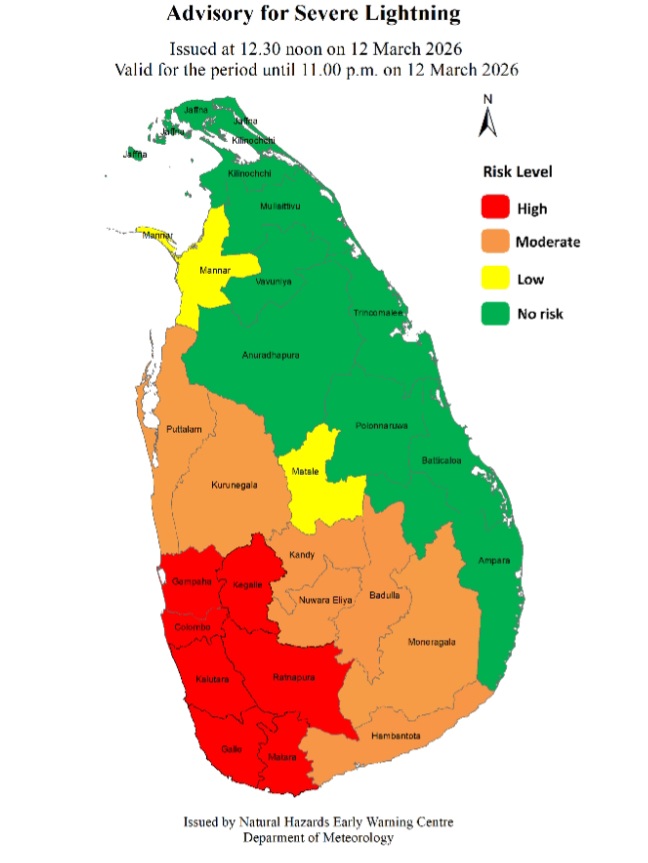
Advisory for Severe Lightning Issued by the Natural Hazards Early Warning Centre at 12.30 noon 12 March 2026 valid for the period until 11.00 p.m. 12 March 2026
Thundershowers accompanied with severe lightning are likely to occur at some places in the Western and Sabaragamuwa provinces and in Galle and Matara districts after 2.00 p.m.
There may be temporary localized strong winds during thundershowers. General public is kindly requested to take adequate precautions to minimize damages caused by lightning activity.
ACTION REQUIRED:
The Department of Meteorology advises that people should:
Seek shelter, preferably indoors and never under trees.
Avoid open areas such as paddy fields, tea plantations and open water bodies during thunderstorms.
Avoid using wired telephones and connected electric appliances during thunderstorms.
Avoid using open vehicles, such as bicycles, tractors and boats etc.
Beware of fallen trees and power lines.
For emergency assistance contact the local disaster management authorities.
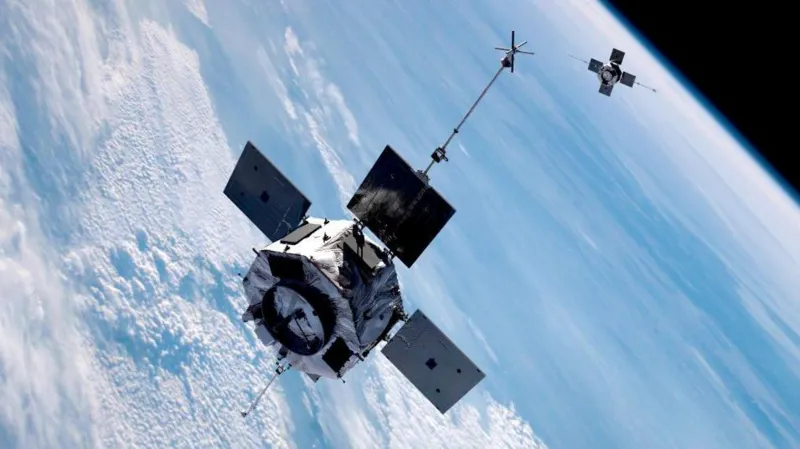
A Van Allen Probe spacecraft weighing more than 1,300lb (600kg) is expected to re-enter Earth’s atmosphere almost 14 years after its launch, Nasa says.
The spacecraft is projected to re-enter around 19:45 EDT (23:45 GMT) on Tuesday the US Space Force predicted, according to Nasa, though there is a 24-hour margin of “uncertainty” in the timing.
The Van Allen Probe A, which launched in 2012, is expected mostly to burn up as it travels through the atmosphere, though some components may survive.
The space agency said there is a one in 4,200 chance of being harmed by a piece of the probe, which it characterised as “low” risk.
The spacecraft and its twin, Van Allen Probe B, were on a mission to gather unprecedented data on Earth’s two permanent radiation belts.
It was not immediately clear where in Earth’s atmosphere the satellite is projected to re-enter. The BBC has contacted Nasa for further detail.
Nasa and the US Space Force have said they will monitor the re-entry and update any predictions.
The mission, which was originally designed to last two years, went on for almost seven. It ended after the spacecrafts ran out of fuel and were no longer able to orient themselves toward the Sun.
The probes flew through rings of charged particles trapped by Earth’s magnetic field from 2012 to 2019, in order to study how particles were gained and lost, per Nasa.
Those rings, called the Van Allen belts, shield Earth from cosmic radiation, solar storms and streaming solar wind, which are harmful to humans and can damage technology.
The mission made significant discoveries, including the first data that show the existence of a transient third radiation belt, which can form during times of intense solar activity, Nasa said.
Van Allen Probe B is not expected to re-enter the Earth’s atmosphere before 2030.
[BBC]

Prime Minister Dr. Harini Amarasuriya visited the International Rice Research Institute (IRRI) headquarters in Los Baños, Laguna, Philippines, on 11 March 2026, and held bilateral discussions with Yvonne Pinto, Director General of IRRI, focusing on strengthening cooperation in the field of rice research and sustainable agricultural development.
During the meeting, discussions centered on rice cultivation in Sri Lanka, including the key challenges faced by Sri Lankan paddy farmers. The Prime Minister highlighted issues affecting the sector such as productivity constraints, climate-related impacts, and the need to support farmers through improved agricultural practices and technological innovations.
Both sides also discussed the importance of introducing modern techniques and research-driven approaches to rice cultivation in order to enhance productivity and ensure long-term food security. In this regard, IRRI shared insights on ongoing global research initiatives aimed at improving rice varieties, strengthening climate resilience, and promoting sustainable farming practices.
The discussion further focused on the potential for expanded collaboration between Sri Lanka and IRRI, particularly in areas such as research partnerships, knowledge sharing, and capacity building for Sri Lankan agricultural institutions and farmers. The Prime Minister emphasized Sri Lanka’s interest in strengthening cooperation with IRRI to support the development of the country’s rice sector and to improve the livelihoods of paddy farmers.
The visit reaffirmed the importance of science-based agricultural innovation and international collaboration in addressing food security challenges and enhancing sustainable rice production in Sri Lanka.

(Prime Minister’s Media Division)

Advisory for Severe Lightning issued to the Western and Sabaragamuwa provinces and Galle and Matara districts

Jemimah Rodrigues, Harmanpreet Kaur, Mitchell Starc and Kuldeep Yadav among ESPNcricinfo award winners for 2025

China approves ‘ethnic unity’ law requiring minorities to learn Mandarin

Nasa spacecraft weighing 1,300lb due to re-enter Earth’s atmosphere

Chinese national arrested over attempt to smuggle 2,000 queen ants from Kenya

Attacks reported on three more cargo ships in Gulf, with oil price back near $100

‘Dates have the highest sugar content to fight Coronavirus’

Sunday Island 27 December – Headlines

#SundayIsland 17th December – Headlines

Sunday Island – 28th March

Sunday Island Headlines – 21 March

Sunday Island – 21st February – Headlines
-

 News7 days ago
University of Wolverhampton confirms Ranil was officially invited
-

 News7 days ago
Female lawyer given 12 years RI for preparing forged deeds for Borella land
-

 News6 days ago
Peradeniya Uni issues alert over leopards in its premises
-

 News4 days ago
Repatriation of Iranian naval personnel Sri Lanka’s call: Washington
-
 News7 days ago
Library crisis hits Pera university
-

 News6 days ago
Wife raises alarm over Sallay’s detention under PTA
-

 News7 days ago
‘IRIS Dena was Indian Navy guest, hit without warning’, Iran warns US of bitter regret
-
 Latest News7 days ago
Sri Lanka evacuates crew of second Iranian vessel after US sunk IRIS Dena