
Latest News
Landslide early warnings in force in the Districts of Badulla, Kandy, Kegalle, Kurunegala, Matale, Nuwara Eliya and Ratnapura

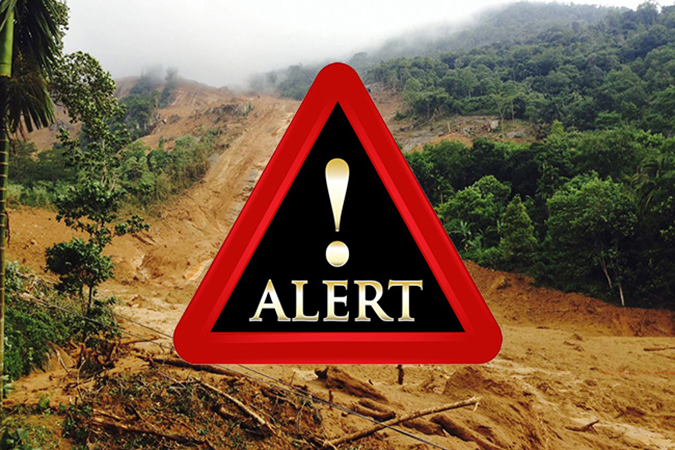
The Landslide Early Warning Center of the National Building Research Organisation [NBRO] has issued landslide early warnings to the Districts of Badulla, Kandy, Kegalle, Kurunegala, Matale, Nuwara Eliya and Ratnapura valid until 1600hrs on 14th December 2025.
Accordingly,
LEVEL III RED warnings are in force in the Divisional Secretaries Divisions and surrounding areas of Ududumbara, Medadumbara, Ganga Ihala Korale, Pathadumbara, Panvila, Udapalatha, Doluwa, Deltota and Minipe in the Kandy district, and Rideegama in the Kurunegala district.
LEVEL II AMBER warnings are in force in the Divisional Secretaries Divisions and surrounding areas of Uva Paranagama, Passara, Welimada, Haputhale, Lunugala, Soranathota, Ella, Kandeketiya, Bandarawela, Meegahakivula, Badulla, Hali_Ela and Haldummulla in the Badulla district, Harispattuwa, Pathahewaheta, Thumpane, Udunuwara, Poojapitiya, Hatharaliyadda, Gangawata Korale, Yatinuwara, Kundasale, Akurana and Pasbage Korale in the Kandy district, Rambukkana, Yatiyanthota, Aranayaka, Kegalle, Bulathkohupitiya, Mawanella, Warakapola and Galigamuwa in the Kegalle district, Polgahawela, Mallawapitiya, Alawwa and Mawathagama in the Kurunegala district, Ukuwela, Naula, Wilgamuwa, Matale, Laggala Pallegama, Rattota, Ambanganga Korale, Yatawatta and Pallepola in the Matale district, Walapane, Hanguranketha, Nuwara Eliya, Kothmale East, Mathurata, Nildandahinna, Thalawakele, Norwood, Kothmale West and Ambagamuwa Korale in the Nuwara Eliya district, and Kahawaththa, Kolonna and Godakawela in the Ratnapura district.
LEVEL I YELLOW warnings are in force in the Divisional Secretaries Divisions and surrounding areas of Dehiowita, Deraniyagala and Ruwanwella in the Kegalle district, and Kalawana, Kuruwita, Elapatha, Ayagama, Kiriella, Balangoda, Openayake, Imbulpe, Ratnapura, Kaltota, Eheliyagoda, Pelmadulla and Nivithigala in the Ratnapura district.

The Bangladesh Cricket Board has removed Nazmul Islam as chairman of the board’s finance committee, following the CWAB’s player boycott of cricket in country until he resigns from his position.
“The Bangladesh Cricket Board (BCB) wishes to inform that, following a review of recent developments and in the best interest of the organisation, the BCB President has decided to release Mr. Najmul Islam from his responsibilities as Chairman of the Finance Committee with immediate effect,” the BCB said in a statement.
“The decision has been taken in accordance with the authority vested in the BCB President under Article 31 of the BCB Constitution and is aimed at ensuring the continued smooth and effective functioning of the Board’s affairs. Until further notice, the BCB President will assume the role of Acting Chairman of the Finance Committee.
“The BCB reiterates that the interests of the cricketers remain its highest priority. The Board remains fully committed to upholding the honour and dignity of all players under its jurisdiction.
“In this regard, the BCB hopes that all cricketers will continue to display the highest standards of professionalism and dedication to the betterment of Bangladesh cricket during what is a challenging period for the game, and will do their utmost to ensure continued participation in the Bangladesh Premier League (BPL).”
Both BPL matches on Thursday – the first between Chattogram Royals and Noakhali Express, and the second between Rajshahi Warriors and Sylhet Titans – have been postponed due to the player boycott.
Even though there seemed to be movement on the issues – the BCB agreed to the player body CWAB’s demands and removed Nazmul Islam from his position as head of the board’s finance committee – but it came too late in the day for the matches to go ahead as scheduled. There was no confirmation yet whether the boycott would be called off or not, and whether the BPL matches on Friday would also be impacted.
[Cricinfo]

A crane collapse has killed two people on the outskirts of Thailand’s capital Bangkok, one day after a falling crane in the country’s northeast killed 32.
Thursday’s accident in Samut Sakhon province involved a crane being used to construct an elevated highway that fell onto the road below, Police Colonel Sitthiporn Kasi, superintendent at the local district police station, told the Reuters news agency. Another police official from the station told Reuters that five people had also been injured in the accident.
Transport Minister Phiphat Ratchakitprakarn said the same building firm was also involved, linking Italian-Thai Development to the country’s second deadly crane collapse in two days, according to local media.
The company was contracted to build a section of a China-backed high-speed rail project where a huge crane collapsed on Wednesday in Nakhon Ratchasima province, northeast of Bangkok.
Local media reported that Thursday’s incident occurred in front of the Paris Inn Garden Hotel. Footage showed clouds of dust and rubble scattered across the site after the crane collapsed.
The Rama II Expressway, the site of the latest accident, hosts several major infrastructure projects, including tollway construction, and has seen several deadly accidents in recent years, earning it the nickname “Death Road”.
On Wednesday, the crane involved was being used to build an elevated track as part of a joint Thai-Chinese high-speed rail project, according to reports. The crane fell onto a moving train below, causing it to derail and briefly catch fire.
[Aljazeera]

India has shut down a medical college in Indian-administered Kashmir in an apparent capitulation to protests by right-wing Hindu groups over the admission of an overwhelming number of Muslim students into the prestigious course.
The National Medical Commission (NMC), a federal regulatory authority for medical education and practices, on January 6 revoked the recognition of Shri Mata Vaishno Devi Medical Institute (SMVDMI), located in Reasi, a mountainous district overlooking the Pir Panjal range in the Himalayas, which separates the plains of Jammu from the Kashmir valley.
Of the 50 pupils who joined the five-year bachelor’s in medicine (MBBS) programme in November, 42 were Muslims, most of them residents of Kashmir, while seven were Hindus and one was a Sikh. It was the first MBBS batch that the private college, founded by a Hindu religious charity and partly funded by the government, had launched.
Admissions to medical colleges across India, whether public or private, follow a centralised entrance examination, called the National Entrance Examination Test (NEET), conducted by the federal Ministry of Education’s National Testing Agency (NTA).
More than two million Indian students appear for NEET every year, hoping to secure one of approximately 120,000 MBBS seats. Aspirants usually prefer public colleges, where fees are lower but cutoffs for admission are high. Those who fail to meet the cutoff but meet a minimum NTA threshold join a private college.
Like Saniya Jan*, an 18-year-old resident of Kashmir’s Baramulla district, who recalls being overwhelmed with euphoria when she passed the NEET, making her eligible to study medicine. “It was a dream come true – to be a doctor,” Saniya told Al Jazeera.
When she joined a counselling session that determines which college a NEET qualifier joins, she chose SMVDMI since it was about 316km (196 miles) from her home – relatively close for students in Kashmir, who often otherwise have to travel much farther to go to college.
Saniya’s thrilled parents drove to Reasi to drop her off at the college when the academic session started in November. “My daughter has been a topper since childhood. I have three daughters, and she is the brightest. She really worked hard to get a medical seat,” Saniya’s father, Gazanfar Ahmad*, told Al Jazeera.
But things did not go as planned.

As soon as local Hindu groups found out about the religious composition of the college’s inaugural batch in November, they launched demonstrations demanding that the admission of Muslim students be scrapped. They argued that since the college was chiefly funded from the offerings of devotees at Mata Vaishno Devi Temple, a prominent Hindu shrine in Kashmir, Muslim students had “no business being there”.
The agitations continued for weeks, with demonstrators amassing every day outside the iron gates of the college and raising slogans.
Meanwhile, legislators belonging to Prime Minister Narendra Modi’s Bharatiya Janata Party (BJP) – which has been accused of pursuing anti-Muslim policies since coming to power in 2014 – even wrote petitions to Kashmir’s lieutenant governor, urging him to reserve admissions in SMVDMI only for Hindu students. The lieutenant governor is the federally appointed administrator of the disputed region.
In the days that followed, their demands escalated to seeking the closure of the college itself.
As the protests intensified, the National Medical Commission on January 6 announced that it had rescinded the college’s authorisation because it had failed to “meet the minimum standard requirements” specified by the government for medical education. The NMC claimed the college suffered from critical deficiencies in its teaching faculty, bed occupancy, patient flow in outpatient departments, libraries and operating theatres. The next day, a “letter of permission”, which authorised the college to function and run courses, was withdrawn.

But most students Al Jazeera talked to said they did not see any shortcomings in the college and that it was well-equipped to run the medical course. “I don’t think the college lacked resources,” Jahan*, a student who only gave her second name, said. “We have seen other colleges. Some of them only have one cadaver per batch, while this college has four of them. Every student got an opportunity to dissect that cadaver individually.”
Rafiq, a student who only gave his second name, said that he had cousins in sought-after government medical colleges in Srinagar, the biggest city in Indian-administered Kashmir. “Even they don’t have the kind of facilities that we had here,” he said.
Saniya’s father, Ahmad, also told Al Jazeera that when he dropped her off at the college, “everything seemed normal”.
“The college was good. The faculty was supportive. It looked like no one cared about religion inside the campus,” he said.
Zafar Choudhary, a political analyst based in Jammu, questioned how the medical regulatory body had sanctioned the college’s authorisation if there was an infrastructural deficit. “Logic dictates that their infrastructure would have only improved since the classes started. So we don’t know how these deficiencies arose all of a sudden,” he told Al Jazeera.
Choudhary said the demand of the Hindu groups was “absurd” given that selections into medical colleges in India are based on religion-neutral terms. “There is a system in place that determines it. A student is supposed to give preference, and a lot of parameters are factored in before the admission lists are announced. When students are asked for their choices, they give multiple selections rather than one. So how is it their fault?” he asked.
Al Jazeera reached out to SMVDMI’s executive head, Yashpal Sharma, via telephone for comments. He did not respond to calls or text messages. The college has issued no public statement since the revocation of its authorisation to offer medical courses.

Meanwhile, students at SMVDMI have packed their belongings and returned home.
Salim Manzoor*, another student, pointed out that Indian-administered Kashmir, a Muslim-majority region, also had a medical college where Hindu candidates are enrolled under a quota reserved for them and other communities that represent a minority in the region.
The BJP insists it never claimed that Muslim students were unwelcome at SMVDMI, but encouraged people to recognise the “legitimate sentiments” that millions of Hindu devotees felt towards the temple trust that founded it. “This college is named after Mata Vaishno Devi, and there are millions of devotees whose religious emotions are strongly attached to this shrine,” BJP’s spokesman in Kashmir, Altaf Thakur, told Al Jazeera. “The college recognition was withdrawn because NMC found several shortcomings. There’s no question of the issue being about Hindus and Muslims.”
Last week, Omar Abdullah, chief minister of Indian-administered Kashmir, announced that SMVDMI students would not be made to “suffer due to NMC’s decision” and they would be offered admissions in other colleges in the region. “These children cleared the National Entrance Examination Test, and it is our legal responsibility to adjust them. We will have supernumerary seats, so their education is not affected. It is not difficult for us to adjust all 50 students, and we will do it,” he said.
Abdullah condemned the BJP and its allied Hindu groups for their campaign against Muslims joining the college. “People generally fight for having a medical college in their midst. But here, the fight was put up to have the medical college shut. You have played with the future of the medical students of [Kashmir]. If ruining the future of students brings you happiness, then celebrate it.”
Tanvir Sadiq, a regional legislator belonging to Abdullah’s National Conference party, said that the university that the medical college is part of received more than $13m in government aid since 2017 – making all Kashmiris, and not donors to the Mata Vaishno Devi shrine – stakeholders. “This means that anyone who is lawfully domiciled in [Indian-administered Kashmir] can go and study there. In a few decades, the college would have churned out thousands of fresh medical graduates. If a lot of them are Muslims today, tomorrow they would have been Hindus as well,” he told Al Jazeera.
Nasir Khuehami, who heads the Jammu and Kashmir Students’ Association, told Al Jazeera the Hindu versus Muslim narrative threatened to “communalise” the region’s education sector. “The narrative that because the college is run by one particular community, only students from that community alone will study there, is dangerous,” he said.
He pointed out that Muslim-run universities, not just in Kashmir but across India, that were recognised as minority institutions did not “have an official policy of excluding Hindus”.
Back at her home in Baramulla, Saniya is worried about her future. “I appeared for a competitive exam, which is one of the hardest in India, and was able to get a seat at a medical college,” she told Al Jazeera.
“Now everything seems to have crashed. I came back home waiting for what decision the government will take for our future. All this happened because of our identity. They turned our merit into religion’
[Aljazeera]

BCB removes Nazmul Islam as head of finance committee

Another crane collapses in Thailand, killing two, after 32 die previous day

India shuts Kashmir medical college – after Muslims earned most admissions

Singapore’s opposition leader stripped of title after conviction for lying

BCB issues show cause notice to Nazmul Islam but Bangladesh players firm on boycott

From behind bars, Aung San Suu Kyi casts a long shadow over Myanmar

‘Dates have the highest sugar content to fight Coronavirus’

Sunday Island 27 December – Headlines

#SundayIsland 17th December – Headlines

Sunday Island – 28th March

Sunday Island Headlines – 21 March

Sunday Island – 21st February – Headlines
-

 Business5 days ago
Dialog and UnionPay International Join Forces to Elevate Sri Lanka’s Digital Payment Landscape
-
 News5 days ago
Sajith: Ashoka Chakra replaces Dharmachakra in Buddhism textbook
-

 Features5 days ago
The Paradox of Trump Power: Contested Authoritarian at Home, Uncontested Bully Abroad
-

 Features5 days ago
Subject:Whatever happened to (my) three million dollars?
-

 Business13 hours ago
Koaloo.Fi and Stredge forge strategic partnership to offer businesses sustainable supply chain solutions
-

 News4 days ago
Level I landslide early warnings issued to the Districts of Badulla, Kandy, Matale and Nuwara-Eliya extended
-

 Business2 days ago
New policy framework for stock market deposits seen as a boon for companies
-

 Opinion7 days ago
The minstrel monk and Rafiki, the old mandrill in The Lion King – II