
Latest News
Kusal Mendis counterattack balloons Sri Lanka’s lead before Bangladesh collapse


Sri Lanka moved within four wickets of sealing a series win, with Bangladesh still 96 runs adrift of their first-innings lead in the second Test. After a dominant second day, the hosts consolidated their command on the game with another clinical display, stretching their lead past 200 before Bangladesh collapsed in their second innings. For Sri Lanka, Prabath Jayasuriya led a spin-bowling attack that sent Bangladesh scrambling, leaving them on the cusp of an innings defeat.
A lead of 211 appeared impregnable on a surface that was beginning to take turn. Bangladesh’s brief bright start was cut short on the cusp of tea when, off the last ball of the session, Anamul Haque’s eyes lit up at a short delivery, only to be beaten by the extra pace and bounce as he toe-ended it to short midwicket.
That was the only wicket a fast bowler took for Sri Lanka in their second innings on day three. Post-tea, Jayasuriya spun a web around the batters. Shadman Islam nicked off to the wicketkeeper off just his second ball of the session as the straighter deliveries wreaked havoc upon the batters’ judgments. Jayasuriya was unlucky not to snare Najmul Hossain Shanto on a number of occasions when he beat the outside edge by a whisker, and when Shanto charged down the wicket without connecting, only for the wicketkeeper to fumble the gather.
Dhananjaya de Silva came into the attack and sent Mominul Haque packing, though, exploiting the grip off the surface and the natural advantage of a finger-spinner taking it away from the left-hand batter. Shanto, too, fell in Dhananjaya’s third over as the arm ball went through the gate ,and trapped him plumb in front.
There was enough time to inflict further damage on the visitors. Late in the day, Jayasuriya produced a touch of extra turn that clipped the outside edge of the off stump to send Mushfiqur Rahim back. Then, for the second consecutive session, a wicket ended the session, as Tharindu Ratnayake got one to straighten and send Mehidy Hasan Miraz back when Dhananjaya reviewed.
But it had looked rosier for Bangladesh in the morning. Taijul Islam and Nahid Rana dragged them back into contention as Kamindu Mendis and Kusal Mendis battled to hold on to the advantage Sri Lanka had established on the second day. After a first hour that the visitors dominated with three early wickets, a 49-run stand between the pair held Bangladesh at bay, taking Sri Lanka’s lead into three figures and steadily building upon it.
While off-spinner Nayeem Hasan darted one through Kamindu to just about edge the session for his side, Sri Lanka’s 154-run lead at lunch already threatened to have batted Bangladesh out of forcing a positive result.
Bangladesh were staring into the abyss at the start after toiling all of the second day for two measly wickets as Sri Lanka approached 300. Early in the morning, though, Pathum Nissanka, having crossed 150, chipped Taijul to short cover. As Nissanka walked back to a standing ovation, Bangladesh sensed the new day was bringing with it fresh hope.
Taijul ran an arm ball through Dhananjaya in his following over, and with Sri Lanka suddenly uncertain, Bangladesh prowled. Kamindu decided to break the shackles by taking the quick bowlers on, hitting two boundaries in Ebadot Hossain’s over, and another two in Nahid’s. But Nahid hit the hard length and drew an edge out of nightwatcher Jayasuriya to third slip, one Mehidy snaffled on his second attempt.
That brought Kusal to the crease, and he shared Kamindu’s ideas about how to approach the innings. An entertaining passage of play followed as Sri Lanka tried to revert pressure back on to the bowlers while never quite looking convincing enough to pull clear. At one stage, an edge from Kamindu kissed off stump on its way to the boundary – incredibly, without disturbing the bails.
However, Sri Lanka continued to build on their lead, and it wasn’t until the partnership was one away from 50 that a wicket arrived. Nayeem fired one into Kamindu that never turned. The ball snuck past his inside edge, and deflected on to the stumps off his pads. It brought renewed hope for the visitors of running through Sri Lanka’s lower order, but with Kusal holding firm, that never quite materialised.
Sonal Dinusha didn’t last long as the excellent Nayeem sliced through his defences. But it was the frustrating eighth- and ninth-wicket partnerships that robbed Bangladesh of any momentum. Ratnayake showed Kusal he could be trusted from one end, impressively getting off the mark with a heave off Taijul for six – his first runs in Test cricket. Kusal punished the spinners whenever they dropped short at the other end, getting to his half-century early in the session before continuing to build.
But Ratnayake fell into the trap Bangladesh laid, tempting him into another heave. This time Taijul went quicker, lower and flatter, and had protection at wide long-on, who completed a simple catch when the batter succumbed to the invitation.
Kusal took on a more proactive role, farming the strike alongside Vishwa Fernando as he eyed three figures. That, however, eventually brought his downfall as he hared back for a second run that wasn’t there, a brilliant throw from Ebadot in the deep catching him well short of his crease.
The innings wrapped up later that over with Taijul getting himself to five wickets. However, Bangladesh needed to produce a Herculean batting effort to challenge Sri Lanka after falling so far behind in the first innings. But Jayasuriya and Dhananjaya ensured it was a task Bangladesh look like they will fall far short of.
Brief scores:
Bangladesh 247 in79.3 overs and 115 for 6 in 38.4 overs (Mushfiqur Rahim 26, Litton Das 13*; Dhananjaya de Silva 2-13, Prabath Jayasuriya 2-47) trail Sri Lanka 458 in 116.5 overs (Pathum Nissanka 158, Lahiru Udra 40, Dinesh Chandimal 93, Kamindu Mendis 33, Kusal Mendis 84; Taijul Islam 5-131, Nayeem Hasan 3-87) by 96 runs
[Cricinfo]


Venezuelan President Nicholas Maduro, recently abducted with his wife by US special forces from his home, has appeared in a federal courtroom in New York City for a hearing on alleged ‘narcoterrorism’ and other charges.
Maduro and his wife, Cilia Flores, were brought before US District Judge Alvin K Hellerstein at 12pm (17:00 GMT) on Monday for a brief legal proceeding that kicks off a long legal battle over whether they can face trial in the United States.
Handcuffed and wearing blue jail uniforms, Maduro and his wife were led into the court by officers, and both put on headsets to hear the English-language proceeding as it was translated into Spanish.
Maduro pleaded not guilty, telling the judge, “I was kidnapped. I am innocent and a decent man, the president of my country.”
Across the street from the court, the police separated a small but growing group of protesters from about a dozen pro-intervention demonstrators, including one man who pulled a Venezuelan flag away from those protesting the US abduction.
The left-wing leader, his wife, son and three others could face life in prison if convicted of working with drug cartels to facilitate the shipment of thousands of tonnes of cocaine into the country. Some observers say there is no evidence linking Maduro to cartels.
Maduro’s lawyers said they will contest the legality of his arrest, arguing he is immune from prosecution as a sovereign head of a foreign state, though he is not recognised as Venezuela’s legitimate leader by the US and other nations.
Flores also pleaded not guilty to US charges against her during the arraignment. Hellerstein ordered the Venezuelan leader to appear in court for a hearing on March 17.

Near the end of the hearing, Maduro’s lawyer, Barry J Pollack, said his client “is head of a sovereign state and entitled to the privilege” that the status ensures.
Pollack said there were “questions about the legality of his military abduction”, and there will be “voluminous” pretrial filings to address those legal challenges.
Earlier, images showed the pair being led handcuffed and under heavy guard from a helicopter en route from a detention facility to the court, two days after they were forcibly removed from Caracas in a brazen US special forces operation.
At an emergency session of the United Nations Security Council earlier on Monday, Secretary-General Antonio Guterres expressed concern that Washington’s capture of Maduro violated international law.
“I remain deeply concerned that rules of international law have not been respected with regard to the 3 January military action. The Charter enshrines the prohibition of the threat or use of force against the territorial integrity or political independence of any state,” Guterres said, referring to the UN’s founding document.
“The maintenance of international peace and security depends on the continued commitment of all member states to adhere to all the provisions of the Charter.”
Samuel Moncada, Venezuela’s ambassador to the UN, accused the US of carrying out an illegal armed attack against his country.
Venezuela was subjected to bombing, destruction of civilian infrastructure, the loss of civilian and military lives, and the “kidnapping” of Maduro and his wife, Moncada said.
The abduction of a sitting head of state breached a core norm of international law, the personal immunity of leaders in office, he added, warning that such actions set a dangerous precedent for all countries.
Russia and China, Venezuela’s most powerful allies, strongly condemned Maduro’s abduction and called for his release.
US allies France and Colombia also notably voiced concern, saying Washington’s military operation had undermined international law.
The US ambassador to the UN, Mike Waltz, defended Maduro’s abduction, describing it as a “law enforcement operation”.
“The United States arrested a narcotrafficker who is now going to stand trial in the United States,” Waltz said.
Waltz accused Maduro of being “responsible for attacks against the people of the United States, for destabilising the Western Hemisphere, and illegitimately repressing the people of Venezuela”.
All eyes are on Venezuela’s response to the swiftly moving events after US President Donald Trump said late on Sunday that the US is “in charge” of the South American nation, which has the world’s largest oil reserves.
Vice President Delcy Rodriguez, meanwhile, was officially sworn in as interim president on Monday.
Rodriguez, a 56-year-old labour lawyer known for close connections to the private sector and her devotion to the governing party, was sworn in by her brother, Jorge, who is the head of the National Assembly legislature.
Delcy Rodriguez initially took a defiant stand against the seizure of the president, in what some observers labelled a return to “US gunboat diplomacy”. But she has now offered to colaborate with Washington.
One analyst said that Venezuela’s opposition appreciates the US intervention to remove Maduro from power, but is alarmed by Trump’s comments about US plans to “run” Venezuela, apparently with members of his government.
“Trump doesn’t recognise the decision of the Venezuelan people. We are not a colony of the US. We are an independent country,” Jose Manuel Puente, a professor at the Instituto de Estudios Superiores de Administracion, a private university in Caracas, told Al Jazeera.
“We want to initiate a transition to democracy, to rebuild the institutions, to rebuild the economy, to rebuild the oil sector. And we don’t see that from Trump until now.”
Venezuela’s National Assembly opened on Monday with lawmakers chanting “Let’s go, Nico!” as they denounced his abduction.
“The president of the United States, Mr Trump, claims to be the prosecutor, the judge, and the policeman of the world,” senior lawmaker Fernando Soto Rojas told the assembly. “We say, you will not succeed, and we will ultimately deploy all our solidarity so that our legitimate president, Nicolas Maduro, returns victorious to Miraflores”, the presidential palace, he added.
Rodriguez has served as Maduro’s vice president since 2018, overseeing much of Venezuela’s oil dependent economy and its feared intelligence service, and was next in the presidential line of succession.
She is part of a band of senior officials in Maduro’s administration who now appear to control Venezuela, even as Trump and other US officials say they will pressure the government to fall in line with their vision for the oil-rich nation.
On Sunday, some 2,000 Maduro supporters, including rifle-wielding men on motorcycles, rallied in Caracas with crowds shouting and waving Venezuelan flags. The Venezuelan military, loyal to Maduro, announced it recognised Rodriguez and urged calm.
The White House indicated on Sunday that it does not want regime change, only Maduro’s removal and a pliant new government that will enable US companies to exploit the country’s oil reserves, even if the government is filled with his former associates.
[Aljazeera]
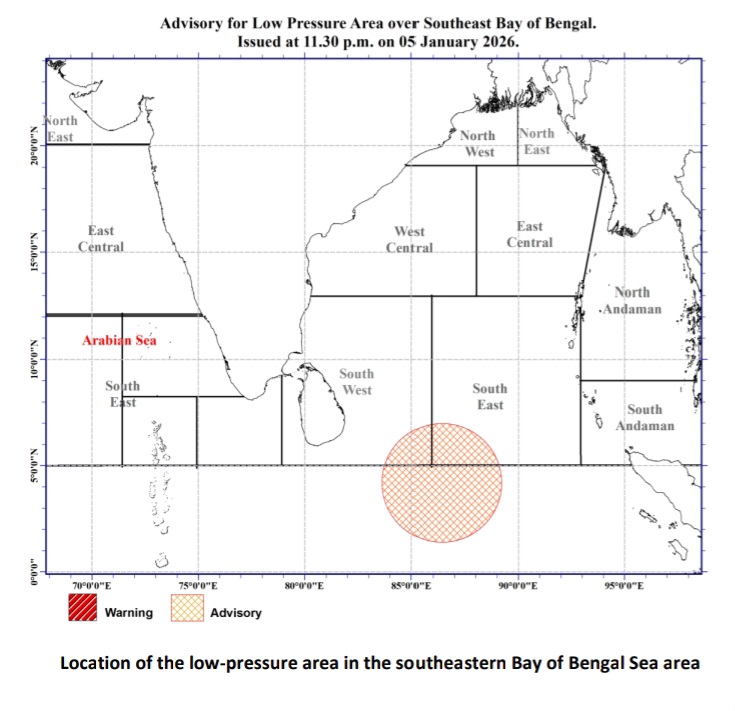
The Natural Hazards Early Warning Centre of the Department of Meteorology has issued an advisory at 11.30 pm on 05 January 2026 regarding a low pressure area over South-east Bay of Bengal Sea area.
The low-level atmospheric disturbance in the Bay of Bengal, to the southeast of the Sri Lanka has intensified into a low-pressure area.
Hence, showery condition over the island, particularly
in the Northern, North-Central, Eastern, Uva and Central provinces is expected to enhance from January 8th.
The Meteorological Department is constantly monitoring the behavior of the system.
The general public are requested to be attentive to the future forecasts and bulletins issued by the Department of Meteorology in this regards.
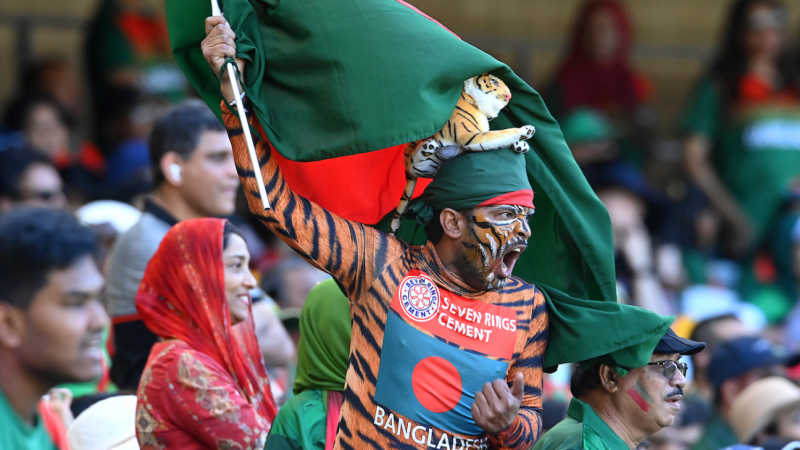
The Bangladesh government has banned the broadcast of IPL 2026 in the country as a response to the BCCI’s decision to pull Mustafizur Rahman out of the tournament.
A statement from the ministry of information and broadcasting said that it had “noted that no reason was communicated for the decision behind Mustafizur Rahman’s exclusion [from the IPL]” and that the development had “caused distress among the people of Bangladesh”. The decision had been taken “in public interest”, it said.
The statement was signed by the ministry’s assistant secretary Firoz Khan.
TV channels and streaming platforms have broadcast the IPL in Bangladesh since its inception in 2008. This is also the first time that the Bangladesh government has banned the telecast of an international cricket tournament, anywhere in the world.
On Saturday, Kolkata Knight Riders (KKR), the team that bought Mustafizur at the IPL auction in December, released him following instructions from the BCCI. The BCCI did not specify a reason – its secretary Devajit Saikia mentioned “recent developments” and did not elaborate.
Over the past few days, Indian spiritual and political leaders had criticised KKR and their owner Shah Rukh Khan for including Mustafizur in their line-up at a time when, according to reports, Hindu minorities are being attacked in Bangladesh. Relations between the two countries have deteriorated since.
Bangladesh are already petitioning the ICC to shift their T20 World Cup matches out of India. No decision has been made on that front yet. The original schedule has Bangladesh opening their campaign against West Indies at Eden Gardens in Kolkata on February 7.
Dr Asif Nazrul, who is currently the sports adviser to the Bangladesh government, said on Saturday evening that the IPL shouldn’t be shown in Bangladesh. Following that post on social media, the country’s information adviser Syeda Rizwana Hasan said any decision to stop broadcasting IPL in Bangladesh would be taken after reviewing the legal basis and thoroughly examining the relevant procedures.
Later on Sunday evening, the BCB confirmed that it has written to the ICC seeking relocation of Bangladesh’s T20 World Cup matches from India, likely to Sri Lanka, the other hosts of the tournament. They have reportedly also written to the BCCI seeking an explanation about Mustafizur’s withdrawal.
While there has been an unspoken ban in the IPL on players from Pakistan for many years now, several Bangladesh players have taken part in the tournament. Mustafizur was the only one picked by a team for the upcoming season, and has been an IPL regular since 2016, with Shakib Al Hasan (KKR and Sunrisers Hyderabad) the other prominent import from the country. Both of them have experience winning the title too.
Abdur Razzak (Royal Challengers Bengaluru), Mohammad Ashraful (Mumbai Indians), Mashrafe Mortaza (KKR), Tamim Iqbal (the now-defunct Pune Warriors India) and Litton Das (KKR) are the others from Bangladesh who have been a part of the IPL in previous years. The new season begins on March 26.
(Cricinfo)

Cuba says 32 Cuban fighters killed in US raids on Venezuela

Venezuela’s abducted leader, Nicolas Maduro, and wife appear in NYC court

Showers about 100 mm are likely at some places in Uva province and in Nuwara-Eliya, Matale, Polonnaruwa, Batticaloa and Ampara districts

Advisory for low pressure area over South-east Bay of Bengal Sea area

US raid on Venezuela violation of UN Charter and intl. law: Govt.

Ban on foreign research vessels: FM promises decision within two months

‘Dates have the highest sugar content to fight Coronavirus’

Sunday Island 27 December – Headlines

#SundayIsland 17th December – Headlines

Sunday Island – 28th March

Sunday Island Headlines – 21 March

Sunday Island – 21st February – Headlines
-

 News1 day ago
Private airline crew member nabbed with contraband gold
-

 News3 days ago
Health Minister sends letter of demand for one billion rupees in damages
-

 Opinion5 days ago
Remembering Douglas Devananda on New Year’s Day 2026
-
 News6 days ago
Leading the Nation’s Connectivity Recovery Amid Unprecedented Challenges
-
 Latest News1 day ago
Curran, bowlers lead Desert Vipers to maiden ILT20 title
-

 Features1 day ago
Pharmaceuticals, deaths, and work ethics
-

 News1 day ago
Bellana says Rs 900 mn fraud at NHSL cannot be suppressed by moving CID against him
-

 News22 hours ago
PM lays foundation stone for seven-storey Sadaham Mandiraya