


News
Korea partners with UNDP to tackle Lanka’s waste management challenges
The Government of the Republic of Korea has partnered with the United Nations Development Programme (UNDP) in Sri Lanka to support Sri Lanka in addressing its growing waste management challenges, with funding of USD 4.7 million for a new initiative.
The project, titled “Scale-up and Sustain the Low-Carbon Municipal Solid Waste Management and Resource Recovery in Sri Lanka,” is funded by the Ministry of Climate, Energy and Environment of the Republic of Korea through the Korea Environmental Industry and Technology Institute (KEITI).
It will be implemented by UNDP Sri Lanka in collaboration with the Ministry of Public Administration, Provincial Councils and Local Government.
According to a statement issued by UNDP, the initiative aims to promote sustainable, low-carbon and locally appropriate solutions to transform municipal solid waste management systems in two selected local authorities within the Central and Sabaragamuwa provinces.
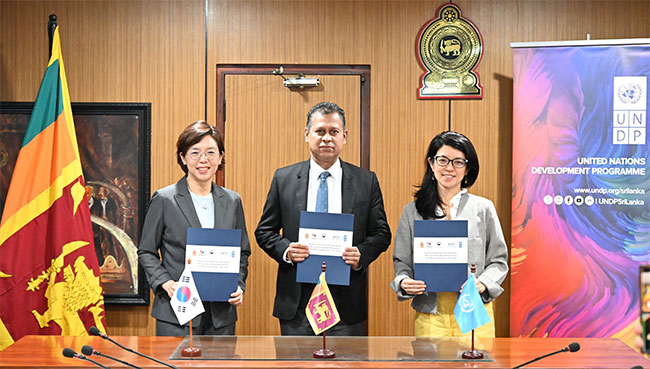
A symbolic signing ceremony was held on Friday with the participation of S. Aloka Bandara, Secretary to the Ministry of Public Administration, Provincial Councils and Local Government; Miyon Lee, Ambassador of the Republic of Korea to Sri Lanka; and Azusa Kubota, Resident Representative of UNDP Sri Lanka, along with representatives of partner institutions.Sri Lanka currently generates more than 10,000 metric tons of municipal solid waste per day. However, only about half of this waste is collected, while only a small fraction is properly treated.
The remainder is often dumped or burned in open sites, creating serious environmental, public health and social risks.
Previous waste management interventions have faced persistent challenges, including unsuitable technologies, financial and institutional limitations, and inadequate community participation. The waste sector has also been severely affected by climate change and natural disasters, as observed during the recent Cyclone Ditwah and floods, which overwhelmed the capacities of local authorities and exposed vulnerable communities engaged in waste-related activities.
Emphasizing the importance of advancing sustainable waste management, Secretary S. Aloka Bandara, Ministry of Public Administration, Provincial Councils and Local Government stated that strengthening municipal solid waste management is a key national priority. He noted that the project represents a major step forward in translating policy into action by building environmentally responsible, locally grounded systems capable of delivering long-term benefits for communities, public health and environmental protection, the statement stated.
The project seeks to overcome existing barriers by strengthening decentralized waste management systems within local authority jurisdictions, thereby avoiding the logistical, social and financial challenges associated with transporting waste across administrative boundaries.
UNDP Sri Lanka will lead the implementation in close coordination with provincial and local government institutions, the Ministry of Public Administration, Provincial Councils and Local Government, local authorities, private sector partners and Korean technical agencies.
Addressing Korea’s commitment to supporting Sri Lanka’s sustainable development and climate initiatives, Ambassador of the Republic of Korea Miyon Lee welcomed the launch of the project and expressed confidence in its successful implementation. She reaffirmed Korea’s willingness to share its advanced technology, expertise and resources to help establish an effective and sustainable solid waste management system across four provinces.
Highlighting the urgency of the initiative, UNDP Sri Lanka Resident Representative Azusa Kubota stated that the project comes at a critical moment for the country. She noted that, with KEITI’s support, the programme will introduce environmentally sound, climate-resilient and disaster-proofed solutions that are also economically viable and socially inclusive, while creating green jobs and strengthening institutional resilience.
Environment Adviser Rhyunmin Park of the UNDP Bangkok Regional Hub also expressed his commitment to collaborating through the project to support the foundation of sustainable waste management systems across the Asia-Pacific region.
Under the initiative, strategic waste management plans will be developed in four provinces namely the Northwestern, Central, Sabaragamuwa and Southern. In addition, demonstration projects will be implemented at the Gampola and Balangoda Urban Councils, the statement said.
In Gampola, an anaerobic digestion plant and pyrolysis technology will be introduced, with an estimated reduction of 168,630 metric tons of carbon dioxide equivalent emissions over a ten-year period. In Balangoda, vermicomposting and pyrolysis technologies will be applied, with an expected reduction of 100,740 metric tons of emissions.
Further underscoring Korea’s support, Eunhae Jung, Director General of the International Cooperation Bureau of the Ministry of Climate, Energy and Environment of the Republic of Korea, stated that the project reflects Korea’s commitment to advancing global climate action through practical and scalable solutions. She noted that beyond emission reductions, the initiative empowers local governments and communities to take leadership in sustainable waste management and by sharing this expertise and innovative technologies, they hope the progress made here will serve as a model for other countries.
News
SLPP MP killing: 12 Aragalaya activists sentenced to death
… ex-Public Security Minister says lives of MP and bodyguard could have been saved
The Gampaha High Court Trial-at-Bar yesterday (11) sentenced 12 persons to death by hanging over the May 9, 2022, killing of former Polonnaruwa District SLPP MP Amarakeerthi Athukorala and his police bodyguard. They were among altogether 39 persons tried by the High Court for the double murder. Of the remaining accused, four persons were handed six-month sentences, suspended for five years, and 23 others acquitted by the Gampaha High Court Trial-at-Bar, consisting of High Court Judges Sahan Mapa Bandara Rashmi Singappuli and A.D. Ruwan Pathirana.
Of the 12 sentenced to death, one continues to evade the law.
The verdict was to be announced on January 14.
Sri Lanka suspended implementation of the death penalty in 1976. The EU has repeatedly warned that resumption of judicial executions would result in consequences.
The new entrant to Parliament, and his bodyguard, were lynched by a ‘Aragalaya’ mob, in broad daylight. They were on their way back to Polonnaruwa when the gang intercepted the MP’s car, in the Nittambuwa town, during violence unleashed in the aftermath of SLPP goons’ attack on those camping at the Gotagohome site at Galle Face.
Footage secured from a nearby CCTV camera showed MP Amarakeerthi Athukorala fleeing the scene with his security officer, who was armed with a gun. Dozens of suspects had been subsequently arrested on several occasions on suspicion of involvement in the MP’s murder. The MP and police officer were killed in a garment store where they took refuge.
Earlier, the case caused major controversy over the Gampaha High Court Trial-at-Bar granting bail to all suspects. The Attorney General appealed to the Supreme Court (SC) to cancel the bail granted by the High Court Trial-at-Bar. The AG argued that releasing the accused on bail would impede a fair trial. The AG asked that the SC cancel the bail order and requested that the accused be placed in remand custody till the conclusion of the trial.
One-time Law and Order Minister Rear Admiral (retd) Sarath Weerasekera told The Island that the lives of the parliamentarian and his police bodyguard could have been saved if the military swiftly responded to the then developing situation. Former Colombo District MP said that he told Parliament that the Army, in spite of having troops at Nittambuwa, didn’t intervene. The powers that be never inquired into the lapses on the part of those responsible for maintaining law and order, the ex-Minister said, alleging that successive governments conveniently neglected that responsibility.
by Shamindra Ferdinando
News
Over one million Lankan devotees venerate sacred relics
The Devnimori Relics of Lord Buddha, brought to Sri Lanka on February 04, 2026, departed for India on February 11, 2026, after the successful conclusion of the Exposition at the Gangaramaya Temple in Colombo. The Relics were accompanied by the Governor of Madhya Pradesh Mangubhai C. Patel, and Deputy Chief Minister of Arunachal Pradesh, Chowna Mein, on their return journey.
At the ceremonial departure, at the Bandaranaike International Airport, Minister of Buddhasasana, Religious and Cultural Affairs (Dr.) Hiniduma Sunil Senevi, Deputy Minister of Buddhasasana, Religious and Cultural Affairs Gamagedara Dissanayake, and High Commissioner of India Santosh Jha, were present to see off the Buddha Relics.
IHC spokesperson: ” During the visit, the delegation led by Governor of Madhya Pradesh, and Deputy Chief Minister of Arunachal Pradesh met Minister of Foreign Affairs, Foreign Employment and Tourism Vijitha Herath, Deputy Minister of Environment Anton Jayakody, and Governor of North Western Province Tissa Kumarasiri Warnasuriya. In addition, the dignitaries interacted with members of the Indian-origin community in Sri Lanka.
The Exposition was inaugurated by President Anura Kumara Dissanayaka from the Sri Lankan side, and Governor of Gujarat Acharya Devvrat, and Deputy Chief Minister of Gujarat Harsh Sanghavi from the Indian side, in the presence of the Chief Incumbent of the Gangaramaya Temple Ven. Dr. Kirinde Assaji Thera at the Gangaramaya Temple, Colombo, on February 04, 2026. The week-long Exposition saw over a million devotees paying their respects. Prime Minister of Sri Lanka (Dr.) Harini Amarasuriya and several Cabinet Ministers, as well as the Speaker, the Leader of Opposition, former Presidents and numerous other Members of Parliament paid their respects during the course of the Exposition.
The Exposition marked the first public veneration of these Holy Relics outside of India. Complementing the exposition, two exhibitions titled “Unearthing the Sacred Piprahwa” and “Sacred Relic and Cultural Engagement of Contemporary India” were also held to showcase the shared Buddhist heritage of India and Sri Lanka.
The Exposition was announced by Prime Minister Narendra Modi during his State Visit to Sri Lanka in April 2025. The Exposition further reinforced the spiritual and cultural linkages between the two civilizational partners. India remains committed to deepening the linkages between both countries through continued bilateral initiatives and regular exchanges between the monastic and scholarly communities.”
News
Flooded Chemmani mass grave cleared amidst persistent rain
Action was taken on Monday (9) to drain rainwater from the Chemmani mass graves as preparations continued for the next phase of excavation, Tamil Guardian has reported.
During the first and second phases of excavation at Chemmani, a total of 240 sets of human skeletal remains were identified. Of these, 239 sets have so far been exhumed under court supervision.
Although funds had already been allocated and preliminary arrangements were in place to begin the third phase of excavation, persistent heavy rainfall, in Jaffna, since November last year, resulted in rainwater stagnating within the burial site, bringing the process to a halt.
In response, steps were taken on Monday to remove the accumulated water with the assistance of the Nallur Pradeshiya Sabha. However, despite the drainage, the site remains heavily waterlogged and muddy, making immediate excavation unsafe, Tamil Guardian reported.
As a result, it has been decided that a determination on when the next phase of excavation can commence will be made on 16 March, when the case is due to be taken up again. The matter has been adjourned to that date.
The drainage operation was inspected on site by a team that included Jaffna Magistrate S. Lenin Kumar, Judicial Medical Officer Sellaiyah Pranavan, and Attorneys-at-Law Niranjan and G. Rajitha.
Tamil Guardian disclosed that funds allocated last year by the Ministry of Justice for the third phase of excavation have lapsed and been returned, as the work could not proceed within the allocated timeframe. As a result, a fresh budget proposal must now be submitted for the current year in order to secure the necessary funding.
The Judicial Medical Officer has taken steps to submit a new cost estimate to the court, so that the excavation process can resume once conditions at the site permit.
-
Features4 days agoMy experience in turning around the Merchant Bank of Sri Lanka (MBSL) – Episode 3
-
Business5 days agoZone24x7 enters 2026 with strong momentum, reinforcing its role as an enterprise AI and automation partner
-
Business4 days agoRemotely conducted Business Forum in Paris attracts reputed French companies
-
Business4 days agoFour runs, a thousand dreams: How a small-town school bowled its way into the record books
-
Business4 days agoComBank and Hayleys Mobility redefine sustainable mobility with flexible leasing solutions
-
Business1 day agoAutodoc 360 relocates to reinforce commitment to premium auto care
-
Business5 days agoHNB recognized among Top 10 Best Employers of 2025 at the EFC National Best Employer Awards
-
Business5 days agoGREAT 2025–2030: Sri Lanka’s Green ambition meets a grid reality check