
News
JVP: Chinese ship controversy exposes Sri Lanka’s foreign policy mismanagement

By Saman Indrajith
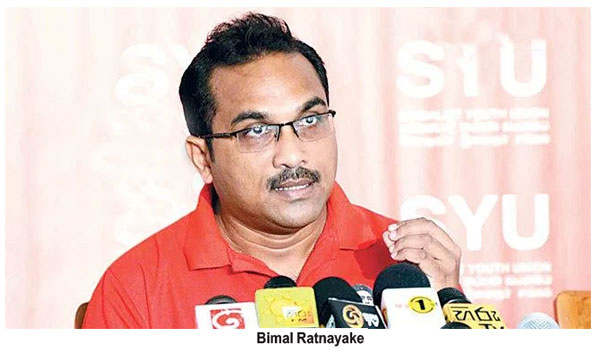
The controversy over the berthing of China’s space and satellite tracking research vessel, Yuan Wang 5, at Hambantota was proof of how Sri Lanka mismanaged its foreign policy, says JVP Politburo Member and International Affairs Secretary, Bimal Ratnayake.
Rantnayake, in a brief interview with The Island, said India would continue interfere with the affairs of its neighbours. “It will meddle with the internal affairs of neighbouring countries. Besides, India is trying to gain control of the Sri Lankan economy. It is against this backdrop that the Yuan Wang 5 controversy has to be viewed. Chinese ship had been given permission by the Lankan government to dock at the Hambantota port. When concerns were raised by India, Lankan authorities asked China to defer the docking of the ship. China asked for an explanation. It is then that our government contacted the Indian government and asked whether it had concerns on the issue and, if so, on what grounds. When India softened its stand, the Lankan government informed the Chinese ship to come and dock. This is the way our authorities are handling the foreign affairs,” Ratnayake said, adding that the Yuan Wang 5 fiasco was a huge embarrassment for Sri Lanka and its repercussions could be seen in the future.
“As we know, both India and China would not go for a full-scale war because they are convinced that such a scenario would lead to the destruction of each other.
He pointed out that India had been involved in Sri Lankan affairs increasingly in recent times. “We would like to thank India for assisting Sri Lanka during the current economic crisis. But its assistance should not be leveraged to pressure Sri Lankan authorities to privatise national assets; this was exposed during the sittings of the parliamentary Committee on Public Enterprises by then Chairman of the Ceylon Electricity Board. In July 2020, the Reserve Bank of India (RBI) extended a swap facility of USD 400 million to help Sri Lanka cope with the impact of the first wave of the pandemic, and later provided a three-month roll over until February 2021, when the Central Bank of Sri Lanka settled it.
“Indian External Affairs Minister Dr. S. Jaishankar visited Sri Lanka in Jan 2021 and insisted that the expectations of the Tamil people should be fulfilled. That applies equally to commitments made by the Sri Lankan government on meaningful devolution, including the 13th Amendment.
“During his visit to New Delhi, in November 2021, the then Lankan Finance Minister, Basil Rajapaksa, Lanka soughta one-billion-dollar credit line for essential imports, and a $ 500 million credit line for petroleum imports. The Indian Foreign Secretary then visited Sri Lanka. India is expected to take stock of every infrastructure project India is running here and ascertain causes of delay. During this visit, there was a push for the oil tank farm project, in Trincomalee, and for the West Container Terminal for the Adani Group. In passing, he raised the problems of Tamil people and the 13th Amendment to the Sri Lanka Constitution. The Adani group sealed a deal with Sri Lanka to develop and run the strategic Colombo Port’s West Container Terminal, and is also exploring the possibility of investing in Sri Lanka’s energy, and the wind power sector, in Mannar.
“In January 2022, the Indian High Commission, in Colombo, confirmed the extension of USD 900 million financial facility, including USD 400 million currency swap to Sri Lanka. On January 06, 2022, Lanka IOC, Ceylon Petroleum Corporation and the Government of Sri Lanka signed three lease agreements on jointly developing the Trincomalee oil tank farm. On January 18, 2022, India offered a new Line of Credit (LOC) of USD 500 million to Sri Lanka for purchase of petroleum products. Amidst these developments came the reports that India has plans to construct a shortest route to Trincomalee from Dhanushkodi after they take over the Trincomalee Oil Tank Farm.
“In Feb, 2022, Export-Import Bank (EXIM) of India and the government of Sri Lanka signed a USD 500 million Short-Term Line of Credit (STLOC) agreement for the purchase of petroleum products. Several days later, it was reported that the shareholder, site lease and financing agreements for the Colombo Port’s West Container Terminal were signed and the first instalment of a premium of US$ 15mn will be deposited with the Sri Lanka Ports Authority. The shareholder agreement was signed between the SLPA, India’s Adani Ports, local private sector partner John Keells Holdings (JKH) and CWIT. Adani Ports holds 51 percent of equity, JKH has 34 percent, and SLPA controls 15 percent.
“In March, 2022, the Reserve Bank of India issued a notification to operationalize the US$ 500 million loan to Sri Lanka for Petroleum products. On March 17, 2022 Sri Lanka signed a one-billion-dollar credit line with India for procurement of food, medicines and other essential items. In the same month, India signed a joint venture with Sri Lanka for a 100MW solar power plant in Trincomalee. On March 11, 2022 Lankan government signed an MoU with the Adani Group allocating two large-scale renewable energy generation projects in Mannar and Pooneryn to that company. Just six days later came the reports that India was ready to sign off on a $1-bn emergency credit line to Sri Lanka for food and essential commodities during Lankan Finance Minister Basil Rajapaksa’s visit. India pushed Colombo for the finalization of earlier proposals on the joint development of Palaly airport and Kankesanthurai harbor.
“On March 28, 2022 Indian External Affairs Minister, Dr. S. Jaishankar, visited Sri Lanka and signed six MoUs for implementation of Sri Lanka Unique Digital Identity (SL-UDI) programme with GOI’s grant assistance; for providing a Maritime Rescue Coordination Center; on implementation of Hybrid Power Projects in three Islands off Jaffna; on cooperation in development of Fisheries Harbours in Sri Lanka; for the establishment of Modern Computer Labs and smart boards with customized curriculum software in 200 schools, in the Galle District; and an MoU between Sushma Swaraj Institute of Foreign Service and the Bandaranaike International Diplomatic Training Institute.
“In May 2022, India gave a USD 16 million donation of rice, milk powder to Sri Lanka and a few weeks later renewed the calls to get back Kachchathivu Island.
“On June 11, 2022, Sri Lanka and India’s EXIM Bank signed an agreement for a $ 55 million financing to procure urea fertiliser. On June 17, 2022, it was reported that Adani Group secured permission to explore floating solar and wind power potential in Lanka’s territorial waters. On June 23, an India government delegation visited Sri Lanka to push for quicker implementation of its projects here, including the Mannar-Pooneryn wind power plants granted to Adani Green Energy Limited; West Container Terminal in which Adani Ports has a controlling stake; the proposed joint venture solar power plant in Sampur, Trincomalee with India’s National Thermal Power Corporation; the laying of a high-powered electricity cable between the two countries; asked for two zones in the Mannar Basin for oil exploration and the lands surrounding Trincomalee Harbour to be developed as an industrial zone. In the same month, it was announced that Lanka would get a US $ 40 million loan from EXIM Bank of India. A few days later, during the last week of June, Lanka’s Ministry of Defence gave the green light for Cargo Ferry Service between KKS and Tamil Nadu and it was also announced that Sri Lanka would resume flights from Jaffna to India.”
“India has taken more of what it has given away,” Ratnayake said noting that Sri Lanka had to work closely and independently with India, China and the US. Anti-Indian or anti-Chinese lines would not work.
Sri Lanka made a diplomatic blunder by allowing the Chinese to build the Colombo Port City.
“One should see how China and India worked together as for the Ukraine crisis, they work in BRICS, and their foreign ministers regularly communicate. At the same time their soldiers are fighting on borders with bare hands, India is participating in QUAD new Asian Nato military exercises, and there is a lot of anti-Chinese rhetoric in Indian media and anti-Indian rhetoric in Chinese media. But China is India’s biggest trading partner until 2021. Still China is the USAs biggest trading partner. If they are fighting seriously how can this be? This explains the complexity and fluidity of international relations. So we must not become a member of any camp and should not try to be the best boy of any of these big powers. Nonaligned policies and tailor made tactics which are compatible with the nonaligned policy, implemented by wise experienced diplomats as well as the government as a whole, is the only remedy for not falling into the pitfalls created by these.

Latest News
Heat Index at Caution level’ in the Northern, North-central, North-western, Western and Southern provinces and in Trincomalee district.


Warm Weather Advisory
Issued by the Natural Hazards Early Warning Centre
Issued at 3.30 p.m. on 12 April 2026, valid for 13 April 2026.
Heat index, the temperature felt on human body is likely to increase up to ‘Caution level’ at some places in the Northern, North-central, North-western, Western and Southern provinces and in Trincomalee district.
The Heat Index Forecast is calculated by using relative humidity and maximum temperature and this is the condition that is felt on your body. This is not the forecast of maximum temperature. It is generated by the Department of Meteorology for the next day period and prepared by using global numerical weather prediction model data.

Effect of the heat index on human body is mentioned in the above table and it is prepared on the advice of the Ministry of Health and Indigenous Medical Services.
ACTION REQUIRED
Job sites: Stay hydrated and takes breaks in the shade as often as possible.
Indoors: Check up on the elderly and the sick.
Vehicles: Never leave children unattended.
Outdoors: Limit strenuous outdoor activities, find shade and stay hydrated.
Dress: Wear lightweight and white or light-colored clothing.
Note:
In addition, please refer to advisories issued by the Disaster Preparedness & Response Division, Ministry of Health in this regard as well. For further clarifications please contact 011-7446491.

On the apparent northward relative motion of the sun, it is going to be directly over the latitudes of Sri Lanka from 05th to 15th of April in this year.
The nearest areas of Sri Lanka over which the sun is overhead today (13th) are Pesalai, Mankulam and Nedunkerny about 12:11 noon.
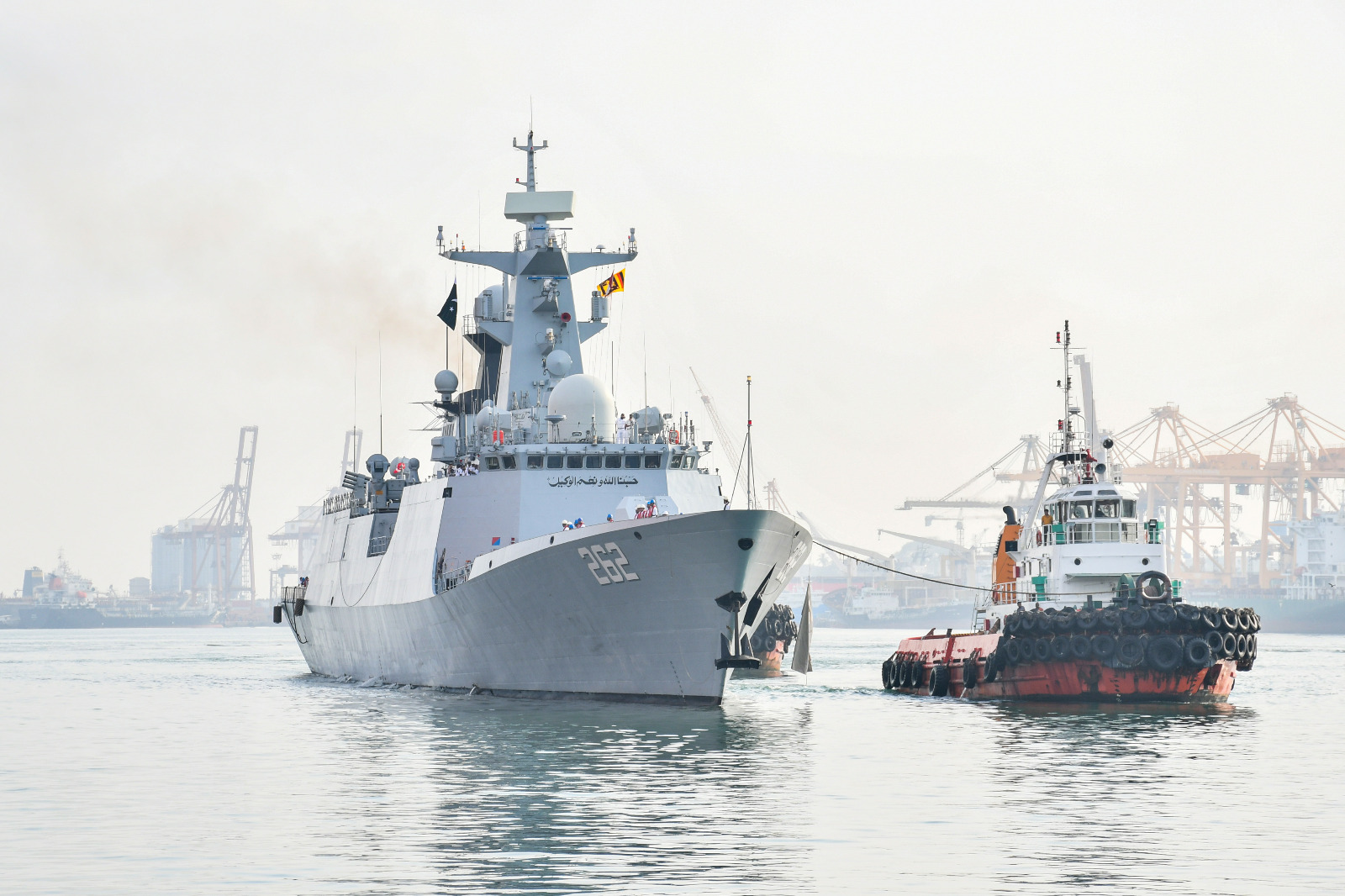
The Pakistan Navy Ship (PNS) TAIMUR and ASLAT arrived at the Port of Colombo on a goodwill visit on 12 Apr 26.
The visiting ships were welcomed by the Sri Lanka Navy in
compliance with naval traditions.
The duo of ships is commanded by Captain NIAMAT SAEED KHAN (PNS TAIMUR) and Captain NADIR MATEEN AFRIDI (PNS ASLAT).
Meanwhile, the ships are expected to conduct a Bilateral Naval Exercise LION STAR V with the Sri Lanka Navy in Colombo seas.

Salt and Patidar power RCB past Mumbai Indians

Prasidh, Buttler set up comfortable win for Gujarat Titans

Heat Index at Caution level’ in the Northern, North-central, North-western, Western and Southern provinces and in Trincomalee district.

Showers above 75 mm are likely at some places in the Western, Sabaragamuwa, Central, Southern and North-western provinces.

Sun directly overhead Pesalai, Mankulam and Nedunkerny about 12:11 noon

PNS TAIMUR & ASLAT arrive in Colombo

‘Dates have the highest sugar content to fight Coronavirus’

Sunday Island 27 December – Headlines

#SundayIsland 17th December – Headlines

Sunday Island – 28th March

Sunday Island Headlines – 21 March

Sunday Island – 21st February – Headlines
-

 News7 days ago
Lankan-origin actress Subashini found dead in India
-

 News2 days ago
CEB orders temporary shutdown of large rooftop solar systems
-

 News5 days ago
AG: Coal procurement full of irregularities
-

 Business4 days ago
Israeli attack on Lebanon triggers local stock market volatility
-

 Business5 days ago
Hayleys Mobility introduces Premium OMODA C9 PHEV
-

 News7 days ago
UN Regional Director launches SL’s first Country Gender Equality Profile during official visit
-

 Business4 days ago
HNB Assurance marks 25 years with strategic transformation to ‘HNB Life’
-

 News7 days ago
Dialog Launches ‘GanuDenu QR’, Making Cashless Transfers Free for All with eZ Cash and Dialog Finance