
News
JVP: Chinese ship controversy exposes Sri Lanka’s foreign policy mismanagement

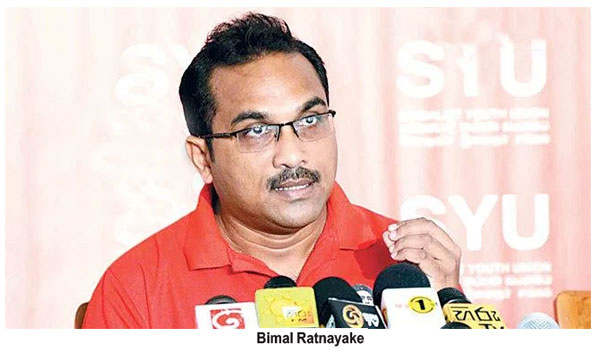
By Saman Indrajith
The controversy over the berthing of China’s space and satellite tracking research vessel, Yuan Wang 5, at Hambantota was proof of how Sri Lanka mismanaged its foreign policy, says JVP Politburo Member and International Affairs Secretary, Bimal Ratnayake.
Rantnayake, in a brief interview with The Island, said India would continue interfere with the affairs of its neighbours. “It will meddle with the internal affairs of neighbouring countries. Besides, India is trying to gain control of the Sri Lankan economy. It is against this backdrop that the Yuan Wang 5 controversy has to be viewed. Chinese ship had been given permission by the Lankan government to dock at the Hambantota port. When concerns were raised by India, Lankan authorities asked China to defer the docking of the ship. China asked for an explanation. It is then that our government contacted the Indian government and asked whether it had concerns on the issue and, if so, on what grounds. When India softened its stand, the Lankan government informed the Chinese ship to come and dock. This is the way our authorities are handling the foreign affairs,” Ratnayake said, adding that the Yuan Wang 5 fiasco was a huge embarrassment for Sri Lanka and its repercussions could be seen in the future.
“As we know, both India and China would not go for a full-scale war because they are convinced that such a scenario would lead to the destruction of each other.
He pointed out that India had been involved in Sri Lankan affairs increasingly in recent times. “We would like to thank India for assisting Sri Lanka during the current economic crisis. But its assistance should not be leveraged to pressure Sri Lankan authorities to privatise national assets; this was exposed during the sittings of the parliamentary Committee on Public Enterprises by then Chairman of the Ceylon Electricity Board. In July 2020, the Reserve Bank of India (RBI) extended a swap facility of USD 400 million to help Sri Lanka cope with the impact of the first wave of the pandemic, and later provided a three-month roll over until February 2021, when the Central Bank of Sri Lanka settled it.
“Indian External Affairs Minister Dr. S. Jaishankar visited Sri Lanka in Jan 2021 and insisted that the expectations of the Tamil people should be fulfilled. That applies equally to commitments made by the Sri Lankan government on meaningful devolution, including the 13th Amendment.
“During his visit to New Delhi, in November 2021, the then Lankan Finance Minister, Basil Rajapaksa, Lanka soughta one-billion-dollar credit line for essential imports, and a $ 500 million credit line for petroleum imports. The Indian Foreign Secretary then visited Sri Lanka. India is expected to take stock of every infrastructure project India is running here and ascertain causes of delay. During this visit, there was a push for the oil tank farm project, in Trincomalee, and for the West Container Terminal for the Adani Group. In passing, he raised the problems of Tamil people and the 13th Amendment to the Sri Lanka Constitution. The Adani group sealed a deal with Sri Lanka to develop and run the strategic Colombo Port’s West Container Terminal, and is also exploring the possibility of investing in Sri Lanka’s energy, and the wind power sector, in Mannar.
“In January 2022, the Indian High Commission, in Colombo, confirmed the extension of USD 900 million financial facility, including USD 400 million currency swap to Sri Lanka. On January 06, 2022, Lanka IOC, Ceylon Petroleum Corporation and the Government of Sri Lanka signed three lease agreements on jointly developing the Trincomalee oil tank farm. On January 18, 2022, India offered a new Line of Credit (LOC) of USD 500 million to Sri Lanka for purchase of petroleum products. Amidst these developments came the reports that India has plans to construct a shortest route to Trincomalee from Dhanushkodi after they take over the Trincomalee Oil Tank Farm.
“In Feb, 2022, Export-Import Bank (EXIM) of India and the government of Sri Lanka signed a USD 500 million Short-Term Line of Credit (STLOC) agreement for the purchase of petroleum products. Several days later, it was reported that the shareholder, site lease and financing agreements for the Colombo Port’s West Container Terminal were signed and the first instalment of a premium of US$ 15mn will be deposited with the Sri Lanka Ports Authority. The shareholder agreement was signed between the SLPA, India’s Adani Ports, local private sector partner John Keells Holdings (JKH) and CWIT. Adani Ports holds 51 percent of equity, JKH has 34 percent, and SLPA controls 15 percent.
“In March, 2022, the Reserve Bank of India issued a notification to operationalize the US$ 500 million loan to Sri Lanka for Petroleum products. On March 17, 2022 Sri Lanka signed a one-billion-dollar credit line with India for procurement of food, medicines and other essential items. In the same month, India signed a joint venture with Sri Lanka for a 100MW solar power plant in Trincomalee. On March 11, 2022 Lankan government signed an MoU with the Adani Group allocating two large-scale renewable energy generation projects in Mannar and Pooneryn to that company. Just six days later came the reports that India was ready to sign off on a $1-bn emergency credit line to Sri Lanka for food and essential commodities during Lankan Finance Minister Basil Rajapaksa’s visit. India pushed Colombo for the finalization of earlier proposals on the joint development of Palaly airport and Kankesanthurai harbor.
“On March 28, 2022 Indian External Affairs Minister, Dr. S. Jaishankar, visited Sri Lanka and signed six MoUs for implementation of Sri Lanka Unique Digital Identity (SL-UDI) programme with GOI’s grant assistance; for providing a Maritime Rescue Coordination Center; on implementation of Hybrid Power Projects in three Islands off Jaffna; on cooperation in development of Fisheries Harbours in Sri Lanka; for the establishment of Modern Computer Labs and smart boards with customized curriculum software in 200 schools, in the Galle District; and an MoU between Sushma Swaraj Institute of Foreign Service and the Bandaranaike International Diplomatic Training Institute.
“In May 2022, India gave a USD 16 million donation of rice, milk powder to Sri Lanka and a few weeks later renewed the calls to get back Kachchathivu Island.
“On June 11, 2022, Sri Lanka and India’s EXIM Bank signed an agreement for a $ 55 million financing to procure urea fertiliser. On June 17, 2022, it was reported that Adani Group secured permission to explore floating solar and wind power potential in Lanka’s territorial waters. On June 23, an India government delegation visited Sri Lanka to push for quicker implementation of its projects here, including the Mannar-Pooneryn wind power plants granted to Adani Green Energy Limited; West Container Terminal in which Adani Ports has a controlling stake; the proposed joint venture solar power plant in Sampur, Trincomalee with India’s National Thermal Power Corporation; the laying of a high-powered electricity cable between the two countries; asked for two zones in the Mannar Basin for oil exploration and the lands surrounding Trincomalee Harbour to be developed as an industrial zone. In the same month, it was announced that Lanka would get a US $ 40 million loan from EXIM Bank of India. A few days later, during the last week of June, Lanka’s Ministry of Defence gave the green light for Cargo Ferry Service between KKS and Tamil Nadu and it was also announced that Sri Lanka would resume flights from Jaffna to India.”
“India has taken more of what it has given away,” Ratnayake said noting that Sri Lanka had to work closely and independently with India, China and the US. Anti-Indian or anti-Chinese lines would not work.
Sri Lanka made a diplomatic blunder by allowing the Chinese to build the Colombo Port City.
“One should see how China and India worked together as for the Ukraine crisis, they work in BRICS, and their foreign ministers regularly communicate. At the same time their soldiers are fighting on borders with bare hands, India is participating in QUAD new Asian Nato military exercises, and there is a lot of anti-Chinese rhetoric in Indian media and anti-Indian rhetoric in Chinese media. But China is India’s biggest trading partner until 2021. Still China is the USAs biggest trading partner. If they are fighting seriously how can this be? This explains the complexity and fluidity of international relations. So we must not become a member of any camp and should not try to be the best boy of any of these big powers. Nonaligned policies and tailor made tactics which are compatible with the nonaligned policy, implemented by wise experienced diplomats as well as the government as a whole, is the only remedy for not falling into the pitfalls created by these.



SLPP MP Namal Rajapaksa and former Krrish Group Executive Director and businesswoman Janaki Siriwardena were further remanded until October 23 by the Colombo Chief Magistrate’s Court yesterday in connection with an alleged Rs. 70 million bribery case involving the Krrish Group.
Colombo Chief Magistrate Asanga S. Bodaragama rejected the bail application filed on behalf of Siriwardena.
The Magistrate said the order on Namal Rajapaksa’s bail application was not ready and would be delivered on the next court date.
The Commission to Investigate Allegations of Bribery or Corruption (CIABOC) arrested the two suspects and produced them before court over allegations that a bribe of Rs. 70 million had been solicited and accepted in connection with the affairs of the Krrish Group.

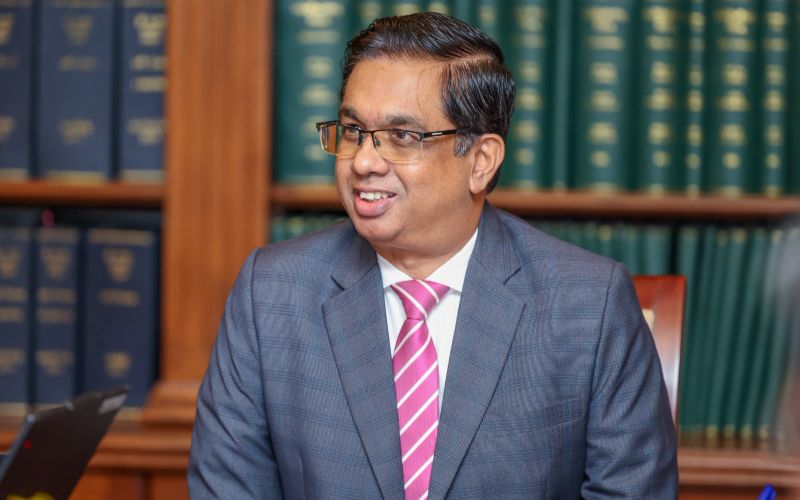
A progress review meeting on reforms and modernisation initiatives at Sri Lanka’s key state revenue-collecting institutions was held on Thursday (15) at the Presidential Secretariat, chaired by Secretary to the President Dr Nandika Sanath Kumanayake, with the participation of representatives of the International Monetary Fund (IMF) and officials of the Revenue Administration, Reform and Modernisation Bureau (RARMB) of the Presidential Secretariat.
At the meeting, the IMF representatives commended the revenue collection efficiency of the Department of Inland Revenue, Sri Lanka Customs and the Department of Excise, the country’s three leading state revenue-collecting institutions. Extensive discussions were also held on the progress of the reform and modernisation programmes being implemented at these institutions.
Secretary to the President Dr Nandika Sanath Kumanayake outlined the progress achieved by the three institutions to date and the reforms planned for implementation in the future.
The IMF representatives also highlighted the importance of strengthening risk management, developing human resources and ensuring the efficient operation of computer systems at the respective institutions.
Senior Additional Secretary to the President Seevali Arukgoda also attended the meeting. The IMF was represented by Cindy Negus, Senior Economist in Revenue Administration for the Asia and Pacific, Europe, Middle East and Central Asia regions; Alison Lister, Revenue Administration Adviser; and Gregory Toppin, Resident Revenue Adviser in Sri Lanka. A group of senior officials from the Revenue Administration, Reform and Modernisation Bureau of the Presidential Secretariat also participated.
(President’s Media Division)
By Anuradha Hiripitiyage
Electricity tariffs should be reduced by between 3 and 5 percent instead of being increased by 2.88 percent in the fourth quarter, as proposed by the National System Operator (NSO), Electricity Consumers’ Association Secretary Sanjeewa Dhammika said.
Addressing a media briefing in Maradagahamula, Divulapitiya, Gampaha, yesterday (16), Dhammika said a proper assessment of electricity generation costs, including the contribution of hydropower, could justify a reduction in tariffs.
He said the NSO had sought approval from the Public Utilities Commission of Sri Lanka (PUCSL) for a 2.88 percent tariff increase, which was expected to generate an additional Rs. 4,438 million.
However, the Commission had indicated that an increase of only 1.46 percent was warranted, amounting to Rs. 2,245 million, he said, adding that even this increase was unnecessary.
Dhammika alleged that the proposed revision sought to pass on to electricity consumers the financial burden arising from the non-arrival of five coal shipments and failed tenders.
“The Government had said that the burden of coal-related losses would not be passed on to the public. It is therefore unjust to make consumers bear these costs,” he said.
He pointed out that the PUCSL had forecast that hydropower would account for 32.34 percent of total electricity generation in the coming quarter, while the cost of such generation would represent only 3.45 percent of the overall cost of electricity production.
Consumers should benefit from the lower cost of hydropower generation rather than bear the burden of more expensive thermal power generation, he said.
Dhammika also questioned the inclusion of Rs. 669 million in capacity charges that had not been approved by the PUCSL, as well as a further Rs. 1,069 million to repay loans relating to incomplete projects.
Including such charges in the proposed tariff revision was unjustifiable, he said.
The PUCSL has given the public until October 30 to submit their views on the proposed tariff revision.
Dhammika said the possibility of increased hydropower generation in the coming weeks, as reservoir levels rise, should also be taken into account when determining electricity tariffs.
He maintained that tariffs could be reduced by 3 to 5 percent if hydropower generation was properly assessed and coal-related losses and unapproved charges were excluded from the calculations.
He further claimed that electricity tariffs could be reduced by as much as 10 percent through the promotion of renewable energy and the effective use of solar power and battery storage systems.
The Electricity Consumers’ Association urged the Government to withdraw the proposed tariff increase, insisting that consumers should not be made to bear costs arising from coal supply problems and other disputed charges.

Namal, Janaki further remanded

Achintha smashes 1,500 metres record at All Island Schools Games

Rare pink diamond goes on display in France 100 years after amateur heist

Nursery owner in China jailed for life after hundreds of children poisoned

Pakistan, Sri Lanka look to find the right mix as World Cup countdown begins

Mumbai Indians and head coach Mahela Jayawardene part ways

‘Dates have the highest sugar content to fight Coronavirus’

Sunday Island 27 December – Headlines

#SundayIsland 17th December – Headlines

Sunday Island – 28th March

Sunday Island Headlines – 21 March

Sunday Island – 21st February – Headlines
-

 News7 days ago
Sri Lanka escalates anti-graft drive with Shiranthi’s jailing
-

 News7 days ago
Iranian ships stranded, Lanka fears US sanctions
-

 Latest News6 days ago
Farhan and Sadaqat help Pakistan seal series in style
-

 Latest News4 days ago
Nissanka’s return headlines Sri Lanka’s Test squad against Pakistan
-

 Features6 days ago
Intake 16: 45 years of duty and honour
-

 News6 days ago
Malwathu Chapter issues statement on talks with President over Gnanasara Thera’s robes
-

 News7 days ago
Navi Pillay’s Lankan affairs in focus as she wins 2026 Nobel Peace Prize
-

 News6 days ago
CP alleges NPP has taken the blame for illegal US sanctions on Iranian vessels