
Features
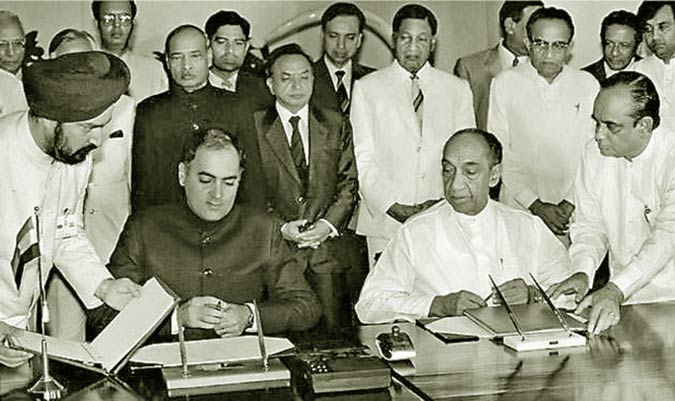
JRJ’s detailed account of the drawing of the Indo-Lanka Peace Agreement

(Excerpted from Men and Memories by
JR Jayewardene)
A timetable was worked out between the two governments for signing an Accord based on these proposals to take place preferably in January 1987. Chidambaram and Natwar Singh visited Colombo for further discussions with me for the third time on December 17, 1986. No agreement could be reached at these discussions for (a) ( the merger of the two Provinces (the North and the East) or (b) exclusion of the Amparai District from the Eastern Province.
An official statement issued after the 19 December 19 meeting, made the following points:
President J.R. Jayewardene and the two Indian Ministers discussed further ideas in continuation of the discussions held in the past. At the end of the discussions, the following proposals emerged:
i) The present territory comprising the Eastern Province minus the Amparai Electoral District may constitute the new Eastern Province.
ii) A Provincial Council will be established for the new Eastern Province.
iii) The institutional linkages between the Northern Province and the Eastern Province discussed earlier will be further refined in order to make it more acceptable to the parties concerned.
iv) The Sri Lanka Government will be willing to consider a proposal for a second stage of constitutional development providing for the Northern Province and the new Eastern Province to modalities being agreed upon for ascertaining the wishes of the people comprised in the Northern Province and the Eastern Province separately.
v) The Sri Lanka Government is willing to consider the creation of an office of Vice-President to be appointed by the President for a specified term.
vi) The five Muslim M.P.s of the Eastern Province may be invited to visit India and to discuss matters of mutual concern with the Tamil side under the auspices of the Government of India.
It would appear that the LTTE was intent on scuttling the agreement that the two governments were on the verge of signing and as a means of preventing this they hit upon the notion of a unilateral declaration of Independence in the North of the Island. The Sri Lanka Government’s response to this was predictably tough.
In an attempt to preempt such a declaration, the government sent troop reinforcements into the Eastern and Northern provinces with instructions to clear these areas of the LTTE and other separatist groups. Contrary to expectations, the LTTE did not put up much of a fight. The LTTE forces fled to the Jaffna peninsula.
The Indian Government, much perturbed by this turn of events, put considerable pressure on the Sri Lankan Government to abandon these military moves and to resume the search for a political solution. These public expressions of displeasure from New Delhi strained relations between the two countries in February and March 1987. On March 14, 1987, an Indian emissary, another Minister of State, Dinesh Singh, was sent to meet me in the hope that the political process could be revived.
In response, the Sri Lankan Government offered the Tamils a ceasefire for the duration of the national holidays in April 1987. The LTTE spurned this offer and responded with the Good Friday-Bus Massacre in April where 130 persons were mowed down by automatic weapons on the road from Trincomalee to Colombo. The LTTE followed this up with a bomb explosion in Colombo’s main bus station in which over 100 persons were killed.
Faced with a serious erosion of political support as a result of these outrages, the government decided to make an attempt to regain control of the Jaffna peninsula. ‘Operation Liberation’, which began in April 1987 in the Vadamarachchi division of the North-Eastern part of the peninsula, was directed at preventing the hitherto easy movement of men and material from Tamil Nadu. By the end of May, Sri Lankan forces had gained control of this area.
The LTTE, the most formidable Tamil separatist group, had suffered a serious setback, and in a region they had dominated for long. At this point, India moved swiftly to prevent the subjugation of the Jaffna peninsula by the Sri Lanka forces. The Indian High Commissioner, J.N. Dixit, pointedly informed Lalith Athulathmudali, Minister of National Security, that India would not permit the Sri Lanka Army to take Jaffna town. The same message was conveyed to me.
In the course of my speech at the Bank of Ceylon’s new headquarters building opening on 27 May 27, I dwelt at some length on the Vadamarachchi operation, and the government’s intention to proceed with that till the LTTE forces were defeated. In the evening, Dixit called on me at my home in Ward Place and conveyed a message from Rajiv. The gist of it was written by Dixit on an envelope! It read as follows:
1. Deeply disappointed and distressed
2. Thousands of civilians killed since 1983, has aroused tremendous indignation.
3. Your latest offensive in Jaffna peninsula has altered the entire basis of our understanding.
4. We cannot accept genocide.
5. Please do not force us to review our policies.
The “review of our policies”, which Dixit threatened on behalf of the Indian Government, came. There was first a public monetary grant of US$3.2 million from the Tamil Nadu Government to the LTTE and its allies. The Indian Government, for its part, escalated the level of its own involvement in Sri Lanka when it announced that it was sending shipments of food and petroleum products to Jaffna, which, it claimed, was facing a severe shortage of these items through a blockade by the Sri Lankan forces.
Despite the refusal of the Sri Lankan Government to accept this offer or concede the need for it, a first shipment, in a flotilla of about 20 Indian fishing vessels, was dispatched on June 3, 1987, but was turned back by the Sri Lanka Navy. When this happened, the Indian Air Force in a blatant violation of International Law and of the Sri Lankan airspace, dropped food and medical supplies to Jaffna on the following day.
All these constituted an unmistakable demonstration of Indian support for the Tamil separatist movement in Sri Lanka. The Indian supply of food to Jaffna continued over the next few weeks by sea with the formal, but clearly reluctant, agreement of the Sri Lankan Government. In the rest of the country, the mood was a mixture of anxiety over a long war of attrition in the North.
The demonstration of India’s sea and air power achieved a number of objectives. It saved the LTTE from imminent destruction, stopped any further expansion of the Sri Lanka Army’s campaign after Vadamarachchi, and reduced the Sri Lanka Government to military impotence if India continued to give more help to the terrorist movement, especially the LTTE.
In June 1987, Minister Gamini Dissanayake received a letter from N. Ram, the Associate Editor of the Madras based Indian newspaper The Hindu. Dissanayake and Ram had known each other for some time as Gamini was on the Board of Control for Cricket in Sri Lanka, and during his visits to India to discuss cricket affairs, he got to know Ram who was also interested in cricket. Ram was also known to Prime Minister Rajiv Gandhi.
The letter contained proposals for a possible settlement of the Sri Lanka crisis through Indian mediation. After talks with Dixit, who was given a mandate by his government to discuss with me the principles in Ram’s letter, I received word from Rajiv, sometime after July 9, 1987, that he was intent on helping to break the deadlock in the negotiations on the settlement of Sri Lanka’s ethnic conflict, and that he would force the Tamil separatists to accept a settlement on the basis of the agreements reached between the Governments of India and Sri Lanka between May and December 1986.
The gist of the offer was as follows: If the Sri Lanka Government would agree to a joinder of the Northern and Eastern Provinces on a temporary basis, India would impose a settlement on the Tamils. If the LITE would not agree, the settlement would still go ahead, and they would be forced to comply.
I suggested that the temporary joinder should have a time-limit and that a referendum be held in the Eastern Province to decide whether or not people there wished their Province to be linked to the Northern Province.
The Indians agreed to this. I took a calculated risk, as I had in 1957, opposed the Bandaranaike–Chelvanayagam Pact on this very issue. There was however the escape clause of a referendum which I hoped would mollify critics of this move, because the Sinhalese and the Muslims who together constituted 60 per cent of the population of the Eastern Province would not willingly accept this merger and that at a referendum the 60 per cent would win.
By mid-July, the Indian Government agreed to underwrite the settlement, provided some of the foreign policy concerns were included in the letters that were to be exchanged. Rajiv too was tired of Prabhakaran and the LTTE and decided to go along with me, with the acquiescence of the LTTE, if possible, or even without it. He agreed to afford such military assistance as was necessary to implement these proposals if the Government accepted it.
Sri Lanka insisted that the agreement should be between the two governments and not between the Sri Lanka Government and the LTTE and other terrorist groups. India agreed to this. Sri Lanka also agreed to the mention of the foreign policy concerns of the Indian Government in the exchange of letters which formed part of the annexures to the agreement to be incorporated in a treaty between the two countries at a later date.
Minister Gamini Dissanayake on my behalf and High Commissioner Dixit on behalf of Rajiv Gandhi, did much of the preliminary drafting which were put up to the two leaders for their approval.
The draft of the agreement was ready by July 15, 1987 for discussion by the Cabinet at its meetings. Mr. Dixit attended the meetings of the Cabinet held on July 15 and 25. Rajiv Gandhi, in the meantime, informed me that he was prepared to come to Colombo on Saturday, July 25, to sign the Accord. I requested him to delay the arrival till Wednesday, July 29.
I needed to get the support of the Cabinet, the Working Committee of the UNP and Prime Minister Premadasa, who was out of the island and was due to return on July 25. The final Cabinet meeting was fixed for Monday July 27. On July 27, the Cabinet approved of my signing the Accord on the scheduled date, that is July 29. One member of the Cabinet, Minister Gamini Jayasuriya, resigned a few weeks later when the Provincial Council Bill was approved by the Cabinet to be presented in Parliament.
On July 29, 1987, Prime Minister Rajiv Gandhi arrived in Sri Lanka and the Agreement was signed, while there was violent opposition to its signing in certain parts of the island, especially in Colombo.
I was informed by the Inspector General of Police that 4,000 of his men were deployed in Kandy where the annual Perehera (religious procession) to do honour to the Buddha’s Tooth Relic was being held and large crowds were gathering worsening my predicament.
Rajiv offered to help. We agreed that he would provide me with planes and helicopters to bring down some of our troops from the North to the South and that he would send a few of his troops to do ground duty in the North. It was peaceful after the Agreement was signed. The main points of the Agreement were as follows:
A complete cessation of hostilities, and the surrender of all weapons held by the Tamil separatist activists, within seventy-two hours of the implementation of the Accord.
The provision of Indian military assistance to help in its implementation.
The establishment of a system of Provincial Councils in the island based on the island’s nine Provinces.
The joining together of the Northern and Eastern Provinces into a single administrative unit with a Provincial Council for it to be elected within three months.
The holding of a referendum in the Eastern Province to determine whether the mixed population of Tamils, Sinhalese and Muslims there would support its merger with the Northern Provinces into a single Tamil-dominated province.
A general amnesty for all Tamil separatist activists in custody, imprisoned or facing charges, after the general surrender of arms.
The repatriation of about 100,000 Tamil refugees in India to Sri Lanka.
The resumption of the repatriation of Indian citizens to Sri Lanka, under the terms of agreements reached between the Governments of Sri Lanka and India in 1964 and 1974.
The prevention of the use of Indian territory by Tamil separatist activists for military or propaganda purposes; the prevention of the military use of Sri Lanka ports, Trincomalee in a manner prejudicial to Indian interests; and Tamil and English to have equal status with Sinhala, as official languages in Sri Lanka.
Rajiv Gandhi narrowly escaped serious injury, if not death itself, as stated earlier, at the Guard of Honour Ceremony prior to his departure from Colombo on July 30. Four years later on May 20, 1991, the LTTE succeeded in doing precisely that in Tamil Nadu.
On his return to New Delhi on July 31, 1987, Rajiv Gandhi was informed that Prabhakaran had at last agreed to accept the Agreement. He conveyed this information to me on August 2, 1987 in a document that reads as follows:
1. In the light of offers conveyed through Dixit in August, about interim administrative arrangements in the North-Eastern Province to be created, and offers concerning employment of Tamil separatist cadres after they surrender their arms, Prabhakaran, leader of the LTTE has: agreed to participation in the implementation of the agreement; agreed to the surrender of arms; and Prabhakaran would like to be in Jaffna personally to organize surrender of arms.
2. In the interest of conciliation and peaceful implementation of the Accord, Prabhakaran will be airdropped at Jaffna by the evening of today, August 2. Prabhakaran has agreed to the following schedule for the surrender of arms, etc. as given by the Government of India:
August 2 evening arrive in Jaffna
August 3 noon Indian Army to fan out into all parts of the Jaffna peninsula, including Jaffna City.
August 4 surrender of arms by LTTE. Events to be witnessed by the Press and TV.
August 5 President Jayewardene may kindly announce the decision in principle, to set up an Interim Administration in the North-Eastern Province before Provincial Council elections. Details to be worked out in consultation with Government of India.
3. I would like to assure you that if Prabhakaran goes back on his word in any manner or fails to organize surrender of arms, the Indian Army will move to disarm LTTE by force.
4. In the light of the above, time limit for the surrender of arms will have to be extended from 1530 hours of August 3 to the evening of August 5: another 48 hours extension is envisaged. Ceasefire will be maintained by the Indian forces.
5. I request that no publicity should be given to these arrangements till the late afternoon of 3 August 3. The above arrangements can be announced on the August 3 afternoon.
For three months there was peace. In October 1987, when certain prominent LITE leaders were captured illegally conveying arms to Sri Lanka, the Sri Lanka Government insisted that the captured men be brought to Colombo for interrogation. When they were to be brought to Colombo by plane, 17 of them consumed cyanide and 12 of them died. Their deaths gave the LTTE the excuse to do what they had always intended to do. They turned their guns on the Sinhalese in Jaffna, Batticaloa and Trincomalee.
Since that date, the LTTE have been fighting the IPKF, till the IPKF was withdrawn at the request of the Sri Lanka Government. However, because of the Agreements, except the LTTE, all the terrorist and other groups had given up violence and were cooperating with the government and in the democratic way of life. They were the EPRLF, TELO, EROS, PLOT and TULF.
Provincial Council elections were held for the combined Northern and Eastern Provinces on November 19, 1988 and an EPRLF Chief Minister was elected. Much of this has been nullified by the LTTE’s violent opposition. They have fought some of the other groups mentioned above and killed many of their supporters. Today they alone are fighting a battle with the present Government of Sri Lanka whereas the others have all joined in the democratic way of life and some are representatives of their areas in the supreme legislature, the Parliament of Sri Lanka. India no longer helps them. They instead fought them in Sri Lanka and are fighting them in India.


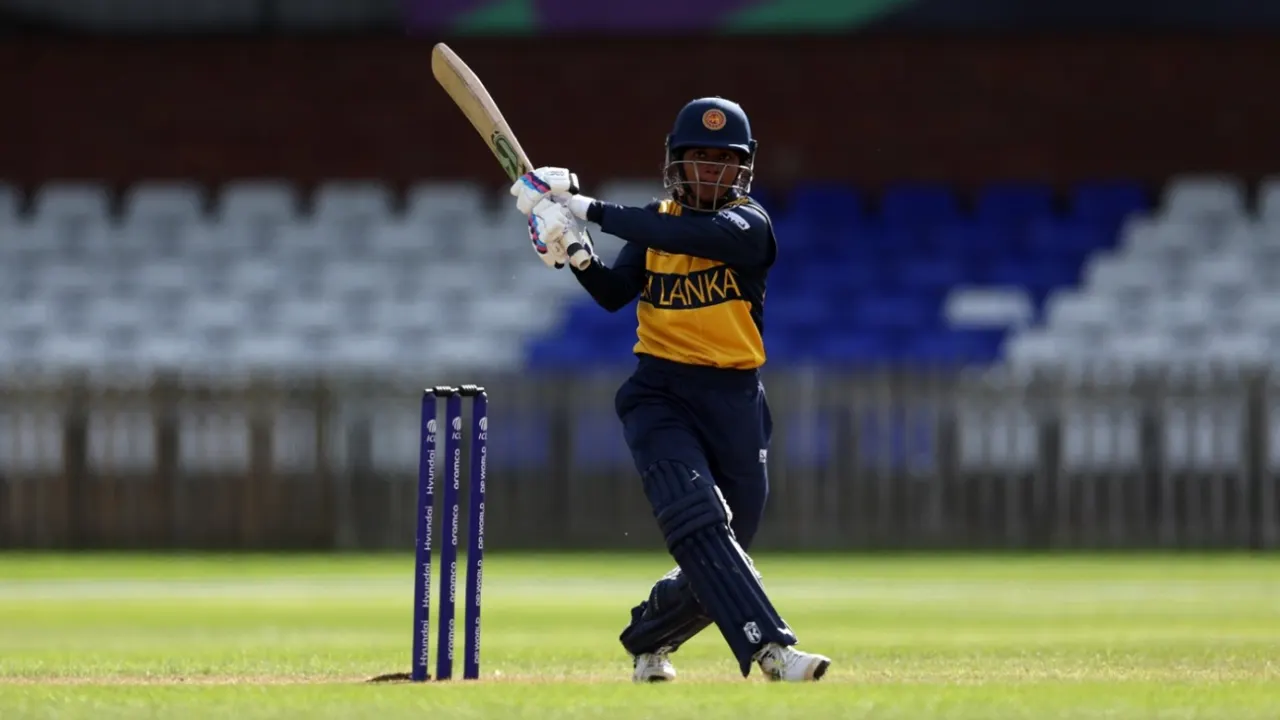
Harshitha Samarawickrema was 14 when Sri Lankan women’s cricket first pricked the national consciousness. She had already been playing cricket for her school, Gothami Balika Vidyalaya, but had largely pursued cricket merely for the sake of playing a sport, and also because she had enjoyed watching the men’s team play. But watching Sri Lanka defeat England in a thriller at the 2013 World Cup stirred up a deeper yearning.
“I’d watched all of the matches at that World Cup actually – that was the first time those kind of matches were telecast,” Samarawickrama said once. “That’s when I decided I was going to play and win matches for Sri Lanka one day.”
That victory against England was a new dawn for Sri Lanka’s women for two reasons. First up it was the highest-profile victory on their ledger until then, marking an unexpected high point in a World Cup in which little was generally expected of the team. But it also marked the rocket-powered arrival of Chamari Athapaththu, who top-scored with 62 to help set up the chase.
Thirteen years later, Samarawickrama has not only fulfilled her promise to herself, she has also helped Sri Lanka bring to life the promise of that 2013 campaign. Athapaththu, who has since has become the superstar around which Sri Lanka’s cricket orbits, has never known a more consistent batting collaborator than Samarawickrama. In T20Is, the pair have put on 1,202 runs together – easily the best for Sri Lanka. Though both are lefties who revel in pressure, that’s about where the similarities end – Athapaththu having grown up idolising the big-hitting of Sanath Jayasuriya, while Samarawickrama had been a disciple of the Kumar Sangakkara school of left-handed batting. (Samarawickrama still tries to replicate that famous bent-kneed cover drive, though she invariably sprinkles a little of of her own flair to the endeavour.) Oppositions have found this combination difficult to contend with, Athapaththu commanding through the legside and brutal on errors of length, while Samarawickrama flits around the crease and carves boundaries through cover and point.
It has been clear for years now that Sri Lanka’s chances in pretty much any match depend primarily on Athapaththu runs. But Samarawickrama’s advance as a T20 batter has now opened up a new frontier in the team’s batting performance. Ideally, what Sri Lanka want is not merely big runs from their captain, but a strong partnership between Athapaththu and Samarawickrama. In victories, the Athapaththu-Samarawickrama stand averages 41.38.
More tellingly, a good Samarawickrama innings has become as reliable a predictor of a strong Sri Lanka showing as a good Athapaththu innings. In T20I wins, Athapaththu averages 40.18 and strikes at 131, in comparison to 17.94 and a strike rate of 94 in losses. Samarawickrama’s corresponding numbers are even more stark. In Sri Lanka victories, Samarawickrama averages 44.08 with a strike rate of 109. In losses those numbers are 16.94 and 87. Other Sri Lanka batters have leveled up in recent years too – Kavisha Dilhari, Nilakshika Silva and Hasini Perera having become more frequent contributors, while 20-year-old Vishmi Gunaratne has also showed promise. But 11 years into her international career, Samarawickrama now has a serious body of work.
Samarawickrama had been modest in the shortest format in 2025, but she arrives at the Women’s T20 World Cup 2026 having had a good six months. Against Bangladesh in April, Samarawickrama had cracked 61 off 35, then 49 off 29, in back-to-back matches that Sri Lanka won (Samarawickrama was top-scorer on both occasions). This was in addition to having put up good numbers in the ODI series that preceded the T20Is. Her 36 not out off 34 in a comfortable warm-up win against Netherlands suggests she is still riding on that form.
This is the first T20 World Cup in which serious runs are expected of Samarawickrama, and if history is much to go by, she is not the sort to be daunted by occasion. Samarawickrama’s finest moments as a Sri Lanka cricketer had come in their most-celebrated win of all, in the Asia Cup final of 2024, against India. Typically, that chase of 166 in Dambulla had been propelled by an 87-run Athapaththu-Samarawickrama stand, but when Athapaththu was dismissed, Samarawickrama ensured she remained at the crease until the winning moments, hitting 69 not out off 51, ultimately collecting the Player-of-the-Match award.
If 2013 was a new dawn inspiring a fresh generation of Sri Lanka cricketers, 2024 was the year in which the team hammered its stake into the ground, breaking through into an entirely new galaxy of recognition and acclaim at home. Frequently batting in the shadow of Athapaththu, but always charting her own path, Samarawickrama has grown into a leader.
[Cricinfo]

 The announcement by the US authorities of an anti-migrant stance during a recent commemoration in France of the epochal D-Day Landings of June 6, 1944, ought to strike impartial observers as a supreme irony. Whereas what should have been expected was a vibrant celebration of the beginning of the process of Western Europe freeing itself decisively from Nazi or fascist control during the crucial stages of World War Two, this was not to be.
What the world heard instead was a call to contemporary Western Europe to arm itself against a seemingly rising and threatening migrant presence in the region. In other words, the migrant must be despised and ‘shown the door’.
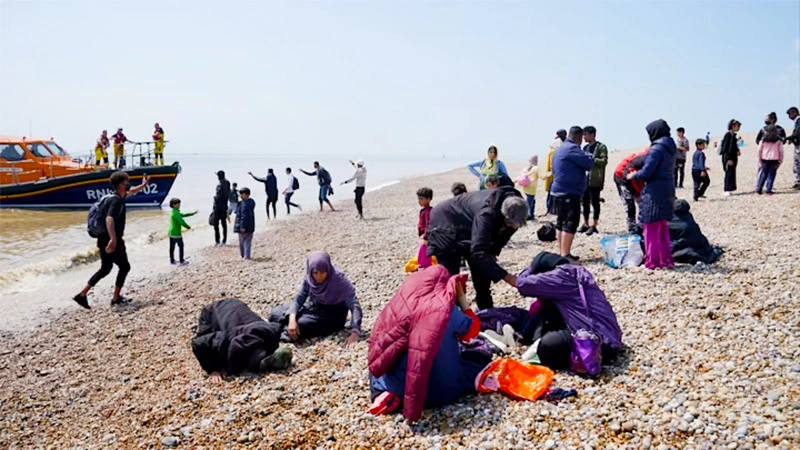
Instead of a commemoration that rejoiced in the flourishing of liberal democracy and its values what one got was a strong affirmation of fascism and racial chauvinism. US Defense Secretary Pete Hegseth vented his spleen against the migrant or foreigner presence in Europe reportedly thus: ‘Sadly today different European beaches are stormed by different dangerous ideologies.’ To ‘beaches in Spain and Italy and Greece and Bulgaria, boats and men arrive. When will European capitals do something about that invasion?’
While at the outbreak of World War Two it was Nazi Germany that was doing the invading and bringing some principal European countries under its suzerainty, this time around we are being given to understand that it’s migrants to the West who are seeking to colonize the latter. It goes without saying that such inflammatory rhetoric would have the deleterious effect of keeping racial tensions alive in the West and jeopardize all possibilities of the countries concerned cementing and maintaining social stability.
The Trump administration gives the impression of taking a leaf from the politically underdeveloped regions of the South to keep the US polity stable and united. In South Asia, for instance, we are not short of ambitious demagogues who use what is referred to as the ‘race card’ to gather unto themselves a following and thereby further their political fortunes. By seeking to stir and sustain anti-migrant hysteria, the Trump administration is also essentially replicating Nazi Germany’s policy of anti-Semitism. That is, fascism is very much alive in the US under President Trump.
Such efforts at churning racial hysteria at this juncture in the US should not come as a surprise. For all intents and purposes, the Trump administration is nowhere near achieving its aims in West Asia, for instance, in the short term. It has failed to bring Iran down to its knees, as it hoped to do, but is adopting the expedient of keeping the world guessing and confused on what it is doing in the region, since it cannot withdraw from the theatre in a hurry without losing face.
While perhaps working out an escape strategy the Trump administration it seems, is hoping to maintain its following at home intact and silent by playing on their racial biases and insecurities. Hence, the anti-foreigner campaign.
Simultaneously, the Trump administration will need to keep a close eye on how economic pressures on the domestic front are panning out. Anti-administration sentiments first break to the surface at meal tables. On this score, the news cannot be good because the average US family’s spending power ought to be shrinking on account of rising energy and oil prices. Consequently, it would not be a bad idea to keep the attention of the US consumer diverted by adeptly playing ‘the race card’; once again, lessons from intellectually bankrupt Southern politicians are coming in handy.
To be sure such comparisons many politicians in vibrantly democratic countries would find quite unflattering. But the stark truth is that racism cannot be tolerated in civilized societies and those politicians who resort to it risk being branded as racists of the first degree. In fact they could be seen as being on par with the likes of German dictator Adolph Hitler and his close collaborators.
However, on the question of migrant policy the Trump administration would likely be at polar opposites with the most vibrant of liberal democracies of the West. This will be the case with the UK, France and Italy for instance. The latter continue to keep their doors open to legal migrants and they are likely to view a virtual blanket ban on migrants as reprehensible.
Moreover, in the foremost democracies of the West debates are vibrantly ongoing on the need to keep racism or any hint of it completely outlawed in the public plane. There is the case of the UK, for instance, where the authorities continue to emphatically pinpoint their adherence to the principle of anti-racism in the conduct of public affairs.
One proof of the above was the parliamentary debate relating to the killing of 18-year-old Henry Nowak in Southampton. Police handling of the victim came in for sharp scrutiny by particularly the opposition in the House of Commons but there seemed to be a consensus over the main political divide that the matter should not be politicized.
Moreover, the UK authorities stressed in the House the government’s strict adherence to the policy of non-racism. It was also pointed out that British institutions set up to manage racism at the national, county and neighbourhood levels, for example, were very much intact. In fact, Sri Lanka could gain considerably by studying and implementing locally, legislation modeled on the relevant UK laws if it is in earnest when it speaks of ‘reconciliation’.
Accordingly, it is highly unlikely that Western Europe would ‘cave in’, so to speak, to US pressure on issues related to migration. The liberal democracies of Western Europe in particular would remain for the foreseeable future migrant-welcoming, multi-ethnic and plural democracies.
Nor is it likely that Western Europe would be passively receptive to US demands that it drastically increases its defense spending to meet the latter’s aims. Within the Western fold the EU is remaining committed to backing Ukraine, for instance, in its ongoing armed resistance to the Russian invasion and it is not giving any indication of being deferent to US pressure.
However, although tensions would continue to bristle within US-Western Europe relations on the above and numerous other matters of contention it would be far too premature to announce a parting of company between the two sections of the West. In that sense, the post-World War Two order remains essentially intact. There are still many things in common between the two, particular on the economic plane, that will ensure the continuance of the partnership.
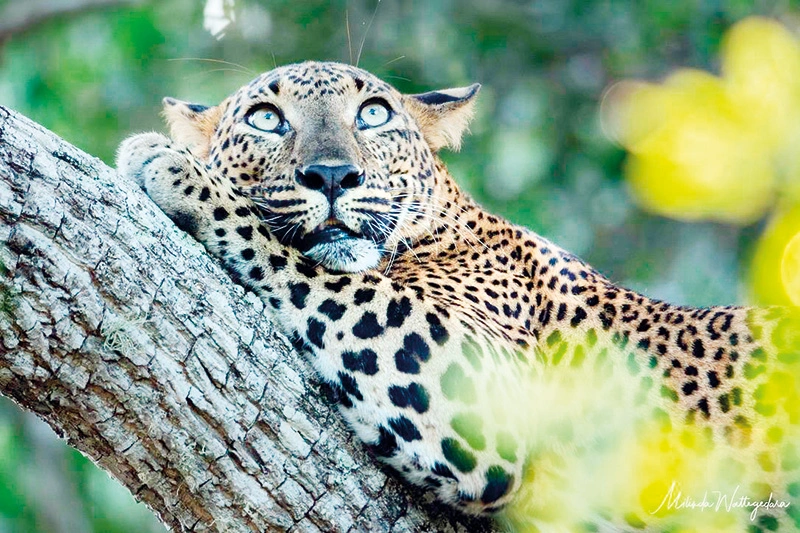
The first rays of dawn creep over the ancient rocks of Yala. The Indian Ocean glimmers in the distance, and the wilderness slowly awakens. Somewhere amid the scrub jungle, a pair of amber eyes scans the landscape.
For wildlife conservationist and leopard researcher Milinda Wattegedara, moments such as these have defined more than a decade of dedication to one of Sri Lanka’s most iconic creatures—the Sri Lankan leopard.
What began as fascination evolved into a remarkable conservation journey that has transformed the understanding of Yala’s leopard population and placed Sri Lanka firmly on the global wildlife research map.
“Long before I ever lifted a camera, leopards had already captured my imagination,” says Wattegedara. “What fascinated me was not merely their beauty but the complexity of their lives—their hunting strategies, movements, reproductive behaviour and their remarkable ability to adapt to changing environments.”
That fascination led to the birth of the Yala Leopard Diary in 2013, an ambitious long-term project dedicated to documenting individual leopards and unraveling the mysteries surrounding their lives.
For many visitors, a leopard sighting is a fleeting thrill. For Wattegedara and his team, every encounter is a chapter in an ongoing scientific story.
“Each photograph was never the end of an encounter,” he explains. “It was the beginning of deeper questions. How did a particular leopard use the landscape? How did its behaviour change with the seasons? What environmental pressures shaped its decisions?”
These questions drove years of meticulous fieldwork. Every sighting was carefully recorded with details including location, habitat, behaviour, date and time. Photographs were analysed to identify individual animals through unique spot patterns, allowing researchers to distinguish one leopard from another with remarkable accuracy.
What followed was groundbreaking.
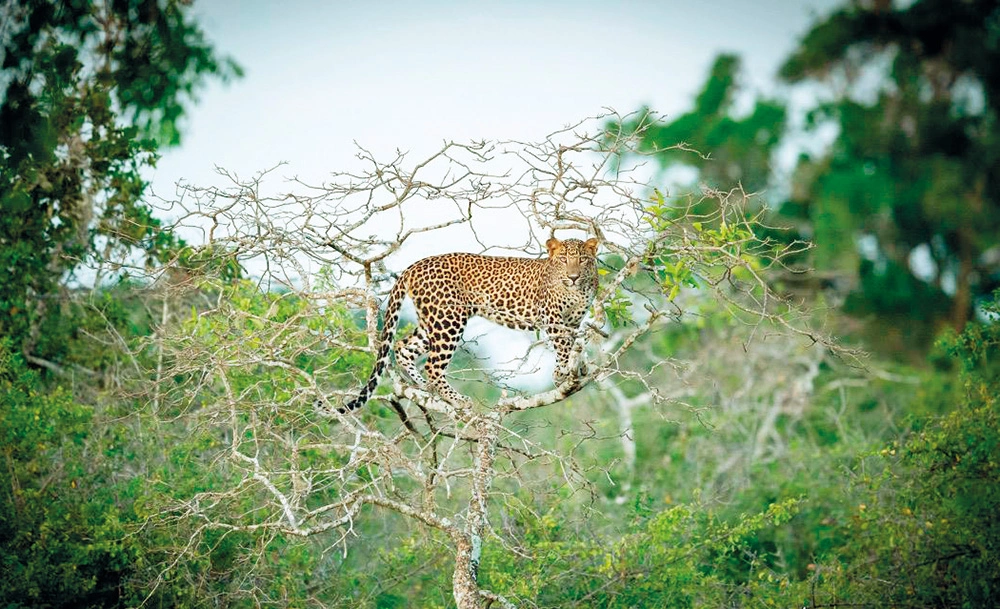
YF77 “Shelly” pauses in quiet observation, embodying the alertness
and grace that define Yala’s leopard population.
From 2013 to 2026, the Yala Leopard Diary identified an astonishing 189 individual leopards within the Yala Block 1. The research revealed a leopard density of approximately 0.524 leopards per square kilometre, making Yala one of the highest leopard-density landscapes ever recorded anywhere in the world.
Such findings have elevated Yala’s status among global wildlife researchers.
Nestled between the Indian Ocean and a mosaic of habitats, ranging from rocky outcrops to dense scrub forests, Yala offers an ecological stage unlike any other.
Here, leopards are photographed silhouetted against ocean horizons, perched atop ancient granite formations, resting on tree branches and stalking prey across sunlit grasslands.
The images tell stories of extraordinary lives.
There is Haminee, a devoted mother navigating the challenges of raising cubs in a competitive landscape. There is Lucas, one of Yala’s most frequently documented males, striding confidently across the Gonalabba Plains with the vast ocean forming an unforgettable backdrop.
There is Ruki demonstrating the species’ incredible strength by hoisting prey onto branches, and Shelly, quietly surveying her surroundings in a moment of feline vigilance.
Together, these individuals have become familiar characters in a living wilderness drama.
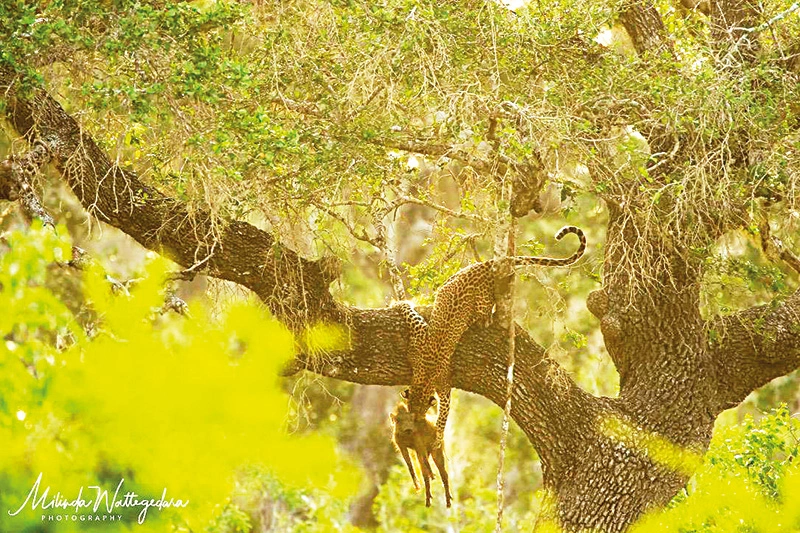
YM31 “Ruki” secures prey on a branch, illustrating the remarkable strength and coordination of the Sri Lankan leopard.
Recognising the immense value of long-term documentation, Wattegedara joined forces with fellow researchers Dushyantha Silva, Raveendra Siriwardana and Mevan Piyasena to establish the Yala Leopard Centre in 2020.
Located at the Palatupana entrance to the Yala National Park, the centre is believed to be the world’s first information facility dedicated exclusively to leopards.
“The centre serves as a repository of knowledge, accumulated through years of observation and research,” Wattegedara says. “Our goal is to connect visitors with the science behind conservation and foster a deeper appreciation of these magnificent animals.”
The project’s impact extends far beyond Sri Lanka’s borders.
Research arising from the Yala Leopard Diary has been published in internationally recognised scientific journals. One study introduced an innovative framework for identifying individual leopards, while another documented an extraordinary and previously unrecorded case of a leopard cub being consecutively adopted by two different adult females—first a relative and later an unrelated leopardess.
The discovery attracted international scientific attention and highlighted the complexity of leopard social behaviour.
Yet for Wattegedara, the most important lesson remains one of humility.
“One conclusion has become increasingly clear,” he reflects. “Our understanding of these leopards remains far from complete. We are only beginning to understand how they live, adapt and persist in one of Sri Lanka’s most dynamic protected landscapes.”
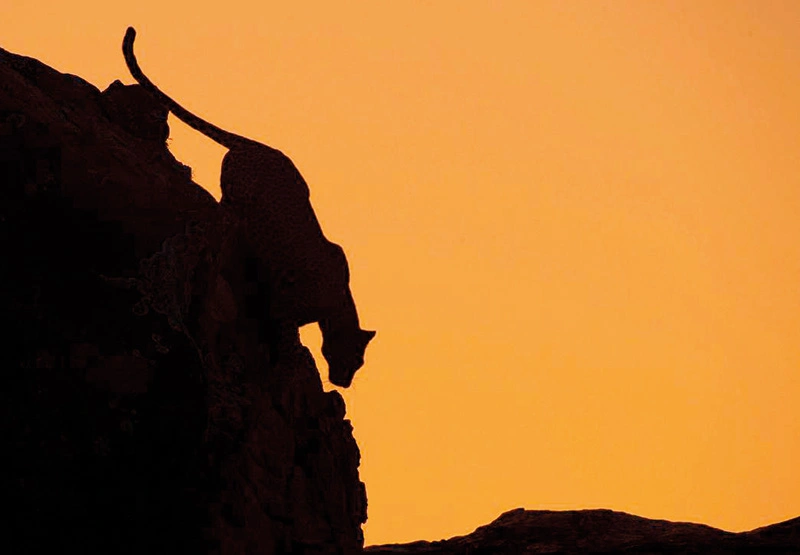
YF15 “Hope” descends Rukvila Rock at dawn, showcasing the agility and adaptability of Yala’s leopards.
His words underscore an essential conservation truth: the more we learn about nature, the more mysteries emerge.
As Sri Lanka navigates growing environmental challenges, the Yala Leopard Diary stands as a shining example of what sustained observation, scientific curiosity and public engagement can achieve.
Beyond the stunning photographs and remarkable sightings lies something even more valuable—a growing body of knowledge capable of informing future conservation decisions and ensuring that future generations inherit a wilderness where leopards continue to roam free.
For more than a decade, Wattegedara and his colleagues have followed the tracks of Yala’s elusive predators through dust, rain and scorching heat.
Their work has revealed that every leopard has a story, every sighting has significance and every photograph can contribute to conservation.
And perhaps, most importantly, it has reminded us that the golden ghosts of Yala still have many secrets left to share.
By Ifham Nizam
Sri Lanka look to their bowlers against big-hitting West Indies

Edgbaston takes center stage as England, Sri Lanka kick off T20 World Cup

Trump says US will hit Iran ‘very hard tonight’

Firefighters on scene at Pentagon during ‘hazardous materials incident’

Samarawickrama’s rise gives Sri Lanka a second pillar

Prabhsimran, Gaikwad, Tilak score fifties in DLS loss to Afghanistan A

‘Dates have the highest sugar content to fight Coronavirus’

Sunday Island 27 December – Headlines

#SundayIsland 17th December – Headlines

Sunday Island – 28th March

Sunday Island Headlines – 21 March

Sunday Island – 21st February – Headlines
-
 Features7 days ago
Power crept into the Sangha and is now tearing it apart
-
 News5 days ago
Women’s T20 World Cup 2026 warm-up: Chamari Athapaththu’s 94 helps Sri Lanka beat Pakistan
-

 Features7 days ago
Kondachchi wind farm and battery storage project to boost energy security, says Power Ministry Secretary
-
 Features7 days ago
Saudi Arabia sets new benchmark in Hajj management as 1.7 million pilgrims complete sacred journey
-

 News6 days ago
Asst. Manager, security officer arrested over Rs 30 mn snatch at Horana PB branch
-

 Editorial4 days ago
Probe Sallay’s complaint
-

 News5 days ago
Lankan-Canadian inducted to Toronto Sports Hall of Fame
-
 News2 days ago
Local firms move millions of dollars overseas for phantom imports: Govt.